The trick to knowing how to entertain kids on a road trip is not having more activities. It’s having three or four that start without an argument. Pack one small kit, decide the order before you leave the driveway, and rotate between talking games, quiet projects and short movement breaks.
Most family road trip tips focus on the destination. The hours in the car are where it actually gets hard, especially past the third hour when snacks are gone and the novelty of a moving window has worn off. Twenty minutes of preparation before you leave solves most of it.
What follows is the plan we use: a supply list, six steps in the order they actually happen, and the mistakes that trip up almost every family the first time. It works whether you’re driving 90 minutes or 12 hours.
Table of Contents
- What You Need
- Step-by-Step: Build a Road-Trip Entertainment Plan
- 1. Match activities to the length of the drive
- 2. Pack a ready-to-use activity kit
- 3. Prepare a simple activity rotation
- 4. Add movement and family participation
- 5. Use a comfort-item backup plan
- 6. Build in breaks and reset points
- Common Mistakes
- Frequently Asked Questions
- What is the 3-3-3 rule for a road trip?
- What are some fun games I can play with my kids on a road trip?
- How do you entertain a 3-year-old without screens on a long drive?
- How do I keep my kids from fighting in the back seat?
- How do you prevent motion sickness in children?
- What car activities are actually safe?
- Conclusion
What You Need
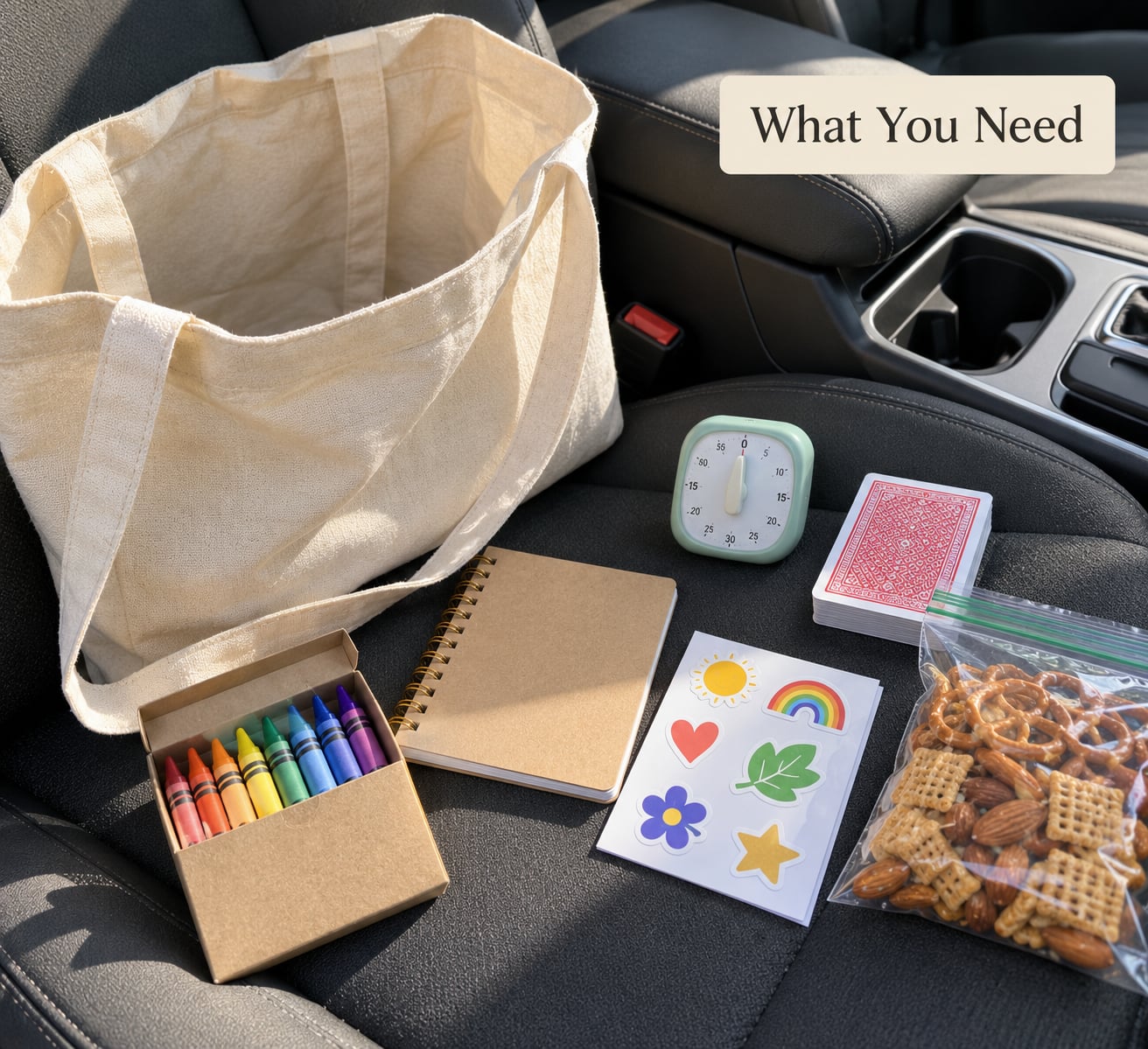
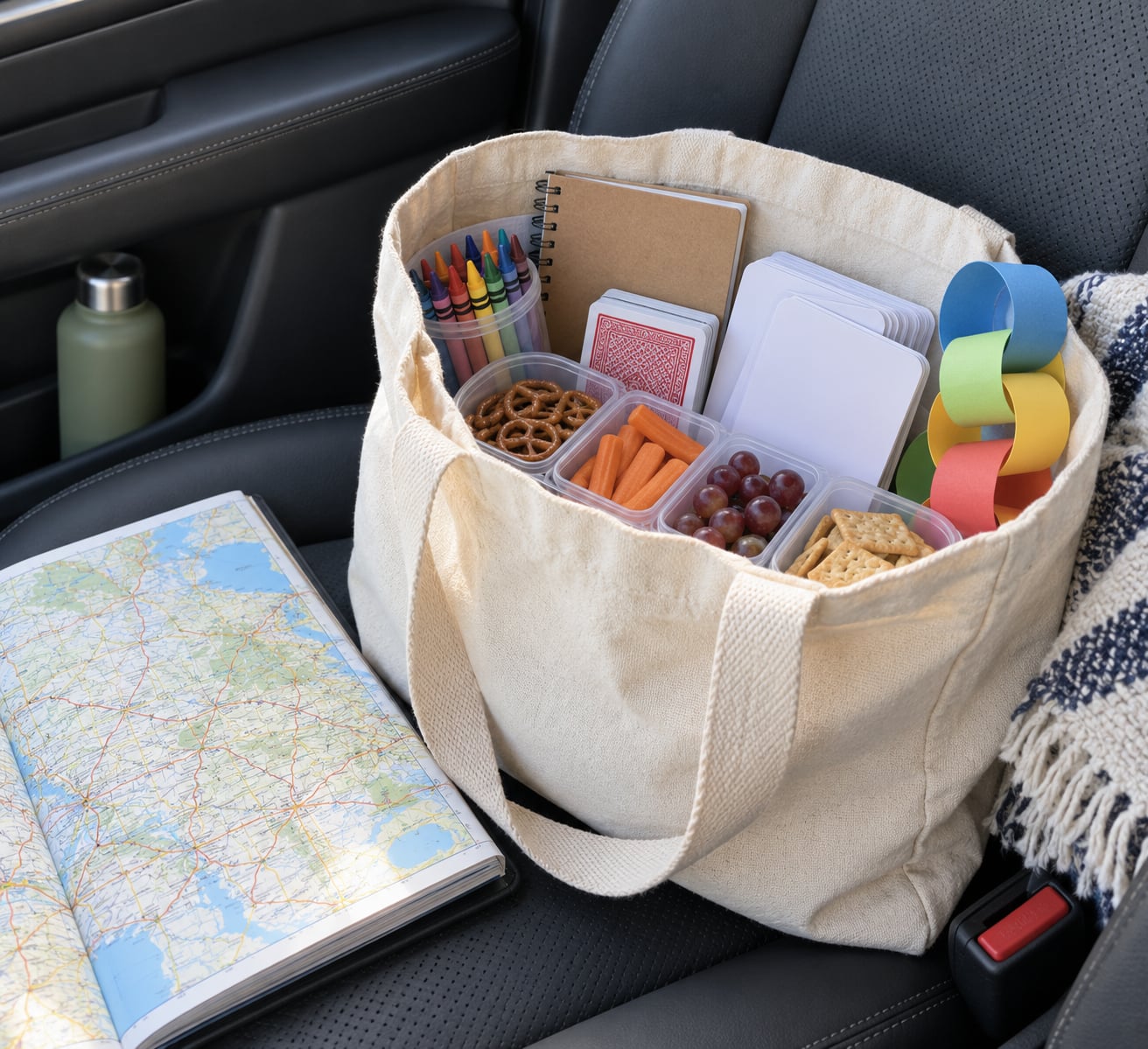
Everything on this list costs very little, fits in a tote bag, and survives a car seat. Most of it you probably already own.
- One pouch per child, plus one shared pouch. Separate bags stop the backseat bargaining that starts the second two kids reach into the same box.
- Paper supplies. Index cards, a small notebook, sticky notes and a few blank flashcards for making your own games.
- A dry erase board or laminated cards and a dry erase marker, so a game can be wiped and reused instead of filling up with paper.
- Washable markers and crayons. Skip permanent markers entirely. A permanent mark on a car seat is a problem that outlasts the trip.
- A deck of playing cards, two dice, and a road trip bingo or scavenger hunt sheet. Print the sheet or draw your own squares.
- Stickers, a small craft kit, and pipe cleaners for anything that needs hands.
- Portioned snacks in containers each child can open alone, plus a small trash bag clipped within reach.
- Headphones and a splitter if two children will share one audio player.
- A paper chain or ribbon that gets one link removed every fifteen minutes, so the trip is visible rather than guessed at.
- A change of clothes and a pack of wipes. Not for the kids only.
One rule for the whole kit: nothing small enough to disappear into a seat gap. Cars have hundreds of hidden cracks, and you will not find whatever falls in there until after the trip.
Step-by-Step: Build a Road-Trip Entertainment Plan
1. Match activities to the length of the drive
Short drives need almost nothing. A 90-minute trip survives on conversation, two car games and one snack stop. Trying to entertain a two-year-old for 90 minutes is a different job than keeping a nine-year-old busy for nine hours, and the activities are not interchangeable.
A useful starting point is to plan roughly one new activity per hour, then add one backup you have not used yet. For a four-hour drive that means five activities. For a twelve-hour drive across two days, it means twelve, which is why you pack more than you think you need and use about half.
Order them by energy. Start the drive with something everyone can talk over while the driver is fresh, move into quiet individual projects in the middle, and hold the loud group games and audio for later when everyone is tired and needs less effort from the front seat.
2. Pack a ready-to-use activity kit
The kit lives where children can reach it without the driver turning around. That usually means the floor of the backseat or a bag hooked over a headrest, not the trunk.
Fill small zip pouches rather than one big bin. A child who has to dig past three other activities to find the one they were allowed to choose will get frustrated before they get started. Label them if more than one child is old enough to read.
Load the kit the night before and leave it by the door. Deciding what to pack at 6 a.m. with a full car is how families end up with nothing but the tablet.
3. Prepare a simple activity rotation
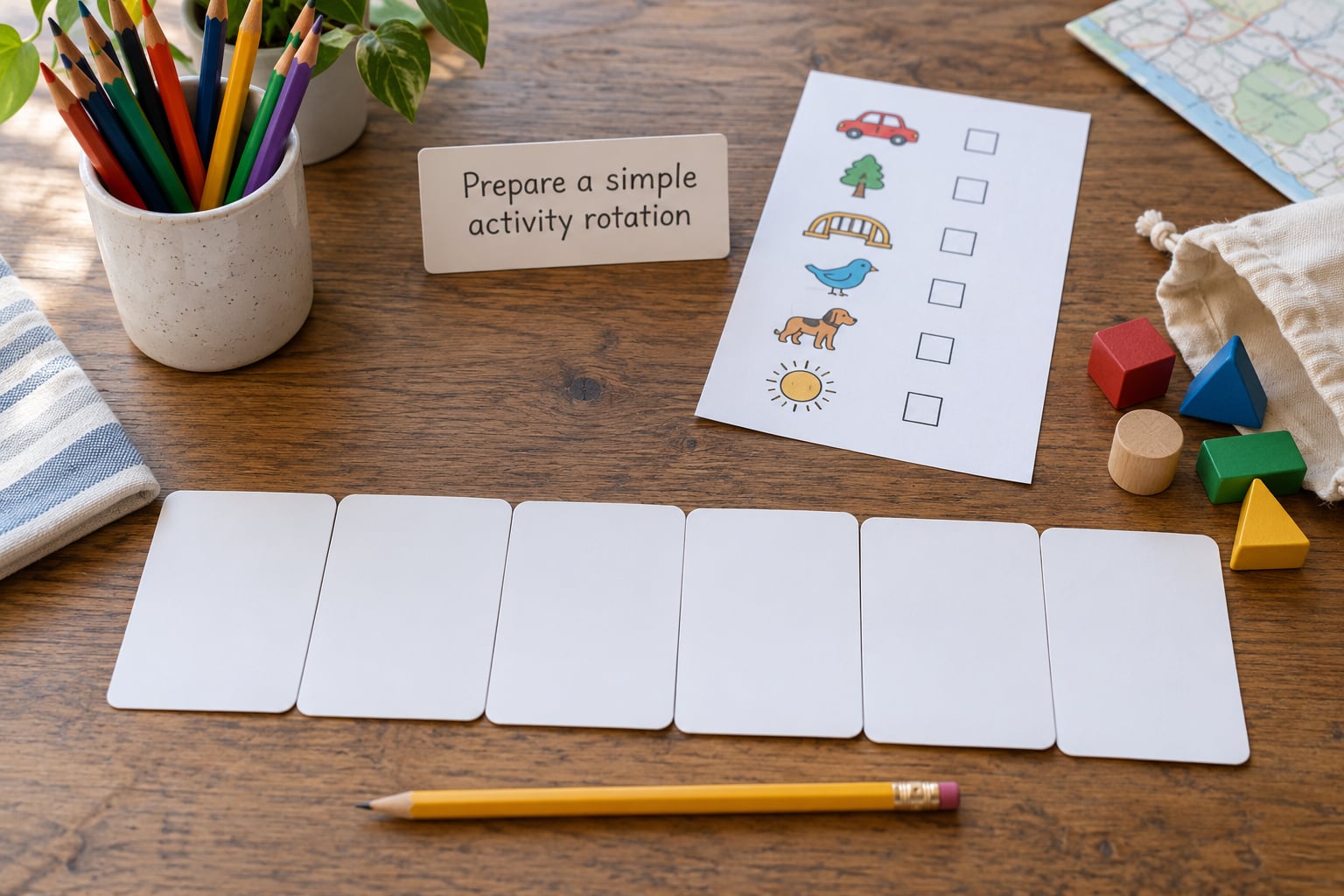
Alternate between three modes: something quiet and solo, something the whole car does together, and something with movement. Alternating is what keeps the drive from flattening out into one long stretch of the same activity.
Here is a rotation that works for a mixed-age group of about four hours.
- Quiet: drawing on a dry erase board, sticker scenes, a pipe cleaner puzzle, an audio story with headphones.
- Together: the license plate game, I Spy with colors, twenty questions, the alphabet game, singing something the whole family already knows.
- Movement: a stretch break at a stop, a scavenger hunt that requires looking at signs and barns, a mid-drive playlist round.
Do not run two activities at once. Kids who are left to choose constantly burn out faster, and adults end up refereering instead of driving. Offer two choices, let them pick, and move on.
4. Add movement and family participation
Backseat boredom is usually physical boredom. Kids are packed into a seat for hours with nothing to burn off, and restlessness shows up as arguing. Build in a stretch stop every two to three hours, even if it is a fuel stop and a walk around the parking lot.
Between stops, seated movement works fine: shoulder rolls, reaching for the ceiling, toe touches with legs straight, a round of singing with hand motions, or a freeze-dance song with everyone moving in their seats.
Family participation matters as much as activity. Twenty minutes of the whole car playing a game does more for the mood than an hour of three kids doing parallel puzzles, and it gives the driver something to listen to that is not an audiobook.
5. Use a comfort-item backup plan
Know which stretch of road is the hard one and plan a rescue for it. It is usually the last hour before arrival, when everyone has used up the good ideas and the destination is still too far away.
The backup is a small sealed pouch nobody opens unless needed: a favorite book, a sticker book, a small stuffed item, a card game with a short familiar round. Keep it separate from the main kit so it stays unused, and let one adult hold it so the decision to break the seal belongs to you.
Tired and overstimulated children need less, not more. A quiet audiobook in the last hour usually beats a noisy game for a four-year-old who has been going since dawn.
6. Build in breaks and reset points
Schedule stops on the map before departure rather than waiting for a crisis. Pick rest areas or parks at roughly two-hour intervals and note what is at each one, because knowing there is somewhere to run around at 11:20 changes the whole mood of the two hours before it.
Give transition warnings. Five minutes before a stop, two minutes before the driver changes activities, and one minute before screens go away. Children handle change much better when they hear it coming, and the warnings are free.
Build a cleanup routine into every activity switch: everything back in the pouch, wrappers in the trash bag, cards stacked on top. Without it, the second hour has crayons rolled into the seat and sticker backing scattered across the door.
Common Mistakes
Overpacking. Forty activities in a bag means the good ones get buried. Six to ten well-chosen items beat forty mixed ones, and a tote that fits in the console keeps everything accessible.
Activities with loose small parts. Foam beads, tiny puzzle pieces and detachable car toys vanish into the seat and come out in another family’s driveway. Choose items too large to fall through a gap.
Relying only on screens. Screens are a reasonable tool on a long drive and a bad default, because a tablet that runs out of charge or downloads or loses interest takes the trip down with it. Screen-free ideas are also the ones children remember. Set a rule before you leave about when screens come out and how long they last, and use audio in the middle stretch.
Forgetting the driver. Games that require reading a card out loud, spotting things, or handling small objects pull the front seat’s attention off the road. Keep them to whole-car games where the driver can participate with their eyes and voice only.
Starting everything at once. A pile of options produces a standoff. Two choices, one decision, then start.
No way to show time passing. Young children cannot feel four hours remaining, which is where “are we there yet” comes from. A paper chain that loses one link every fifteen minutes, or a countdown printed for the trip, answers the question before it gets asked.
Ignoring the adults. Whoever is not driving deserves the plan too. Pack a book or an audiobook for the front passenger and swap the driving shift if you can.
A few final tips. Let each child pack their own pouch the night before; children take better care of choices they made themselves. Bring activities you have already tested at home, because a game that needs reading rules fails in a moving car. And keep a trash bag within a child’s reach, because most road trip frustration is really about sticky hands and crumbs.
Frequently Asked Questions
What is the 3-3-3 rule for a road trip?
The 3-3-3 rule is a planning guideline parents use for car trips: roughly three hours of driving, three activities or breaks, and three hours of sleep or downtime in the day. It is a planning prompt rather than a rule, but the idea is useful. Nobody sits well for three straight hours, so a break every two to three hours keeps the driver alert and the kids from reaching the point of no return.
What are some fun games I can play with my kids on a road trip?
The classics work because they need no supplies and can be stopped at any time. I Spy works in any color or letter you pick. The license plate game awards a point per state, with a second point for a plate you cannot read. Twenty questions works well with older kids, and the alphabet game, where each person names something starting with A and then B, gets competitive fast.
How do you entertain a 3-year-old without screens on a long drive?
Three-year-olds do well with anything repetitive and simple: sticker peeling, drawing on a dry erase board, sorting small toy blocks by color, or singing the same song on repeat. Keep to activities they can finish, since a project that takes 40 minutes loses them at minute ten. Pack more than you think you need for the first hour, and hold something back for later.
How do I keep my kids from fighting in the back seat?
Fighting usually comes from boredom, shared resources or no say in what happens next. Give each child their own pouch and one solo activity, then offer a whole-car game so the focus moves off each other. Let them choose between two options instead of deciding for them, which reduces most arguments before they start. Stop for a walk every two to three hours; most backseat fights end within ten minutes of fresh air.
How do you prevent motion sickness in children?
Motion sickness is easier to prevent than to treat. Seat children where they can see the road and the horizon rather than in a rear-facing seat, and keep the car ventilated. Avoid reading, drawing and screens for a child who gets queasy, and offer small sips of water instead of heavy snacks. For anything beyond that, talk to your child’s pediatrician before the trip about what is appropriate for their age.
What car activities are actually safe?
Safe car activities need no more than one hand, no loose small parts and no turning around. That rules out beads, tiny pieces, sharp tools, anything requiring the driver to read or look back, and games that scatter pieces across the floor. Choose activities with a lap tray or a clipboard, keep markers washable, and remember that nothing should be done while the vehicle is moving if it takes a child’s attention off the window.
Conclusion
Start with the first 30 minutes. Pick three activities for that stretch, put them in one pouch within a child’s reach, and choose the order now rather than in the car. Add one quiet solo option and one whole-car game, pack them the night before, and leave something sealed for the last hour when everyone is running out of ideas.
Adjust as you go. If they are loud, go quieter. If they are bored, move or stop. The plan that works for your family on a four-hour drive will not be the same one you use next summer for a fourteen-hour run, and that is fine. Knowing how to entertain kids on a road trip is really knowing how to swap the activity without making a production of it.