The best water play ideas for toddlers in the backyard need almost nothing: a hose, a few buckets, and somewhere to get wet. A sprinkler, a water table, a tub of soapy water and a sponge cover a whole afternoon, and toddlers will happily fill and empty the same cup for 40 minutes.
Water works because cause and effect is so visible. Pour and the level rises, spray and the concrete darkens, freeze and the ice shrinks. That repetition quietly builds fine motor control, early maths and a stack of new words, and it burns off energy at the same time.
Every idea below lists what you need, how long setup takes, and which ages it suits. Start with whichever one matches the space you actually have and the amount of supervision you can manage on a given afternoon.
Table of Contents
- Water Play Ideas for Toddlers in the Backyard at a Glance
- How to Choose the Right Water Play Idea for Toddlers in the Backyard
- 1. Backyard Sprinkler Splash Pad That Takes Five Minutes
- 2. Toddler Water Wall for Cause and Effect Practice
- 3. Backyard Water Table for Scooping and Pouring
- 4. Nature-Themed Water Sensory Bin for Calming Play
- 5. Spray Bottle Painting on the Patio With Washable Paint
- 6. Backyard Bubble Hunt for Chasing and Popping
- 7. Fill-and-Pour Bucket Station for Steady Hands
- 8. Shallow Tub and Ball Bath for Buoyancy Play
- 9. Backyard Drip and Pour Station Built From Recycled Bottles
- 10. Toddler Water-Target Game With Plastic Containers
- 11. Leaf and Flower Water Play From the Yard
- 12. Backyard Car Wash Play With a Hose and Sponge
- Safety, Supervision, and Easy Cleanup
- Frequently Asked Questions
- How long can toddlers play in water outside?
- What backyard water play ideas work without a sprinkler?
- How can I keep toddler water play safe on a hot day?
- What should I do if my toddler gets too cold during water play?
- How do I clean up water toys and a wet patio?
- Conclusion
Water Play Ideas for Toddlers in the Backyard at a Glance
| Activity | Best Setting | Setup Time | Age Fit | Main Skill |
|---|---|---|---|---|
| Sprinkler splash pad | Lawn or driveway | 5 minutes | 12 months+ | Gross motor, cooling off |
| Toy water wall | Fence or deck rail | 20 minutes | 18 months+ | Cause and effect |
| Water table | Flat ground anywhere | 3 minutes | 12 months+ | Scooping and pouring |
| Nature sensory bin | Porch or shaded patio | 10 minutes | 18 months+ | Sensory regulation |
| Spray bottle painting | Patio or driveway | 10 minutes | 18 months+ | Colour and mark making |
| Bubble hunt | Anywhere open | 5 minutes | 12 months+ | Tracking and popping |
| Fill-and-pour station | Patio step or deck | 5 minutes | 12 months+ | Hand control, volume |
| Tub and ball bath | Patio or grass | 3 minutes | 12 months+ | Buoyancy |
| Drip and pour station | Shaded patio | 15 minutes | 24 months+ | Coordination |
| Water-target game | Patio wall or bins | 10 minutes | 24 months+ | Aiming and throwing |
| Leaf and flower play | Shaded patch of yard | 5 minutes | 18 months+ | Sorting, floating |
| Car wash play | Driveway | 10 minutes | 24 months+ | Pretend play |
How to Choose the Right Water Play Idea for Toddlers in the Backyard
Pick based on four things: how much outdoor space you have, how close you can stay, what the weather is doing, and whether your child wants to be active, calm, or creative.
A toddler who runs everywhere will get more from a sprinkler than a sensory bin. A child settling down after a busy morning usually prefers a slow drip station or soapy suds in a tub. Yard size matters too, since a water wall needs a fence and a car wash needs a driveway.
Keep in mind that even shallow water needs an adult within arm’s reach and sight. A fun setup you cannot supervise is not worth the setup time.
1. Backyard Sprinkler Splash Pad That Takes Five Minutes
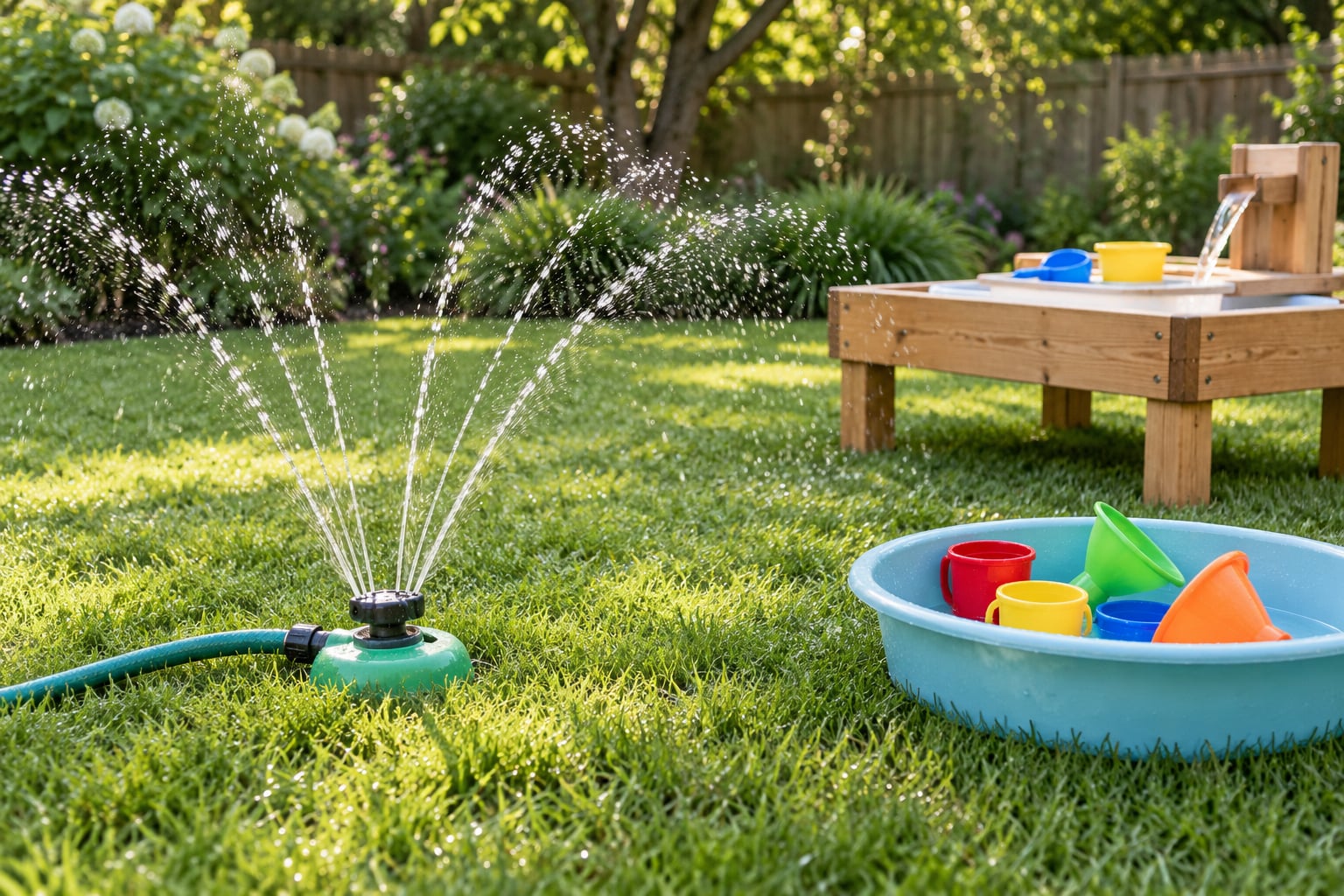
What you need: any sprinkler, a garden hose, and a shallow basin or a tarp laid on the grass. Setup time: about five minutes. Age fit: 12 months and up.
Lay the tarp or set two or three basins around the sprinkler head so the spray lands somewhere fun. A sprinkler that arcs over a low spot gives you a natural wading area, and a spray bottle held by an adult makes a fine mist for kids who are still nervous about water on their face.
For example, I set the sprinkler at one end of the lawn and put a bowl of floating toys under the arc. The result was a toddler who spent 30 minutes carrying cups back and forth between the two, which is really just pouring practice in disguise.
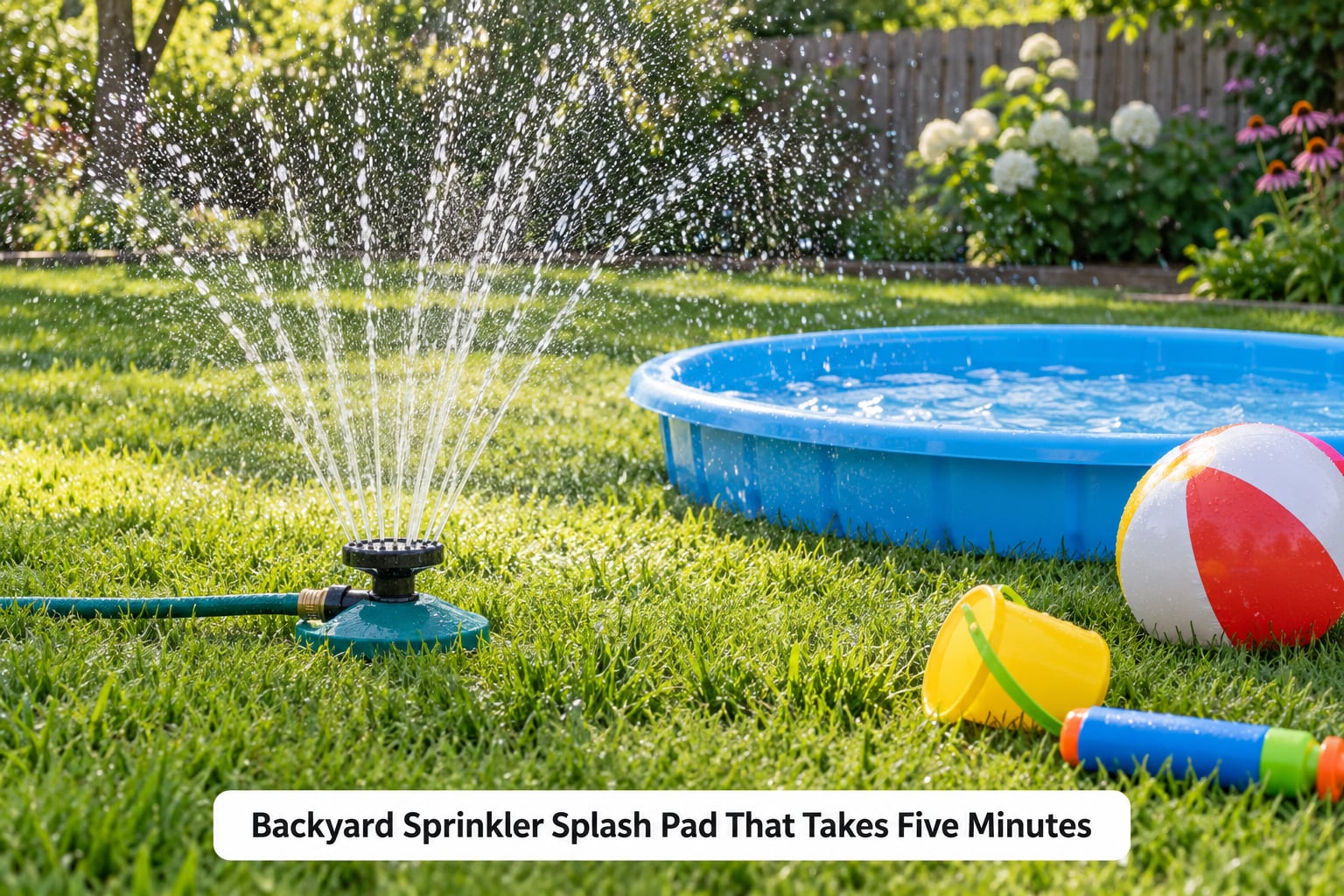
On hot days run it in the morning or late afternoon rather than at midday, and keep breaks in the shade. On cooler days a sprinkler becomes an active game rather than a way to cool off, which works just as well for burning energy.
2. Toddler Water Wall for Cause and Effect Practice
What you need: recycled bottles with the tops cut off, a few lengths of string or hose clamps, and a sturdy fence or deck rail. Setup time: 20 minutes. Age fit: 18 months and up.
Poke a hole in each bottle cap and hang the bottles upside down along the rail so water runs out of the necks. Add a few lengths of gutter or half a pool noodle as slides underneath. Turn the hose on gently at the top and let the wall do the rest.
Children quickly work out that tilting a bottle changes the spray and that blocking a slide makes a splash. A 20-month-old will happily move one bottle from side to side for half an hour, which is exactly the repetition this age needs.
Skip this one on a deck rail a toddler could climb or lean over. Mount it on ground-level fence boards instead, within sight from a kitchen window if that is where you sit.
3. Backyard Water Table for Scooping and Pouring
What you need: a water table, or any wide shallow tub plus cups, funnels, scoops and a few floating objects. Setup time: 3 minutes to fill. Age fit: 12 months and up.
Keep the water shallow, around an inch or two, and set the table at a height where your child’s feet can plant on the ground. Funnels, plastic measuring cups and a turkey baster cover most of a session on their own.
For a toddler still developing fine motor control, skip the water guns and give bigger tools with wide mouths. A scoop that spills everywhere is not a failure, it is a toddler learning that volume has a shape.
Parents often ask whether the table is worth buying. One What to Expect thread has a parent saying they bought one for a first birthday and the same table was still in use five years later, now as a pool for dolls, so it earns its space if you have a flat patch of ground.
4. Nature-Themed Water Sensory Bin for Calming Play
What you need: a sturdy bin, water, stones, leaves, sticks, small flowers, and scoops. Setup time: 10 minutes. Age fit: 18 months and up.
Fill the bin a few inches deep on a shaded porch or patio, then add a layer of gathered natural materials. Toddlers dig, sift and float things, and the slower pace of sensory work tends to settle an overstimulated kid.
Early-years practitioners describe exactly this pattern, watching children wash rocks in a bucket of water and then use those same rocks to build streets and paths. That spontaneous shift from water play to small-world play is the whole point, so resist redirecting it.
Stay within arm’s reach, especially with a child under two, and keep the bin out of reach of outdoor pets. Empty it the same day rather than leaving standing water overnight.
5. Spray Bottle Painting on the Patio With Washable Paint
What you need: washable tempera paint, empty spray bottles, a patio or driveway, and a hose for rinsing. Setup time: 10 minutes. Age fit: 18 months and up.
Dilute the washable paint with water until it runs, pour it into spray bottles and let your child spray broad marks across concrete or a fence. Large sweeping motions come before fine control, and the results dry away on their own.
A second round uses chalk: draw shapes on the patio, then hand over a wet sponge and a bucket. The sponge leaves the shape visible a beat longer, which keeps toddlers trying to hit it.
Skip non-washable paint, and check that your patio sealant will tolerate scrubbing before you start. Rinse everything once the colours dry rather than trying to clean wet tempera off concrete.
6. Backyard Bubble Hunt for Chasing and Popping
What you need: a bubble wand, a small bucket of water with a couple of tablespoons of dish soap, or a store-bought bottle. Setup time: 5 minutes. Age fit: 12 months and up.
Bubbles give toddlers something small, bright and slow-moving to track with their eyes, which is a genuinely hard skill at this age. Wands with big loops work better than thin ones for small hands, and plain bubble solution is safer for little ones than the concentrated refill bottles sold for older kids.
If bubbles are not working, try the non-bubble version: scatter a handful of plastic lids or pom-poms across the lawn and let your child find and gather them, or blow up a few balloons and hand over a paper square to bat them.
Soap leaves a film on grass and can stress plants in hot sun, so keep it on the driveway and rinse after.
7. Fill-and-Pour Bucket Station for Steady Hands
What you need: nesting cups, two or three small buckets, and a small watering can. Setup time: 5 minutes. Age fit: 12 months and up.
Set everything on a low step, a patio mat, or an overturned shallow crate so your child can reach without stretching. Fill one container from another, over and over. It sounds boring and it is not, because toddlers repeat a task until the motor pattern is solid.
Add a real mini job and it becomes pretend play: watering the potted plants, filling a dog bowl, or pretending to run a car wash. Give the station a boundary with a towel or mat underneath so the floor stays containable.
Ten minutes of this fills one small bucket and leaves you with a dry-ish patio. That predictability is exactly what you want on a day when a full hose feels like too much.
8. Shallow Tub and Ball Bath for Buoyancy Play
What you need: a shallow wash tub or plastic storage box, water, and lightweight plastic balls. Setup time: 3 minutes. Age fit: 12 months and up.
Fill the tub to about two inches. Enough water for the balls to float and slosh, not enough for a head to go under. Let your child push a ball under and watch it pop back up, which is the simplest buoyancy lesson available.
A spoonful of unscented dish soap turns it into a foam bath and adds pretend play, though rinse the patio afterwards since soap plus sun is hard on grass.
This one has the firmest rule: you stay within arm’s reach for the entire session, no exceptions, even for a minute. A toddler can drown in very little water very quickly, and toddlers who climb out of tubs unattended go looking for water on their own.
9. Backyard Drip and Pour Station Built From Recycled Bottles
What you need: plastic bottles, a shallow tray or baking sheet, sticks or skewers, a funnel, and a few small bowls. Setup time: 15 minutes. Age fit: 24 months and up.
Poke holes in the caps of empty bottles, invert them over sticks in a tray, and set the tray on a small slope or prop it with a brick. Water drains through slowly and collects in the tray, where your child can pour it into bowls and watch the level change.
The slow rate is the point. It suits an older toddler who has run out of interest in a fast splash and wants to control the flow. A dropper or a small watering can works alongside the drip for children ready to pour more precisely.
Skip this one if you have squirrels, because a punctured bottle outdoors rarely stays punctured.
10. Toddler Water-Target Game With Plastic Containers
What you need: empty plastic containers or buckets in a row, small water balls or wet sponges, and a short throwing distance. Setup time: 10 minutes. Age fit: 24 months and up.
Line up three containers and set them close enough that a gentle underhand throw can reach them. Sponge balls soak up water and are heavy enough to fly in a flat arc, so they land softly rather than thwacking the side of a bucket.
Adapt for weaker control by skipping the throw: have your child carry a full sponge to the row and squeeze it over each container, or squeeze it into a bowl and count together as it empties. Dumping is the skill that comes first anyway.
Skip water balloons for this age. Latex pieces are a choking risk and the cleanup is endless; sponges do the same job and go in the washing machine.
11. Leaf and Flower Water Play From the Yard
What you need: fallen leaves and flowers, a tub or basin of water, a bug net or slotted spoon, and small cups. Setup time: 5 minutes. Age fit: 18 months and up.
Fill a basin, add leaves and let your child test which ones float, which sink, and which tear when soaked. Sorting them into two bowls gives a quiet sorting task for a child who needs a breather from gross motor play.
Collect only from ground you know is safe. Avoid any plant you cannot identify, skip anything that has been treated with pesticide or herbicide, and keep the basin away from pet access.
The sorting game works well alongside a bucket and a small net: catch the floating leaves, move them to the dry bowl, and count as they land.
12. Backyard Car Wash Play With a Hose and Sponge
What you need: toy cars, a hose with a gentle nozzle, a bucket of water with a drop of dish soap, a sponge, and a small cloth. Setup time: 10 minutes. Age fit: 24 months and up.
Set a few plastic cars on the driveway and let your child wash, rinse and dry them in a repeating sequence. Foam makes it look like real car wash work, which is the sort of borrowed-from-life play toddlers lean into hard.
Then turn it around: the cars queue up at the end and your child runs the car wash for them. Feeding the animals, filling the watering trough and washing muddy paws all use the same hose and the same soapy bucket.
Rinse the driveway thoroughly afterwards. Soap left on concrete in direct sun leaves a film, and it is slick the next time anyone runs across it.
Safety, Supervision, and Easy Cleanup
Supervision is not optional. Pediatric guidance is consistent on this: an adult should be within arm’s reach and in sight of a toddler around any water, including a shallow tub, a water table and a filled bucket. Drowning is fast and silent, and toddlers who climb out unsupervised will go looking for water on their own.
Change the water in any standing container at the end of every session. Overnight water in buckets, wading pools and water tables is a breeding ground for mosquitoes, and it is also simply the hazard you were trying to avoid.
Watch surfaces and clothing. Non-slip matting or a towel under any tub helps, and expect wet clothes. Plan the session around a change of outfit rather than trying to prevent one.
Sun safety needs real attention, not a checkbox. Pick a hat before the session starts rather than after the child is pink, apply sunscreen to exposed skin, offer water breaks, and move the whole setup into shade when the sun is highest. Look for flushed skin, headache, unusual sleepiness, or a child who stops wanting to play, and move indoors.
Keep in mind what not to use under age three: water beads and gel balls, which are a serious ingestion risk and should not be used at all around small children, small toy parts that fit inside a toilet paper roll, marbles, and salt ice, since salt can irritate or burn skin.
As for cleanup, a bucket under the tap catches most of the splash before it reaches the patio, and a spray of water on dry concrete lifts grit that a broom would only scatter. Let everything dry in the sun, empty the containers, and wipe down the fence handles.
Frequently Asked Questions
How long can toddlers play in water outside?
Most toddlers do well with 20 to 30 minutes of focused water play at a stretch, followed by a break in the shade. Sessions longer than an hour tend to fade into aimless splashing rather than play. Watch for the usual signs: shivering, chattering teeth, pale or goosebumpy skin, or suddenly clingy behaviour. Dry the child off, get them into dry clothes, and warm up. Younger toddlers may only manage 10 minutes, and that is completely fine.
What backyard water play ideas work without a sprinkler?
Most of them. A water table, a bucket station, a shallow tub of soapy water with balls, a spray bottle painting station and a leaf-and-float basin all need only a hose or a tap. The car wash and the water wall work best with running water but can be done from buckets instead. Save the sprinkler for when you want the whole lawn involved and nobody is holding a cup.
How can I keep toddler water play safe on a hot day?
Go early or late rather than at midday, and set up in shade whenever possible. Apply sunscreen before the session starts, not during it, and put a wide-brimmed hat on before you head outside. Offer water breaks on their own schedule and watch for flushed skin, headache, unusual sleepiness or a child who drops their usual energy. Those mean move inside and cool down straight away.
What should I do if my toddler gets too cold during water play?
Stop the water and get out of it. Remove wet clothes, dry the child thoroughly including between the toes, and get them into warm dry layers. Warm water on hands and feet is fine, and a warm drink helps too. Keep them warm and watch them over the next hour, since a genuinely chilled toddler can seem fine and then tire quickly. If they are shivering hard, unusually sleepy or hard to wake, seek medical advice.
How do I clean up water toys and a wet patio?
Empty every container the same day rather than overnight, and rinse toys under the hose or in the sink with a little dish soap. For a wet patio, sweep off grit first, then hose it down; soap leaves a film in sun and makes concrete slippery the next day. Dry in the sun, wipe down fence and door handles, and put the toys away so nothing is left standing open.
Conclusion
The twelve setups above cover the whole range, from a three-minute sprinkler that cools everyone down to a recycled-bottle drip station for a child who wants control rather than volume. Most of them run on buckets and a hose you already own.
Start with the simplest one that fits your space, your supervision capacity and your toddler’s mood that afternoon. A running-over-the-feet sprinkler beats an ambitious setup every time, and once the novelty fades, a new activity in the same familiar spot beats a new toy every time.