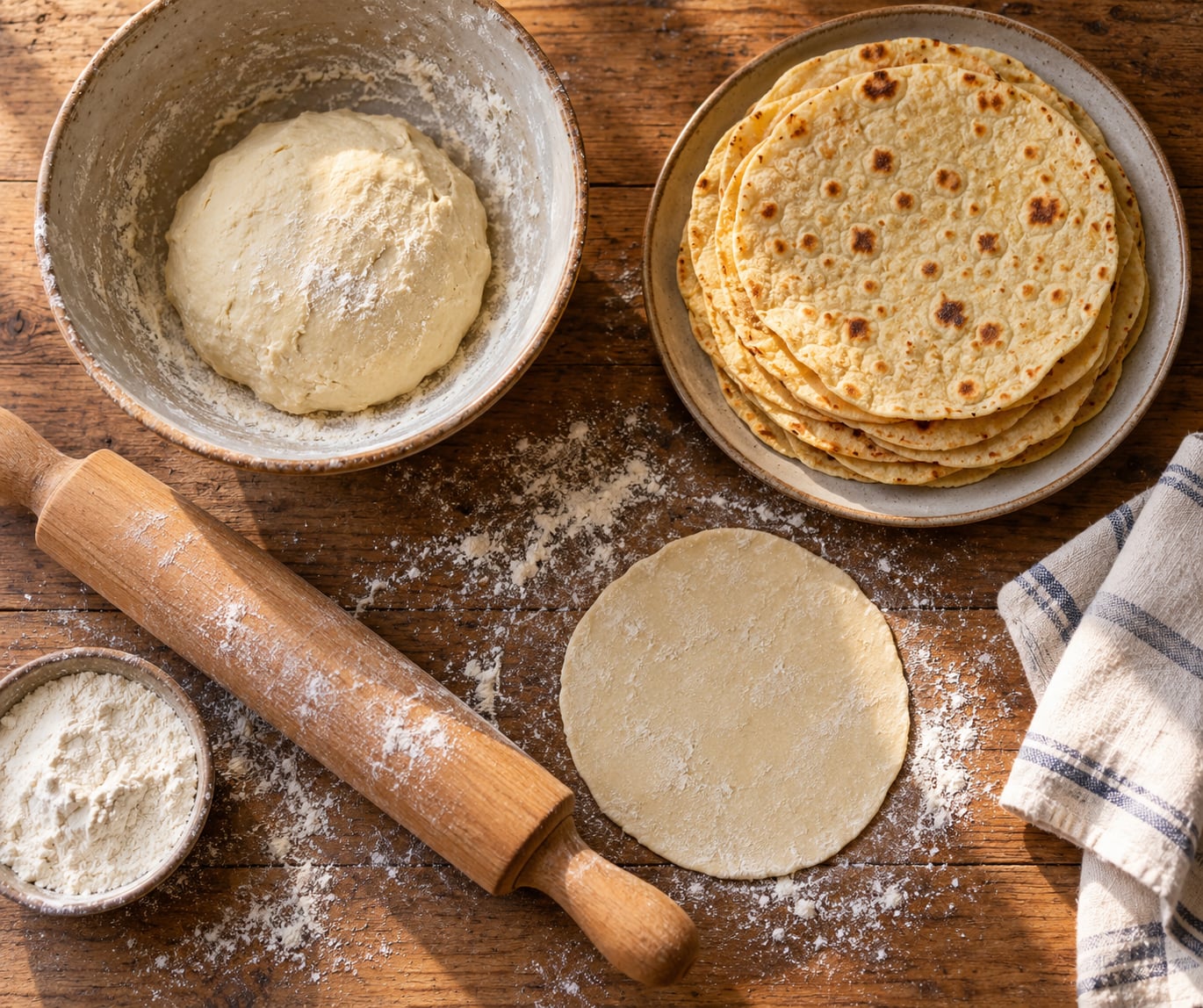
To make tortillas from scratch with kids, mix a four-ingredient dough, let the children roll or press it into rounds, and cook the rounds on a hot skillet while an adult handles the pan. The whole session takes about an hour, with roughly 30 minutes of actual work, and one batch makes 10 to 12 tortillas.
It is one of those rare activities where the mess is part of the fun and the result is dinner. Kids measure, stir, knead and roll, and they get to eat something they built with their hands. You stay close for the knife-adjacent bits and the hot pan, and that is it.
Flour tortillas are the easier starting point because the dough rolls rather than fights back. Corn tortillas made with masa harina are more forgiving to press, cook in 30 seconds a side, and are worth a second session once the flour version feels routine.
Table of Contents
- What You Need
- Flour tortilla dough (makes 10 to 12 tortillas)
- Corn tortilla dough (makes 10 to 12 tortillas)
- Equipment
- Step-by-Step: How to Make Tortillas from Scratch with Kids
- 1. Make the Dough
- 2. Rest the Dough
- 3. Roll the Tortillas
- 4. Cook the Tortillas
- 5. Fill and Serve
- Common Mistakes and Helpful Tips
- Frequently Asked Questions
- Can children make tortillas from scratch?
- How long should tortilla dough rest before rolling?
- What flour is best for homemade tortillas?
- How do I keep tortillas from sticking to the pan?
- How long do homemade tortillas keep, and how should I store them?
- Can I make tortillas without a griddle or skillet?
- Conclusion
What You Need
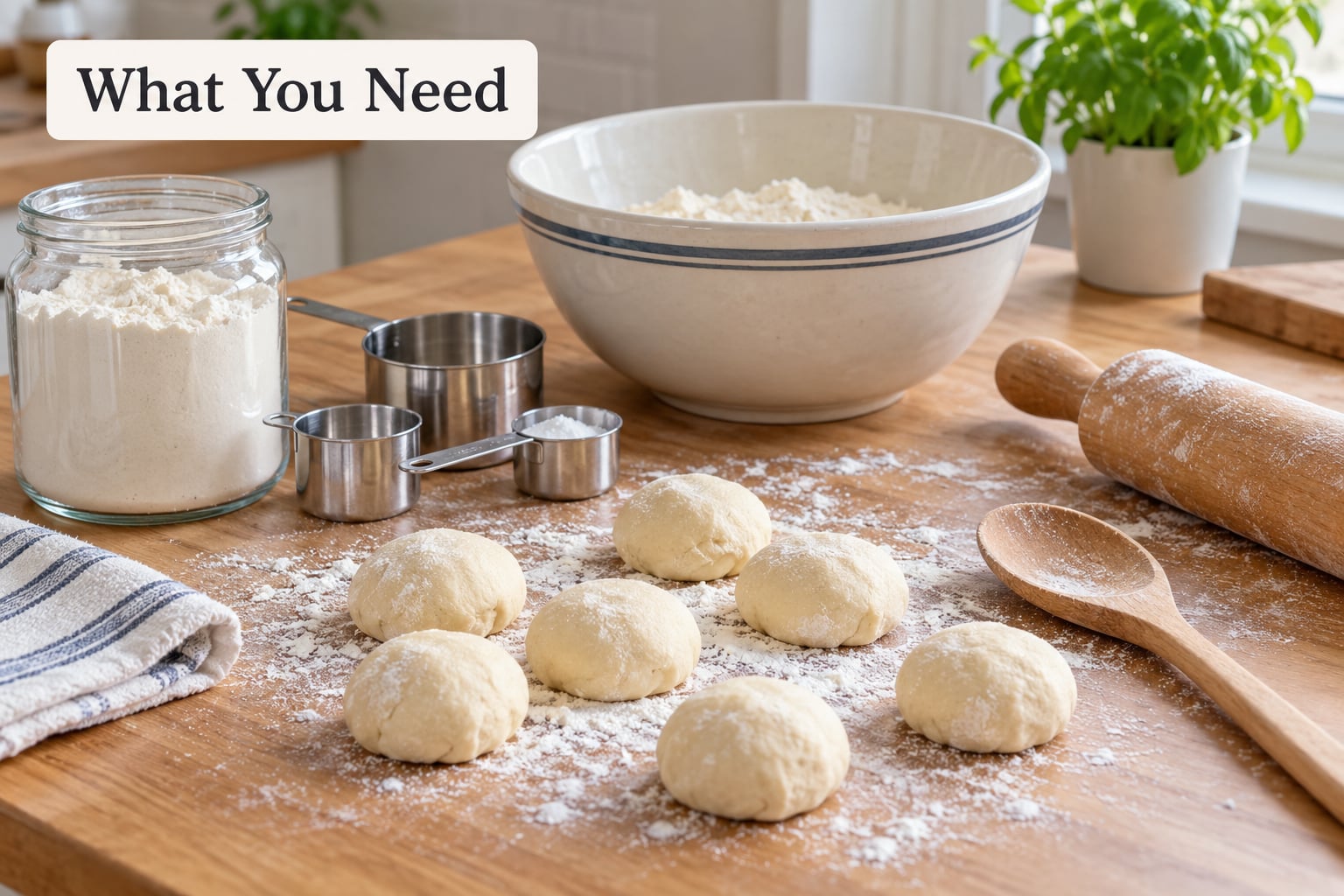
Searches ask about three, four and five ingredient tortillas more than almost anything else in this topic, so here are all three versions in one place. Three: all-purpose flour, warm water, salt. Four: add olive oil. Five: add a teaspoon of baking powder, which gives you a slightly puffier, softer tortilla for quesadillas.
Flour tortilla dough (makes 10 to 12 tortillas)
- 3 cups all-purpose flour (about 360 g)
- 1 teaspoon salt
- 2/3 cup warm water, roughly body temperature
- 2 tablespoons olive oil
Corn tortilla dough (makes 10 to 12 tortillas)
- 2 cups masa harina (about 240 g)
- 1 teaspoon salt
- 1 1/4 cups warm water, add a spoonful at a time
Masa harina is not cornmeal. It is dried, treated corn, and the treatment is called nixtamalization, where corn is soaked in an alkaline solution so the body can absorb its niacin. Plain cornmeal never gets that step, which is why it bakes up gritty and falls apart.
Equipment
- A tortilla press, a heavy skillet, or a clean rolling pin
- A cast iron skillet or flat griddle
- A clean work surface, a bowl, measuring cups and spoons
- Two or three damp clean towels for stacking the cooked tortillas
You do not need a tortilla press. A rolling pin works, it just takes a minute longer per tortilla. A cast iron skillet pressed upside down over a round of dough is a decent stand-in in a pinch, and a heavy flat skillet does the same job.
Two jobs stay with you no matter how old the children are: the hot pan, and handling the cooked tortillas once they come off the heat. Everything else can be handed over, and how you split the jobs depends more on attention span than on age.
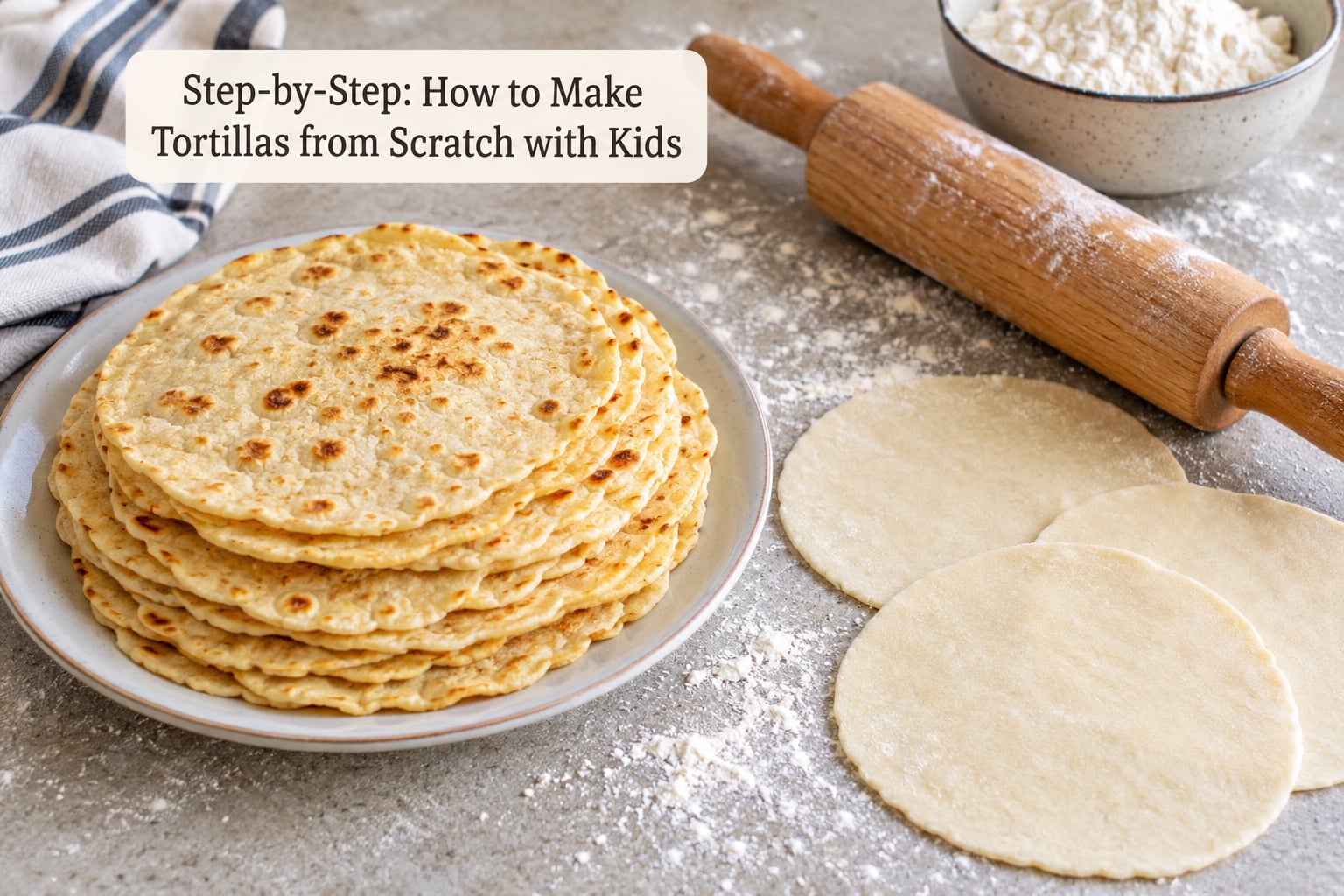
Step-by-Step: How to Make Tortillas from Scratch with Kids
1. Make the Dough
Set the flour out in a bowl and let a child measure it with the cup. Wetting the measuring cup first stops the flour from packing down and giving you half a cup too much.
Add the salt, then the warm water, then the oil. Stir with a wooden spoon until no loose flour is visible, about a minute, then turn the dough out onto the counter and knead. Six to eight minutes of pushing with the heel of the hand, folding, turning, repeat.
You want the dough to go from shaggy and tearing to smooth and slightly tacky. The test is a slow spring-back: press a thumb in about half an inch and the dent should mostly fill back in on its own. A dough that springs straight back is under-kneaded, and that is the reason many beginner tortillas crack at the edges.
Corn dough behaves differently. It is wetter, sticky, and it does not spring back. It should feel like soft modeling clay, and if it crumbles when you squeeze a piece, add water a spoonful at a time.
2. Rest the Dough
Wrap the dough in plastic or a damp towel and leave it on the counter for 30 minutes. That wait is what relaxes the gluten your kneading developed, which is why rested dough rolls out without fighting back and stays pliable instead of snapping.
Use the time to set up the stations. One child dusts the counter with a light film of flour, another lays out the filling bowls, and someone else counts tortillas into piles of five. The wait is the messiest and most boring stretch of the whole process, so plan for it rather than rushing it.
When you come back, pinch or cut the dough into 10 to 12 balls, each about the size of a golf ball. Cover them with a towel so they do not dry out while you work through them. Families who cook on a whim wrap each ball individually in plastic and refrigerate them, then bring out one or two at a time, which keeps a bored child from wandering off mid-session.
3. Roll the Tortillas
Flatten a dough ball with the heel of your hand, then hand it to a child with instructions: flour the top, roll it out, and stop before it turns paper-thin. About 1/8 inch is the target, and 5 to 8 inches across depending on how small the tortillas should be for the kids.
Flour the surface lightly, not heavily. Dipped straight into the bowl, the dough glues itself to the counter and you end up with a dusty mess that peels off in patches. A pastry brush, a shaker, or a few taps from a cup gives you just enough.
Two things surprise beginners. Tortillas spring back as you roll, shrinking a good inch, so aim for a larger circle than you want. And thinner is better than thicker because the cooking step dries it out further, so a tortilla that is too thick stays chewy and folds badly at the table.
With a press, sandwich the dough ball between two round liners cut from a clean plastic bag, swing the top plate down, and press once. That one press usually does it. The plastic stops the dough from welding itself to the metal, and the liners cost nothing.
By age, the job grows: ages 2 to 3 can flatten balls and sprinkle flour, ages 4 to 6 can roll with a pin, ages 7 to 10 can work the press and watch the pan, and older kids can cook a tortilla under your supervision. Nobody needs to be at the stove alone.
4. Cook the Tortillas
Heat a cast iron skillet or flat griddle over medium-high heat until a drop of water skitters and evaporates in a few seconds. A flick of oil, then lay a tortilla down flat.
Give it 30 to 40 seconds untouched. The edges will lift slightly, bubbles will appear across the surface, and brown freckles will start at the spots touching the pan. Flip with a spatula or tongs, cook another 30 to 45 seconds, and pull it off. A well-cooked tortilla puffs like a mini pita and flexes when you hold it.
Leftover tortillas go onto the stack, not back into the pan. The second cooking of a batch is always darker and drier than the first.
No griddle? A heavy flat skillet works exactly the same way. Without any pan at all, microwave a tortilla on a plate for 30 to 45 seconds, flip, and repeat until it softens, then cook it in a dry pan for 15 seconds to give it a little browning.
5. Fill and Serve
Set out fillings in small bowls and let everyone build their own. Pinwheels work for small hands, quesadillas for toddlers, and a taco assembly line keeps four hungry people from colliding.
Keep cooked tortillas wrapped in a folded clean towel or under foil while you finish the batch. Wrapping traps steam, and uncovered tortillas dry out and crack within minutes.
For meat fillings, cook to the safe minimum internal temperature and check with a thermometer: 165°F for poultry, 160°F for ground meat, 145°F for whole cuts and fish. Scrub the board, and have anyone who touched raw meat wash hands with soap for 20 seconds before they go back to the dough station.
Common Mistakes and Helpful Tips
| Problem | Why it happens | Fix |
|---|---|---|
| Edges crack while rolling | Under-kneaded or under-rested dough | Knead to a slow spring-back, rest 30 minutes, knead again |
| Dough sticks to the press | Dry dough, no barrier | Add water a teaspoon at a time; use plastic bag liners |
| Sticks to hands or counter | Surface floured too heavily or too lightly | Use a light even dusting, never a free pour |
| Tortillas come out thick and chewy | Rolled short of the 1/8 inch target | Roll thinner; you can always cook longer, not thinner |
| No puff, dense and flat | Dough dried out, pan not hot enough | Fresher dough balls, preheat longer, drop of water test |
| Uneven browning, one side black | Pan too hot, or moved around too early | Lower to medium, leave it 40 seconds before flipping |
| Tortilla rips when you flip | Edge is thin and dry, spatula too wide | Use a thin spatula and slide it fully under |
| Fillings leak out of tacos | Tortilla cooled too long, or overfilled | Fold in thirds and use warm tortillas, less filling |
On mess, flour dust is the constant complaint. Pour flour into a separate bowl rather than from the bag, dust the counter before the dough comes out, and put a damp towel by the stove for hands. When the session ends, sweep the flour dry with a broom or brush before anyone dampens a cloth, and flour sticks to a damp cloth more than most people expect.
Storage: cooked tortillas keep about 2 days in a resealable bag at room temperature, 4 to 5 days in the fridge, and freeze individually on a sheet pan for a month. Reheat in a dry pan for 15 seconds per side, or 20 to 30 seconds in the microwave. A cold tortilla straight from the bag is fine for a quesadilla, since the pan reheats it anyway.
If your kids are picky about plain tortillas, make the batch and put the fillings out separately. Kids who assembled the shell themselves are usually far more willing to taste it, which parents on cooking forums report over and over. Another option is folding the first batch into pinwheels, which read as a snack rather than a vegetable.
Frequently Asked Questions
Can children make tortillas from scratch?
Yes, with supervision. A child as young as two can measure flour and flatten dough balls, a four to six year old can roll with a pin, and a seven to ten year old can work a tortilla press. The hot pan should stay with an adult, along with the cooked tortillas, since they stay hot well past the visible bubbling. Washing hands after handling dough and raw fillings keeps the rest of the session simple.
How long should tortilla dough rest before rolling?
About 30 minutes at room temperature is the sweet spot. Resting relaxes the gluten your kneading developed, so the dough rolls out without springing back and tearing. Longer is fine, up to an hour, and many families wrap individual dough balls in plastic and refrigerate them for up to a few days, then bring out one or two at a time. Let refrigerated dough sit out 20 minutes before rolling it.
What flour is best for homemade tortillas?
Plain all-purpose flour is the standard and it works well. Whole wheat flour works too, but it drinks up more water, so swap in an extra tablespoon or two and expect slightly denser tortillas. A one-to-one gluten-free baking blend such as Cup4Cup substitutes cleanly for all-purpose flour with no other recipe changes. Skip bread flour; its extra protein makes dough that rolls tough.
How do I keep tortillas from sticking to the pan?
Heat the pan long enough. A drop of water should skitter across the surface and evaporate in a few seconds, which means the pan is genuinely hot. Add a very light film of oil, lay the tortilla down flat, and leave it alone for 30 to 40 seconds before any attempt to move it. Tortillas that stick are almost always released too early or from a pan that never got hot enough.
How long do homemade tortillas keep, and how should I store them?
Stack cooked tortillas with a layer of parchment or paper towel between each, then store them in a resealable bag. They hold roughly 2 days on the counter, 4 to 5 days in the fridge, and up to a month in the freezer if you freeze them individually before stacking. Cool them fully before sealing, and always warm them again before serving, since cold tortillas crack when you fold them.
Can I make tortillas without a griddle or skillet?
Yes, though the tortillas will be softer and less blistered. Microwave each tortilla on a plate for 30 to 45 seconds, flip it, and repeat until it feels pliable, then finish it in a dry pan for about 15 seconds to add a little color. A tortilla press is also optional. A rolling pin works, and a heavy flat skillet or a cast iron pan pressed upside down over the dough is a workable stand-in.
Conclusion
Start smaller than feels right. Mix one batch of the four-ingredient dough, hand each child a single dough ball, and let the rolling, dusting and filling be the activity itself. Keep the skillet stage to yourself and the hour will end with hot tortillas that everyone helped make.