The fastest way to use up leftovers with kids is to change the shape of the food, not just reheat it. Chopped chicken becomes a wrap, leftover rice becomes crispy fritters, and the last two spoonfuls of sauce become a five-minute snack plate your child will actually finish.
Most families throw away perfectly good food because the second dinner looked exactly like the first one. Kids remember the plate, not the flavour. Change the format and the same chicken reads as a completely different meal.
Here is the whole process: sort what you have, let your child pick the direction, cook it into something new, turn small amounts into an activity, then store or freeze whatever is left. Most of it takes under 20 minutes.
Table of Contents
- What You Need
- Step-by-Step: How to Use Up Leftovers with Kids
- 1. Sort Leftovers by Safety and Use
- 2. Let Kids Choose a Leftover Idea
- 3. Cook the Leftovers Into a New Family Meal
- 4. Turn Extra Food into a Kid-Friendly Activity
- 5. Store, Freeze, and Use the Remainder
- How to Use Up Leftovers With Kids at Every Age
- Common Mistakes and Easy Fixes
- Frequently Asked Questions
- How long can leftovers be kept in the refrigerator?
- Can I freeze cooked vegetables, rice, or chicken?
- What are easy ways to get kids involved without making a mess?
- What can I do with leftovers that my child does not want to eat?
- Can I use leftover food for crafts or sensory play?
- A Simple Leftovers Routine That Works
What You Need
You do not need special equipment. You need somewhere to put the food so it stays visible, and a few things your child can handle without asking you for help every ten seconds.
Start by sorting. Take everything out of the fridge and put it in one place on the counter. Group it into four piles: eat today, repurpose into a new meal, freeze, or bin it. Anything that smells off, looks slimy, or has sat out past two hours goes in the bin pile without a debate.
Check the clock, not the calendar. Cooked leftovers keep about three to four days in a refrigerator at 40°F or below. Anything past that is a gamble, especially for a toddler. When in doubt, freeze it right away rather than trying to use it on day six.
Gather the basics:
- Airtight containers in a size your child can eat from, so you are not portioning out the same reheated dinner twice.
- A sheet pan for anything you plan to crisp or roast.
- A mixing bowl and a set of child-safe measuring cups and spoons.
- A grater or zester for turning stray cheese or citrus peel into something useful.
- A freezer tray for flat, quick-freeze portions.
Optional activity materials: a small muffin tin, parchment paper or silicone liners, wooden skewers or tongs, cookie cutters, a cookie sheet, and a damp cloth for hands. Those five things cover vegetable faces, fruit ice, and decorate-your-own snacks.
Here is the short version of what to make from what you have. Pick two or three before you open the fridge.
| What you have left | What to make | Time |
|---|---|---|
| Cooked chicken or turkey | Chicken quesadillas, chicken fried rice, deconstructed taco plate, soup | 10 to 20 minutes |
| Cooked rice | Leftover rice fritters, fried rice, rice balls with dip | 10 to 15 minutes |
| Roasted or steamed vegetables | Fritters, veggie egg muffins, soup, snack plate | 10 to 20 minutes |
| Cooked pasta | Frittata, pasta salad, crispy muffin bites | 15 minutes |
| Roast meat and its gravy | Individual pot pies, open sandwiches, topped baked potato | 20 minutes |
| Bread or tortillas | Grilled cheese, croutons, egg in a hole, bruschetta | 10 minutes |
| Soft fruit | Smoothie packs, fruit ice, baking-banana bread, fruit salsa | 10 minutes or less |
| Cheese | Cheese toasties, cheese crisps, melted over vegetables | 10 minutes |
| Yogurt or milk | Berry yogurt bark, smoothies, overnight oats | 5 minutes |
| Sauces and condiments | As a dip for snacks, a drizzle bowl, or the base of a quick stir-fry sauce | 2 minutes |
Step-by-Step: How to Use Up Leftovers with Kids
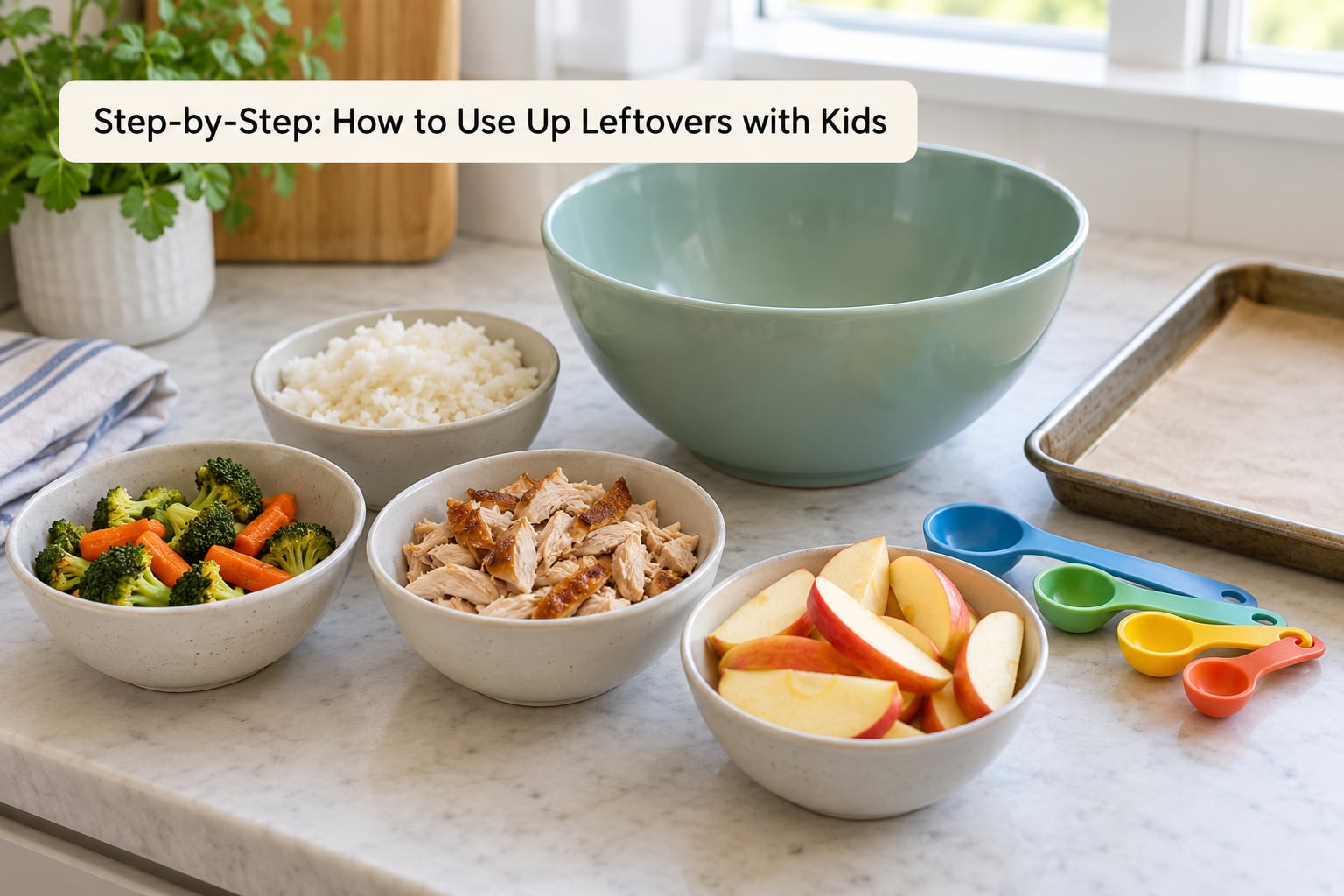
1. Sort Leftovers by Safety and Use
Put every container on the counter and make four piles: eat today, repurpose, freeze, discard. Label them with masking tape or just move them apart on the counter so nobody puts the wrong lid back on.
Check each container for time and temperature. If it has been refrigerated three or four days, it goes in the eat-today or repurpose pile. If you are not sure how long it has been there, freeze it now while it is still safe, and label the date.
Discard without hesitation anything that smells sour or ammonia-like, anything with mould on it, and anything that sat out on the counter for more than two hours. One spoiled container can taint the rest of the pile, and the point of sorting is to make the rest of the leftovers easier to trust.
2. Let Kids Choose a Leftover Idea
Choice is what makes leftovers land with kids. Give them two or three options and let them pick, rather than asking an open question and listening to no.
A simple system works well. Crunchy leftovers become snacks, cooked vegetables become fritters or wraps, soft fruit becomes frozen treats, and grains become bowls or patties. The rule most families land on is straightforward: if it will not go on a plate, it goes on a pizza, into a smoothie, or into soup.
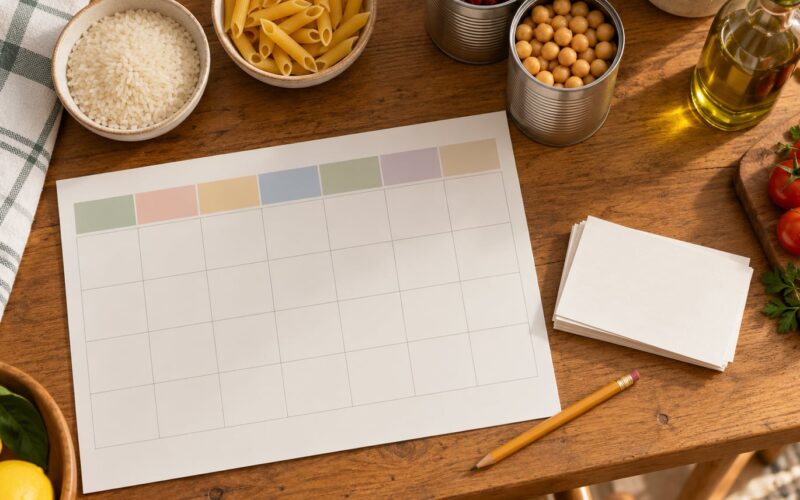
Put the choices on cards so the negotiation takes thirty seconds instead of ten minutes. My rule is two options, never more. Three feels like a choice; four feels like homework.
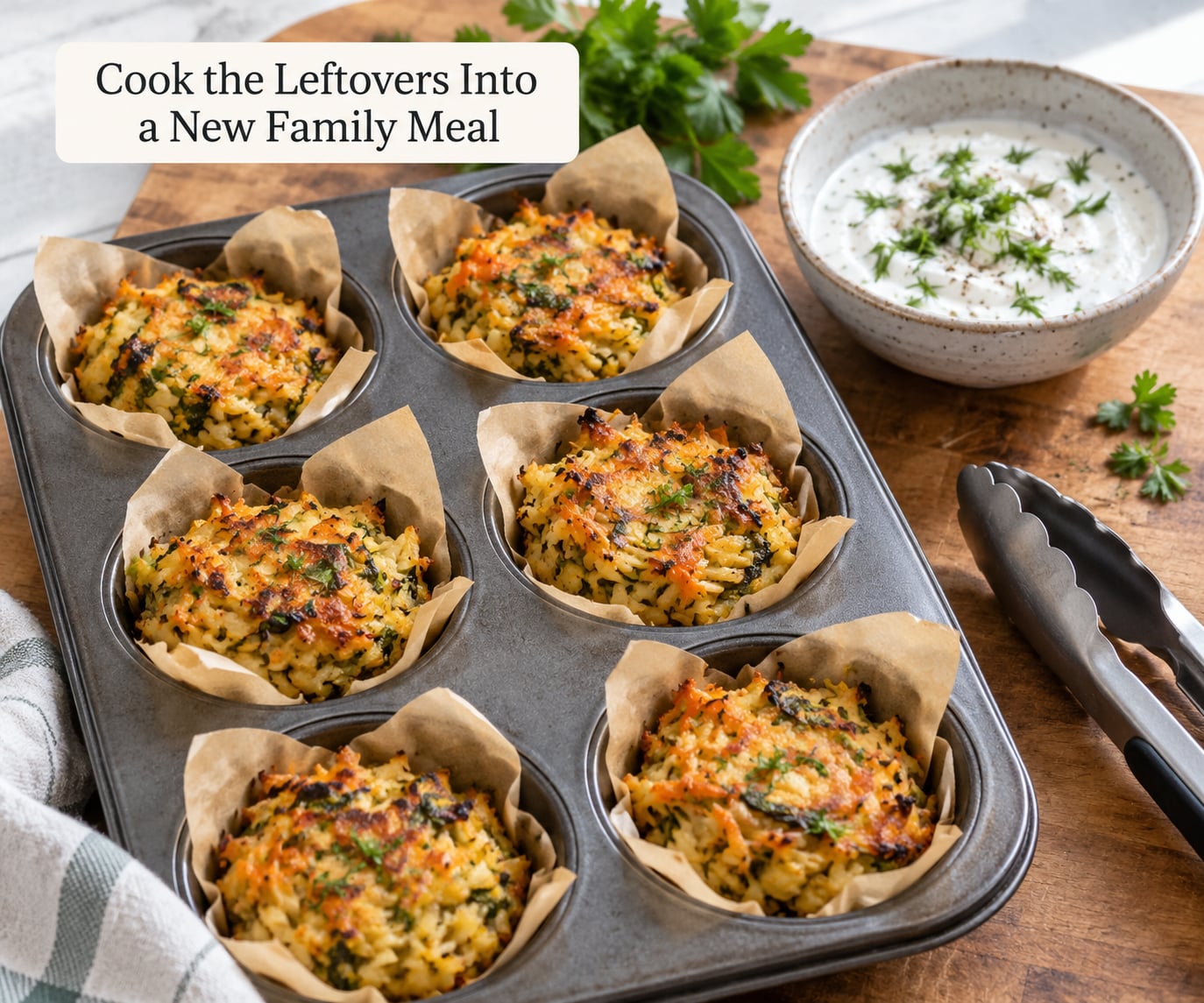
3. Cook the Leftovers Into a New Family Meal
This is where the actual transformation happens. Each base leftover becomes a different meal through one simple change.
Cooked chicken. Shred it and turn it into quesadillas with cheese and whatever roasted vegetables are sitting there. Or push it into cooked rice with soy sauce and a fried egg on top, which is a full dinner in one pan. Leftover roast plus its gravy becomes a pot pie if you have small ramekins, or a loaded baked potato if you do not.
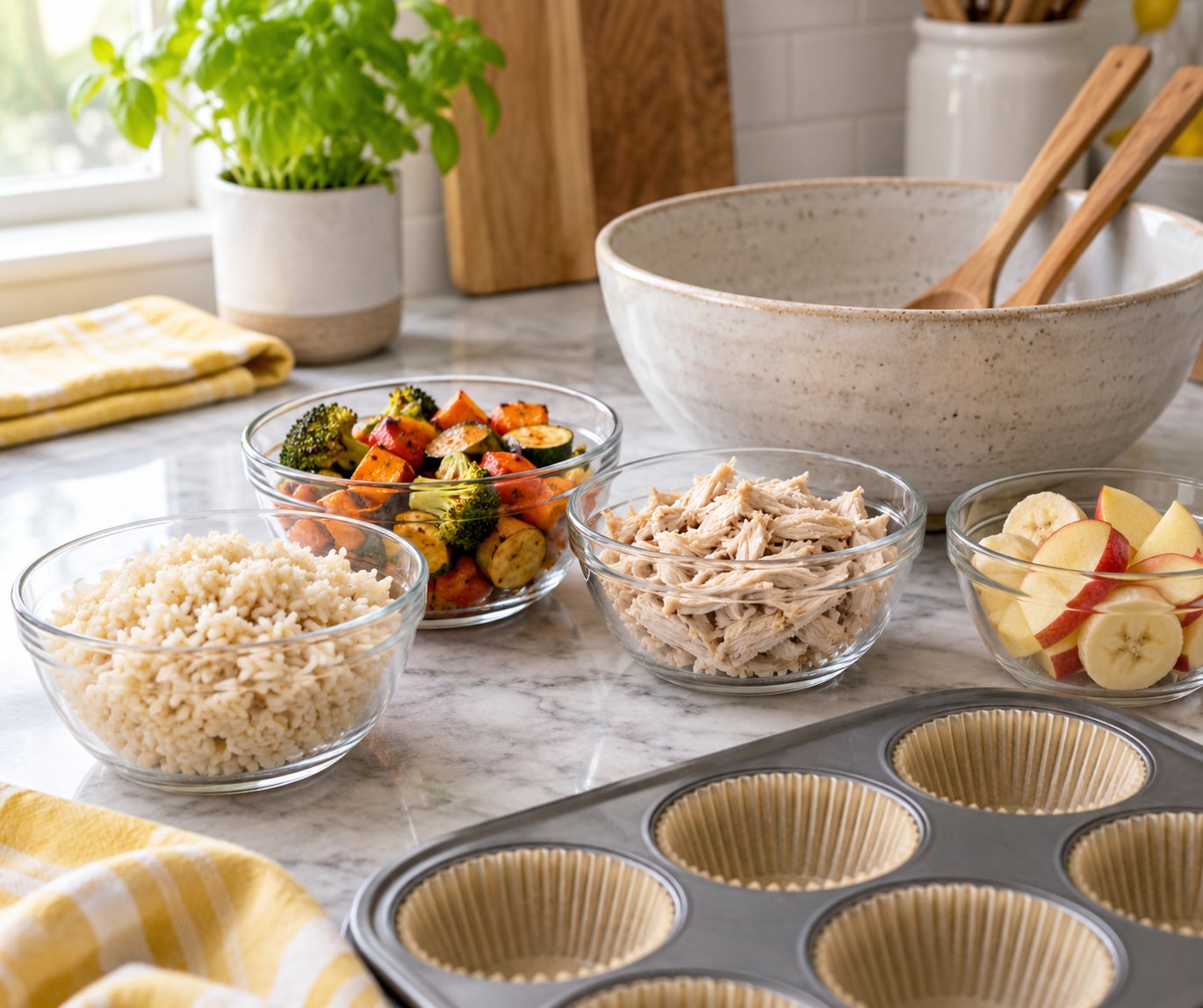
Cooked rice. Mix it with one beaten egg and a handful of grated vegetables, drop spoonfuls onto a hot oiled pan, and flip when the edges crisp. Rice fritters are the single most useful leftover transformation I know, because they are finger food and they do not look like leftovers. Add leftover chicken or chopped vegetable to the mix for protein.
Roasted vegetables. Chop them small and fold them into an egg muffin tin with beaten egg, or blitz them into soup with a splash of stock. Roast vegetables that are going soft work better here than raw ones, because the flavour is already concentrated.
Cooked pasta. Tip it into a muffin tin with egg and cheese and bake until set. These are the ones that travel in a lunchbox without turning to mush, which makes them a genuinely useful packed lunch.
Roast meat, potatoes and gravy. Layer them in a small dish, top with shredded cheese, and bake until bubbling. Individually portioned dishes get eaten far more often than one big tray, because each child controls their own serving.
Reheat everything once, to 165°F for poultry and reheated leftovers, steaming hot all the way through. Cool it in shallow containers rather than deep ones so it chills fast, then refrigerate within two hours of cooking.
4. Turn Extra Food into a Kid-Friendly Activity
Sometimes there is nothing left to cook, only a small amount of something safe. That is where the activity approach helps, and it works because the food gets handled and eaten in a way that never happens at the dinner table.
Vegetable faces. Give each child a plate and a small cup of leftover cooked vegetables. Two rounds of a muffin tin become eyes, a slice of cheese becomes a mouth, and a piece of bread becomes the head. Children who will not eat broccoli will place it, rearrange it and eat it, because the goal has shifted from eating to building.
Fruit ice. Blend soft fruit with a splash of yogurt or milk, pour it into small silicone moulds or a muffin tin with liners, and freeze. Grapes and melon freeze into something that tastes like a popsicle in about four hours.
Decorate-your-own snack board. Put every safe leftover in small bowls on a tray and let children build their own combination with tongs. Dips made from leftover yogurt or hummus mixed with roasted vegetables become the anchor instead of the rejected food itself.
Leftover pizza night. Half a cooked pizza and a tray of vegetables turns into a build-your-own assembly, and the child controls what goes where. Build-your-own dinners work well for exactly this reason, because assembly removes the fight over a fixed recipe.
Keep the scale right. Activities only work when they are about the food already in the fridge, and if they produce three new piles of waste, skip them.
5. Store, Freeze, and Use the Remainder
The part that gets missed is planning for what survives the week. A leftover with no plan is a leftover that goes off.
Portion before you freeze. Freeze single family portions in flat containers or on a tray, then bag them once solid. A frozen block of three servings will thaw and go bad twice before anyone eats it.
Freeze what travels well. Chilis, soups, stews, stuffed pastas and individual pot pies reheat well from frozen. Soups and chilis freeze fast in a flat tub. Cooked rice and cooked poultry freeze fine for a short period but lose texture after thawing, so use them within about a month.
Build a use-it-soon box. Put a small basket or a marked shelf in the fridge for food that needs eating in the next two days. Children can check the list themselves, which turns forgetting into a decision.
Keep a running list. A note on the fridge or a shared phone list saying what needs using up stops food from quietly aging in the back.
How to Use Up Leftovers With Kids at Every Age
The same leftover needs a different treatment depending on who is eating it.
- Toddlers (1 to 3 years): soft textures only, cut small, served deconstructed with a dip. Chicken as a dip with cucumber and fruit; vegetables as a frittata they can hold. A simple plate-and-scoop method for a 3-year-old tends to keep working as they grow.
- School-age (4 to 10 years): finger foods they built themselves. Fritters, pinwheel sandwiches, muffin-tin pasta bites, or a snack board they assembled.
- Teens: let them finish the cooking. A teen who browns the chicken and builds the wrap is far more likely to eat it, and it is a genuine life skill rather than a way to hide vegetables.
Serving a separate simple plate for a picky child while adults eat the transformed version is fine. Repeated no-pressure exposure matters far more than one meal, and pressure at the table reliably makes things worse.
Common Mistakes and Easy Fixes
Mistake: reheating the same plate of food. This is the most common one, and it is a format problem, not a cooking problem. Fix: change one thing every time. Chopped instead of whole, sauced instead of dry, mixed into something else, or served as a dip.
Mistake: reheating food more than once. Each reheating and cooling cycle adds risk. Fix: reheat only what will be eaten in that sitting, reach for 165°F in the middle of the food, and put the rest straight into the freezer or the use-it-soon box.
Mistake: cooking portions no one asked for. Cooking for adults plus a toddler and then scraping the plate is routine. Fix: cook the smaller amount, serve the rest at the table where children can take what they want, and expect leftovers on purpose rather than as an accident.
Mistake: ignoring changes in smell, texture or colour. Wilted is fine. Slimy, fuzzy or sour-smelling is not. Fix: one clear sniff test before serving, and if anything seems off, bin it without discussion so the child never learns that food can be argued with.
Mistake: building activities that create more mess than value. A craft that needs six ingredients and half an hour will not beat a bored Tuesday. Fix: use one leftover, one tray, and ten minutes, and only if you would do it anyway.
Mistake: offering only foods the child already rejected. Refusal is often about the food’s colour, texture or visibility, not its taste. Fix: chop it small, blend it into a familiar base like pasta sauce or a smoothie, or build it into something with a new shape such as a fritter or a muffin bite.
A few habits do most of the work: portion leftovers into single-serving containers from the start, freeze on the day you cook rather than on the day you remember, label containers with the date, and buy slightly less each week than you think you need.
Frequently Asked Questions
How long can leftovers be kept in the refrigerator?
Cooked leftovers generally keep three to four days in a refrigerator at 40°F or below, whether you are storing cooked meat, cooked rice, pasta or vegetables. Cool food in shallow containers and refrigerate within two hours of cooking. Label containers with the date so you are not guessing. Children who eat reheated food often do so more frequently than adults, so when in doubt, freeze the portion rather than stretching it to day five.
Can I freeze cooked vegetables, rice, or chicken?
Yes, all three freeze, but the textures differ. Chilis, soups, stews, stuffed pasta and individual pot pies freeze and reheat well. Cooked rice and cooked poultry are safe to freeze but dry out after thawing, so use them within about a month. Blanch vegetables for two to three minutes before freezing to hold the colour. Freeze in single family portions on a flat tray, then bag them once solid.
What are easy ways to get kids involved without making a mess?
Give children tasks with a clear end: tearing lettuce, stirring a bowl, spooning muffin tins, arranging a snack board with tongs, or washing up. Younger children can scoop and decorate, older children can chop with a blunt knife and read a recipe aloud. Keep the work surface small, set a ten-minute limit, and accept a messy result, because the mess is usually water and crumbs rather than anything serious.
What can I do with leftovers that my child does not want to eat?
Serve the leftovers to adults in the transformed version and give your child a simple separate plate, which removes the pressure entirely. For the leftover itself, change the format rather than the flavour: chop it fine, blend it into a sauce or smoothie, fold it into an egg dish, or turn it into a crisp item such as a fritter or muffin bite. Keep offering it without comment, since repeated low-pressure exposure is what actually changes acceptance over time.
Can I use leftover food for crafts or sensory play?
Yes, as long as the food is still safe to eat, since most activities end with a child tasting what they made. Cooked vegetables work for building scenes, soft fruit works for freezing into ice, and cooked grains work for shaping. Skip anything mouldy or past its safe window for sensory bins, and use inedible alternatives like cooked pasta or play dough for anything that will not be eaten. Any activity that generates more waste than it saves is not worth the time.
A Simple Leftovers Routine That Works
Check the refrigerator first. Everything out on the counter, sorted into eat today, repurpose, freeze, or discard.
Then choose one safe leftover idea, let your child pick between two options, and get them helping with the part that takes the least supervision. Freeze or schedule anything remaining before the day ends.
Last thing: cool leftovers in shallow containers, refrigerate within two hours, reheat only once until steaming hot all the way through, and throw away anything that smells off. If you are unsure about a child with a weakened immune system or a serious medical condition, ask your pediatrician rather than guessing.