How to meal plan with kids input is simpler than it sounds: give each child a real but bounded say, letting them pick one dinner from two or three options you have already approved while you keep control of the structure, the nutrition, and the schedule. Plan the week, honor the picks, and leave the rest flexible.
That is the whole system. The hard part of family meal planning is not cooking, it is deciding, and decision fatigue is what kills a plan by Wednesday. Giving kids a say drains some of that load off you and buys you cooperation at the table, which is where most plans actually fail.
This guide walks through a six-step process that runs in about 30 minutes on a Sunday afternoon. It works for toddlers through teens, for picky eaters, for allergies, and for families whose schedules never line up perfectly.
Table of Contents
- What You Need
- Step-by-Step: How to Meal Plan With Kids Input
- 1. Check the schedule and food needs first
- 2. Offer choices within clear limits
- 3. Mix familiar favorites with a few new meals
- 4. Match meals to the week’s actual energy
- 5. Turn the plan into a grocery list
- 6. Let kids help safely, then close the feedback loop
- Common Mistakes
- Frequently Asked Questions
- What is the 3-2-1 meal plan?
- Can ChatGPT make a meal plan?
- At what age can kids help plan meals?
- How can you encourage children to eat their food?
- How do I meal plan with a picky eater?
- What is the best meal planning app for families?
- Conclusion
What You Need
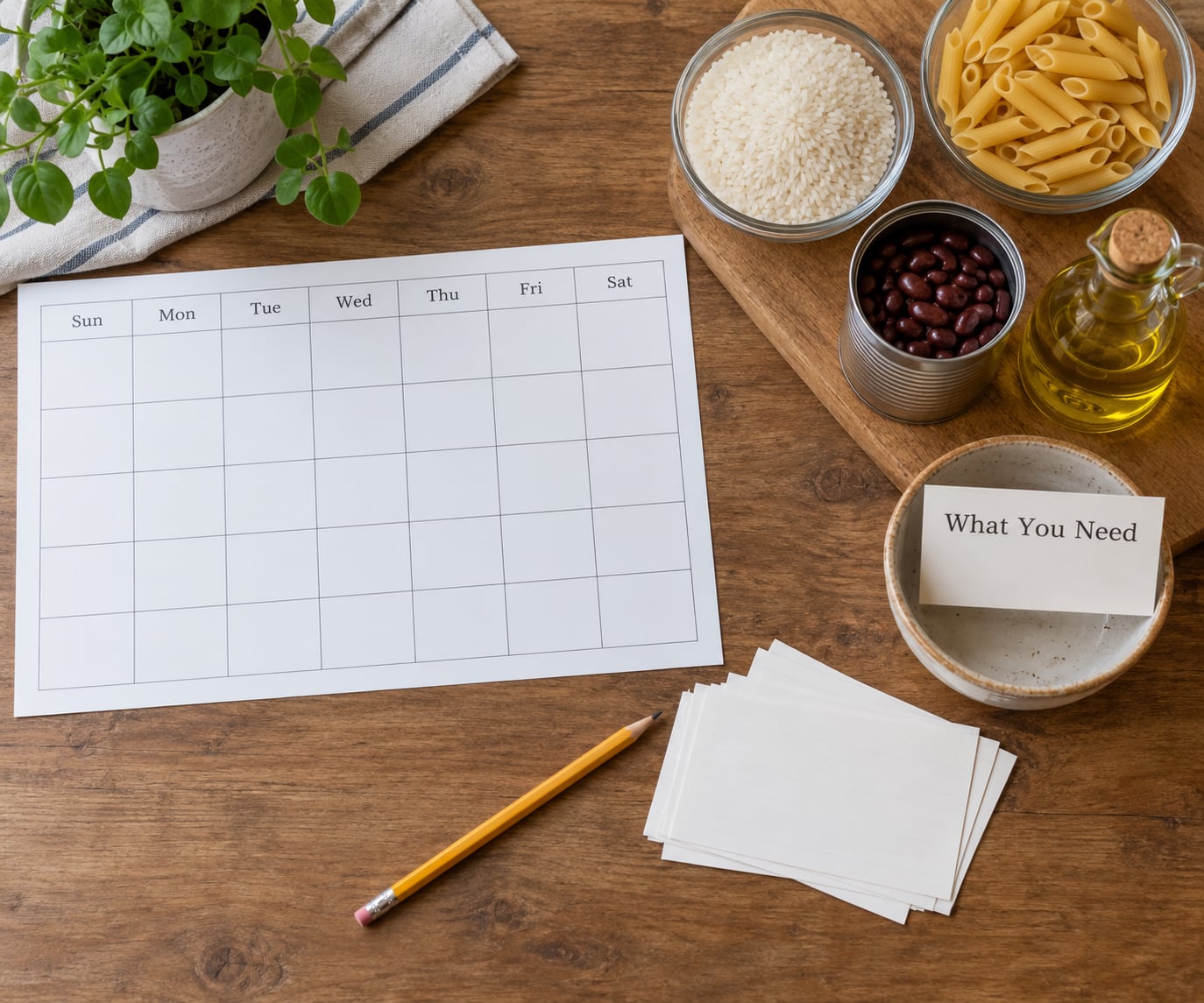
You do not need an app to start. You need a place to write things down and a short list everyone in the family can actually picture.
- A weekly grid. A paper calendar on the fridge or a single page in a notebook. Seven columns for seven days, one row for dinner. Add rows for breakfast, lunch, and snacks later if your family wants them.
- A running meal list. Somewhere you keep the meals that already work: fifteen or so names is plenty. Parents in family meal-planning forums keep this list in a notes app or a recipe manager like Paprika, which is often recommended because tags make it easy to pull every pasta recipe in one tap.
- Grocery notes. A running list that lives on the fridge door. Parents report sticking with this habit far more reliably than they stick with a meal-planning subscription.
- Choice cards or a visual board. Index cards, sticky notes, or a whiteboard where the two or three approved options for the week are posted. Young children choose far better when they can point at something than when they have to hold a whole week in their head.
- Your pantry staples on hand. Know what you have before you plan: the pasta, rice, canned beans, tortillas, frozen vegetables, and oils that turn into a meal in twenty minutes.
- Notes on allergies, dietary needs, and the week ahead. Allergies, intolerances, religious restrictions, sensory needs, and the ingredients your family cannot use at all. These get filtered out before any child gets a vote.
Time-wise, a first run takes closer to 45 minutes because you are building the list of family favorites. After that, most families land somewhere between 15 and 20 minutes a week.
Step-by-Step: How to Meal Plan With Kids Input
1. Check the schedule and food needs first
Before anybody suggests a meal, look at the actual week. Mark the school days, the appointments, the practices, the late work nights, and the one evening where everyone happens to be home at the same time.
Then write down the food limits. A child with a peanut allergy, a child who cannot eat dairy, a family avoiding pork, a texture-sensitive eater: none of those are up for negotiation this week, and filtering them out first saves you from a veto battle nobody needed.
You are also deciding which nights need fast meals. Most weeks have two or three of them, and they are the nights when kid input matters least. A family with Monday soccer, Wednesday swim, and a Thursday evening commitment should plan the fifteen-minute dinners on exactly those nights.
2. Offer choices within clear limits
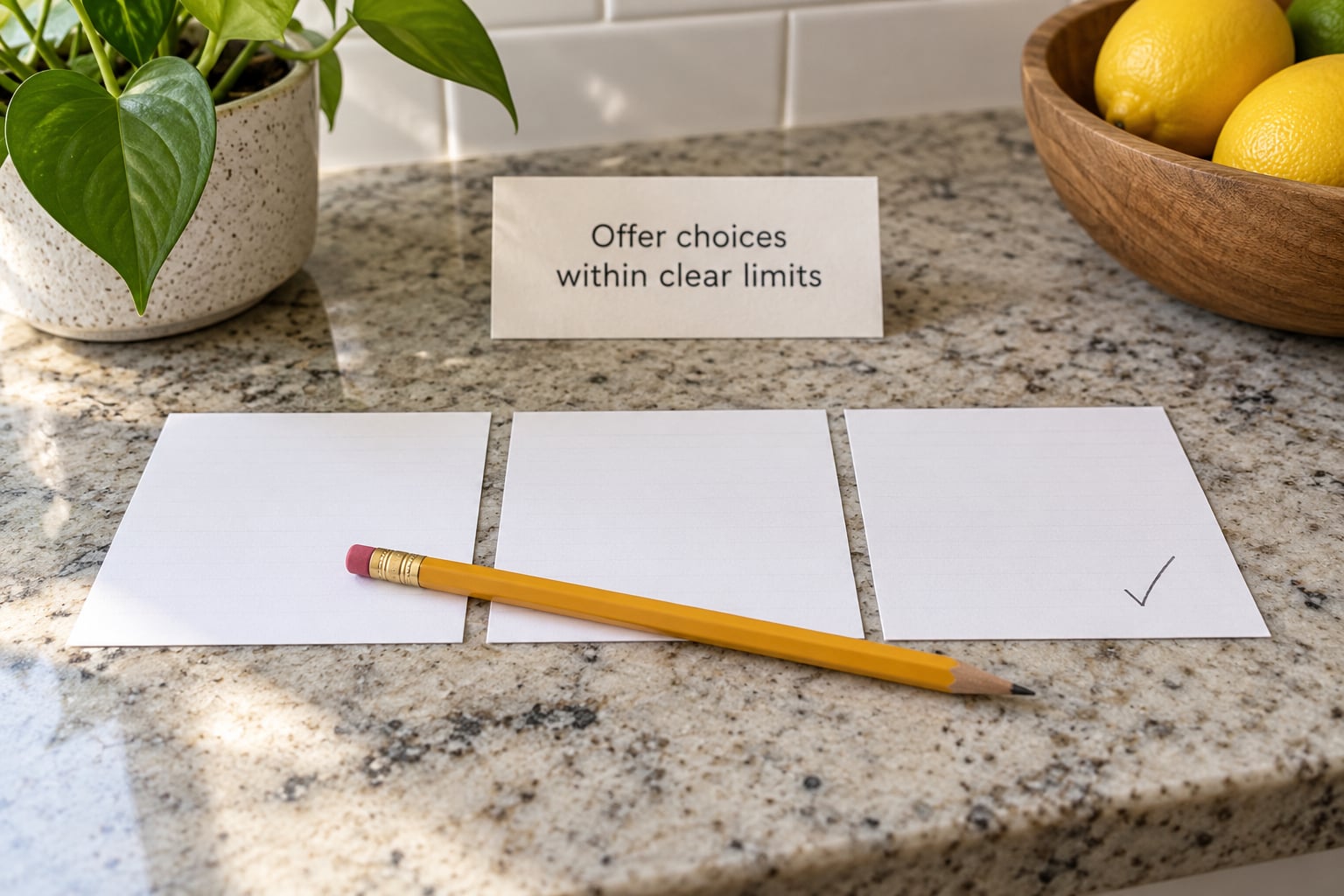
This is the step that makes or breaks the system. The rule is simple: you build the options, the kids pick from them. Never the other way around. If you are working out how to meal plan with kids input, this is the step worth slowing down on.
How many choices? Two or three per child. Two is usually enough, and three is the ceiling before you get option overload and a five-minute negotiation instead of a meal. More options do not make kids happier; they just give them more ways to say no.
Give each child one pick and one veto. One pick is the dinner they are guaranteed to cook. One veto is a single meal on the plan they can send out, no reasons needed. The veto is where the real negotiating power lives, which is why families that hand over a veto but no pick tend to have calmer weeks than families that do the opposite.
Rotate whose pick gets honored. With two kids, one takes the honored pick on odd weeks and the other on even weeks. Siblings will spot an unfair pattern in about two seconds, so write the rotation on the calendar and stick to it.
Age decides how much say they get.
- Ages 2 to 3: one pick between two options you set up, plus the job of washing vegetables or tearing lettuce. They choose, they do not plan.
- Ages 4 to 5: one pick from three, plus one veto, plus a say in the snack for the week. Start letting them look at the grocery list and pull two things off the shelf.
- Ages 6 to 8: one pick from three, a veto, and ownership of one full side dish on one night. They can read the recipe card for it.
- Ages 9 to 12: they pick two nights of the week, budget included, and one of those gets cooked with an adult standing nearby.
- Teens: let them claim one entire night and cook it with a set amount of money. This is where the planning skills pay off, and it buys you a night off that they earned.
What you keep. The anchor meals. The protein on the table. The structure of the week and the time each night allows. Say this out loud once and it stops sounding like you are ruling on everything: the kids choose the meals, you choose the framework, and both halves have to be there for the plan to hold.
3. Mix familiar favorites with a few new meals
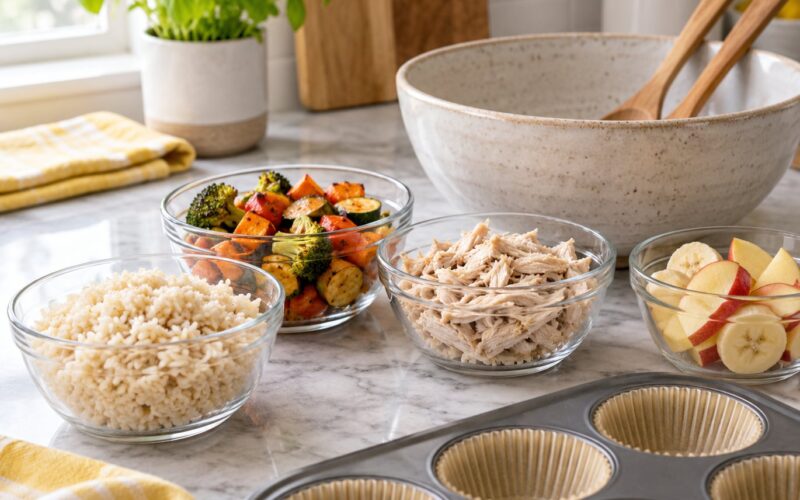
Build the seven-night list out of four or five meals your family already eats without argument, one or two genuinely new ones, and at least one flexible meal. Tacos, sheet-pan dinner, or a build-your-own bowl work well because the parts arrive separately and nobody has to eat a mystery mixture.
Use a theme to shrink the number of decisions: taco night, pasta night, breakfast-for-dinner night. A theme means the same handful of ingredients gets used two or three times in a week, which cuts the grocery list and the cooking time without the family noticing a pattern.
Here is the grid. Print it, or copy it into a shared note, and fill in the kid’s pick column during the planning session.
| Day | Dinner | Kid’s Pick | Prep Note |
|---|---|---|---|
| Monday | Sheet-pan chicken and vegetables | — | Marinate the night before |
| Tuesday | Taco night, build your own | — | Grind the meat Sunday |
| Wednesday | Fifteen-minute pasta with jarred sauce | — | Fast night, soccer |
| Thursday | Breakfast for dinner | — | Uses eggs and toast, nothing else |
| Friday | New recipe, small batch | — | Cook once, freeze half |
| Saturday | Leftovers lunch, then a relaxed dinner | — | Clear the fridge |
| Sunday | Batch cook, double the batch | — | Freeze four portions |
Food safety shapes the batch-cooking step more than most people expect. Cook poultry to 165°F, ground meat to 160°F, and whole cuts of meat or fish to 145°F, measured with a thermometer in the thickest part. Refrigerate cooked food within two hours, use refrigerated leftovers within three to four days, and freeze anything you will not eat in that window.
4. Match meals to the week’s actual energy
A plan that only works on a calm Saturday is not a plan. Put the ambitious recipe on the night with energy, and put leftovers on purpose rather than by accident.
A useful shape is three nights of cooking from scratch, two nights of fast assembly, one night of a frozen or refrigerated batch you already made, and one night where dinner genuinely does not matter. That last one is the night everybody survives on whatever is in the fridge, and naming it in advance removes the shame of it later.
Cook once, eat twice is the single biggest time saver most families never adopt. Sunday’s chili becomes Wednesday’s dinner, or lunch portions go into the freezer with the dish name and the date written on the lid. Freezer meals are also the answer when the week falls apart, which it will.
Keep one plan-B meal in your back pocket at all times: a fifteen-minute assembly meal everybody can make from pantry ingredients without arguing. Its whole job is to exist so the real plan can miss a night without anyone treating it as a crisis.
5. Turn the plan into a grocery list
Go through the plan once, kitchen by kitchen, and list what each meal actually needs. Then open the pantry and cross off what you already have, because a plan that ignores the freezer is how you end up with a third bag of rice and a week of expensive takeout.
Write the grocery list in the order you will walk the store. Produce, protein, dairy and alternatives, frozen, bakery, pantry, household. Grouping by department means fewer backtracks and a shorter trip, which is most of the actual savings in a family grocery budget.
Two details pay off fast. Mark the ingredients that belong to each child’s chosen meal so nobody can quietly swap it, and watch for overlap across the week, because one bag of shredded cheese can cover three dinners if you bought it with the plan in mind rather than the meal in front of you.
Check the food waste at the end of the week, not before. Whatever did not get eaten tells you which recipe leaves the list next time, and that feedback is worth more than any app.
6. Let kids help safely, then close the feedback loop
Kids who cooked a meal are usually more willing to eat it, which is the cheapest fix for picky eating there is. Match the job to the age and keep everyone away from sharp blades and hot pans regardless of how capable they seem.
- Ages 2 to 3: washing produce, tearing lettuce and herbs, stirring cold mixtures, setting the table.
- Ages 4 to 5: measuring with a cup, mashing bananas, cracking eggs with help, counting out portions.
- Ages 6 to 8: reading a recipe and working a simple sequence, chopping with a blunt knife, stirring at the stove with an adult next to them.
- Ages 9 and up: cooking a whole side dish unsupervised within reach of the stove, prepping proteins for the week.
After dinner, ask three questions instead of a general how was it: what did you like most, what were you willing to try even if you did not love it, and what should change next week. Record exactly one change. If you write down four, the plan never survives contact with a real week.
You can also start from a draft rather than a blank page. Parents on r/FamilyMealPlanning and r/Mommit report feeding their allergies, restrictions, and dislikes into ChatGPT to get a full week back, then editing it themselves. It is a decent first draft. It is not a plan until your family has read it and changed it.
Common Mistakes
Asking kids to make every decision. The classic failure, and it ends in takeout and cereal within a week. Fix it by keeping the anchor meals, the protein, and the week structure off the ballot. Kids choose from your short list, never from an empty one.
Offering too many options. Ten options is not freedom, it is a chore. Two or three is a real choice that a child can finish. The whole point is that the decision takes under a minute.
Promising a meal they have never eaten. A new recipe picked by a child who has never seen it is a gamble you lose most of the time. Fix it by letting them veto new meals before they are cooked, and by having them in the kitchen when it is made so the first exposure is positive rather than pressured.
Planning only dinner. Breakfast, lunch, and snacks are where the week quietly falls apart. Add the rows once the dinner plan is working, not before, and start with the school-night lunches since they repeat five days in a row.
Forgetting allergies and storage. Filter the candidate list before the kids weigh in, and check the fridge and freezer dates while you are already looking at the list. Cooking a big batch of something nobody eats is a waste, and leftovers in the fridge past three to four days are a safety question, not a scheduling one.
Treating one bad meal as a failed plan. Plans break. That is normal and not a moral failure for anyone at the table. The recovery move is to fall back to your plan-B meal, use the freezer batch, and swap in an already-accepted leftover rather than cooking something new and more ambitious out of guilt.
A few habits that keep the routine alive:
- Keep the same planning slot every week, even if it is only fifteen minutes.
- Let a child who cooked something choose the next night’s meal. It keeps the kitchen help attractive.
- Never plan more new meals than your table can handle. One a week is plenty.
- Write honored picks down. Verbal memory loses to a calendar every time.
- Count food waste once a month and prune the meals that keep getting refused.
- Hold the rule that the person who shops does not get to make every decision, and vice versa.
Frequently Asked Questions
What is the 3-2-1 meal plan?
The 3-2-1 rule is a planning guideline rather than a strict diet rule. It means three meals a week built around a different protein, two built around a different plant protein, and one that is mostly vegetables and grains. Some families use it as a loose weekly target to keep the plan varied without counting anything. It works well as a starting point for family meal planning because it is flexible and easy to remember at the grocery store.
Can ChatGPT make a meal plan?
Yes, as a rough first draft. Give it your allergies, dietary restrictions, household size, the week schedule, and a list of meals your kids already eat, then ask for a seven-day grid with prep notes. Treat the output as a draft your family edits. It can repeat ingredients, forget a restriction you did not spell out, and suggest a technique nobody in your kitchen enjoys.
At what age can kids help plan meals?
Around age 4 they can choose between two options you have set up, and by 6 or 7 they can pick from a short list and cook a simple side dish. Teens can plan and buy a whole night if you give them a budget. Under 3, keep it to pointing, choosing, and helping with a simple job at the counter. Match the amount of say to the amount of reading and planning they can actually handle.
How can you encourage children to eat their food?
Involvement works better than persuasion. Let kids wash produce, measure, and stir, then let them eat a small portion of what they helped make before anyone else is served. Serve sauces and toppings on the side so a child can build something acceptable. Offer new foods without pressure, keep the meal short, and stop the meal when it is over rather than extending it. Repeated exposure matters more than any single night.
How do I meal plan with a picky eater?
Plan a base everyone eats, then let the picky eater assemble their own version of it. Tacos, sheet-pan dinners, and build-your-own bowls work well because the components are separate. Add one predictable item to every meal, such as a familiar side, and stop negotiating once the plate is served. Keep offering without pressure, and never make the dessert or the outing conditional on finishing.
What is the best meal planning app for families?
There is no single winner, and many parents find subscription apps cluttered and not worth paying for. Recipe managers like Paprika are often recommended in family meal-planning forums because tags let you pull every recipe of one type in a tap. A shared note or a paper grid on the fridge works nearly as well. Pick whatever everyone in the family will actually open on Sunday, since consistency beats features.
Conclusion
Learning how to meal plan with kids input is less about giving up control and more about spending it in the right place. You keep the anchor meals, the protein, and the structure. Kids get one pick, one veto, and a job in the kitchen, and the whole thing runs on a grid you write down once a week.
Start small. Pick one week, set two or three constraints such as allergies, budget, and which nights need fast food, offer two approved choices, and let each child claim one safe preparation task. Build from there, and by the second week the plan starts running itself.