Baking with kids makes a mess, and it always will. How to bake with kids without a mess isn’t really about a spotless kitchen, it’s about containment: a five-minute setup before any ingredient comes out, a work zone that catches every spill, and recipes chosen so almost nothing lands on the floor. Most of the work takes about 30 minutes plus baking time, and the cleanup runs while things are in the oven rather than after.
That’s the honest version. A clean kitchen isn’t the goal, a shared one is. Here’s how to get there without handing your child a mop.
Table of Contents
- What You Need
- Step-by-Step
- How to Bake with Kids Without a Mess: Pick an Easy Recipe
- How to Bake with Kids Without a Mess: Set Up a Mess-Controlled Station
- How to Bake with Kids Without a Mess: Give Each Child a Real Job
- How to Bake with Kids Without a Mess: Clean in Five-Minute Rounds
- Common Mistakes
- Frequently Asked Questions
- What age can children start helping bake?
- What is the easiest recipe to bake with kids?
- How can I protect my kitchen floor while baking with children?
- Can children decorate baked goods without making a huge mess?
- How do I keep flour and other ingredients from spreading everywhere?
- What baking tools are safe and easy for young children?
- Conclusion
What You Need
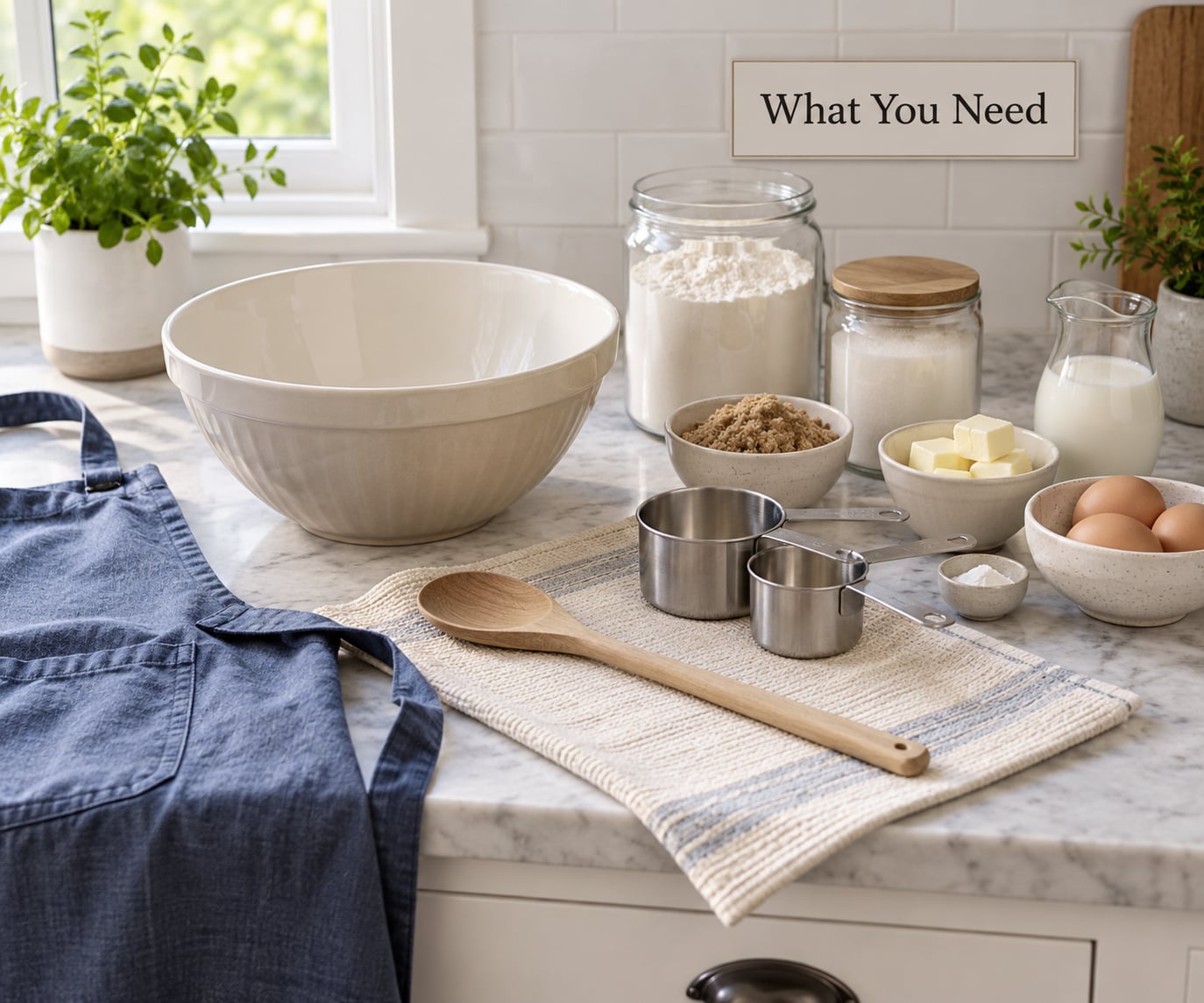
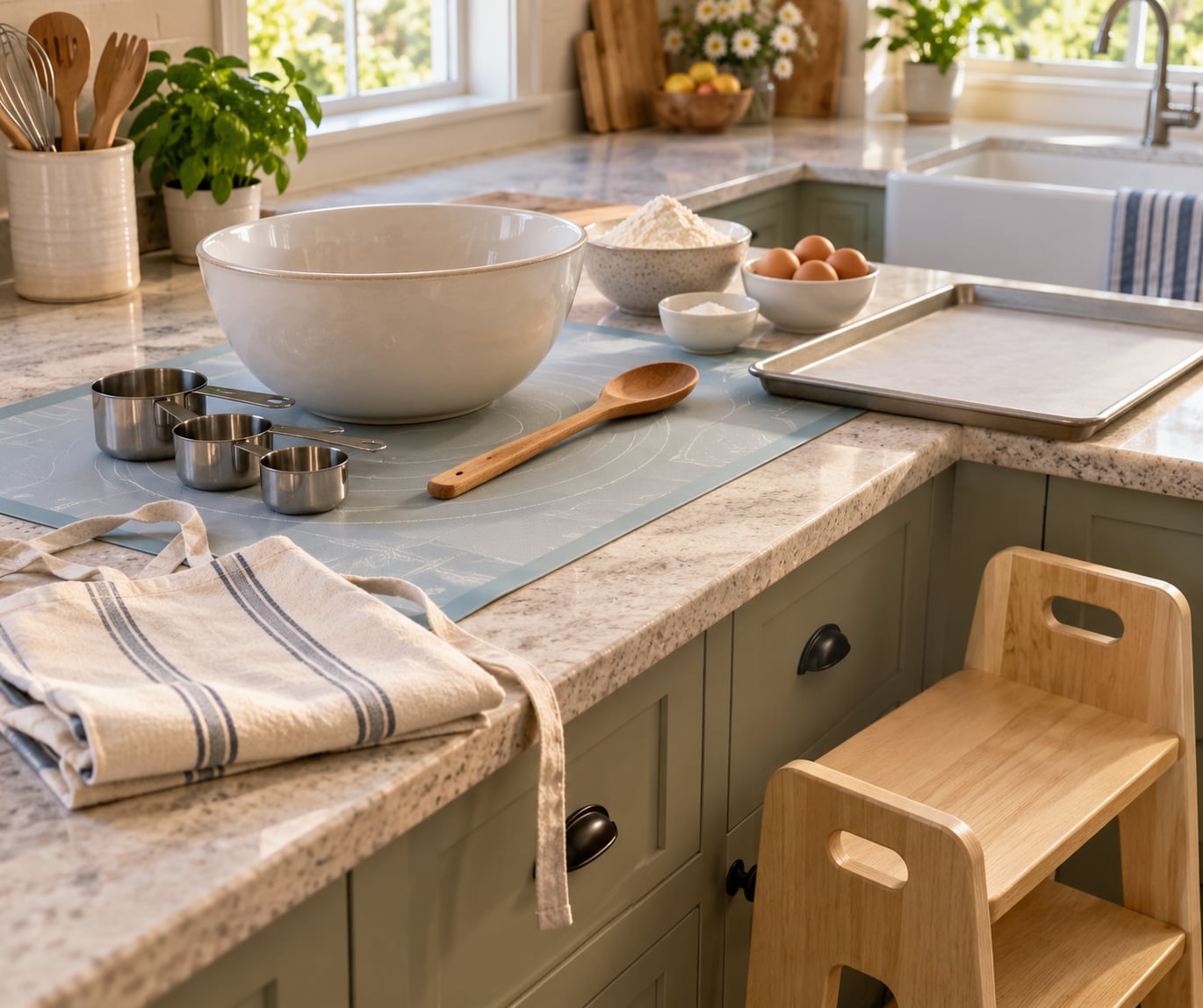
Almost everything below is stuff you already own. Group it into two piles before you start: setup supplies that control the mess, and baking supplies that do the actual work.
| Setup supplies (mess control) | Baking supplies (the work) |
|---|---|
| Rimmed baking sheet or silicone mat | Mixing bowls, one per child plus one spare |
| Plastic tablecloth or shower curtain | Wooden spoon, silicone spatula, rubber scraper |
| Apron, smock, or an old oversized shirt | Measuring cups and spoons your child can lift |
| Paper towel roll and damp dish towels within reach | Cookie scoop, muffin tin, or rimmed tray as a work tray |
| Small bin for scraps and shells | Baking parchment or silicone baking mat |
| Stable step stool so nobody needs to climb | Piping bag for decorating instead of a knife |
On a tight budget, the substitutions are easy. A plastic tablecloth and a sheet pan handle most of the containment work. A trash-can lid works as a dough catch. A freezer bag with the top snipped off turns into a piping bag. Skip the silicone mat entirely and use parchment paper.
The one non-negotiable is a step stool. Climbing on a chair to see the counter causes more broken things than flour ever will.
Step-by-Step
Four moves handle most of it: pick a forgiving recipe, build a contained station, hand out one real job per child, then clean in short rounds while the oven works.
How to Bake with Kids Without a Mess: Pick an Easy Recipe
Choose recipes with few ingredients, no sifting, and short baking times. The best dough and batters are sticky and forgiving, because dough that rolls into a ball instead of cracking apart doesn’t shatter onto the counter. When a recipe can go wrong in a way a child can see, skip it that day.
Banana muffins, quick bread, sugar cookies, pancakes, and muffin-cup fruit pies all hold up well. Muffin-cup pies work especially well because each one is a small, contained unit with a premade crust, so nothing spills between pans. Bread-in-a-bag, where the dough is mixed and kneaded inside a sealed freezer bag, keeps flour off the counter entirely.
Match the recipe to the child’s age, since that determines how much they can actually own.
| Age | Good low-mess picks | What they do | Why it stays contained |
|---|---|---|---|
| Toddler (1-3) | No-bake energy balls, yogurt bark, fruit skewers with yogurt dip | Rolls, presses, sprinkles | No oven, no knife, no loose flour |
| Preschool (3-5) | Muffin-cup fruit pies, banana muffins, sugar cookies, pancakes | Mashes bananas, fills cups, presses dough | One bowl, one tray, sticky dough that holds |
| School-age (6-12) | Quick bread, no-bake cheesecake cups, from-scratch pizza on a sheet pan | Measures, stirs, cracks eggs, decorates | Real steps with a rimmed work zone under the bowl |
If you only have one recipe in you, make pancakes. The batter lives in one jug, it pours instead of scatters, and the pan goes straight to the oven or the stovetop with no greasing-and-flouring step.
How to Bake with Kids Without a Mess: Set Up a Mess-Controlled Station
This is the whole system. Run it before anyone opens the fridge, and it takes about five minutes.
- Clear the counter completely. Nothing gives you a slippery workspace faster than flour on top of a crumb hidden under a toaster.
- Lay down the work zone. A rimmed baking sheet, a silicone mat, or a plastic tablecloth under every bowl. Spills stop at the edge instead of migrating to the floor. This single move does more than anything else in the article.
- Protect the floor. If you have hard flooring, put a second layer down. Flour that slides is a falls risk, not just a chore.
- Clear an aisle. Push chairs back so nobody backs into the counter while carrying a bowl. Breakables go to a high shelf for the duration.
- Measure and pre-chop everything first. This is what cooks call mis en place, everything in its place. Pre-measure flour into a cup, pre-chop nuts, grate cheese, unwrap butter. Kids with short attention spans need one easy job, not four hard ones.
- Cover and label the remaining ingredients. Bowls of dry ingredients with plastic wrap on top cannot aerosolize flour across the kitchen.
- Dress everyone. Aprons, smocks, or an old shirt buttoned over their clothes. Hair ties if hair is long.
- Stage the cleaning kit. Damp towel, dry towel, paper towel roll, and a scrape card or scraper for returning flour to the bowl, all within arm’s reach of the child, not the adult.
You’ll know the setup worked if a ten-minute-old spill is still inside the work zone when you notice it. That’s the whole test.
How to Bake with Kids Without a Mess: Give Each Child a Real Job
Children lose interest when their contribution is vague. Assign one named job per child before mixing starts, and change it only when the job is finished.
- Washer washes produce under running water. Safety rule: sleeves rolled, hands dried. Done when the fruit sits in the colander.
- Measurer fills one measuring cup and levels it with a finger. Safety rule: scoop and tap, don’t bang the cup on the counter. Done when the cup’s level with the rim.
- Musher mashes bananas or cooked beans in a bowl. Safety rule: fork or masher, never a knife. Done when no lumps are left.
- Stirrer uses a wooden spoon, no electricity, nothing sharp. Safety rule: one hand on the bowl. Done when the timer rings.
- Shaper presses dough into a muffin cup or rolls balls on the tray. Safety rule: hands washed and dried. Done when every cup is filled.
- Decorator uses a piping bag and sprinkles placed on a small plate first. Safety rule: seated, sprinkles stay on the plate. Done when the tray reaches the oven.
Give the jobs silly names and they stick. Chef of Mashing, Duke of Decorating, Officer of Wiping. When two kids need different jobs, split the work rather than competing for one bowl, which is where sibling collisions usually start.
How to Bake with Kids Without a Mess: Clean in Five-Minute Rounds
Cleanup that happens after everything is finished never happens. Run it during, in short rounds, framed as roles rather than corrections.
- Wipe first, keep moving. Spreads get wiped the moment they land, not at the end. Flour on a wet counter becomes cement.
- Sweep, don’t throw. Use a scraper card or the edge of a bench scraper to push dry flour back into the bowl. Kids find this genuinely fun, which is the point.
- Reset between steps. Every time the bowl goes to the oven or the fridge, the child returns the mixing bowl and spoon to the sink. Thirty seconds, and the counter resets.
- Sort at the door. While the pan bakes, bowls and trays get washed in small batches by whoever is least covered in dough.
- Last pass as a crew. Everyone wipes one surface together, including light switches and door handles, which are where flour turns up most often and nobody looks.
On raw batter: refrigerate anything with raw egg, use it within two days, and don’t let anyone taste raw dough. Raw flour and raw batter can carry Salmonella, so a taste of the mixture isn’t a snack.
Common Mistakes
Nearly all of these are avoidable by removing one step, which is the easiest fix available.
- Sifting dry flour into a bowl. Flour dust travels. Swap it for spooning pre-measured flour and letting the child whisk it instead.
- Greasing and flouring pans. Two messy steps for no benefit at home. Use parchment liners, a silicone mat, or a light spray on the pan.
- Loose sprinkles and sugar. Put them on a small plate and let the child pinch from the plate rather than shaking over the whole tray.
- Boiling sugar or making hard candy. Melted sugar causes serious burns and needs an adult anyway. Skip it.
- Knife chopping. Under age six, use pre-chopped ingredients or tear greens by hand. Give older children a child-safe knife and a dedicated board.
- Bowls filled to the brim. Leave a third of the headroom. It’s the difference between a spill and a cleanup.
- Taking the job away when it’s slow. Slow is fine. Redoing it yourself while they watch teaches nothing except that helping isn’t worth their time.
- Trying to bake and mind a toddler at once. If there’s a toddler and a hot oven, pick the recipe that doesn’t need the oven, or put the toddler somewhere visible and close with a tray of their own.
Two habits keep the whole thing calm: set a start time that matches the attention span, not the recipe’s ambition, and stop while everyone still wants more. Leftover dough and raw cookies in the fridge give you a second session without a second setup.
Frequently Asked Questions
What age can children start helping bake?
Children can join in from about age one with jobs that involve no heat and no tools, like washing fruit, tearing herbs, or rolling play dough. From ages three to five, most kids can mash, fill muffin cups, and stir with a wooden spoon. Six and up, they can measure, crack eggs, and use a child-safe knife on a separate board. Always supervise, and keep the oven and stovetop to adults.
What is the easiest recipe to bake with kids?
Pancakes are usually the easiest, because the batter lives in one jug and pours instead of scattering, and the pan needs no greasing or flouring. Sugar cookies and muffin-cup fruit pies are close behind. Muffin-cup pies work well because the crust comes pre-made and each cup is a small, self-contained unit, so nothing spills between pans.
How can I protect my kitchen floor while baking with children?
Cover the work surface first with a rimmed baking sheet, a silicone mat, or a plastic tablecloth, since most mess stops at that edge before it reaches the floor. On hard flooring, add a second layer underneath, because flour that slides creates a falls risk, not just a chore. Push chairs back to clear an aisle so nobody backs into the counter carrying a bowl.
Can children decorate baked goods without making a huge mess?
Yes, if the decorating materials are staged rather than scattered. Put sprinkles and sugar on a small plate and let children pinch from it instead of shaking over the tray. Use a piping bag instead of a knife or a spoon, seat children while they work, and put finished cookies on a wire rack over a rimmed tray so stray frosting falls onto something washable.
How do I keep flour and other ingredients from spreading everywhere?
Pre-measure flour into a cup and skip the sifter entirely, since sifting is the main source of airborne flour. Cover any dry ingredients still waiting to be used with plastic wrap so they cannot puff out. Measure ingredients into a clear bowl instead of directly onto the counter, and hand children a whisk or a wooden spoon rather than a measuring cup they can bang and spill.
What baking tools are safe and easy for young children?
Wooden spoons, rubber spatulas, plastic measuring cups, and child-sized bowls are all easy to grip and harmless to drop. A stable step stool lets small children reach the counter without climbing a chair, which prevents falls and broken dishes. A piping bag with one corner snipped off handles frosting safely, and a child-safe knife on a dedicated board works for children six and older.
Conclusion
Three things do most of the work. Pick a recipe with few ingredients and a sticky, forgiving dough. Build the station first, with a rimmed sheet pan as the work zone and everything measured before mixing begins. Then give each child one real job and one way to see they finished it.
Bake with kids in 2026 because a wiped counter is a small price for the measuring, mashing, and arguing over who gets the spoon. Contain the mess, keep the good parts, and put the dough scraps somewhere everyone can reach them.