To make pizza dough with kids, mix plain flour with warm water and a little yeast or baking powder, let it rest, then hand over the rolling pin and let the children shape and decorate their own. The basic version takes about 2 hours including a 45-minute rise, most of which is waiting. No mixer, no special equipment.
We make pizza dough with kids most Fridays in our house, and the part they actually remember is never the dough. It is the ten minutes of rolling, where they turn a lumpy ball into a circle and get to decide what goes on top.
So the method below is built around that: the adult handles measuring, mixing and the oven, and the children get jobs sized to their age. If you only have half an hour before everyone loses interest, skip to the no-yeast version further down.
Table of Contents
- What You Need to Make Pizza Dough with Kids
- Tools worth keeping off the counter
- Substitutions and allergy swaps
- Step-by-Step: How to Make Pizza Dough with Kids
- Step 1: Wake up the yeast
- Step 2: Mix and bring the dough together
- Step 3: Knead for 5 to 7 minutes
- Step 4: Let it rise
- Step 5: Shape it
- Step 6: Top and bake
- How to Make Pizza Dough with Kids Using a Simple No-Knead Method
- Which dough method suits your afternoon?
- Jobs Kids Can Take by Age
- Common Mistakes and How to Fix Them
- Frequently Asked Questions
- What age can children help make pizza dough?
- Can kids make pizza dough without a mixer or electric appliance?
- How long should pizza dough rise before children shape it?
- Can I use all-purpose flour to make pizza dough at home?
- How do I store extra pizza dough after making a batch?
- What are easy pizza toppings for young children?
- Conclusion
What You Need to Make Pizza Dough with Kids

This makes one large family pizza or four small individual ones. All the quantities below work in US and metric.
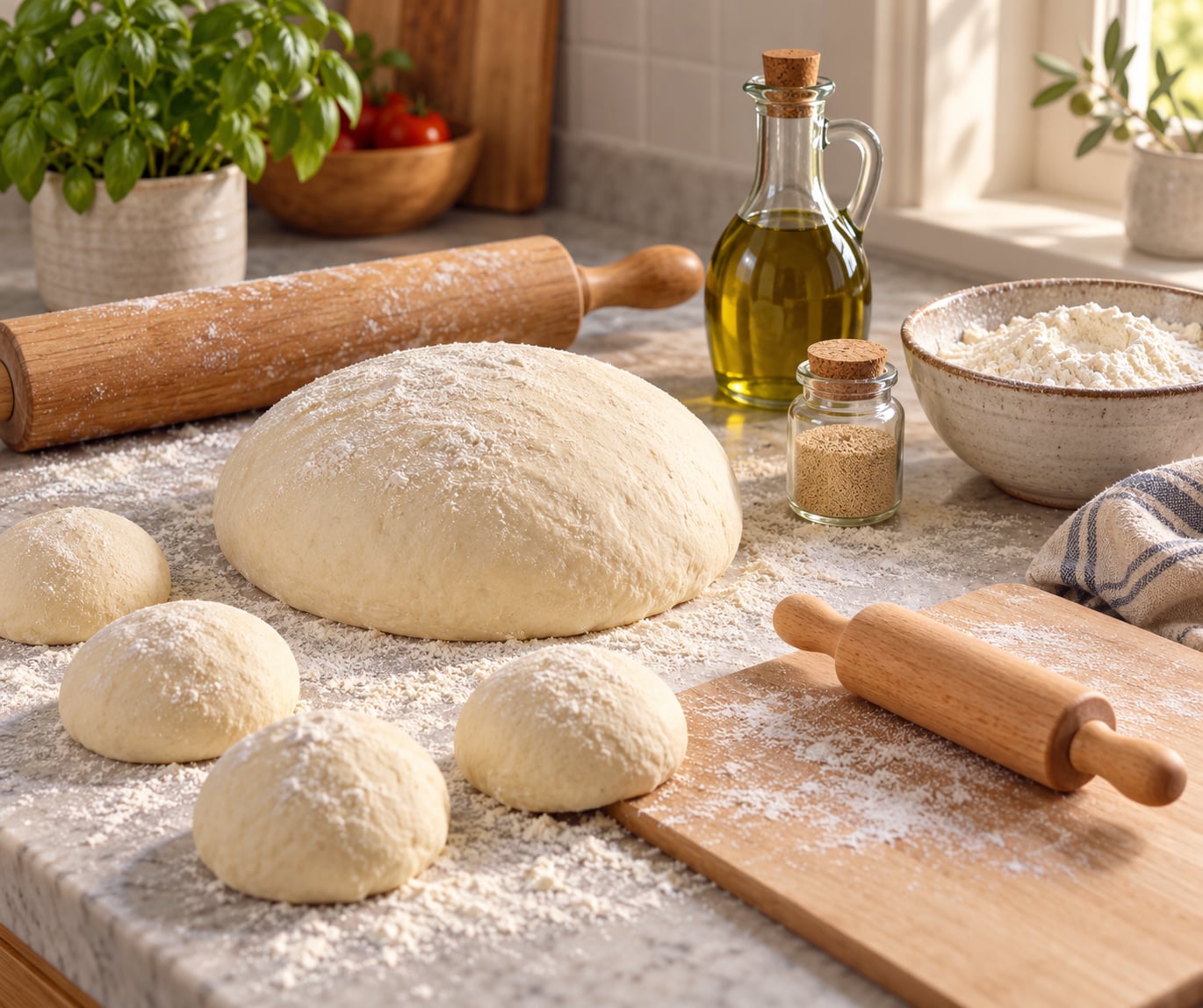
- Plain flour (all-purpose), 3 cups (360 g) — plus extra for dusting the counter
- Warm water, 1 and 1/4 cups (300 ml) — about 105 to 110°F (40 to 43°C), warm like a bath, not hot
- Instant yeast, 2 and 1/4 teaspoons (7 g) — or 1 packet
- Sugar, 1 teaspoon — this is food for the yeast, not for sweetness
- Olive oil, 2 tablespoons
- Salt, 1 teaspoon
You will also need a large bowl, a wooden spoon or spatula, a rolling pin, a baking tray or stone, and parchment paper. Give each child their own small bowl and a spoon they will actually recognise as theirs. That alone prevents the meltdown over sharing.
Tools worth keeping off the counter
Glass bowls, sharp pizza wheels, vegetable peelers and anything that has been in the oven stay out of reach. A wooden or plastic rolling pin is safer for small hands than metal, and a bench scraper replaces the knife for cutting dough into balls. Set the hot tray on a cold surface, not across the front of the hob.
Substitutions and allergy swaps
Bread flour works and gives a chewier, more blistered crust, but it is thirstier, so add another tablespoon or two of water. Self-raising flour already rises on its own, so drop the yeast and the sugar and treat it like a no-yeast dough. A gluten-free blend works but needs no kneading at all and wants a hot tray, since it browns faster.
For dairy, use olive oil instead of butter in the dough and skip the cheese. Check that your yeast is not sitting in anything containing gluten before a child with a coeliac diagnosis touches it.
Step-by-Step: How to Make Pizza Dough with Kids
Step 1: Wake up the yeast
Pour the warm water into a bowl, stir in the sugar, then sprinkle the yeast over the surface. Wait 5 to 10 minutes. If the water turns cloudy and foamy, the yeast is alive and working. If it sits flat, your water was too hot and killed it, so start again with cooler water.
Step 2: Mix and bring the dough together
Add about half the flour and stir with a spoon until it is too thick to stir. Tip in the rest of the flour, the oil and the salt, and mix with clean hands until no dry flour remains in the bowl. The dough will look shaggy and unpromising at this point. That is normal.
Step 3: Knead for 5 to 7 minutes
Push the dough away with the heel of your hand, fold it back, turn it a quarter, repeat. A child can do this standing next to you and pushing with both palms, which is genuinely useful because adult kneading is tiring and hard to supervise at the same time. You are looking for a smooth, slightly tacky ball that springs back slowly when you poke it.
Step 4: Let it rise
Put the dough in a lightly oiled bowl, cover with a tea towel or cling film, and leave somewhere warm for 45 to 60 minutes, or until it has roughly doubled. A warm cupboard or the inside of a switched-off oven works. Poke it with a finger and look for the dent that springs back partway. That is the test.
Step 5: Shape it
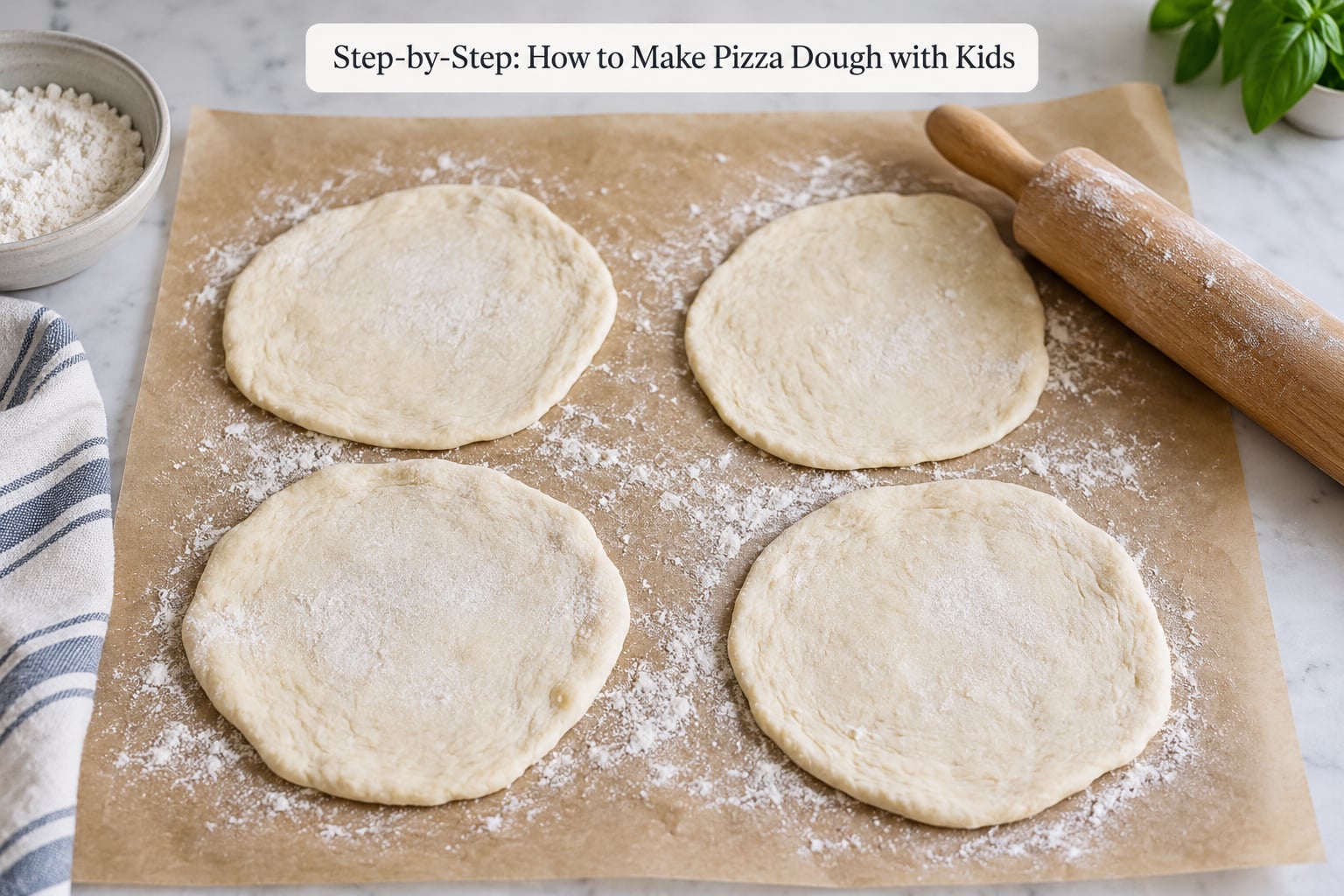
Tip the dough onto a floured counter and give it a gentle knock-back to release the trapped gas. Divide it into four balls for individual pizzas or leave it whole for one big one. Let each child dust the counter, press a ball flat with their palms, then roll it out. Aim for 1/4 inch (6 mm) thick. Pushing the dough tears it, so flour generously and roll outward from the middle every time.
Step 6: Top and bake
Heat the oven to 475°F (220°C), gas mark 8, with the tray already inside. Spread sauce on in a spiral, leaving a 1 inch (2.5 cm) border, then add toppings. Bake 8 to 12 minutes for small pizzas, 12 to 15 for a large one, until the crust is golden underneath and the cheese bubbles.
The most common pizza night failure is not the dough. It is children piling the middle so high that steam can never escape, which leaves a pale, wet centre. Less sauce, lighter topping in the middle, and an empty border fixes almost every case.
How to Make Pizza Dough with Kids Using a Simple No-Knead Method
This is the version for children under five, for anyone without patience for a rise, or for a weekday night when you want to be eating in 20 minutes. Baking powder does the rising instead of yeast, so there is no waiting at all. Mix 2 cups (240 g) plain flour, 2 teaspoons baking powder, 1/2 teaspoon salt and 3/4 cup (180 ml) warm milk until it forms a soft dough. Roll it straight out to 1/4 inch (6 mm) and bake straight away.
The texture is more cakey and crumbly than a yeasted crust, so it wants thinner rolling and less time in the oven. Around 6 to 8 minutes on a hot tray. Kids tend to prefer it anyway, because the shape holds better when they decorate it.
Which dough method suits your afternoon?
Three routes cover almost every situation. Times assume one oven at 475°F (220°C).
| Method | Hands-on time | Rise time | Total time | Best for |
|---|---|---|---|---|
| No-yeast (baking powder) | 10 min | None | 20 min | Toddlers, short attention spans, weeknight speed |
| Quick yeast dough | 20 min | 45 to 60 min | 1 hr 20 min | A proper Friday pizza night with school-age kids |
| Overnight fridge dough | 15 min | 8 to 24 hrs cold | 15 min to bake | Birthday parties and feeding a crowd of small people |
One parent mixes the dough the night before and leaves it sealed in the fridge. It comes out cold and slack, so extra flour goes on as she shapes it, and the cold overnight rise gives a deeper flavoured crust with almost no effort on the night itself. It is the single best trick for a children’s party, where you want the cooking to be the fun part.
You can also roll the dough into individual blanks, freeze them on a tray until solid, then bag them up. They keep for about a month in the freezer and go from freezer to oven with a 20-minute thaw on the counter.
Jobs Kids Can Take by Age
This is the part that makes the difference between a good evening and a bad one. Match the job to the child and the activity survives the whole hour.
- Toddlers, 1 to 3: tearing basil, sprinkling pre-grated cheese, poking holes in the risen dough with a finger. Nothing hot, nothing sharp, no precision required.
- Preschool, 3 to 5: stirring the bowl, counting spoonfuls of flour into it, rolling a ball flat with both palms, choosing one topping.
- School age, 6 and up: rolling out a full pizza, spreading sauce, arranging toppings in a pattern. Give them the small knife and a ruler and let them cut their own.
One parent who taught seventeen four-year-olds to make pizza solved the crowding problem by mixing and rising the dough in the kitchen first, then carrying the dough and the toppings to a table where each child built their own. She let them specify what they wanted instead of handing out a fixed recipe.
Common Mistakes and How to Fix Them
The dough is sticky and clings to everything. You did not dust enough. Lift the dough rather than dragging it, and push rather than pull with the rolling pin. Cornmeal on the counter stops sticking better than plain flour and adds a slight crunch to the base.
The dough feels dry and cracks at the edges. It needs more water than you think, or more kneading. Wet your hands and work it for another 2 minutes before adding anything else. Flour added later makes the crust tough, so fix it with water first.
It comes out dense and heavy. Either it was under-risen, or it was rolled too thin. Give the rise a full 60 minutes in a genuinely warm spot, and keep the finished pizza at 1/4 inch rather than paper thin. Dense also happens when you top it before the oven is fully up to temperature.
It springs straight back when you roll it. It needs to rest, not fight. Leave the shaped balls for 10 minutes and the gluten relaxes. Rolling cold straight from the fridge makes this much worse, so move the overnight dough out about 20 minutes before you handle it.
The base is pale and the top is brown. Your tray was in a cold oven or the oven runs cool. Put the empty tray in first and let it heat for 10 minutes, and if the crust still pales, bake on the lowest shelf for the last 3 minutes.
The middle is soggy. Too much sauce, too much topping, no border. Fork the base lightly with a clean fork before topping to stop it sealing, and keep the topping thin in the centre.
The kids abandon the activity during the rise. Plan for it. The rise is 45 to 60 minutes of nothing happening, so set up a dough-agnostic activity before you start mixing: drawing the pizzas they are about to eat, decorating a paper plate to eat off, or rolling playdough balls to compare sizes later. Screen-free, short, and it means they are at the table when you call them back.
On mess control, which is the loudest complaint from anyone baking with young children: put a sheet down first and treat it as disposable, use a separate small cup for measuring flour rather than tipping from the bag, keep the dough in one bowl rather than moving it around the counter, and sweep the flour off surfaces with a dry brush rather than a cloth, which just smears it around.
Frequently Asked Questions
What age can children help make pizza dough?
Toddlers from around age two can tear herbs, sprinkle cheese and poke the dough. Preschoolers can stir, count spoonfuls of flour into the bowl and press a ball flat. From six, most children can roll a pizza and spread sauce on it themselves. Keep the oven, knives and rolling pin handles to the adults, and give every child a job rather than letting them hover.
Can kids make pizza dough without a mixer or electric appliance?
Yes, and this recipe is built that way. Everything mixes with a spoon and kneads by hand for five to seven minutes, which takes about as long as an electric mixer would take you anyway. Hand-kneading also gives children something real to push and fold. If you have a stand mixer, a dough hook works, but nothing in this dough requires one.
How long should pizza dough rise before children shape it?
Between 45 and 60 minutes at room temperature, until the dough has roughly doubled in size and a finger dent springs back only partway. Warm speeds it up, cold slows it down, so a cold kitchen can push it toward 75 minutes. If you are in a hurry, the no-yeast baking powder dough skips the rise entirely and can be rolled straight away.
Can I use all-purpose flour to make pizza dough at home?
Yes, and it is what this recipe uses. Plain flour gives a softer, more forgiving crust that suits children better than a stiff bread-flour dough. Bread flour has more protein and produces a chewier, blistered crust, but it is thirstier and harder for small hands to roll. Self-raising flour rises on its own, so leave out the yeast and sugar if you use it.
How do I store extra pizza dough after making a batch?
Refrigerate it in an airtight container or a sealed bag for up to three days, then bring it to room temperature for about 20 minutes before rolling. It will look slack and wet, which is normal, so dust it with extra flour as you shape it. For longer storage, roll spare dough into 1/4 inch (6 mm) blanks, freeze them flat until solid, then bag them up for about a month.
What are easy pizza toppings for young children?
Start with tomato sauce and grated mozzarella only. That is a pizza most children will eat, and it gives you a baseline before you add anything. From there try corn, diced tomato, shredded chicken, sliced olives, sweet peppers or banana. Cut everything small, keep the border clear, and let each child build their own so nobody has to eat someone else’s choices.
Conclusion
Start with the mixing bowl. Give each child a job sized to their age, plan something for the hour of rising, and keep the oven, knives and hot tray to yourself. From there the rest is rolling, decorating and arguing over who gets the biggest piece, which is the entire point.