A chore chart kids will use is a visual list of a few specific tasks, written where the chores happen, with a way for your child to mark each one off themselves and a reward that arrives within a day or two. That last part is what most parents miss. The build takes about half an hour, costs almost nothing, and works best when your child helps you make it.
Most failed chore charts were not failed because the idea was wrong. They failed because the tasks were vague, the chart hung in the wrong spot, the parent did all the ticking, and the reward was weeks away. Fix those four things and the routine usually takes hold on its own.
Here is the system I would build from scratch today, with a paper version and a craft version.
Table of Contents
- What You Need
- Step-by-Step: How to Make a Chore Chart Kids Will Use
- Step 1: Choose a Few Chores Children Can Actually Finish
- Step 2: Let Your Child Choose Some Jobs
- Step 3: Pick a Format That Makes a Chore Chart Kids Will Use
- Step 4: Create the Chart Together
- Step 5: Add a Reward System That Is Not a Trap
- Step 6: Introduce It Without a Lecture
- Step 7: Review, Adjust, and Retire Tasks
- Common Mistakes
- Frequently Asked Questions
- What age is a chore chart appropriate for?
- How do you motivate a child to use a chore chart?
- What are good rewards for chores that are not money?
- How do you handle chores that more than one child shares?
- What should parents do if a chore chart stops working?
- Should chore chart points be connected to allowance?
- Conclusion
What You Need
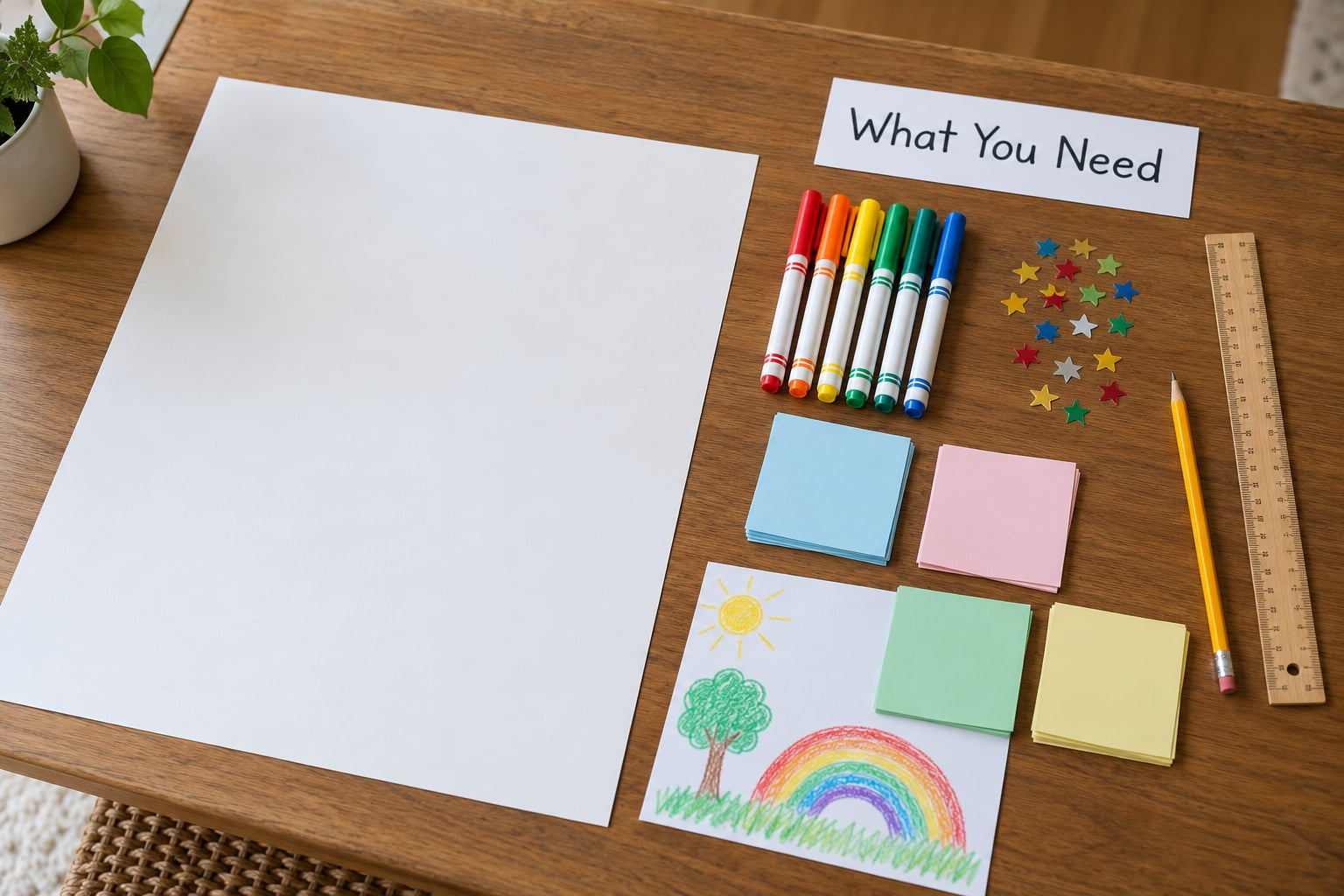
Start with what you already own. A sheet of card stock, a ruler, and a set of markers will carry you through the whole build.
Beyond that, pick based on the child rather than the project. A preschooler needs picture cards and chunky check boxes. A nine-year-old can handle a written list with a points column. A teenager mostly needs a quiet spot on the fridge and a weekly review.
Add a few optional extras only if they solve something real. Card pockets let a child flip a finished card over. A dry erase board makes mistakes cheap. A jar of small counters turns points into something they can watch fill up. Skip anything that costs more than the chore it tracks.
One tip: use a ruler and a pencil. Freehand lines on a grid chart look uneven, and kids notice.
Step-by-Step: How to Make a Chore Chart Kids Will Use
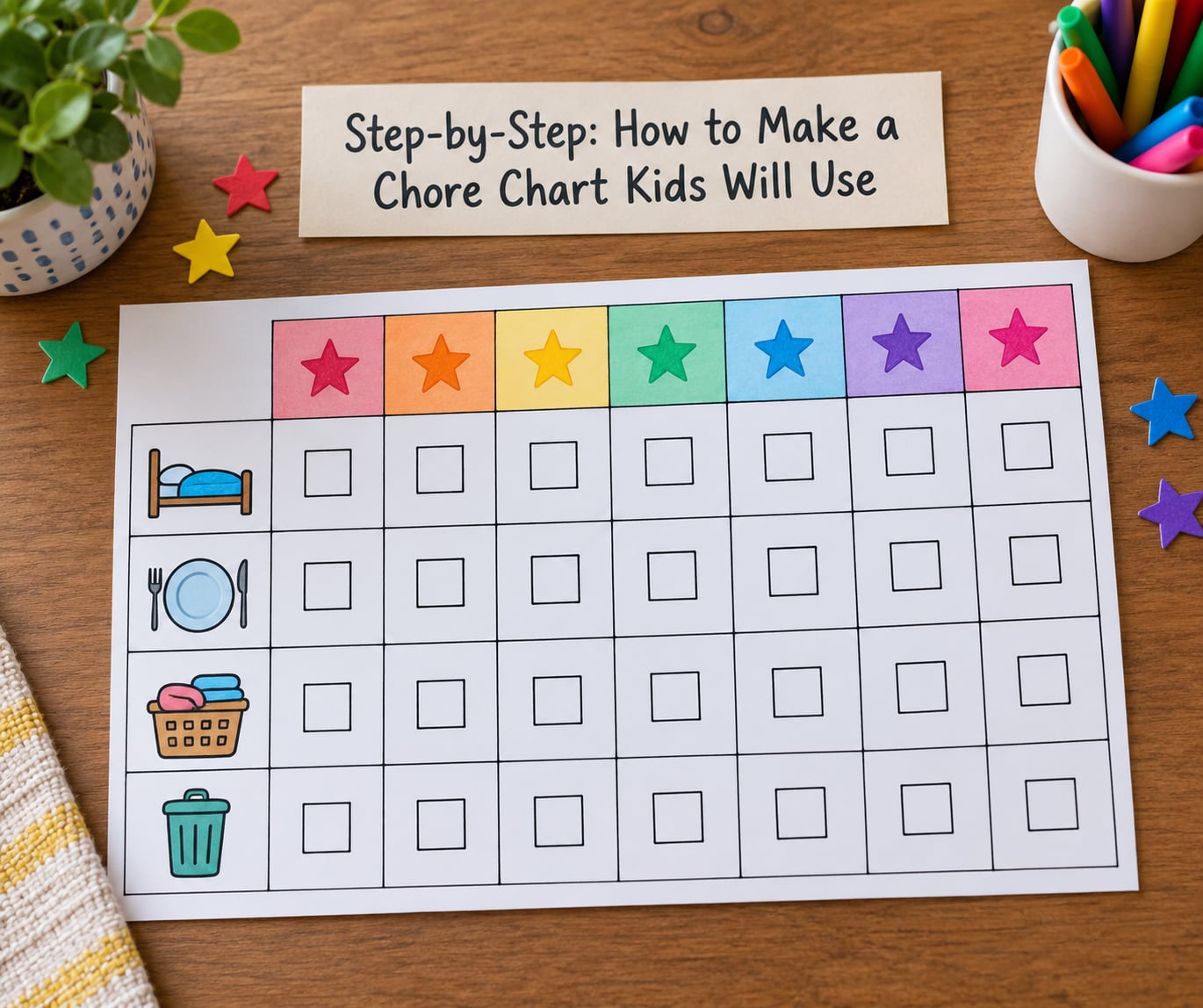
Seven steps, in this order. You will know each one worked by what your child does next, not by whether they say they like it.
Step 1: Choose a Few Chores Children Can Actually Finish
Pick two to five jobs. That is the whole list, at least for the first month. Parents routinely fill a chart with tasks their child physically cannot do alone, and the chart dies on day four.
Write down what finished actually looks like for each job, because that is where the arguing comes from. Not “tidy your room” but “all toys in the toy bin, clothes on the floor picked up.” Not “help with dishes” but “clear the table and scrape plates into the bin.”
Keep daily jobs daily and bigger ones weekly. A five-year-old can handle a bed made every morning and a bathroom wipe-down on Saturday. A twelve-year-old can take a trash-and-recycling round twice a week plus their own laundry.
You know it worked when the child can tell you, unprompted, what done means for every line.
Step 2: Let Your Child Choose Some Jobs
Offer three or four options and let them pick at least two. Ownership is the whole point, and this is the cheapest way to get it.
Keep the choice bounded. “Pick two of these four” is a decision. “Pick whatever you want” is a negotiation, and you will be having it every Sunday.
When a child picks something they find hard, keep it and shrink it. Wash the car becomes wipe down the door handles. Take out recycling becomes empty one bag.
Step 3: Pick a Format That Makes a Chore Chart Kids Will Use
Match the format to the reader. Here is what tends to work at each stage.
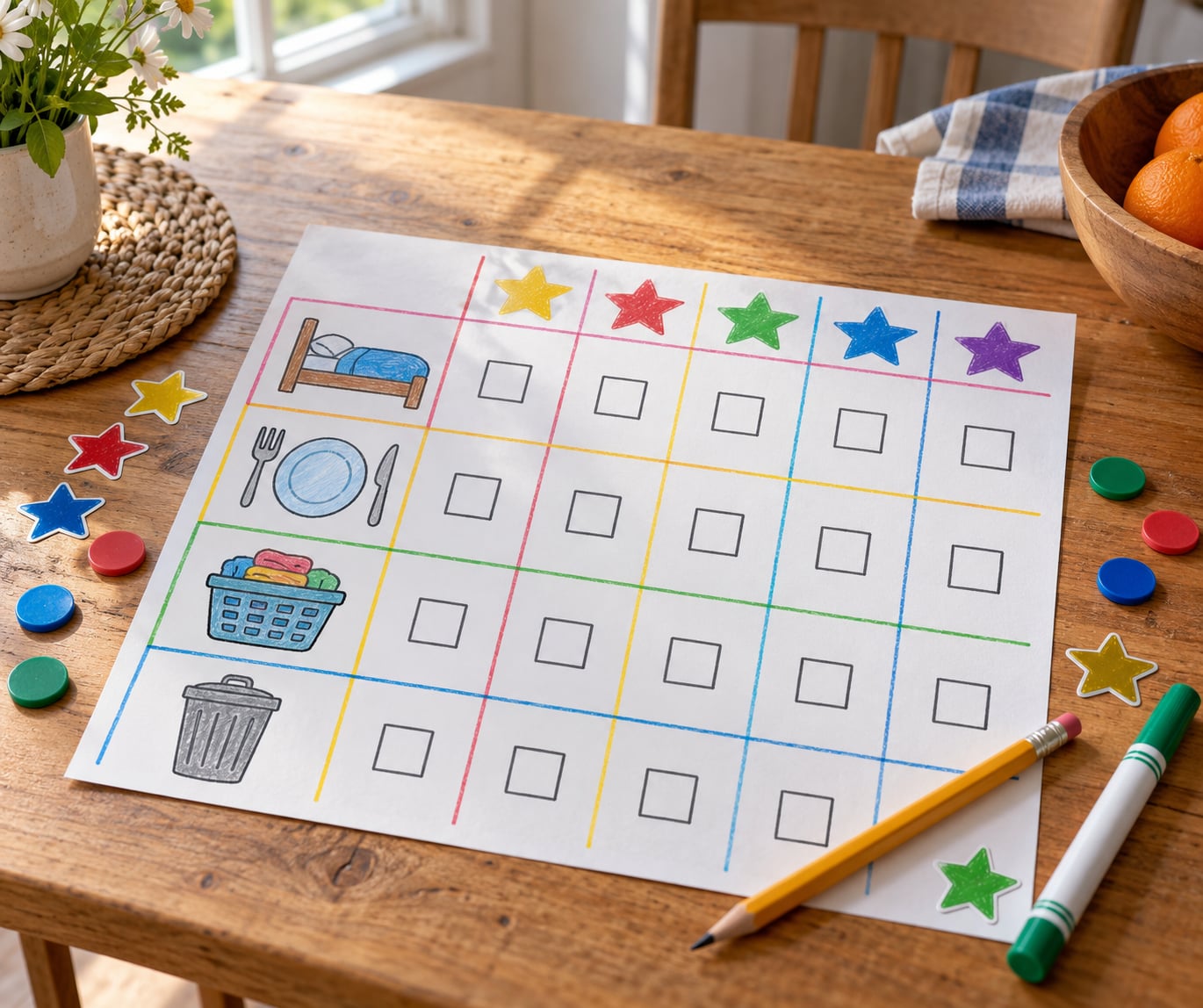
Picture cards on a pocket chart suit children who are just learning to read. A weekday grid suits school-age kids who can follow a sequence. A magnetic board suits a household that wants one reusable surface and no laminating. A written checklist on a clipboard suits tweens who think stickers are babyish. An app is useful when you are split across two homes and need shared reminders, though most families with two or three chores never need one.
Whatever you choose, the child must be the one who marks it. That is the detail parents report matters most.
Step 4: Create the Chart Together
Write or draw one chore per row. Add a small picture for younger children, a check box for everyone, and a done column on the right so the chart shows progress rather than just a list.
Keep the wording positive and short. “Feed Pepper” beats “Remember to feed the dog.” One short label per row, in big enough writing to read from across the kitchen.
Then display it where the routine already happens, not in a drawer. The kitchen door or the fridge is better than a child’s bedroom, because that is where you already stand while making dinner. Do not over-design it. A chart that takes a weekend to make is a chart that never gets adjusted.
Step 5: Add a Reward System That Is Not a Trap
Start with things you already do. Praise at the moment of completion, a later bedtime on a full row, first pick of the family movie, a special breakfast. These cost nothing and work for years.
If you use points, keep the rules boringly simple. One point per finished job. A small set of rewards posted where the chart lives, each with a point value. Your child redeems them, you deliver them. Write down the exchange so it does not become an argument about fairness.
Avoid paying cash for every small task. Parents commonly describe it as a bribe, and children start to expect money for things that should just be part of being a family member. If you already pay an allowance, tie it to the chart as a separate weekly event rather than per chore.
The reward matters less than the timing. A star tonight beats a big prize next month.
Step 6: Introduce It Without a Lecture
Try something like this: “This is our list. You helped me build it, and you mark off what you finish. When the row is full, we do something fun on Saturday. Do you want to start with the first one now?”
No threats, no long explanation about responsibility. Children tune out speeches, and the chart is meant to do the talking.
If they resist, ask what specifically feels wrong. Often it is one task or one reward, not the system. If they simply forget, that is normal for the first week. Point at the chart, do not recite it.
Step 7: Review, Adjust, and Retire Tasks
Set a five-minute review, once or twice a week. Sunday evening works well because Monday is ahead, not behind.
At the review, acknowledge what got done, then change one thing only. Too many changes at once and nothing feels different.
Retire anything that has been completed without argument for weeks, or anything your child has quietly agreed to hand over to a sibling. A chart should shrink as children get more capable. If it has not changed in a month, it is wallpaper.
Common Mistakes
Most charts fail for a handful of repeatable reasons, and each one has a straightforward fix.
Too many chores. Eight lines a day turns into avoidance by day three. Cut to three daily tasks and rotate the rest weekly.
Vague instructions. “Be helpful” cannot be checked off by anyone, least of all a four-year-old. Replace it with a specific action you could see from the sofa.
You tick the boxes. This is the big one. If the parent marks it, the child stops looking at it, and the chart becomes an adult to-do list. Let the child move a magnet, flip a card, or cross a box themselves.
Re-doing their chores. Doing the job better than they did, out loud, teaches nothing except resentment. If the standard was not met, hand it back and let them redo it.
Rewards too far away. A treat two weeks out competes with everything else in a kid’s week. Shorten the interval first, raise the value later if you need to.
Forgetting to review. Two quiet weeks is enough for a chart to die. Put the review in your own calendar, not your memory.
Using it as punishment. Adding extra chores to a missed row turns a system into a scolding. Rewards only.
Two habits keep a chart alive long term. Keep the total number of tasks under five, and let the child own the tracking as early as they can hold a marker.
Frequently Asked Questions
What age is a chore chart appropriate for?
A simple picture chart works as soon as a child can match a symbol to a task, usually around age three. Written lists suit kids who can read independently, closer to six. Tweens and teens usually ignore anything with stickers, so offer a points or privilege list instead. The age matters less than the reading level, the number of tasks, and whether the child can mark the chart alone.
How do you motivate a child to use a chore chart?
Let them help build it and let them mark it off. Children engage with systems they helped design and control, and a chart the parent ticks becomes the parent’s job. Keep tasks to three or four a day, use short labels, and place the chart where the chore happens. Novelty fades in two or three weeks for almost everyone, so plan a review before you plan a reward.
What are good rewards for chores that are not money?
Choose privileges and experiences over objects. A later bedtime, first pick of the family film, choosing dinner, staying up after everyone else, or an extra park trip costs nothing and wears out less than a toy. Praise the effort at the moment the job is done, then name the bigger reward for a full row. Keep the reward list short, posted next to the chart, so expectations stay clear.
How do you handle chores that more than one child shares?
Give the chart one row per task, not one column per child, and let names rotate through the days. Fixed assignments end in arguments, while a rotation gives everyone a turn and a reason to ask how the rest of the week went. If the two children are far apart in age, pair them deliberately: the older one supervises while the younger does the simple part, and both mark the row.
What should parents do if a chore chart stops working?
Shrink it first. Cut the list to three tasks, swap anything that produces arguments, and change the reward interval or the reward itself. A chart often fails because the child was never tracking the tasks, so build that into the next version by letting them mark their own work. If nothing shifts after two weeks, retire the chart rather than nagging, then start fresh with a different format.
Should chore chart points be connected to allowance?
You can connect them, but keep them separate. Many families find that paying for every small job feels like a bribe and leaves children expecting money for ordinary household contributions. If you already pay an allowance, tie it to a completed week or a completed row, not to individual tasks. That keeps the chart about contribution and the allowance as a separate, predictable family routine.
Conclusion
Start tonight with two or three chores your child can finish without help. Sit down, build the chart together, hang it where dinner happens, and let them tick the first box themselves.
Then check it once or twice a week, change one thing when it stalls, and shrink the list as your child grows. That is how to make a chore chart kids will use: a small clear list, a reward that arrives soon, and a child who owns the ticking.