Make-ahead breakfasts are dishes you cook, assemble, or portion ahead of time, usually on a Sunday, so weekday mornings need nothing more than a reheat, a quick topping, or a grab-and-go from the fridge. These 10 make ahead breakfast ideas for busy families turn a 25-minute morning cook into about two minutes of work, and every one below comes with a real storage window and a reheating method that survives the school-week rush.
The part most roundups leave out is what happens on Wednesday. A batch that looked great on Sunday can turn rubbery, soggy, or smell off by midweek, and then a whole family skips breakfast because nobody wants to argue with a reheated egg muffin. So each idea here lists how long it keeps refrigerated, whether it needs the freezer on day one, and how to reheat it without wrecking the texture.
A few ground rules before the list, and they are the same ones that keep working in 2026. Everything gets cooled quickly in shallow containers before the lid goes on, because warm food sealed in a box steams itself soggy. Everything gets a label with the date it was made. And eggs are reheated to 165°F (74°C), which is the USDA minimum internal temperature for reheating cooked eggs.
Table of Contents
- Make Ahead Breakfast Ideas for Busy Families at a Glance
- 1. Overnight Oats Jars
- How to Prep Make Ahead Breakfast Ideas for Busy Families
- 2. Mini Breakfast Egg Muffins
- 3. Breakfast Frittata Cups
- 4. Freezer Breakfast Burritos
- 5. Make-Ahead Breakfast Wraps
- 6. Baked Oatmeal Breakfast Bars
- 7. Freezer Pancake or Waffle Pockets
- 8. Yogurt and Fruit Parfait Cups
- 9. Freezer Smoothie Packs
- 10. One-Pan Breakfast Hash
- Frequently Asked Questions
- How far ahead can I make breakfast for a busy family?
- Which make-ahead breakfasts freeze well?
- How should I safely reheat eggs and other make-ahead breakfasts?
- What can I prepare the night before for a very early school morning?
- How can I reduce morning mess when serving make-ahead breakfasts?
- Which common allergens should I account for in make-ahead breakfasts?
- Start With One Breakfast
Make Ahead Breakfast Ideas for Busy Families at a Glance
This table answers the practical question first: which of these can survive a full Monday-to-Friday week, and which need the freezer on day one.
| Breakfast | Active prep | Make-ahead method | Storage | Reheating | Best use on a busy morning |
|---|---|---|---|---|---|
| Overnight oats jars | 10 min | Mix and chill, add mix-ins later | 4 days fridge | None, served cold | Cold grab-and-go, eaten in the car |
| Egg muffins | 15 min | Bake a full muffin tin | 4 days fridge, 2 months freezer | Microwave 30-45 sec | Warm breakfast in under 3 minutes |
| Frittata cups | 15 min | Bake in a muffin tin, cool fully | 4 days fridge, 3 months freezer | Microwave or toaster oven | Protein-heavy start for hungry kids |
| Freezer burritos | 25 min | Assemble, flash-freeze, bag | Freeze on day one | Thaw in fridge, then microwave | Breakfast for a large crowd |
| Breakfast wraps | 20 min | Roll, chill, or freeze | 4 days fridge, 2 months freezer | Optional, works cold | Two-handed breakfast for the car |
| Baked oatmeal bars | 10 min | Bake a pan, cool before cutting | 5 days fridge, 3 months freezer | Toaster oven or microwave | One-handed eating, no utensils |
| Pancake pockets | 20 min | Cook plain, fill, freeze flat | Freeze on day one | Direct from frozen | Breakfast kids think is a treat |
| Yogurt parfait cups | 10 min | Layer wet and dry separately | 2 days fridge | None, served cold | No-cook mornings, 2 minute assembly |
| Smoothie packs | 10 min | Portion fruit into freezer bags | 1 month freezer or longer | Blend with liquid | Kids can assemble their own |
| One-pan hash | 15 min | Cook one pan, divide into portions | 4 days fridge, 2 months freezer | Skillet or microwave | Use up leftover roast potatoes |
1. Overnight Oats Jars
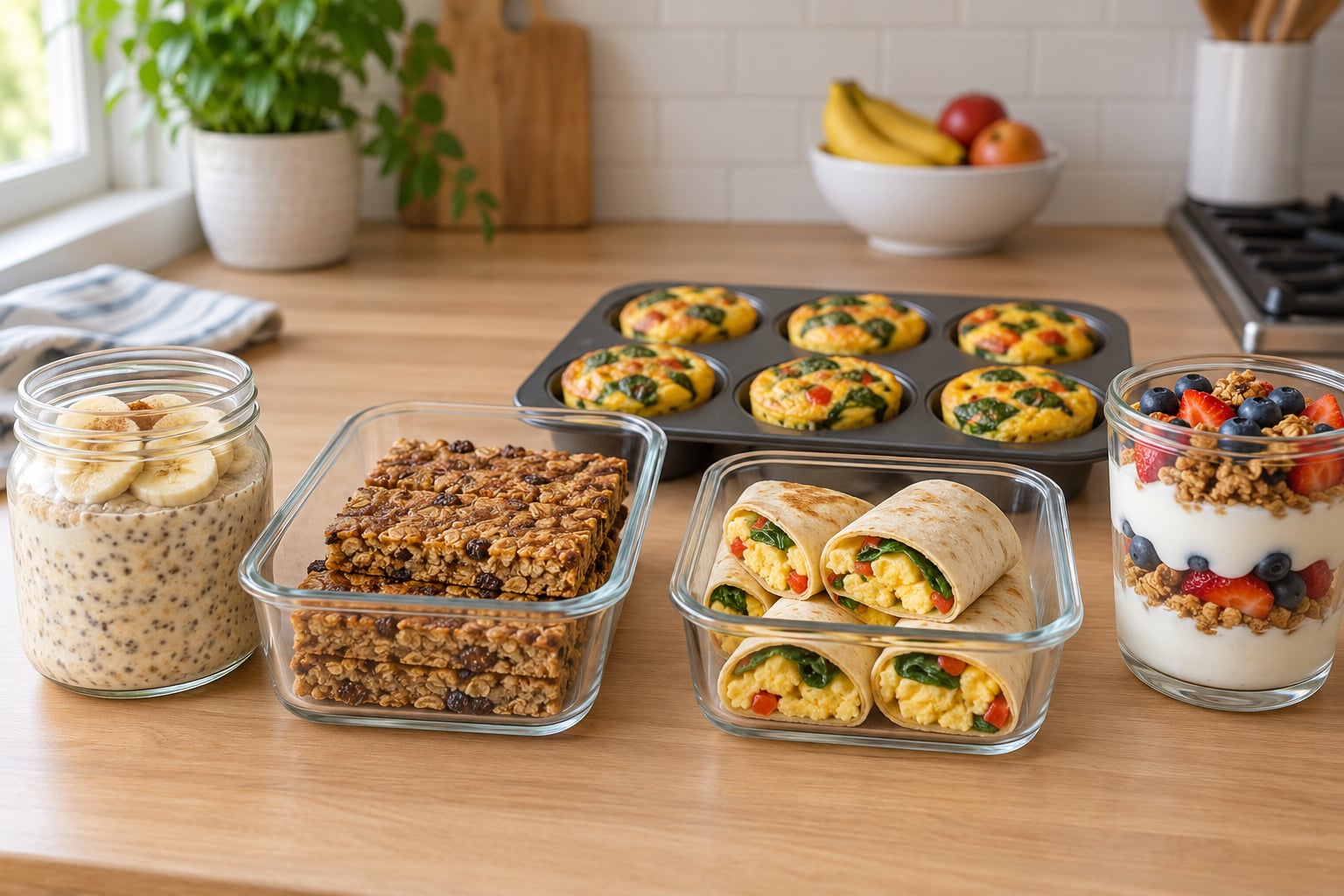
Overnight oats are the easiest make-ahead breakfast on this list because there is no cooking at all, and the jar can be built five at a time in about ten minutes. Combine equal parts rolled oats and milk in each jar, add a spoonful of yogurt for protein and thickness, stir in a sweetener, and refrigerate. The oats soften overnight and are ready to eat cold straight from the jar.
Keep mix-ins out of the jar. Bananas go brown and berries release juice into the oats, so slice the banana or stir in the berries in the morning. For a kid-friendly peanut butter and banana version, mix 1/2 cup oats with 1/2 cup milk, 2 tablespoons peanut butter, and a splash of vanilla, then top with banana coins at serving time.
Assembled jars keep about 4 days refrigerated in a sealed container. Most homes eat them within 2 days because the texture is best early, so make two jars Sunday and two more on a Wednesday evening for the back half of the week.
A note for nut allergies: sunflower seed butter swaps in at the same thickness and keeps the jar nut-free for school.
How to Prep Make Ahead Breakfast Ideas for Busy Families
Sunday batching is what turns these ideas into a system, and it takes about 90 minutes for a full week. Here is the workflow I use.
- Cool everything uncovered. Set portions on the counter in shallow containers, then refrigerate once they stop steaming. Food sealed while warm goes soggy faster than food that stays uncovered for 20 minutes.
- Label with the date and the weekday it is for. A label reading “Tuesday” beats a date when you are standing at the fridge at 6:50 a.m.
- Follow the two-hour rule. Cooked food should not sit out longer than two hours, and no more than one hour in a hot kitchen. That means burritos and hash get refrigerated the same afternoon you cook them.
- Freeze on day one anything egg-based. Egg muffins, frittata cups, burritos, and hash are the items that fade fastest in the fridge. Move the Wednesday and Thursday portions to the freezer as soon as they cool.
- Portion by what people will actually eat. One jar for a toddler, two for a hungry teenager. A single big container invites someone to eat half the batch standing at the counter.
- Separate the mix-ins. Nuts, fruit, granola, and sauces go in small lidded cups so nothing gets soggy and nothing is wasted.
- Stack the freezer flat and stand the fridge upright. Burritos and wraps freeze best in a single layer, then get bagged once solid.
2. Mini Breakfast Egg Muffins
Egg muffins are the workhorse of breakfast meal prep because one 12-cup tin becomes twelve portable portions, and kids eat them like little savory cupcakes. The method is simple: crack 8 to 10 eggs into a bowl, whisk with a splash of milk, salt, and pepper, then pour into a greased muffin tin about two-thirds full and add your fillings before the eggs set.
Good fillings for children include grated cheddar, diced bell pepper, spinach, chopped scallions, and small cubes of potato. Skip raw onion if anyone is sensitive, since it sharpens as it sits for four days. You can also separate the whites and yolks and make half the batch with no yolk at all, which helps households avoiding cholesterol-heavy mornings.
Portion for children by cutting one large muffin in half, which also makes the batch stretch further. Freeze on day one if you are covering the back half of the week.
They also work at room temperature for the first couple of hours, which makes them a good choice for a guest breakfast or a sleepover morning where nobody wants to turn on an oven.
Reheat in the microwave for 30 to 45 seconds, stopping to check, until the center reaches 165°F (74°C). If reheating from frozen, run 20 extra seconds first, or use a damp paper towel over the top to keep the surface from turning rubbery. Egg muffins keep 4 days refrigerated and up to 2 months frozen in an airtight container.
3. Breakfast Frittata Cups
Frittata cups are what you make when you want a breakfast that feels like a real meal. The difference from egg muffins is the base: a small amount of cooked potato and onion goes in the cup first, then the egg mixture on top, then cheese. Potatoes are the reason these are filling, and they are the reason a frittata cup can carry a kid through to lunch.
Start with about 1/4 cup of diced cooked potato and a teaspoon of cooked onion per cup, pour over the eggs, and bake at 350°F (175°C) for 20 to 25 minutes. A little spinach or chopped broccoli folded into the eggs adds vegetables without a separate step.
Cooling matters more here than with any other egg dish. Frittata cups are dense, and a cup that goes straight from the oven into a sealed box will be wet and heavy by Tuesday. Cool them on a rack for 20 minutes, then refrigerate uncovered for the first hour.
They keep 4 days refrigerated and 3 months frozen. Reheat in the microwave until the center hits 165°F (74°C), or run them in a toaster oven at 350°F (175°C) for 8 to 10 minutes, which dries the surface slightly and makes them taste less like a reheated leftover.
4. Freezer Breakfast Burritos
Freezer breakfast burritos are the answer to feeding a large crowd on a school morning, and the most reliable way to feed a family of five without standing at a stove. The assembly is short: warm a flour tortilla, fill with scrambled eggs, a protein, some cheese, and a vegetable, then roll tightly.
Two fillings work well for most families. The classic is scrambled eggs with cheddar, black beans, and diced bell pepper, which is cheap and vegetarian. The heartier version is eggs plus cooked breakfast meat or turkey and a slice of cheese, which needs the egg mixture and the meat to reach safe temperatures during cooking: eggs to 160°F (71°C) or above for a well-set scramble, poultry to 165°F (74°C), and whole cuts or fish to 145°F (63°C) as USDA guidance specifies.
Scale for a crowd by assembling the filling in one big bowl and letting everyone build their own, then rolling on the counter together. Twelve to fifteen burritos covers four to five people across two breakfasts, and rolling with the kids turns the prep into something they look forward to on Sunday evening.
Flash-freezing is the step people skip and then wonder why their burritos crack. Lay the finished burritos in a single layer on a baking sheet, freeze until solid about an hour, then move them to a freezer bag or container. They keep 2 to 3 months frozen.
Plan the thaw, not just the reheat. Move burritos from the freezer to the fridge the night before, then microwave 60 to 90 seconds, turning once, until steaming hot throughout. Reheating straight from frozen leaves cold spots in the middle, and that is where the rubbery-egg complaint usually comes from.
5. Make-Ahead Breakfast Wraps
Wraps differ from burritos in one important way: they are eaten cold or barely warmed, often in a car. That makes them the best pick for mornings where one adult has 12 minutes and the bus is already outside.
For a vegetarian version, spread a flour tortilla with hummus, add sliced cucumber, baby spinach, and a little feta, then roll. For a meat-and-cheese version, use cream cheese or mayo as the spread, then turkey, cheddar, and a thin slice of apple. Both roll tightly, hold their shape, and travel well in a sheet pan or a container lined with parchment.
Chill the finished wraps seam-side down on a plate in the fridge for 20 minutes before moving them to airtight containers, which sets them so they do not unroll in the lunch bag. They keep 4 days refrigerated and 2 months frozen in a freezer bag with parchment between the layers.
Most kids will happily eat one cold straight from the wrap. To warm it, microwave for 20 seconds, or use a dry skillet for 2 minutes per side if you want the tortilla crisp. Fillings with eggs should still be reheated to 165°F (74°C) if you cooked them in advance.
6. Baked Oatmeal Breakfast Bars
Baked oatmeal is the answer for families who want something that travels without a fork and survives being dropped in a backpack. It is a one-bowl batter of rolled oats, milk, eggs, a little oil or melted butter, and a sweetener, poured into a lined 9 by 13 inch pan and baked at 350°F (175°C) for about 30 minutes.
Customizations are simple. Mashed banana and cinnamon make it taste like a banana bread bar, applesauce keeps it moist with no added sugar, chocolate chips make it feel like a treat, and any nut butter swirled into the batter adds protein and holds attention with picky eaters. Berries get folded in during the last five minutes so they do not bleed through the bars.
The one rule is cooling before cutting. Bars cut while warm crumble into uneven chunks, and the cut surface dries out faster in the fridge. Let the pan cool on a rack for at least 30 minutes, then cut into 12 bars.
Kept airtight, they hold 5 days refrigerated, which makes them the longest-lived baked item on this list, and 3 months frozen. Warm a bar in the toaster oven at 350°F (175°C) for 5 minutes, or microwave 15 to 20 seconds. For a gluten-free swap, use certified gluten-free oats and a gluten-free baking mix; the texture is closer to a granola bar than a cake, which is fine.
7. Freezer Pancake or Waffle Pockets
Pancake and waffle pockets exist for one reason: the real problem with cold weekday pancakes is that they are dry, and filling them solves it. Cook plain pancakes or waffles on a Sunday, let them cool completely, spread filling between two, and press the edges with a fork or a little batter to seal.
Two fillings worth trying. Berry yogurt combines 2 tablespoons of yogurt with a spoonful of mashed berries, which stays tangy after freezing. Banana cinnamon is mashed banana with a pinch of cinnamon, which is sweeter and cheaper. Both hold their shape better than jam, which leaks and makes the pocket soggy in a day.
Freeze the finished pockets flat in a single layer, then stand them upright in a freezer bag once hard. They keep 2 months frozen, and in my experience the texture is noticeably better than the same pancakes refrigerated for a week.
Reheat straight from frozen in the microwave for 30 to 40 seconds, or in a toaster oven at 350°F (175°C) for 6 to 8 minutes until the edges crackle. From the fridge, halve the time. A thin drizzle of maple at the table is worth more than anything you could bake into the pocket before freezing.
8. Yogurt and Fruit Parfait Cups
Parfait cups take ten minutes and require no heat, which makes them the right choice for the week when you are already stretched. The single most useful thing to know is layer order: wet ingredients at the bottom, dry crunchy things on top.
Start with yogurt, add fruit, then granola last, and cover with a tight lid. Granola sitting against wet fruit overnight turns to paste, and by Tuesday the whole cup is a disappointment. If you want granola, pack it in a separate little cup and tip it in at the table, which takes four seconds.
Two kid-friendly builds: plain vanilla yogurt with sliced strawberries, granola, and a small spoon of honey; or Greek yogurt with banana coins, a spoon of peanut butter, and a cinnamon oat topping. Both are around 15 grams of protein per cup if you use Greek yogurt, which helps with the mid-morning hunger crash.
Assembled cups keep only 2 days refrigerated, so make them Monday and Wednesday rather than all at once. A shortcut that stretches this to four days is to add the fruit in the morning instead. Transport is the other issue: a tall jar leaks, so wide cups with snap lids go in the bag upright in a container with a towel underneath.
9. Freezer Smoothie Packs
Smoothie packs are the best make-ahead breakfast for a family with older kids, because the morning assembly is theirs. You do the portioning once, and each person picks a bag, dumps it in the blender with liquid, and presses one button.
To build a pack, chop fruit into blender-sized pieces, measure it into a labeled freezer bag, and press out the air before sealing. Two combinations that work for children: banana, strawberry, and yogurt with milk; and mango, peach, and a handful of spinach that disappears into the sweetness.
Smoothie packs keep 1 month in the freezer and honestly improve slightly in the first week, because the fruit freezes into a softer texture that blends faster. For a small child, move the bag to the fridge for 20 to 30 minutes to soften it, or add room-temperature milk first so it blends without ice chips.
Check allergens carefully here, because this is where hidden ones hide out. Smoothie packs commonly contain dairy, and any nut butter added to a pack must be declared if the smoothie travels to school. To make a pack dairy-free, use a plant milk and coconut yogurt, and check that the granola or protein powder is nut-free if the school is nut-free.
10. One-Pan Breakfast Hash
Breakfast hash is the idea to save for the night you have leftovers. Cook diced potatoes in a skillet, push them to the edges, crack eggs into the middle, and add chopped vegetables and any cooked breakfast meat you have around. One pan, one clean-up, and a genuine plate of breakfast rather than a pastry on the move.
For a family of five, use a large skillet or a sheet pan. Cook the potatoes until they brown, about 10 to 12 minutes, then add the eggs and vegetables. Keep the meat and the eggs at safe minimum internal temperatures: eggs cooked until the whites and yolks are firm, poultry to 165°F (74°C), ground meat to 160°F (71°C), and whole cuts or fish to 145°F (63°C).
One adjustment saves cleanup: wipe the skillet with a paper towel and put the hash straight into containers rather than serving it and then scraping a fried pan at 9 p.m. Portion it while the pan is still warm, and the potatoes stay separate.
Divide into single-serving containers once the skillet is off the heat and the food has stopped steaming, then refrigerate uncovered before lidding. A hash that is sealed hot will release water into the container and turn the potatoes soft. Cool it fast in shallow portions, not one deep bowl.
The hash keeps 4 days refrigerated and 2 months frozen. Reheat a portion in a dry skillet for 4 to 5 minutes over medium heat to re-crisp the potatoes, or microwave 60 to 90 seconds until the eggs reach 165°F (74°C). The skillet method is worth the extra two minutes.
Frequently Asked Questions
How far ahead can I make breakfast for a busy family?
Most make-ahead breakfasts keep 3 to 5 days refrigerated, so cooking on Sunday covers a full Monday-to-Friday week. Anything with cooked eggs should be frozen on day one and thawed overnight, because refrigerated egg dishes fade fastest. Non-egg breads, bars, and overnight oats keep longest, while assembled parfait cups last only 2 days and are better made fresh on Wednesday.
Which make-ahead breakfasts freeze well?
Freeze well: egg muffins, frittata cups, breakfast burritos, make-ahead wraps, baked oatmeal bars, pancake and waffle pockets, and one-pan hash. These hold 2 to 3 months frozen. Do not freeze overnight oats in milk, yogurt parfait cups, or any breakfast with fresh fruit baked into it, since all three turn watery or mushy after thawing. Cool everything fully before it goes in the freezer.
How should I safely reheat eggs and other make-ahead breakfasts?
Reheat cooked eggs until the center reaches 165°F (74°C), which is the USDA minimum internal temperature, and check the middle of a muffin or burrito rather than the edge. Microwave in 30-second bursts so you can stop before the edges turn rubbery. Reheating a large pan of food at once gives you hot spots and cold spots, so reheat in single portions, and let food sit for one minute after heating.
What can I prepare the night before for a very early school morning?
For a before-6:30 a.m. start, nothing that needs a stove or microwave. Build overnight oats jars, pack yogurt with fruit in a sealed cup with granola on the side, or set a freezer smoothie pack with a note telling the kids to add milk and blend. You can also move a frittata cup or hash portion from the fridge to the counter the night before so it is not ice cold at 6 a.m.
How can I reduce morning mess when serving make-ahead breakfasts?
Most make-ahead mess happens in the morning because hot food and open containers are involved. Serve items that are meant cold, such as overnight oats and parfaits, straight from the container onto a plate or straight into a bowl. Reheat the hot items on paper towels, not plates, and let each person add their own toppings from small lidded cups so there is no pile of wet granola to scrape off a dish.
Which common allergens should I account for in make-ahead breakfasts?
The usual suspects are milk, wheat, eggs, peanuts or tree nuts, and soy. A single batch often hits several at once, so make the base recipe flexible: swap dairy milk for a plant milk, use certified gluten-free oats and a gluten-free baking mix for wheat, and use sunflower seed butter in place of peanut butter for a nut-free jar. Check granola and protein powders, which are the most common hidden nut source in a batch.
Start With One Breakfast
Do not prep ten breakfasts in your first attempt. Pick the one your family will genuinely eat, cook one batch, and label it. Egg muffins and baked oatmeal bars are the easiest first two, because both are forgiving, both freeze, and both are eaten without complaint by most kids.
Then run it for one week with two rules: cool everything uncovered, and freeze the Wednesday and Thursday portions as soon as they are cool. By Friday you will know whether your family prefers hot breakfasts or cold grab-and-go options, and the second week of make ahead breakfast ideas for busy families is much faster than the first. A quieter system of three breakfasts you actually eat beats ten nobody finishes.
All storage times and safe internal temperatures here follow USDA guidance for cooked eggs, poultry, ground meat, whole cuts, and fish, so keep a meat thermometer in the Sunday basket and check the middle of a portion rather than the edge.