The best way to declutter kids toys with them is to sort them together in one short session: spread the toys out, set up keep, relocate, donate, and discard, then let your child make most of the calls while you handle cleaning and the donation errand. One category at a time, 20 to 30 minutes, no pressure.
Most parents who dread this job are not dreading the toys. They are dreading the negotiation. A four-year-old holding a chewed plastic horse will argue for its retirement the way a lawyer argues a case, and you will lose because you have somewhere else to be.
So the shift is small but it changes everything: the child becomes the sorter, not the victim. Sorting is a decision-making job, and most children find decisions far less objectionable when they are the one making them. You still hold the veto, especially on safety, but the default flips from you taking things away to them choosing what goes.
One more thing worth saying up front. Do not clean the whole room first. That is the single most reliable way to spend three hours tidying and still find a pile of toys at the end of it, because the sorting is the work that matters and tidying is only the staging.
Table of Contents
- What You Need
- How to Declutter Kids Toys With Them: Step-by-Step
- 1. Start Small When You Declutter Kids Toys With Them
- 2. Set Up Four Simple Decision Categories
- 3. Clean and Inspect Toys as You Go
- 4. Let Your Child Make the Decisions
- 5. Give Away, Store, and Put Everything Away
- 6. Finish With a Five-Minute Reset Habit
- Common Mistakes
- Frequently Asked Questions
- How old should a child be to help declutter toys?
- What if my child refuses to get rid of anything?
- Should I declutter the entire playroom in one day?
- How do I keep donated toys from returning to the playroom?
- What categories of toys should parents remove for safety reasons?
- How often should we reset the toy room?
What You Need
You need less than you think, and all of it is probably already in a closet somewhere in your house.
- A small sorting surface. A blanket, a sheet, or one cleared shelf. Sorting surface area matters more than total floor space, because everything needs to be visible at once.
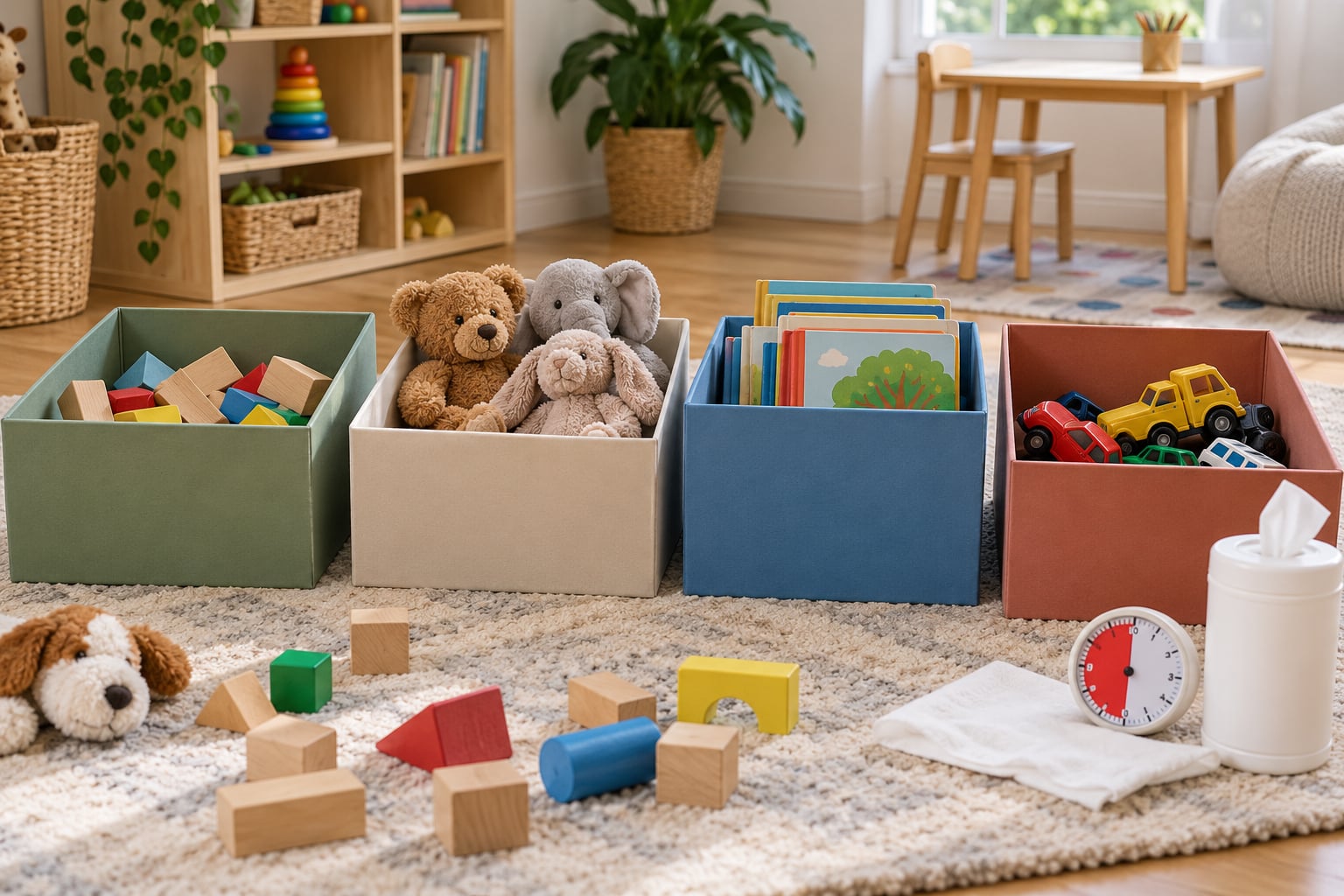
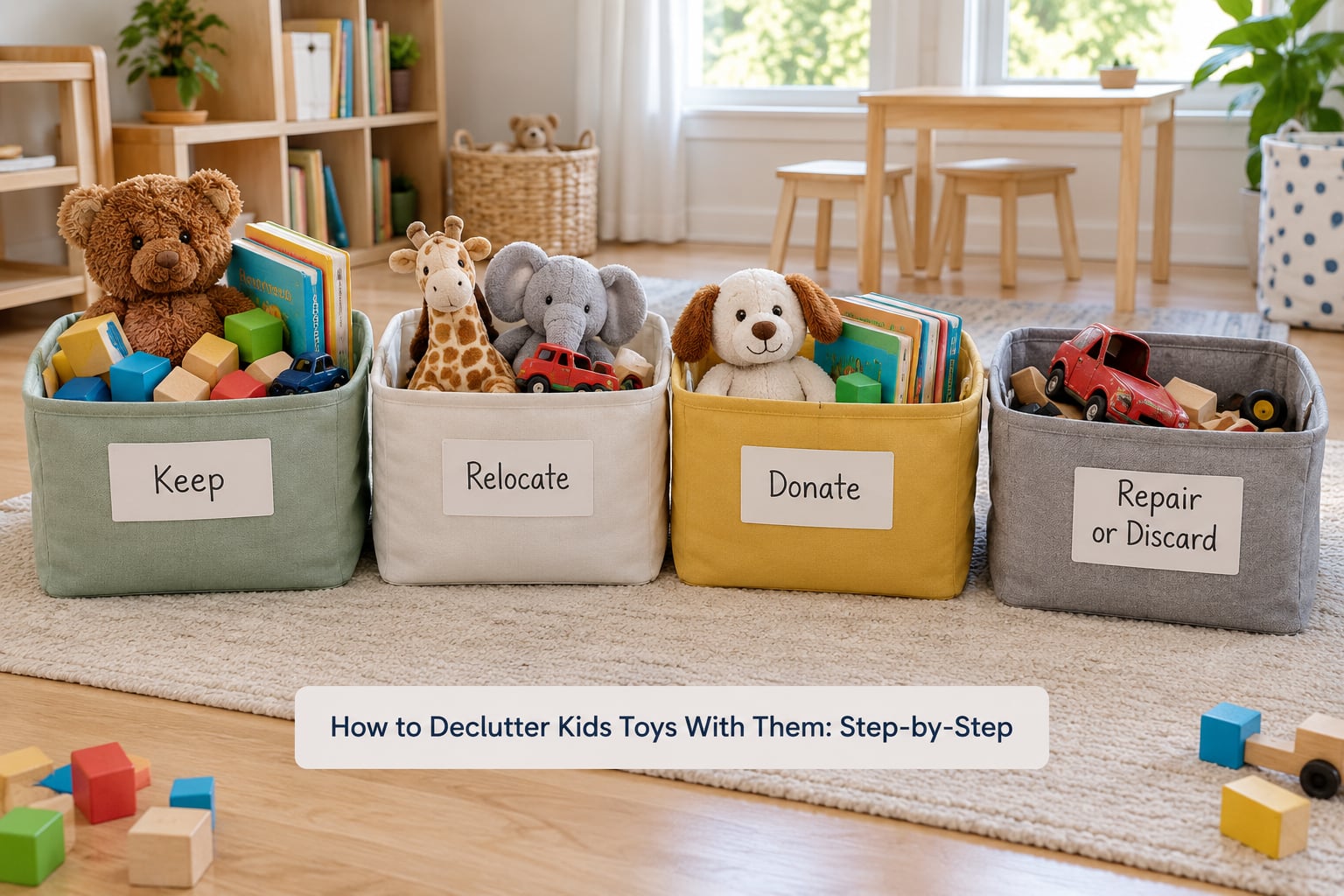
- Four labeled categories. Keep, relocate, donate, and repair or discard. Labels can be index cards taped to laundry baskets, or painter’s tape and a marker on plain boxes.
- Bags or bins for the donation pile. A canvas bag works fine. The point is that it is a container that can physically move out of the house.
- Cleaning supplies. Disinfecting wipes or a damp cloth for the toys that are staying.
- A discard plan. Know your local rules for broken plastic, electronics with batteries, and anything recalled before you fill a bag.
- A timer or a hard time limit. A phone timer set to 25 minutes does more than willpower does.
One honest note about the cleaning supplies. Adults handle the wipes, and you read the label. Disinfecting toys with a wet wipe is fine for surfaces a child touches often, but anything a child mouths is a different question, so check the product directions and skip anything you would not want a toddler mouthing. If a toy cannot be cleaned well enough for a younger sibling, that is a reason to give it away.
How to Declutter Kids Toys With Them: Step-by-Step
Here is the short version before the detail: pick one category, not the whole room. Set a 25-minute timer, label four containers, and hand your child the decisions. You clean, inspect, and drive the donation bag somewhere.
1. Start Small When You Declutter Kids Toys With Them
Pick one toy category or one section of the room, not the whole playroom. Dress-up, cars, or the bin that lives under the stairs all work. Twenty to 30 minutes is the honest window for a young child.
Tell your child the start time and the end time before you begin, and keep the promise. Ending while everyone is still having fun is the difference between a routine and a weekly battle. A short session you repeat three times beats one heroic afternoon nobody survives twice.
Set age-appropriate expectations. A three-year-old will last about a third as long as a nine-year-old, so the toddler’s session might be a single basket of soft toys. Watch for the point where your child starts picking up the same toy repeatedly and putting it back without deciding anything. That is your cue to stop and call it a win.
2. Set Up Four Simple Decision Categories
Four categories work better than three, because discard needs its own home so it does not become a dumping ground for things you are only tired of.
Keep means it lives in one of the play areas. Relocate means it moves to another room, like a spare set of blocks going to a grandparent’s house or the attic. Donate means it goes in the bag and leaves. Repair or discard covers the broken battery toys, the puzzles missing three pieces, and anything a younger child could not safely use.
Label the containers in a way your child can read without help. For pre-readers, tape a photo of a few representative toys to the front of each one. A picture of blocks on the box gets a two-year-old sorting accurately, which is faster than describing it.
Make one rule explicit before you start: nothing sentimental is up for a vote without your child’s input. A named love toy, a gift from someone who has died, a thing they made themselves. Those go in a small keepsake box, not the donation bag, and telling the child that up front takes the sting out of everything else.
3. Clean and Inspect Toys as You Go
Wipe as you sort, not after. A toy that gets a wipe and a fresh inspection as it passes through your hands is clean and checked in the same five seconds.
The inspection matters more than the cleaning. Look for cracked plastic, sharp edges, peeling paint, exposed batteries, or stuffing leaking from a seam. Any of those goes to repair or discard. Not donation. A chipped plastic truck and a dead-battery remote are trash, and putting them in the donation bag is how a donation pile quietly turns into overflow storage.
Adults do the wiping and the inspecting. Children as young as three can help by holding the cloth and rubbing the top of a clean toy, which keeps them involved without handing them a cleaning product. Older children can check for missing puzzle pieces and game pieces and put those in a separate lost-and-found basket rather than a trash bag.
If a toy has been played with heavily and you cannot get it properly clean, treat that as a give-away signal rather than a scrubbing project. Nobody wants to receive a stranger’s grubby plush, and your child will not miss it as much as you expect.
4. Let Your Child Make the Decisions
Give your child three questions and let them answer them out loud. When did you last play with this? Where does this belong? Would you choose it again if you could?
That last question is the workhorse. A child rarely wants to admit they stopped loving a toy, so asking about the choice rather than the feeling gets an honest answer more often than asking whether they still like it.
Match your language to their age. With a toddler, keep it to one sentence: this goes to a home where nobody has toys, or that toy stays here. With a preschooler, use two: you pick things you have not played with in a long time, and they go to kids who do not have them yet. With a school-age child, get specific. Sort the toy cars, then ask which ones earned their place this month. With a tween, let them run the whole session with you as the person who handles the donation bag.
For a child who is overwhelmed, melt-prone, or neurodivergent, cut the categories from four to one. Just the donation bag. A child who cannot sort can still choose three things to give away, and three choices is a decision they can actually make. Autism-parenting communities consistently advise against abruptly removing a comfort object and replacing it with nothing, so if a specific toy is a genuine comfort item, it stays, and you find other toys to give instead.
Expect the objection. I love it is not a reason to keep a toy, it is a feeling, and you can honor both by saying I know you love it, and it is too loved, and somebody who does not have it can play with it too. Parents on decluttering forums say that framing, sharing the love, ends more arguments than any rule about how many toys are allowed.
5. Give Away, Store, and Put Everything Away
The purge is not finished when the bag is full. It is finished when the bag leaves the house, and that is where most cleanouts quietly fail. A donation bag that sits in the hallway for six weeks is a bag of toys you will unpack back into the playroom.
Give the bag a deadline and an errand. Put it in the car and take it the next time you drive past a donation center, a toy bank, a shelter, or a consignment shop. Many communities run toy drives at schools in December and in late summer, and those two dates are the easiest way to get a bag out the door without planning anything.
A local Buy Nothing or Buy Nothing Neighborhood group is another reliable option, because someone is always asking for exactly what your child is outgrowing. If your child is old enough to understand, let them hand the bag over themselves. Watching a stranger take a toy your child chose to give away does more for their understanding of generosity than any conversation does.
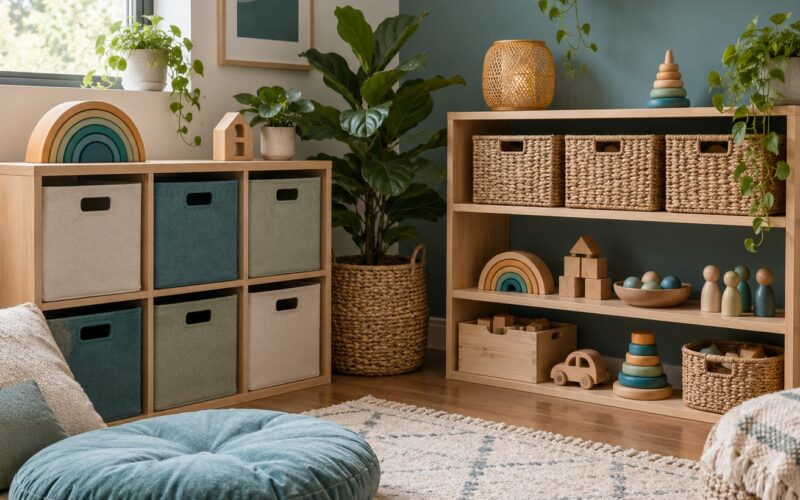
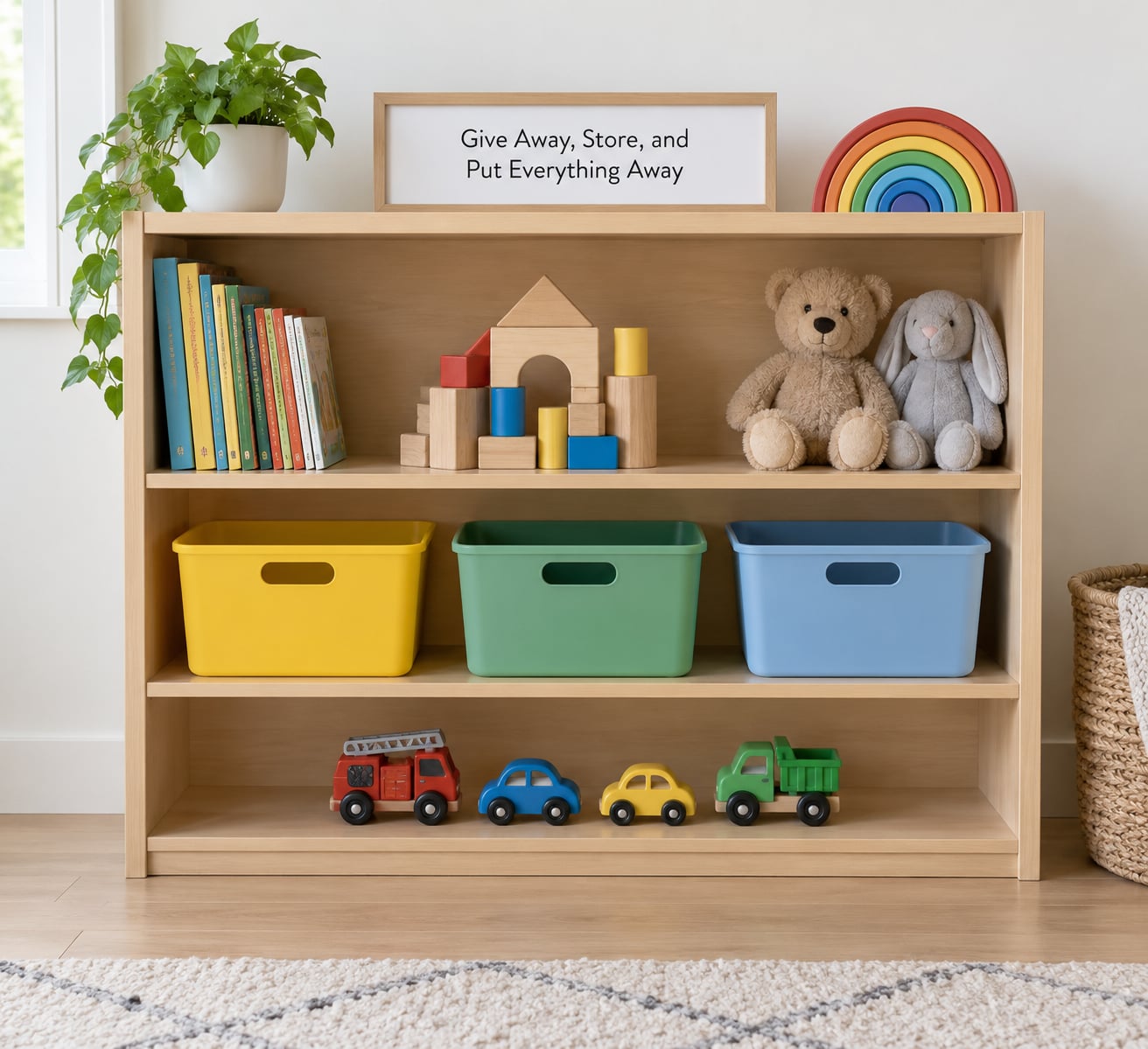
Then put the keepers away in a deliberately limited number of homes. One bin per toy type, one shelf per child, and a shallow container your child can see into and reach without a stool. Open-ended toys like blocks, dolls, and cars earn about three-quarters of the space. Closed toys that tell the child what to do, puzzles, board games, and specific kits earn about a quarter. That ratio is a rule of thumb, not a law, but the direction of it is right.
Keep the rest on a rotation, in a lidded bin on a high shelf or under a bed. Rotating a basket of toys out of sight and a different one back in every few weeks is the single most effective habit here. Parents on decluttering forums report that a child given only five to ten toys at a time plays more deeply, not less.
Put the rest of the relocation pile where it actually belongs, which is sometimes not the playroom. A second set of blocks does not need a second shelf in a small apartment; it needs to go to a grandparent, a waiting room, or a cousin.
6. Finish With a Five-Minute Reset Habit
Sessions fail when the only plan is a big one. Five minutes at the end of play, or five minutes every evening, does more than an hour a month.
Give every toy exactly one home and no exceptions. When a child asks where the blue truck goes, the answer is the car bin, even if the car bin is on the other side of the room. Toys with more than one home end up in none of them, and that is the mechanism behind most of the dumping-bin behavior parents ask about.
Pick one cleanup song, roughly five minutes long, and use the same one every time. A predictable signal works better than a countdown for most children, and for a child who dumps toys on purpose to get a reaction, a song removes the negotiation from the moment entirely.
Then check the floor at the end: is it clear enough for the next activity to start? That is the whole test. If a wooden track or the train set is on the floor, that is what the next thing needs, not a sign you failed.
Common Mistakes
Cleaning the entire house first. You will spend the afternoon on surfaces and finish with the toys still unsorted. Clean toys as you sort them and ignore the rest of the room until later.
Sorting everything in one session. The pile looks enormous at the start, which is exactly why it feels impossible. One category per sitting, repeated weekly, beats a single weekend that ends in tears.
Making your child keep every toy. Then the exercise teaches nothing, because nothing was decided. Let a real number of toys go, and let the child experience the choosing.
Rescuing the donation bag. When it feels too small, or a well-meaning visitor says that truck is nice, add toys back and you have taught your child that the purge was reversible. Bag it, date it, and do not reopen it.
Donating broken or unsafe toys. Chipped plastic, cracked paint, exposed batteries, and plush toys you cannot get clean belong in the trash. Someone else’s family should not receive them.
Arguing about the schedule. Set a date, tell your child the day before, and then keep it. A routine that can be delayed indefinitely will be delayed indefinitely.
Buying replacements before the reset is complete. New containers to solve an overflow problem is recluttering, and it is how a playroom gets two more years of the same mess. Give the new setup a month of use first. If the toys do not fit after that, more go out.
Two maintenance rules do most of the long-term work. First, one in, one out: a new toy only comes in when something leaves, which is the only intake rule that reliably holds. Second, run a short reset at the natural breaks, right after the holidays, at the end of the school year, and before a birthday. The post-holiday one matters most, because that is when the volume of incoming toys peaks.
Frequently Asked Questions
How old should a child be to help declutter toys?
A three-year-old can help in a small way by choosing between two containers. A preschooler can sort a single basket into keep and donate. From about age six, a child can run a whole category on their own. Under three, skip the sorting and just make the clean-up part of daily play.
What if my child refuses to get rid of anything?
Stop trying to get rid of things and start with give-away only. Ask the child to pick three toys for kids who do not have any. Then put the decision away for a week. Often the toys nobody wanted that week become obvious, and you can donate them without another conversation.
Should I declutter the entire playroom in one day?
No, and this is where most cleanouts fail. Do one category or one section per sitting, twenty to thirty minutes at a time, and repeat weekly until it is done. A long session usually ends with a tired child, a frustrated parent, and a pile that still has to be sorted.
How do I keep donated toys from returning to the playroom?
Make the donation pile physically leave. Bag it, put it in the car, and drop it at a donation center or toy bank on your next drive. A bag that stays in the hallway is not donated, it is postponed, and postponed piles get unpacked. Do not reopen a bag once it is dated.
What categories of toys should parents remove for safety reasons?
Remove anything with cracked plastic, sharp edges, peeling paint, exposed batteries, or a torn seam. Small parts and toys intended for children older than yours also come out, along with anything recalled. These belong in the trash rather than the donation bag, since another family should not inherit the risk.
How often should we reset the toy room?
A five-minute clean-up at the end of play, most days, keeps things manageable. Run a full thirty-minute reset about once a month, and add one after the holidays, at the end of the school year, and before a birthday. Pair it with one in, one out so the volume stays about the same.
Start with one category and a short timer. Pick the basket that bothers you most, set 25 minutes, label four containers, and let your child do most of the sorting while you wipe, inspect, and handle the donation bag.
Then let the bag out the door. That single habit, repeated monthly, does more to keep a playroom calm than any storage system you can buy.