A sensory box, also called a sensory bin, is a shallow container filled with a safe, textured material a child can scoop, pour, sort and dig. A filler worth buying is cheap, easy to find, holds up to repeat play and does not spoil overnight.
These 12 sensory bin filler ideas for kids are ranked by texture, mess level and age so you can pick the right base on the first try instead of emptying the pantry twice. Most cost nothing more than a bag of rice or a sheet of scrap paper.
I keep a shallow storage tub under the table with scoops, funnels and measuring cups in it, and it takes about five minutes to build a new bin. That repeatability is the whole trick. Teachers say the same thing: what holds a child’s attention longest is not an exotic filler, it is loose natural parts they can dig through and rearrange.
One rule before anything else. Anything small enough to fit through a toilet paper roll is a choking risk for children under three, and food-based fillers attract bugs once they are wet or dropped on a carpet. Keep bins on a tray, stay within arm’s reach, and pour used food fillers straight into the outside bin.
Table of Contents
- Sensory Bin Filler Ideas for Kids at a Glance
- 1. Dry Rice for Scooping and Pouring
- 2. Colored Salt for Texture Exploration
- 3. Kinetic Sand for Shaping and Storytelling
- 4. Oatmeal for Sifting and Sorting
- 5. Dried Beans for Tactile Play
- 6. Cornmeal for Pouring and Digging
- 7. Play Dough for Creative Building
- 8. Shredded Paper for Crafting and Filling
- 9. Fabric Squares for Touch and Texture Sorting
- 10. Plastic Fillers for Lightweight Construction
- 11. Natural Materials for Nature-Inspired Play
- 12. Mixed Fillers for a Custom Discovery Bin
- Frequently Asked Questions
- What is a sensory box?
- Are sensory bins good for 5 year olds?
- Are sensory bins good for ADHD?
- What sensory bin fillers are safe for toddlers?
- How do I stop sensory bin play from becoming a mess?
- How do you store and refresh sensory bin fillers?
Sensory Bin Filler Ideas for Kids at a Glance
The table sorts all 12 fillers by the three things that decide whether a bin gets used twice or abandoned in a week.
| Filler | Texture | Best age | Mess level | What it builds |
|---|---|---|---|---|
| Dry rice | Smooth, granular | 2 years and up | Medium | Pouring and scooping |
| Colored salt | Coarse, gritty | 3 years and up | High | Drawing and contrast |
| Kinetic sand | Packable, damp | 3 years and up | Low | Shaping and storytelling |
| Dry oatmeal | Soft, flaky | 2 years and up | Low | Sifting and measuring |
| Dried beans | Hard, small, round | 3 years and up | Medium | Sorting and counting |
| Cornmeal | Fine, powdery | 2 years and up | High | Digging and fine control |
| Play dough | Firm, pliable | 18 months and up | Low | Building and patterning |
| Shredded paper | Dry, rustling | 3 years and up | Low | Weaving and sorting |
| Fabric squares | Variable, soft | 18 months and up | Low | Matching and wrapping |
| Plastic fillers | Hard, slippery | 4 years and up | Low | Engineering and counting |
| Natural materials | Irregular, rough | 4 years and up | Medium | Sorting and inspection |
| Mixed fillers | Layered, varied | 3 years and up | Medium | Choice-making and language |
1. Dry Rice for Scooping and Pouring
Plain white or brown rice is the filler most teachers reach for first, because it pours smoothly, hides small objects completely and costs almost nothing. Pouring from one cup to another looks simple but it is genuinely hard work for a young hand, and that is exactly why it works.
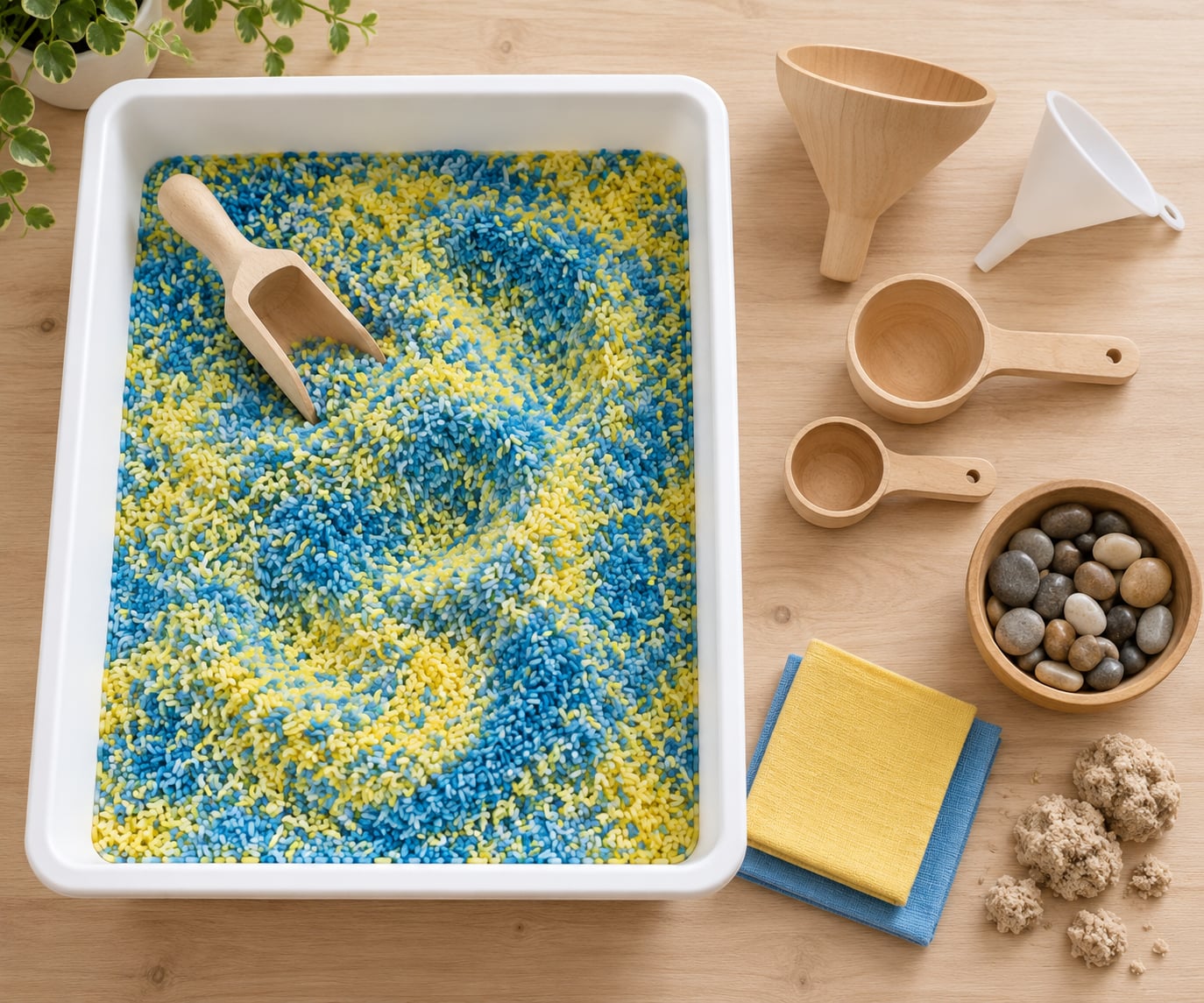
Fill the bin three to four inches deep and hand over four or five tools, not twenty. A set of nesting cups, a funnel, a small scoop and a pair of tongs gives more practice than a bucket of gadgets.
A kitchen-scooping activity that fills twenty minutes: set out six cups of different sizes, let your child fill each one with rice, level the top off with a finger, then dump into a waiting bowl. Add a set of measuring spoons and they will happily measure “two” and “three” spoonfuls for as long as you let them.
Rice is not taste-safe and not a good choice for a child who mouths everything, which rules it out for most children under two. Always sit within arm’s reach, and expect to find it in places you did not check, including inside a shoe.
2. Colored Salt for Texture Exploration
Colored salt gives you two textures in one bin, and the contrast is the point. Layer white salt and dyed salt in stripes, then let a finger drag through them to make spirals and lines.
Dye it at home in a zip bag: add a few drops of food coloring to a quarter cup of salt, seal the bag, and knead until the color spreads. Two or three colors in a wide bin turn into a rainbow drawing surface in under five minutes.
Salt gets everywhere, so set the bin on a tray and put a damp cloth over whatever is underneath. It also stings the eye, which matters if a child rubs their face mid-play, and no amount of wiping fixes that mid-session. Keep paper, glue and thin plastic out of it.
This one is for confident preschoolers and up. A toddler’s attention is better spent on something they can safely put in their mouth.
3. Kinetic Sand for Shaping and Storytelling
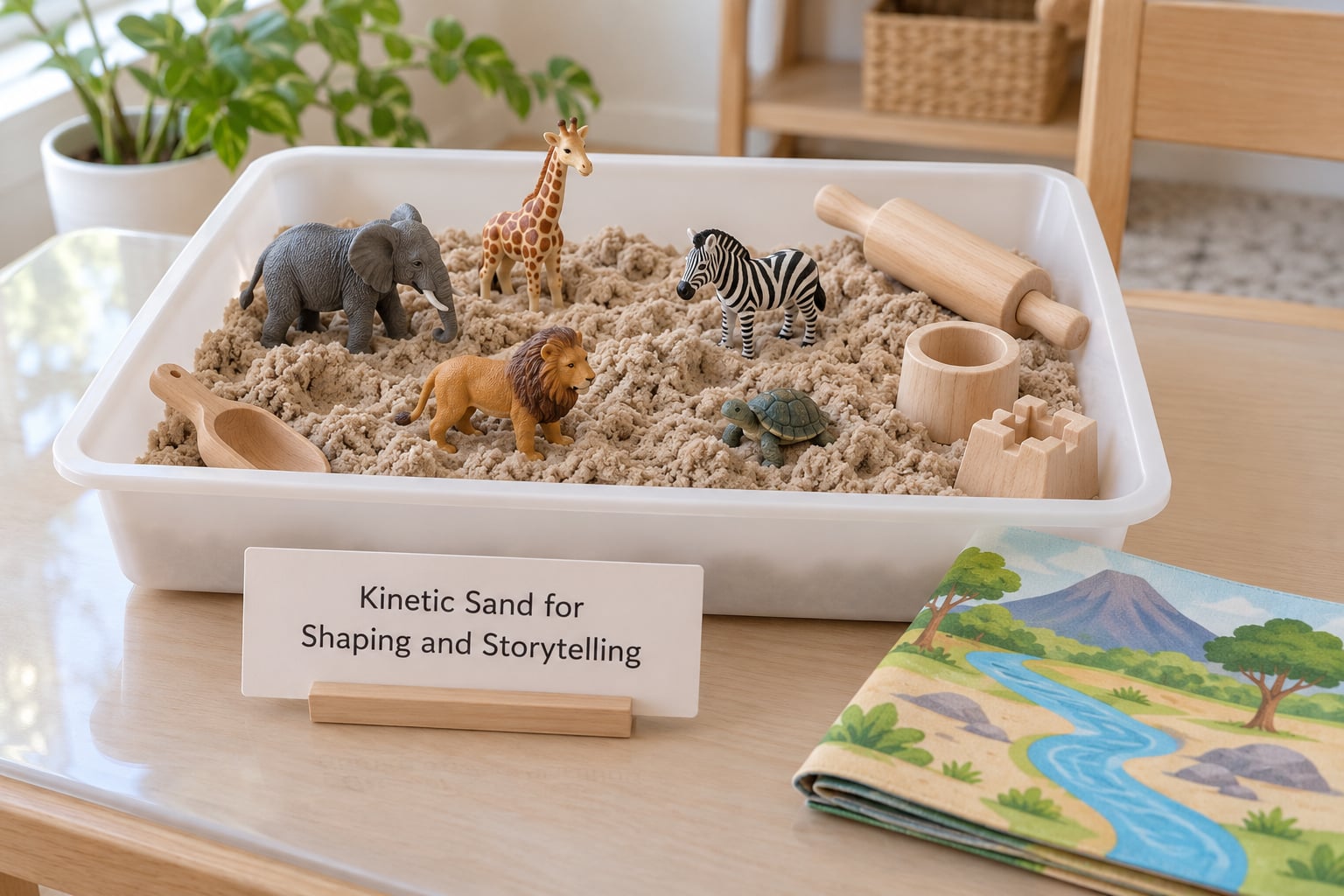
Kinetic sand is the only filler on this list that holds a shape when you press it, so it turns a bin from a digging tray into a sculpting surface. Children build a hill, cut it with a plastic knife, pat it flat and repeat, which keeps a restless child working for longer than loose material usually does.
Give it a story and it lasts even longer. Animal figures plus a few rocks make a habitat, a parking lot for toy cars makes a small-world scene, and a plastic bowl gives somewhere to pour. The sand is the set; the figures are the play.
Kinetic sand is far messier indoors than the packaging suggests. Put it in the bin on a tray, keep the layer shallow, and expect to sweep the outside bits with a dry brush. Wet hands and dry sand also refuse to mix, so if your child loves water, this is the filler they will pour into rather than play with.
Check the label before buying. Some versions smell strongly, and fragrance is one of the first things to bother a sensory-sensitive child.
4. Oatmeal for Sifting and Sorting
Dry rolled oats have a soft, flaky texture that feels nothing like rice, which makes them a good swap when rice has gone stale in your child’s opinion. They sift slowly, which slows the play down, and kids tend to be more patient with them.
Make it useful by adding a fine mesh strainer, a set of funnels and a few small bowls. Sifting oats through a sieve onto paper feels a bit like snow and gives you a quiet, absorbing activity for a child who has just come off the trampoline.
Keep the food out of it. That sounds obvious, but oats are exactly what a hungry toddler wants to eat, so serve this one from a container you also use for baking, never from a food container that sits on the table. If oats pick up any dampness they will clump and smell, so dump and replace rather than storing a used batch.
5. Dried Beans for Tactile Play
Dried beans are the cheapest way to build a sorting station, and the sorting itself teaches more than it looks like it should. Three bowls, three colours, and a child will sort for twenty minutes while you make coffee.
Counting works well with beans too. Fill a jar with a layer of beans, ask how deep it is in beans rather than inches, and let them estimate before they check. Tactile discrimination comes free: hide a small object under the beans and let them find it by feel alone, which is a skill occupational therapists work on deliberately.
Here is the safety part that matters most. Dried beans, lentils and corn are all small enough to block a toddler’s airway. For under-threes, either skip them or use large white beans or dry pasta shapes with holes, and never give a toddler an open container of them.
Watch for pets, too. Beans left in a bin overnight are a real problem in some homes, so store the filler in a sealed jar with a scoop, not in the bin itself.
6. Cornmeal for Pouring and Digging
Cornmeal is the finest texture in the kitchen and behaves completely differently from rice. It holds a fingerprint, a line drawn with a stick, and the track of a toy car pulled slowly through it.
Try the car-track activity: a thin layer of cornmeal, one toy car, and a prompt to drive to the barn. Add a funnel over a cup at the end and you get pouring too. Drawing with a finger before you smooth it over is a surprisingly good fine-motor exercise for a child who finds writing hard.
Cornmeal is the messiest option here. Lay it on a tray with a rim, work over a drop cloth or outdoors, and keep a dry brush and a small dustpan next to the bin. Pouring loose cornmeal into the air produces airborne dust that nobody wants to breathe, so skip the “make it rain” version indoors.
For a child who dislikes sticky or wet textures, cornmeal is a safe choice, since it stays completely dry.
7. Play Dough for Creative Building
Play dough works as a filler base when you bury objects in it. Hide a handful of small toys or laminated cards, bury them, and let your child dig them out and identify what they find. That turns a familiar material into a hunt.
Store-bought dough is fine, but homemade is cheaper and smell-free: flour, salt, water and a spoon of oil mixed together and rested for an hour. Because homemade dough uses raw flour, spread it on a baking tray and put it in a hot oven briefly before anyone plays with it, then cool it completely.
Storage is the whole battle. Roll the dough into a ball, put that ball inside a second ball of plastic wrap, and keep both in a sealed tub in the fridge. It stays workable for weeks. The moment it dries out or picks up a colour, throw it out rather than trying to rescue it with water.
8. Shredded Paper for Crafting and Filling
Shredded paper is a filler most people overlook because it does not pour, and that is precisely why it works with a different child. It suits the child who has gone off wet, sticky textures and wants something dry and noisy.
Sort it by colour into bowls, weave strips through a cardboard loom, or stuff it into a glove and shape it into a puppet. Wrapping small toys in paper and crushing it open with both hands gives the heavy-work input that some children actively seek.
A paper shredder does the work in seconds, and older children can cut strips with kid scissors, which quietly builds scissor strength. Keep the volume manageable, since a deep bin of paper has no bottom and gets frustrating fast.
Unbleached paper ink can run when it gets wet, so keep water and wet fillers away from it if you want the colours to stay separate.
9. Fabric Squares for Touch and Texture Sorting
Cut squares of old cotton, fleece and jersey and you get a filler that never spills, never spoils and never needs replacing. It suits younger children better than dry grains because nothing gets into it and nothing breaks.
Matching work is the obvious use: three soft squares and three corresponding textured ones, and your child pairs them by feel with their eyes covered. Pretend wrapping takes it further, since tying a piece of cloth around a small toy builds bilateral coordination along with the sorting.
Cut squares large enough that a toddler cannot get one down their throat, and wash everything first if the fabric came from a closet rather than a new bolt. Skip anything with long loose threads or decorative beads on it, and stay away from scented oils, which are a common trigger for sensitive children.
10. Plastic Fillers for Lightweight Construction
Plastic is the low-mess option, and it works best with a set of containers rather than a single pile. Clear packing peanuts, perforated plastic cups and cut lids turn into towers, bridges and sorting towers with a very small cleanup.
Counting falls out of it naturally. Fill the cups to the line, count how many, tip them out and do it again. A tong tool turns the same bin into a pincer-grip workout, which is the foundation for holding a pencil later.
Plastic only works with close supervision for the under-threes, since it is smooth, small and slippery. Loose water beads and small marbles are the two fillers to leave out of any bin a child under three can reach, as both are well-documented choking hazards.
Use certified biodegradable packing peanuts and find a recycling program that takes them, since they still end up as loose plastic in the environment.
11. Natural Materials for Nature-Inspired Play
Clean sand, pebbles, shells, pinecones and smooth stones make the richest bin here, and teachers consistently report that these loose natural parts hold attention far longer than plain rice. The irregular shapes give a hand something to puzzle over.
Sorting by size, colour or sharpness turns into a matching game, and counting a jar full of pebbles is a quiet activity for a child who needs a screen break. A small collection of shells supports a sorting task that never gets the same answer twice.
Inspect everything before it goes near a child. Throw out anything with a sharp or broken edge, anything with fuzzy black mould growing in the crevices, and anything that was chemically treated or came from a treated lawn or garden.
Rinse and dry the pieces fully after each session, and store them away from damp storage areas. This filler is the one worth taking outside onto the patio on a warm day.
12. Mixed Fillers for a Custom Discovery Bin
Mixed bins solve the most common complaint from parents: that a child plays with a bin twice and then ignores it. Combining two or three safe textures and rotating the prompts keeps the same materials interesting for weeks.
Layered bins work well. A divided tray holding dry rice on one side, fabric squares on the other and wooden pieces on top gives choices, and choices are what keep a child engaged. Rotating prompts are simple: bury something in the rice, sort the beans by colour, build a tower from the cups.
Watch your child’s sensory profile as you mix. A child who seeks deep pressure and resistance wants beans, pebbles and kinetic sand, while a child who avoids sticky and wet textures is happiest with rice, dry pasta and shredded paper held in a separate section. Serving both textures in one bin without forcing a choice helps either child.
Storage decides whether the rotation works. Keep each filler in a labelled sealed jar, give every bin its own scoop, and date the food-based ones. Most bins come back together in about ten minutes, which is the most realistic cleanup time you will get.
Frequently Asked Questions
What is a sensory box?
A sensory box, also called a sensory bin, is a shallow tray or tub filled with a safe textured material such as rice, beans, sand, water or cloud dough. Tools like scoops, tongs and funnels let a child dig, pour, sort and build. The tactile play builds fine motor strength, language and self-regulation without needing a full craft project.
Are sensory bins good for 5 year olds?
Yes, and they suit older children better than many parents expect. At five, kids can handle small tools, follow themed prompts and build multi-step projects rather than just scooping. Try themed bins with a story, bury-and-find hunts, or measuring and counting games with cups and spoons. Shorten the session once interest drops rather than extending it.
Are sensory bins good for ADHD?
Sensory bins are often recommended for children with ADHD because heavy, repetitive sensory work gives attention somewhere calm and predictable to land. A bin with scoops, funnels and a clear set of rules can absorb twenty minutes of restless energy. If your child is sensory-seeking, reach for deep, resistant fillers like beans or kinetic sand; if they avoid textures, keep it dry and predictable.
What sensory bin fillers are safe for toddlers?
Under three, choose large, non-choking, non-food materials: fabric squares cut generously, large plastic cups, shredded paper, dry oats and play dough. Avoid anything small enough to fit through a toilet paper roll, including dried beans, corn, rice, water beads and marbles. Check for nut, dairy and gluten allergies, and skip scented or glittery fillers entirely.
How do I stop sensory bin play from becoming a mess?
Set the bin on a rimmed tray or in the bathtub, put a drop cloth underneath, and keep the layer of filler shallow. Dry fillers on a tray get swept into a dustpan in a minute. For wet fillers, use a table you can wipe down and keep a bowl of warm water nearby for hands and tools. Never let food-based filler sit overnight, because damp filler smells and attracts bugs.
How do you store and refresh sensory bin fillers?
Store each filler in its own labelled sealed jar so you can rebuild a bin in minutes, and give every bin a dedicated scoop to avoid cross-contamination. Refresh a bin by swapping one element rather than all of them, and let used wet filler go straight down the drain. Replace dried-out play dough, damp oats or musty sand instead of trying to reuse them.
Start with the kitchen: rice, oatmeal or cornmeal costs nothing, sits in a tray and needs four tools. Put the bin somewhere your child can reach it, change one element when the novelty wears off, and toss the food fillers the same day. Everything else on this list is a variation on that idea.