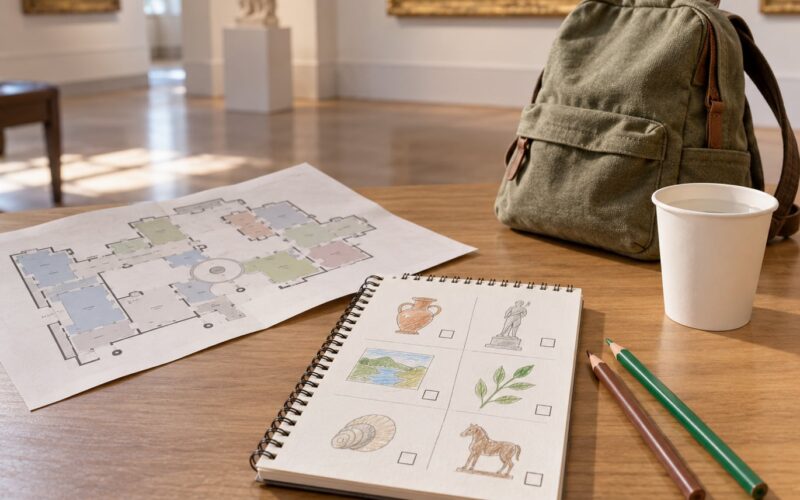
A family bucket list is one shared page of experiences your family brainstorms together, narrows down to a realistic number, and then spreads across all twelve months so it actually gets done. Knowing how to make a family bucket list for the year takes about 30 minutes of setup and an hour of family time, and the hard part is not the ideas. It is cutting the list down to what you will genuinely finish.
Most lists die in February. That happens because families treat the list as a wish list of 80 things, put the expensive items first, and then hit a week where nobody has energy. The families who keep going all year do three things differently: they start with everyone writing ideas privately before anyone talks, they aim for roughly 12 to 24 items instead of a hundred, and they put one anchor activity on the calendar before the year starts.
Here is the process, start to finish.
Table of Contents
- What You Need
- Step-by-Step: How to Make a Family Bucket List for the Year
- 1. Set a shared purpose and timeframe
- 2. Invite ideas from every family member
- 3. Write each idea as a specific experience
- 4. Group ideas into balanced categories
- 5. Choose a realistic number and assign priorities
- 6. Place activities on the calendar
- 7. Review, celebrate, and adjust the list
- Common Mistakes
- Frequently Asked Questions
- How many items should be on a family bucket list for the year?
- How do you get teenagers to actually engage with the family bucket list?
- What are good family bucket list ideas that cost nothing?
- How do you spread a family bucket list across all twelve months?
- What do you do with bucket list items you never got to?
- Conclusion
What You Need
None of this is complicated, and none of it costs anything. You need somewhere to collect ideas, somewhere to display the finished list, and a rough sense of what your family can afford in a year.
- A page for collecting ideas. Paper works well for a family meeting because everyone can see the same surface. A shared document works better if your household is not in one room, or if you want to gather suggestions over a week instead of in one sitting.
- Sticky notes and pens, or one printed sheet per person. Small notes make it easy to move an idea between groups later.
- A wall calendar for the coming year. Paper or digital both work. This is the step families skip, and skipping it is why lists get forgotten.
- A rough spending ceiling. Decide as a family whether the year has no spending limit, a small monthly allowance, or a set total for the big trip. You do not need exact numbers, just a shared ceiling so nobody suggests something wildly out of range.
- Each family member, including the quiet ones. Two separate weeks of solo idea writing gets far better results than one noisy group conversation.
Step-by-Step: How to Make a Family Bucket List for the Year

1. Set a shared purpose and timeframe
Before anyone suggests anything, decide what the list is for and how long it runs. Families who skip this end up with a shopping list, a house project list and a vacation list all tangled on one page.
Say plainly which year you are planning and whether the list is experiences only, or a balanced mix of experiences, learning, creativity, service, food and family traditions. Most families do best with a mix, because it stops the list from turning into a running commentary on the family.
You know it worked when everyone can repeat back what the list is trying to be. If a teenager cannot answer that question in one sentence, the purpose is still too vague.
2. Invite ideas from every family member
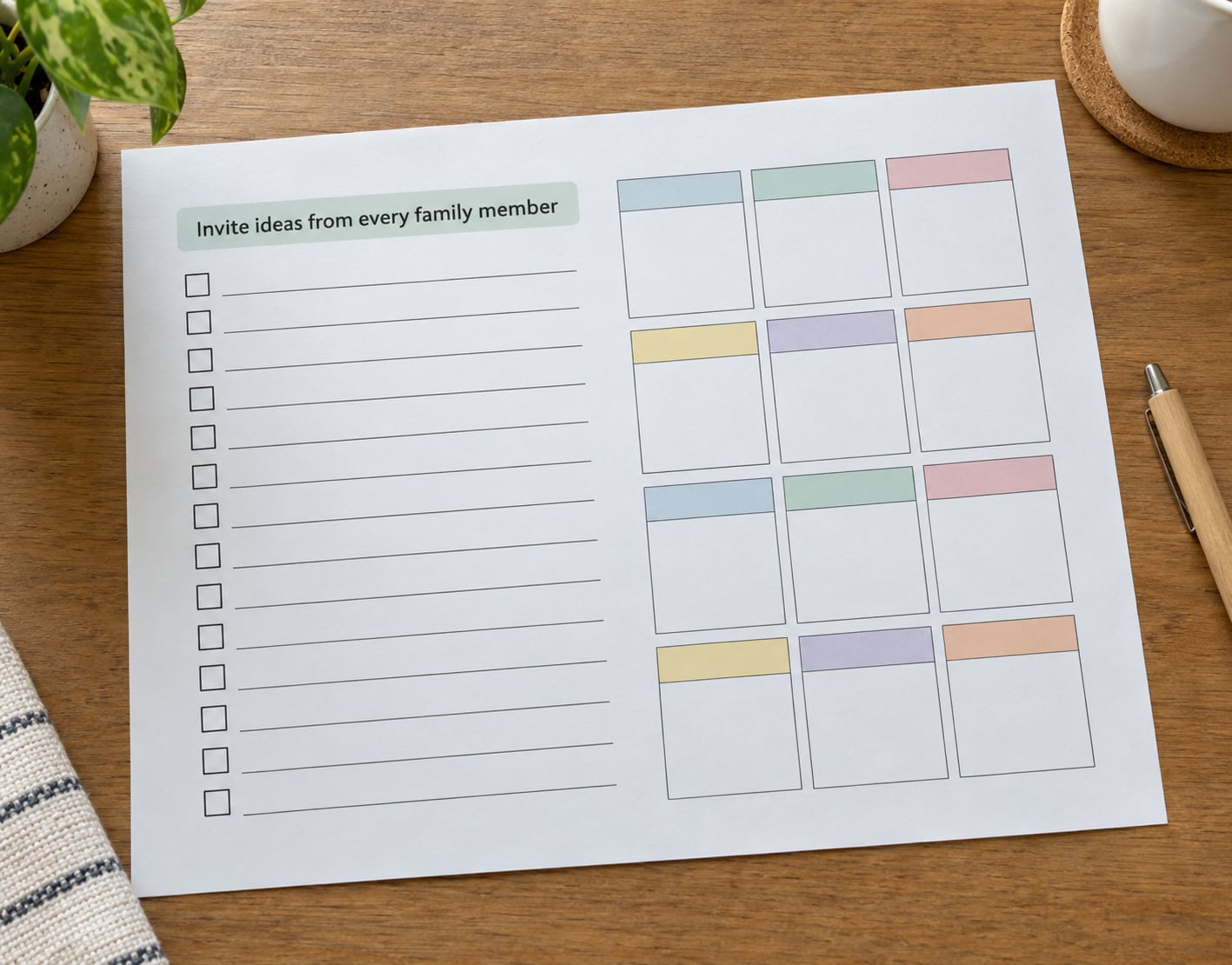
Give everyone the same amount of space, and give the quiet people space in writing first. A solo round before any group discussion is the single change that most improves the list, because the loudest voice in the room otherwise sets the tone for everything.
Each person writes three to five ideas privately and can add more over the next week. Then you gather them. No vetoing, no debating, no explaining why an idea is too expensive. That conversation happens later, with the whole list in front of you.
Watch for a pattern where everything suggested suits the youngest children. If that happens, ask the older kids directly for their own list rather than hoping it shows up in discussion. A mixed-age family needs different activities on the same page, not a compromise on one activity.
3. Write each idea as a specific experience
Vague wishes never get checked off. “Do something together” is a feeling, not a plan. Rewrite every idea as a specific activity with a clear outcome.
Compare “have a movie night” with “make the couch fort, pick a theme for the snacks, and let each person pick one film.” The second one can be scheduled, and you will know on a Tuesday evening whether it happened.
The same test works for everything. If you cannot picture the family doing it on a given Saturday, it is not specific enough yet.
4. Group ideas into balanced categories
Sort the finished list into a handful of buckets so you can see what kind of year you are building. Most families land well with six: free and no-cost, low-cost, a bigger splurge, a real trip or big adventure, milestone or tradition items, and at-home options for bad weather.
Grouping also exposes the problem fast. A list that is 80 percent paid outings is a list that requires a lot of money and a lot of planning. One with a solid block of free items survives ordinary weeks, which is when most list items actually get done.
Then check the balance. Most families find they need more ideas in the no-cost and at-home columns and fewer in the splurge column than they expected.
5. Choose a realistic number and assign priorities
This is where lists go wrong, so use a number instead of a feeling. Twelve to 24 items for a full year, roughly one or two a month, is a range that families consistently finish. A list of 100 items is not ambitious, it is abandoned.
Once you have the number, label everything with a priority. Must-do items are the ones you would be disappointed to skip. Stretch items need a free month and good weather. Spontaneous items are whatever the family wants on a given weekend, and they need a place on the page so they are not forgotten.
Filter as you go. Anything that needs a long drive, most of a free weekend, a specific season or a skill nobody in the family has gets a lower priority unless the family genuinely wants it. You are planning a year, not a fantasy.
6. Place activities on the calendar
Put the list on the calendar or it does not exist. Place one anchor activity per month first, since those are the items most likely to vanish, then fill in the flexible options around them.
Match the activity to the season. Ice skating belongs in winter, a beach day in summer, leaf collecting in autumn, and a new outdoor game in the first warm month when nobody is sick of being inside. Seasonal matching is the cheapest scheduling tool you have.
Leave real gaps. Two open weekends a month is not wasted calendar space, it is the buffer that keeps a busy week from knocking out three items at once.
7. Review, celebrate, and adjust the list
A yearly list should be looked at more than once. Check in after the first month to see whether the anchors actually fit. Check in around the middle of the year, because that is where the year usually goes sideways. Then do a proper review at the end.
Add new ideas as they come up rather than treating the list as a sealed document. If the family picks up a new interest in April, the list should be able to hold it.
Celebrate what you finish, even lightly. A photo, a family dinner where each person names a favorite memory, or a small ornament each year are the things families remember later. And when the year ends, carry a few unfinished items forward. Missing something is normal. Losing the list entirely is the real failure.
Common Mistakes
Making the list too long. A hundred items is a wish list, not a plan. Fix: cap the list at one or two per month, and keep the rest as a separate ideas reservoir you pull from when something is cancelled.
Filling the list only with paid activities. The bill arrives and the enthusiasm goes with it. Fix: require that roughly half the list costs nothing, and schedule those first so they are not crowded out.
Designing the list for the youngest child only. Siblings notice, and the older ones disengage fast. Fix: ask each child for their own two ideas, and treat a parent’s own list as equally valid. The page should look like five different people wrote it.
Scheduling everything. A fully booked year has no room for a spontaneous Saturday, and those unplanned days are often the ones families remember. Fix: leave a fifth of the calendar open on purpose.
Hiding the list in a drawer. A printed list in a folder gets ignored. Fix: put it where you already stand every day, on the fridge, a wall, or a phone home screen. A visible list is what makes checking things off possible.
Treating it as mandatory. A list of obligations stops feeling like fun. Fix: frame must-do items as this year’s anchors and everything else as a maybe worth doing when the chance comes up.
One more habit helps more than any other. Let the person who suggested an item be the one who marks it done. Ownership is most of what makes a plan stick.
Frequently Asked Questions
How many items should be on a family bucket list for the year?
Aim for 12 to 24 items, roughly one or two per month. Families that finish their list usually pick a number before they start choosing activities, which stops the list from growing every time somebody has a good idea. Keep the overflow on a separate ideas page so nothing is lost, and pull from it whenever a week gets cancelled or the weather turns.
How do you get teenagers to actually engage with the family bucket list?
Give them control over part of it rather than asking for cooperation. Ask each teen privately for two ideas, promise they do not have to explain the reasoning, and then let them choose which month their items land in. Teenagers engage when a plan visibly includes something they wanted, and disengage the moment the list feels like another assignment handed down.
What are good family bucket list ideas that cost nothing?
The no-cost column should be the biggest one on the page, because those are the items that survive ordinary weeks. Bake something together, camp out in the living room, run a scavenger hunt around the neighborhood, start a garden in containers, have each family member pick a theme for a family dinner, take a walk with no destination, or build a blanket fort and play board games until bedtime.
How do you spread a family bucket list across all twelve months?
Put one anchor activity on the calendar per month first, since those disappear fastest without a date. Match each one to the season, so cold-weather ideas land in January and outdoor ideas land in spring. Then add flexible items around them and leave open weekends between, because a fully booked year has no room for the spontaneous day your family will actually talk about later.
What do you do with bucket list items you never got to?
Carry a few forward into next year’s ideas reservoir and let the rest go without a lecture. Some items stop mattering once the moment passes, and keeping them on the list year after year turns the whole thing into a guilt list. Bring the same item forward only when the family still wants it, and tell the kids which ones you are rolling over so the year-end review feels honest.
Conclusion
Start with the gathering, not the list. Give every family member a few days to write three ideas privately, bring them all to one place, and pick a small balanced set you can genuinely finish. Then choose one experience you could do in the next month and put it on the calendar before the week gets away from you.
That first item on the calendar is the whole trick. Everything else on the year-long list is easier to keep once the family has watched one thing get checked off.