The fun in a museum visit with young children comes from narrowing it down, not stretching it out. Pick one or two highlights, add one game your child plays while walking, carry a sketchbook and snacks, and let them choose what you look at. Plan ten minutes, then stop while it is still going well.
Most of the parents I know picture a full day of galleries. That is how you get a four-year-old flat on the floor by the second room. The visits that work are short, active and slightly competitive, with a clear end in sight.
Here is how to make a museum visit fun for young kids, one step at a time. It takes about ten minutes of preparation and costs almost nothing.
Table of Contents
- What You Need
- Step-by-Step
- 1. Choose One or Two Museum Highlights
- 2. Create a Mini Scavenger Hunt
- 3. Let Kids Choose the First Stop
- 4. Use Look, Notice, and Wonder Questions
- 5. Build In Movement and Breaks
- 6. End with a Creative Take-Home
- Common Mistakes
- Frequently Asked Questions
- How old should a child be for a museum visit?
- What if my child gets bored or tired quickly at a museum?
- Are scavenger hunts appropriate for young kids?
- How long should a museum visit last with a young child?
- What can we do if a museum is too expensive?
- How do we keep a child interested without forcing them to look at every exhibit?
- Conclusion
What You Need
You need less than you would guess. Everything below fits in one small pouch that lives in the bag you already carry.
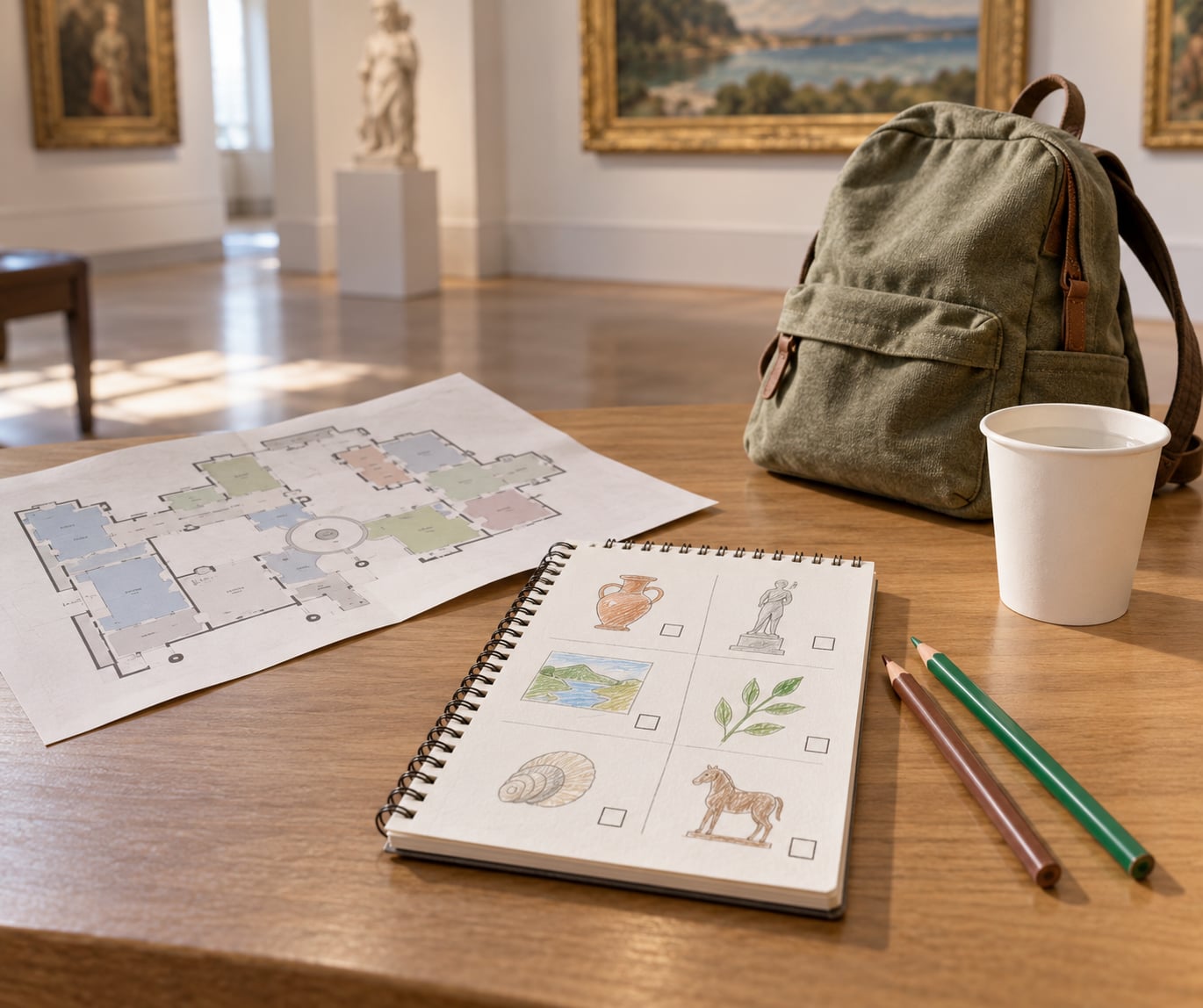
- An activity pouch: six or eight colored pencils or crayons, a small spiral sketchbook, a stack of index cards, and a couple of clipboards if you have them.
- A notebook and pencils for older preschoolers who like collecting facts.
- Snacks and a water bottle. Check the museum site first, since some galleries ban food and most have rules about where you can eat.
- One simple game. A scavenger hunt, an I spy game or a bingo card takes ten minutes to build and carries most of the visit.
- A change of clothes if the museum has water exhibits or an outdoor play area. Wet socks end trips early.
- One quiet toy in a pocket, for the exit line or a gallery where talking is not allowed.
The table below is the part I would tape inside the bag lid. Visit length matters more than any other variable.
| Age | Comfortable visit length | Best museum types | Pack this |
|---|---|---|---|
| 1-2 years | 45 to 60 minutes | Children’s museum, natural history museum with big animals, science centre with a hands-on floor | Snacks, carrier or wrap, one quiet toy |
| 3-4 years | 60 to 90 minutes | Children’s museum, science museum, natural history museum | Sketchbook, pencils, scavenger hunt cards |
| 5-7 years | 90 minutes to 2 hours | Science museum, natural history museum, art museum with a family trail | Notebook, colored pencils, bingo card |
On r/MuseumPros, the fix parents mention most often is exactly this: something to search for, or an exhibit they are allowed to touch. Walking past things they cannot touch is what turns a visit into a chore.
Step-by-Step
1. Choose One or Two Museum Highlights
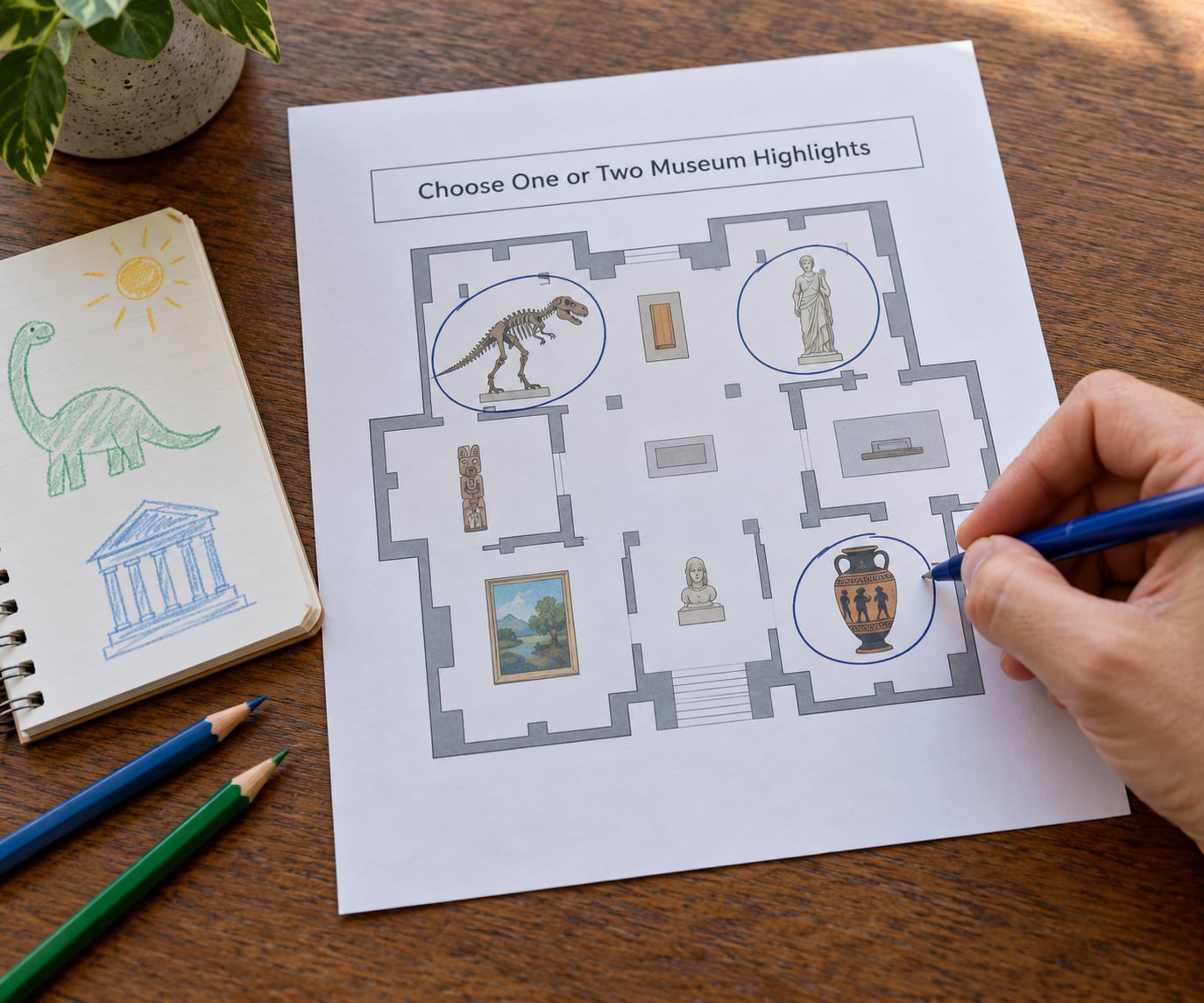
Open the museum website before you go and look at the gallery list, not the whole building. Pick one or two rooms your child will most likely enjoy and mark them on the printed map you grab at the entrance.
You will know it is the right pick if your child could describe it in one sentence. Dinosaurs work. A room of 19th-century portraits does not. If your child has a current obsession, let that pick the room.
Two rooms is genuinely enough for most young children. You can always come back another week.
2. Create a Mini Scavenger Hunt
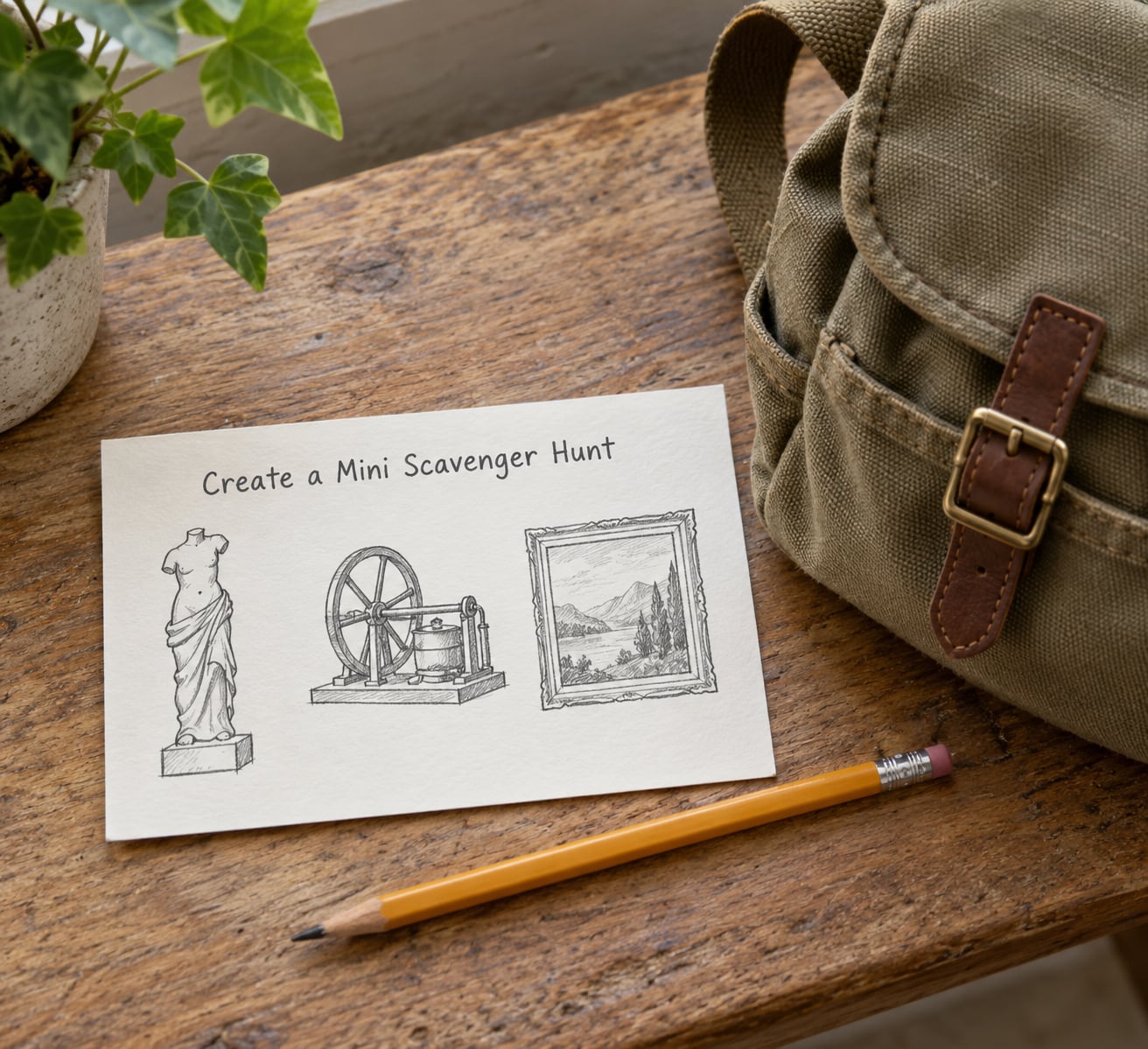
A scavenger hunt is just a short list of things to find, on cards or folded paper. Six items works well. Ten turns into a checklist and children feel tested.
Build it from the museum website in about ten minutes. Read the gallery descriptions, then write one prompt per item:
- Find something taller than your grown-up.
- Find an animal with horns.
- Find something that is red.
- Find a machine with a wheel you can turn.
- Find a painting with a sky in it.
- Find something you could sleep inside.
Draw a tiny picture next to each prompt for children who are not reading yet. Keep the hunt a game, never a report card. If they want to abandon the list and stare at one dinosaur for twenty minutes, let them.
3. Let Kids Choose the First Stop
On the way in, offer a choice between your two highlights. That is it, two options, no more. A child who picks the first room walks faster and complains less.
The same trick works for bigger families. One parent circulating at a normal pace, while whoever has the turn stops everybody at the exhibit they like, gives siblings of different ages a share in the route without anyone being dragged.
4. Use Look, Notice, and Wonder Questions
Young children cannot tell you what a painting means and do not need to. Skip the label-reading and switch to three prompts that work on everything, from a fossil to a fire truck:
- Look. Tell me one thing you see.
- Notice. What is different about this one?
- Wonder. What do you think would happen if it moved?
These do the job of a guided tour without the lecture. The wonder question is the one that surprises you. A four-year-old’s guess about why a dinosaur has a bony frill is usually better than the label.
Answer their questions even when you do not know the answer. I have said I do not know, we will look it up in the car more times than I can count, and it never once caused a problem.
5. Build In Movement and Breaks
Museums are hard on small bodies. Two hours of walking and standing is a lot, and tired children do not listen, which is the adult’s version of not listening.
Plan a reset every twenty to thirty minutes, and treat it as part of the visit rather than a failure of it. Walk the halls with a scavenger hunt on the cards. Sit in the lobby for five minutes. Eat the snack where eating is allowed. Look at the outdoor play area if the museum has one.
Pick the least busy time you can manage. Opening hour on a weekday is usually the quietest, and many museums run a children’s hour or a family program with a slightly later start, which is easier on everyone.
Keep the volume low and the walking feet. Explaining why helps more than correcting: hands stay off the paintings so nobody scratches them, and walking feet keep the room quiet for the people looking.
6. End with a Creative Take-Home
Decide on the take-home before you leave. The best one is a sketch of a single object the child chose, drawn in the lobby on the last page of the sketchbook.
Other options that keep the visit alive for a week:
- A photograph of one favorite exhibit, printed later, turned into a small collection book.
- A story about what would happen if the exhibit came alive, dictated by the child and written out by you.
- A drawing of the family in front of something huge, back facing the camera, so the exhibit is the subject.
At home, the extension is easy and it is the part most museums never mention. Rebuild a favorite object out of cardboard or play dough. Sketch what you think is behind a wall you did not get to open. If you visited a natural history museum, sort your rocks into a sorting tray; if you visited an art museum, paint one thing in the style you saw.
The point is not a masterpiece. It is a small, physical reminder that the day happened.
Common Mistakes
Planning too much. Three rooms in one visit is two rooms too many for a toddler. Fix it by writing the highlights on the map and covering the rest with a pencil.
Expecting every label to be read. Nobody reads labels with a three-year-old, including the parents. Fix it by using look, notice, wonder instead, and reading the labels yourself later.
Skipping breaks. If you skip them, you do not get more exhibit time, you get a child sitting on the floor. Fix it by putting a reset in the plan at set times.
Turning the trip into a test. A hunt with twenty items and a stopwatch becomes homework. Fix it by keeping the list to six, letting go of it freely, and never marking anything off in front of them.
Lecturing. Standing in front of a case delivering a lesson to a child who is looking at the ceiling teaches nobody anything. Fix it by following their lead and asking the wonder question instead.
Rolling a stroller into a quiet gallery. It blocks the aisle, and nobody enjoys the person behind them. Check the bag policy on the site before you go, and plan for the stroller to wait somewhere it is allowed.
One more honest note, because plenty of parents feel this way. A big art museum or a dense history museum is usually a mistake before age four or five. The room is quiet, nothing can be touched, and there is nothing to do but stand and stare, which no four-year-old manages well. A children’s museum, a science museum with a hands-on floor, or a natural history museum is a better bet from age one or two.
And some trips will simply not work. Naps get broken, someone is hungry, the room is too big. About one in five museum visits with a young child ends early. That is not a failure of the visit or of you, and it is not a sign that your child does not like museums. It just means you go back smaller next time.
Free and low-cost options are worth knowing before you pay for anything. Many libraries loan museum passes, plenty of museums have a free day or free first-visit hours for families, and outdoor grounds, sculpture parks, gardens and nature trails are free even when the galleries are not.
Frequently Asked Questions
How old should a child be for a museum visit?
There is no single right age, but the museum type matters more than the birthday. Children as young as one or two enjoy children’s museums, natural history museums with big animals, and science centres with hands-on floors. Most parents wait until about age four or five for a traditional art gallery or a history museum, because those rooms are quiet, no-touch and hard for a young child to sit through. A short first visit at any age beats a long one.
What if my child gets bored or tired quickly at a museum?
Shorten it rather than pushing through. Aim for one room, set a clear end point before you walk in, and leave while the visit is still going well so the next one is an easy sell. If they are flagging, add movement: walk the halls with a scavenger hunt, eat the snack, or head for an outdoor play area. Boredom at a museum is usually a pacing problem, not a lack of interest in the subject.
Are scavenger hunts appropriate for young kids?
Yes, if you keep them small and loose. Six items on index cards works for a preschooler, and pictures next to the words help children who are not reading yet. Write the prompts from the museum website so you know the items exist. Do not turn it into a checklist to complete, stop timing it, and let your child abandon it whenever something else grabs them. A hunt that ends halfway is still a successful visit.
How long should a museum visit last with a young child?
Keep it to about 45 to 60 minutes for ages one and two, 60 to 90 minutes for ages three and four, and up to two hours for ages five to seven. The single best predictor of a good visit is picking one or two rooms in advance rather than the length of the day. Arriving with a fixed end time in mind keeps everyone moving gently, and most young children tell you when they are done.
What can we do if a museum is too expensive?
There is usually a way in. Many libraries loan free museum passes, a good number of museums run free days or free family hours, and some offer reduced rates for children under a certain age. Before paying, check whether the museum has outdoor grounds, a sculpture park, a garden or nature trails, which are often free and just as absorbing for a young child. Cost is rarely the reason a visit succeeds or fails.
How do we keep a child interested without forcing them to look at every exhibit?
Let the child set the route. Walk at their pace, stop only at what they stop at, and offer two choices at the start rather than a full itinerary. Use look, notice and wonder questions to draw them into what is in front of them instead of delivering a lecture. Asking one or two questions per exhibit keeps the visit conversational, and following their lead is what turns a walk past objects into actual looking.
Conclusion
Start small. Pick one highlight your child will actually like, build a six-item scavenger hunt from the museum website while you are making coffee, and put the sketchbook in the bag.
Then let them choose the first room, ask one wonder question, take a break before anyone gets tired, and draw one thing on the way out. That is how to make a museum visit fun for young kids, and it works in 2026 just as well as it did the first time.