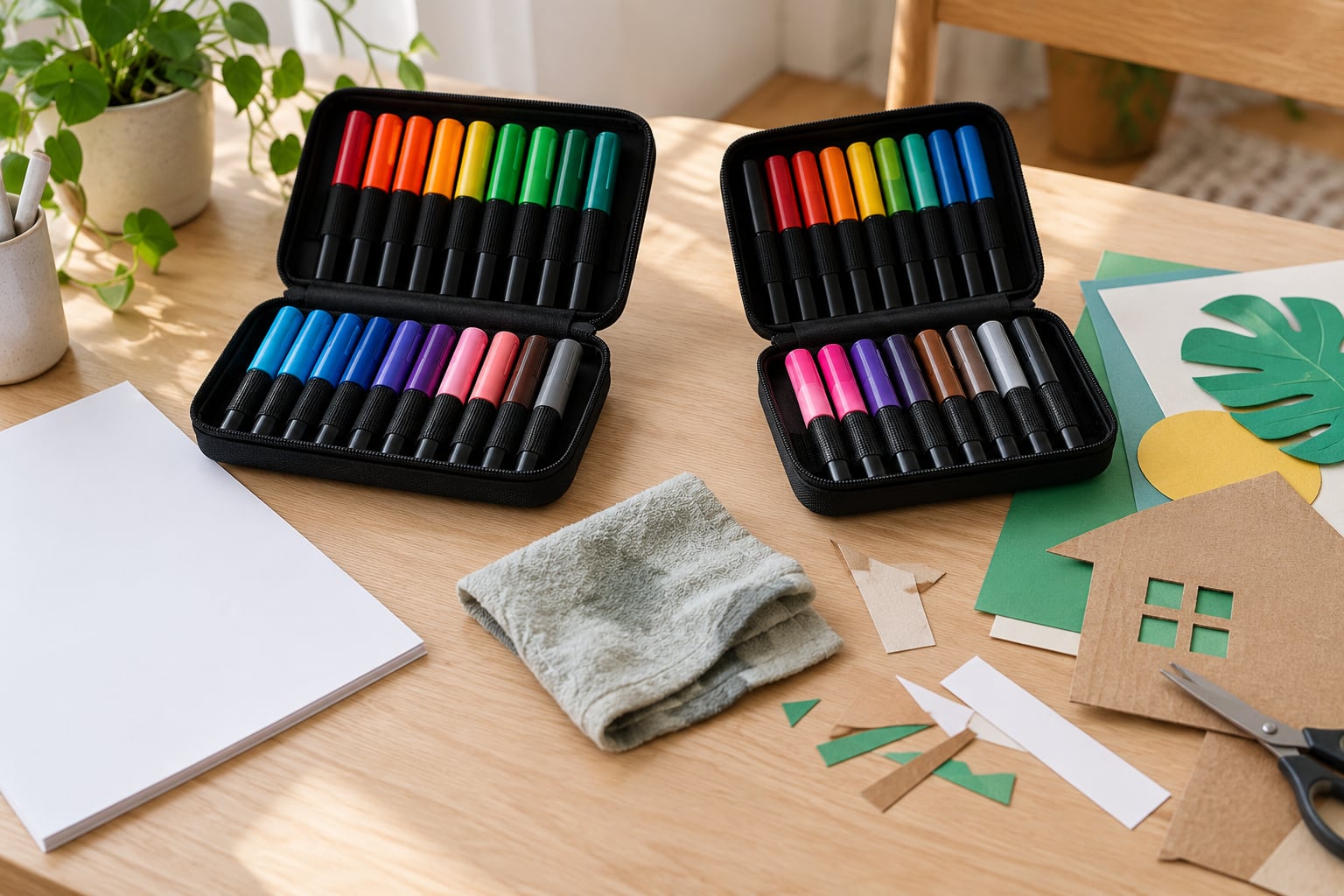
If you’re choosing between washable vs non-washable markers for kids, the short answer is simple. Washable markers are the default for anything a young child will hold indoors, because the ink lifts with soap and water. Non-washable markers earn their place when a project needs to survive washing, rubbing, and sunlight.
The honest part is that “washable” is a promise with conditions attached. It usually means washable from skin, most clothing, and many household surfaces, not every surface in every situation. I’ve cleaned enough marker off a wall to know that distinction matters more than any brand name on the box.
This guide covers how the two ink types differ, which one wins on each surface, how to pick by age, and what to do when a mark doesn’t lift. Updated for 2026, it should take about ten minutes to read and save you a repainting job.
Table of Contents
- Washable vs Non-Washable Markers for Kids at a Glance</
- What Is the Difference Between Washable and Non-Washable Markers?
- Why some washable colors still leave a mark
- What “super washable” and “ultra-clean” actually mean
- Washable Markers: Best for Easy Cleanup and Everyday Art
- Non-Washable Markers: Best for Permanent, Bold Projects
- Where dry erase and paint markers fit
- When permanent ink is the right call anyway
- How to Choose for Your Child’s Age and Art Style
- Washable vs non-washable markers for toddlers, ages 2 and 3
- What to look for on the box
- Which Marker Is Easier to Clean?
- Getting washable marks out of clothes and fabrics
- Getting non-washable marks out
- Which Type Is More Durable and Better for Crafts?
- Safety and Practical Considerations for Children
- Price and Value: Are More Expensive Markers Worth It?
- Which Should You Choose?
- Frequently Asked Questions
- Are Crayola markers always washable?
- Are washable markers safe for kids?
- What kind of markers are safe for 2-year-olds?
- What’s the difference between dry erase and washable markers?
- Do all washable marker colors wash out equally?
- Can I use regular laundry detergent on marker stains?
- Conclusion: Start With the Child’s Projects
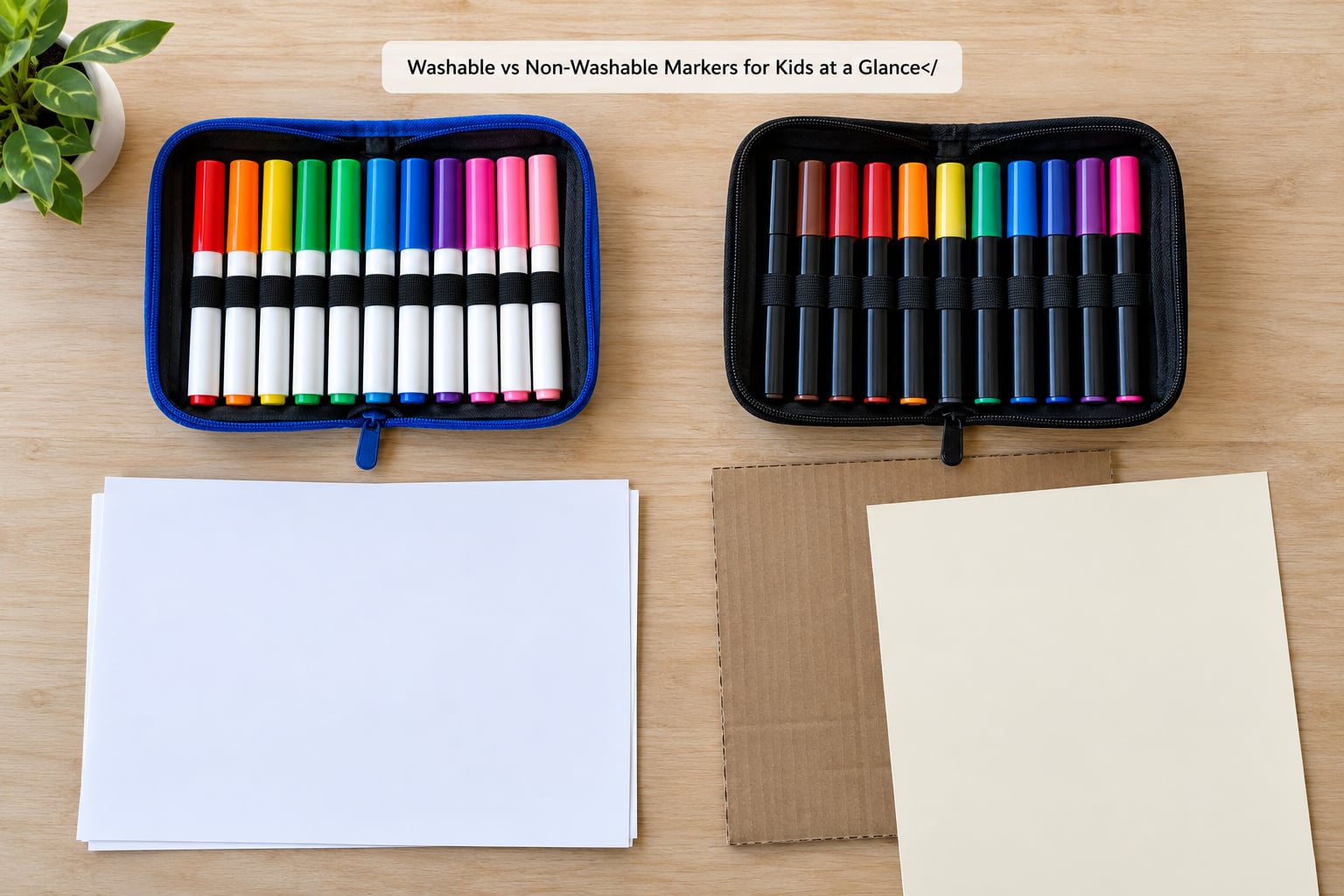
Washable vs Non-Washable Markers for Kids at a Glance</
| Factor | Washable markers | Non-washable markers |
|---|---|---|
| Ink base | Water-based | Alcohol-based or oil-based pigment |
| Cleanup | Soap and cool water | Solvents, scrubbing, or specialist removers |
| Stain risk on clothes | Low, usually rinses out | High, may need hot water and solvent pre-treatment |
| Paper | Good on standard paper, can bleed on thin stock | Sharp lines, less bleed |
| Durability | Moderate, fades and rubs off | High, resists water and sunlight |
| Blending | Limited, leaves hard edges between colors | Alcohol ink blends smoothly |
| Best age fit | About 12 months and up with supervision | School age, roughly 5 and up |
| Typical use | Daily coloring, homework, travel | Crafts, labels, outdoor projects, rock painting |
What Is the Difference Between Washable and Non-Washable Markers?
Washable markers use water-based ink that dissolves when it meets water, so marks rinse off skin, fabric, and coated surfaces with soap and cool water. Non-washable markers use alcohol-based or oil-based pigment that binds into or onto a surface, which produces stronger, more permanent color that resists water and needs solvents or scrubbing to lift.
That single difference in how the ink is carried explains almost every practical behavior you will notice. Water-based ink stays near the surface and lets go easily. Pigment designed to bind does not, and it also sits in the fibers of paper, which is why permanent marker lines stay crisp while washable lines can look softer and occasionally bleed on thin stock.
Why some washable colors still leave a mark
Two words cause most of the disappointment: pigment and dye. Dye-based inks dissolve almost completely, so they rinse away cleanly. Pigment-based inks contain solid color particles that are designed to sit on top of the surface, and those particles can stay behind as a faint shadow even after the washable ink is gone.
Color matters too. Lighter and brighter colors often wash out more easily than dark, saturated ones, and colors that stain most are usually the deep purples and blacks. Bleed-through depends as much on the paper as on the marker: thin coloring-book pages and newsprint will let any wet ink through, washable or not.
What “super washable” and “ultra-clean” actually mean
Brands tier their own washable lines, and the labels are marketing as much as chemistry. A standard washable set is designed for skin and paper cleanup. A super or ultra washable set is engineered to lift more stubbornly, often from clothing and furniture. That extra durability is genuinely useful, and it is also the reason some of those lines will not rinse out of a carpet fiber no matter how long you scrub.
One more trap: many brands sell a washable and a permanent version of a marker that look nearly identical on the shelf. Some also use scented ink in their permanent lines, which reads as a kid-friendly feature and is not a washability signal at all. Check the ink base on the barrel, not the marker shape or the brand name.
Washable Markers: Best for Easy Cleanup and Everyday Art
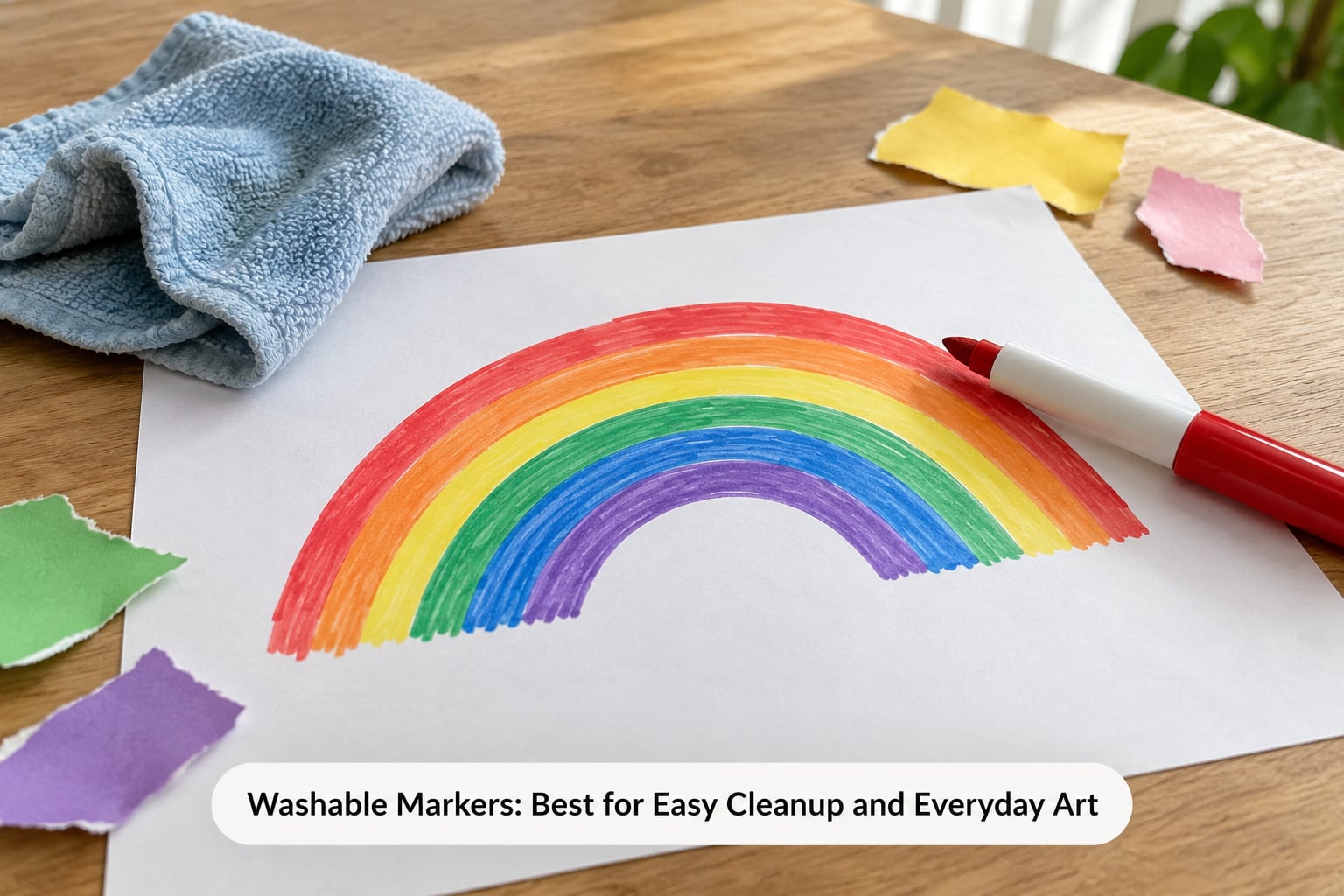
Washable markers are the sensible first set for any child still developing grip and control. A stray stroke on a cheek, a shirt, or a table comes out with a damp cloth and a minute of scrubbing rather than an afternoon of stain treatment. That tolerance for mess is the real product: most children keep painting longer when the wrong stroke is not a crisis.
They suit everyday coloring, homework, letter practice, and travel coloring, where a napkin or a wet wipe handles the damage. Washable ink also behaves better on hands that are still learning how much pressure a tip needs, because the marks lift off skin without any special treatment.
The limits are worth stating plainly. Washable markers need a rinse within a day or two, since dried water-based pigment becomes much harder to lift. They do not blend into each other the way alcohol ink does, so layered colors leave hard edges rather than smooth transitions. And on untreated bare wood, in upholstery fibers, and on semi-gloss or gloss paint, a stubborn residue can remain even after a successful wash.
Dried-out markers are the most common everyday complaint, and the cause is almost always caps rather than ink quality. Children push a cap back on without seating it, so air still reaches the tip. A marker stored horizontally with the cap on tight, in a box rather than a loose cup, survives far longer.
Non-Washable Markers: Best for Permanent, Bold Projects
Permanent markers are the right tool when a project has to outlast the session. That includes name labels inside a school backpack, desk tags, poster board, cardboard constructions, garden markers, and rocks or tiles that will sit outside through rain and sun. A washable label on a lunchbox is a label that will be halfway gone by Thursday.
They also draw cleanly on porous materials that frustrate washable ink, such as bare wood, uncoated paper, and rocks. The color is denser, the lines hold their shape over a large filled area, and the ink resists fading. Older children also tend to prefer the look, which matters if you want drawing to become something they keep doing.
Where dry erase and paint markers fit
Two other types get grouped in with these, and they solve different problems. Dry erase markers are the genuine middle option: they wipe off whiteboards, glossy refrigerator doors, and laminated paper with a dry cloth, but they are a poor choice for a child’s hands, clothes, or walls, since the ink still needs a damp cloth and soap to leave skin.
Paint markers and acrylic paint pens are deliberately permanent by design. They paint opaque color over almost anything, including black poster board, glass, and metal, and they form their own plastic film as they dry, which is what makes them scrub off in sheets or peel away. For rock painting and crafts, that opacity is the whole point. For a kitchen table, it is a liability.
When permanent ink is the right call anyway
There are projects where the mess is the point. A child labeling their own storage bin, tagging a plant pot, or signing a card inside a homemade book needs the mark to hold. Supervise closely, hand over a small number of colors, and put a sheet of newspaper under the work. The rule bends when the durability matters more than the cleanup.
How to Choose for Your Child’s Age and Art Style
Match the marker to the hand, not just the age label on the box. Around 12 months, the useful tools are dot daubers and chunky crayons: a toddler uses a dabbing motion before a drawing motion, and a fine tip only frustrates. From about 18 months to 3 years, a washable marker with a broad barrel and a short chisel tip gives a large mark that a small grip can still control.
Washable vs non-washable markers for toddlers, ages 2 and 3
Washable, without much debate. The deciding factor is that a toddler will draw on the wall at least once, and cleanup time is the difference between a five-minute job and an evening. Choose washable ink, a barrel a small hand can actually hold, and a set with a lid that closes so a rolling marker does not dry out.
Supervision matters more than the label. Markers should be capped and stored out of reach when play ends, and caps are small enough to be a choking hazard for a child who is still mouthy with new objects. Most markers are not designed for a baby to chew, so treat the whole barrel as off-limits indoors rather than handing over a bare marker.
Preschool and kindergarten, roughly 3 to 5, is the sweet spot for washable ink and the first exposure to craft projects. These children can manage a finer tip, which helps with letter formation and early handwriting practice. They are also old enough to hold a mess as their own responsibility, which makes washable ink the reward rather than the constraint.
School-age children, 5 and up, can handle permanent markers on specific jobs while keeping washable for homework and free drawing. If your child draws heavily or creates detailed art, pay attention to the tip instead: a dual-tip body with a fine point for detail and a broad chisel for coverage holds up far better to daily use than a single-tip marker.
What to look for on the box
Look for the ink base, the age rating, and the certification marks before the color count. Any set you buy for a child under three should state an age on the packaging, carry the ACMI AP seal, and show the ASTM D-4236 toxicology information panel on the barrel or box. If a set has no age guidance at all, treat that as information.
Also check whether the caps seal. Retractable or click-style markers solve the lost-cap problem and are praised by parents for not drying out when left uncapped, which is a genuine advantage in a house where markers end up on the floor.
Which Marker Is Easier to Clean?
Cleanup is decided surface by surface, and the differences are big enough to matter. The table below rates how each ink type behaves once the mark has dried, on a scale where 1 means stubborn and 5 means rinses away with plain water.
| Surface | Washable | Non-washable | What actually works |
|---|---|---|---|
| Skin | 5 | 1 | Soap and cool water; for permanent marks, oil then soap |
| Cotton | 4 | 2 | Cold rinse first, then warm wash with detergent |
| Polyester and synthetics | 3 | 1 | Rubbing alcohol or a specialist foam; dyes can bind to synthetics |
| Wool and silk | 2 | 1 | Cool water only, no heat; test a hidden seam first |
| Upholstery and carpet | 2 | 1 | Blot then work in from the outside edge inward |
| Flat wall paint | 3 | 1 | Soap and water, then a damp cloth; flat paint holds dye |
| Semi-gloss and gloss paint | 4 | 2 | Washable ink wipes off; permanent needs alcohol |
| Bare wood | 1 | 1 | Neither lifts fully; sand or paint over the mark |
| Paper | 4 | 5 | Washable can still ghost; permanent stays crisp |
| Dry erase board | 3 | 4 | Dry erase wipes with a dry cloth |
Note the row parents care about most: bare wood is the one surface where washable ink does not lift with water alone. A tray, a tabletop, or an unfinished shelf that takes a permanent mark usually needs sanding or a coat of paint over it.
Getting washable marks out of clothes and fabrics
Markers on clothing or fabrics: rinse with cold water first, blot with paper towels to pull the ink out rather than spreading it, then wash in warm or hot water with laundry detergent. Cold water sets the pigment, so starting hot is the mistake people make first. Test an inside seam before treating a whole garment, and results vary by fabric and color.
On cushions, carpet, and upholstery, the technique that works best is working from the outside of the stain inward with a damp cloth, changing cloths as they pick up ink. Rubbing hard pushes the pigment deeper into the fiber. If the mark has already dried, a small amount of dish soap worked into the area and left for a few minutes will lift more than scrubbing alone.
Getting non-washable marks out
For permanent ink on hard surfaces, saturate the area with rubbing alcohol on a cotton ball or cloth, let it sit for a minute, then blot. On dry paint and laminate, a magic eraser works well. On fabric, pre-treat the stain with alcohol before it goes into the wash. Vinegar, hydrogen peroxide, and hairspray also show up in parent communities as household options, though always patch-test first on an inconspicuous spot.
If a permanent mark has set into upholstery or carpet, treat it as a write-off in most cases. That asymmetry is the strongest practical argument for washable ink indoors: a permanent marker is cheap, and the cleanup is not.
Which Type Is More Durable and Better for Crafts?
Permanent markers win on durability without much argument. Alcohol- and oil-based pigment resists water, sunlight, and handling, and it stays saturated across a large filled area instead of fading to a pale version of itself. If a project needs to survive a wash, a move, or a season outside, that is the ink to use.
Washable markers win on flexibility, not only cleanup. They layer and over-draw well, they work on ordinary paper without the bleed of heavy solvent ink, and a child can change their mind without the paper turning to pulp under a wet cloth. For a drawing that lives in a coloring book, durability is not the point.
One difference worth knowing is blending. Washable ink sits on the paper and resists mixing, so two colors laid side by side leave a visible line between them. Alcohol-based ink dissolves into itself, which gives smooth gradients and is the reason many illustrators reach for permanent markers rather than washable ones. Color intensity runs the same way: permanent pigment reads deeper on both light and dark stock.
On crafts, the material usually decides it. Poster board, cardboard, bare wood, and stone want permanent ink or paint pens. Regular coloring paper and anything that might get wet want washable.
Safety and Practical Considerations for Children
Washable and non-washable are both safe categories when you buy certified art materials. The AP seal from the ACMI means an independent toxicologist has reviewed the formula and found it safe for children as intended, and ASTM D-4236 is the US labeling standard that requires art materials to carry that information along with a toxicity warning where one applies.
Non-toxic does not mean washable, and this is the most misunderstood point in the whole category. Both permanent and washable markers can carry the AP seal. The seal speaks to toxicity, not to whether the ink rinses out of a sleeve. Plenty of parents assume a certified permanent marker is child-safe in the washable sense, and it is not.
For practice, supervise any marker use with children under three, keep caps on and stored away after use, and never let a young child chew on a marker barrel. If a child gets marker on their skin, wash with soap and cool water and watch for irritation; if you notice a rash or a persistent complaint, stop using the product and speak to your child’s doctor. If a marker is swallowed, contact your local poison control center rather than waiting for symptoms.
Storage solves more complaints than any brand switch does. Cap markers tightly, store them tip-down in a container so a loose cap still pushes against the tip, keep them out of direct sun and away from heaters, and replace any marker that has hardened at the tip rather than shaking the whole set and wondering which one is now dead.
Price and Value: Are More Expensive Markers Worth It?
Marker prices track a few visible factors. Ink quality sits at the top of the list, since better pigment costs more to make and is what determines opacity, how cleanly the tip lays down color, and how many washes it survives. Number of colors is the most obvious factor and the least interesting one, since a large set dilutes the budget across colors a child may never touch.
Marker design matters too. Retractable and click-style bodies cost more than simple caps and solve the drying-out and lost-cap problems entirely, which is real value in a household that uses markers daily. Dual-tip bodies also cost more and cut the number of pens a child needs to carry. Refillability and replacement availability decide the long-term price of a set far more than the sticker on the front.
Durability is the sleeper factor. A cheaper set that dries out in six weeks is not cheaper; you simply buy it again. Price per use, not price per pack, is the honest way to compare a 10-color set with a 96-color set. And remember that prices vary by region and change over time, so compare like for like rather than against a remembered number.
Which Should You Choose?
Buy washable markers for everyday drawing, homework, letter practice, and travel, and for any child under five who will hold them indoors. Cleanup speed is the deciding factor, not ink quality, because a child will keep going longer when a mistake costs nothing.
Buy non-washable markers for a specific list of jobs: name labels, cardboard constructions, poster board, garden markers, rocks and tiles, and anything that will be washed or left outside. Hand them over for a contained project rather than as the default set, and put paper underneath.
Consider dry erase markers if your child practices letters on a whiteboard or laminated sheet. It gives them a low-consequence surface that wipes clean, which is genuinely useful for school-age handwriting work and useless for anything involving a T-shirt.
Consider paint markers for craft projects that need opaque coverage, especially over dark or colored surfaces. They are the most permanent option of the three and the least forgiving of mistakes, so treat them as a craft material rather than a drawing tool.
For most families, a mixed setup ends the debate. One washable set for daily life, one or two permanent markers for labels and builds, and a dry erase marker or two for practice covers everything a child actually does.
Frequently Asked Questions
Are Crayola markers always washable?
No. One brand sells washable, super washable, and ultra-clean washable lines alongside standard and permanent markers that look similar on the shelf. Check the ink base and the washable wording on the specific box, not the brand name, because the permanent version of a familiar marker usually carries the same shape and color coding.
Are washable markers safe for kids?
Yes, when you choose certified art supplies. Look for the ACMI AP seal and the ASTM D-4236 information panel on the packaging, and follow the age rating printed on the box. Supervise children under three, keep caps on and stored away after use, and remember that non-toxic describes toxicity, not washability. A certified permanent marker is not rinse-out-of-clothing safe.
What kind of markers are safe for 2-year-olds?
Washable markers with a broad barrel and a short chisel tip suit a two-year-old best, because the large mark is easier to control with a small grip. Dot daubers work for younger toddlers still dabbing rather than drawing. Skip fine tips, which frustrate, and skip anything the child could put in their mouth. Any marker still needs supervision regardless of its certification.
What’s the difference between dry erase and washable markers?
Dry erase ink wipes off a dry, smooth surface such as a whiteboard, laminated sheet, or glossy refrigerator door with a dry cloth. Washable ink is designed to rinse out of skin, fabric, and coated household surfaces with soap and water. Dry erase is gentler on a whiteboard and far worse on hands, clothes, and walls, so it suits practice work rather than free drawing.
Do all washable marker colors wash out equally?
No. Lighter, brighter colors usually rinse away most easily, while deep purples and blacks are the ones most likely to leave a faint shadow after washing. Dye-based inks lift more completely than pigment-based ones, and pigment particles can stay behind in the paper fibers. Paper stock matters too: thin coloring-book pages will ghost with washable ink.
Can I use regular laundry detergent on marker stains?
Yes, and order matters. Rinse with cold water first, since heat can set a marker stain permanently. Blot with paper towels to lift ink instead of spreading it, then wash with detergent as you normally would. For non-washable marks, pre-treat the stain with rubbing alcohol before the wash. Patch-test any treatment on an inside seam, and check the care label first.
Conclusion: Start With the Child’s Projects
Decide by looking at what your child will actually make this week. Daily coloring, homework, and letter practice point to washable markers, because the cleanup speed keeps them drawing. Labels, cardboard builds, rocks, and anything that gets wet or sits in the sun point to non-washable markers, used for that project rather than handed over by default.
Start with one washable set you like the feel of, keep it capped and stored properly, and add permanent markers only when a specific job calls for them.