To teach the five senses to preschoolers, you name the sense, show the body part that does the sensing, hand the child something real to explore, and describe it out loud together in new words. Five to ten minutes a day is plenty, everything comes from the kitchen cupboard, and no worksheet is involved. Sight, hearing, touch, smell and taste build in about three years, so this is a slow drip of play rather than a lesson you finish in an afternoon.
That slow drip is the whole method. A preschooler learns a sense by using it on real things and hearing adults attach precise words to what is happening: crinkly, damp, sour, high-pitched. Repeating that pattern across a week is what makes the learning stick, whether you are a parent, a homeschool family or a teacher running centers.
The table below is the whole thing on one screen. Print it, tape it to the fridge, and use it as your checklist.
| Sense | Body part | What it does | One easy activity | Word to teach |
|---|---|---|---|---|
| Sight | Eyes | Takes in light, color, shape and movement | Sort buttons, caps and pasta into colour piles | speckled, pale, crinkled |
| Hearing | Ears | Picks up vibration, pitch and volume | Listen for one minute, then list the sounds | high, low, muffled, clattering |
| Touch | Skin and fingertips | Reads pressure, temperature and texture | Sort fabric, sandpaper and foil by feel | rough, silky, slippery, bumpy |
| Smell | Nose | Detects scent and connects it to memory | Sniff jars of cinnamon, lemon peel and soil | pungent, fresh, musty, sweet |
| Taste | Tongue | Spots sweet, salty, sour and bitter | Five-senses taste test with familiar foods | sour, salty, bland, tangy |
Table of Contents
- What You Need
- Step-by-Step: How to Teach the Five Senses to Preschoolers
- Start With Sight
- Explore Sound
- Try Smell and Taste
- Use Touch
- Put the Senses Together
- Make It Part of the Day
- Common Mistakes
- Frequently Asked Questions
- How long should a five senses activity last for a preschooler?
- What are good five senses activities for a 2-year-old?
- What are the five senses in Montessori?
- Can you give me a rhyme about the five senses?
- How do I know if my child has a sensory processing problem?
- What materials do I need for five senses activities?
What You Need
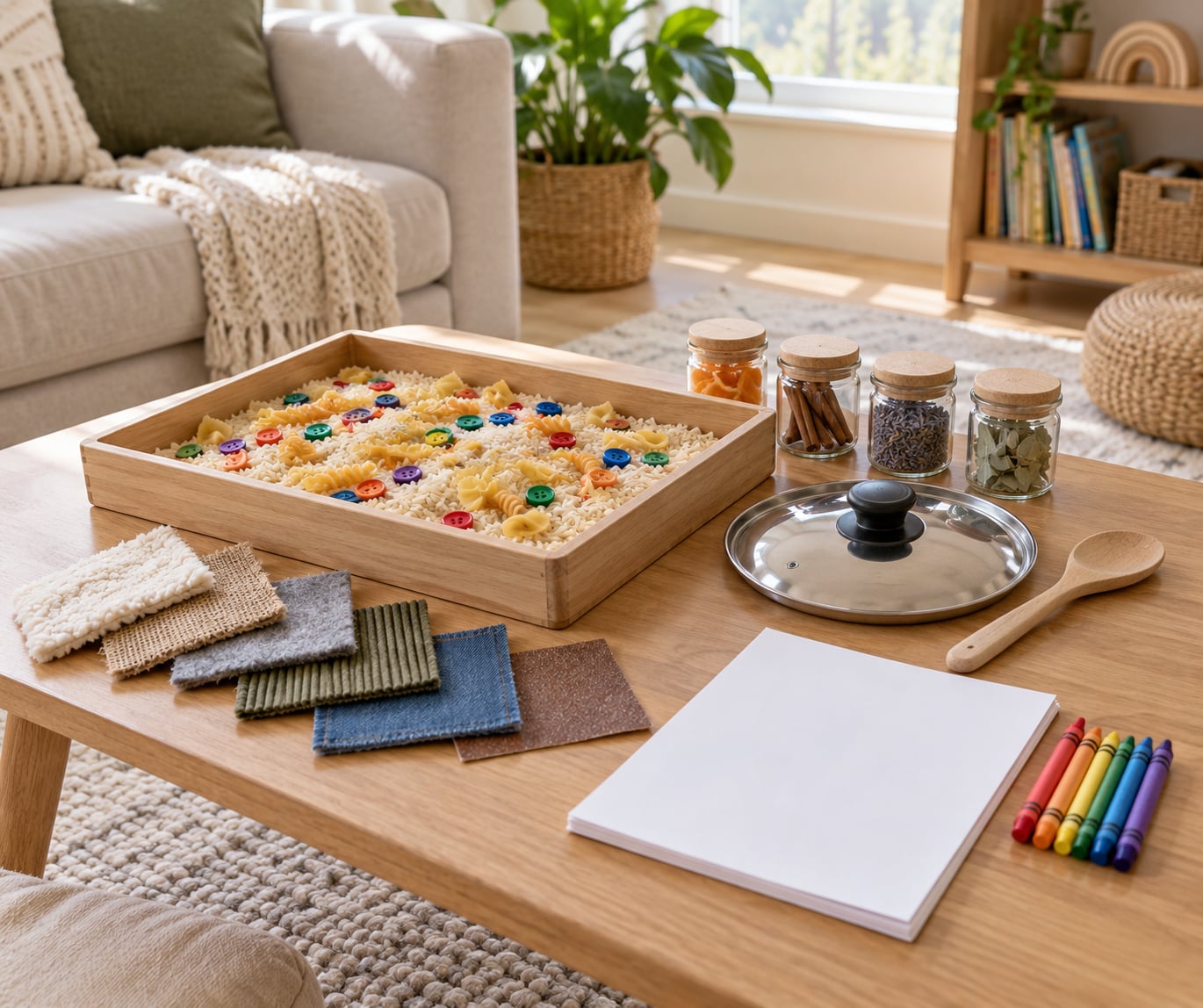
You need a jar or a shallow tub, a handful of things from the pantry, and about ten minutes. Nobody needs a commercial sensory kit for this, and nothing below has to be bought.
For sight: old buttons, bottle caps, large plastic counters, coloured pasta, a flashlight, a magnifier, and a stack of old magazine pages.
For hearing: empty toilet paper rolls, a sealed jar with rice or dried beans inside, a wooden spoon and a pot lid, and two plastic cups with a length of string.
For touch: scraps of fabric, a sheet of sandpaper, aluminium foil, cotton balls, dry rice, play dough or a flour-and-water dough, and a shallow tray of water.
For smell: small lidded jars, cotton balls, lemon or orange peel, a garlic clove, cinnamon, a coffee-soaked cotton ball, and a handful of garden soil or a pinecone.
For taste: whatever you are already serving. A lemon wedge, a pretzel, a raisin, a slice of cucumber and a drop of honey cover sweet, salty and sour without any cooking.
Set the tub on a tray with a rim, put a damp cloth under it, and skip anything liquid if you are not in the mood for mopping. For a no-mess version, use dry materials only: rice, sandpaper, foil, cotton balls and wooden blocks sort beautifully and sweep up into a dustpan.
Some children pull away from sensory play, and that is normal. If your child refuses a texture, offer three pieces rather than one and let them choose; a spoon is easier than bare fingers, gloves work for slime, and you can hold your hand on the material first as a model. For scent, start with one jar at a time and hold it under the nose rather than wearing it on the face. Skip blindfolds entirely if they are uneasy, or have the child close their eyes with hands cupped instead. Bright light is easy to fix: use a lamp rather than direct sun, and take the flashlight game outside on an overcast afternoon.
Ask your pediatrician or occupational therapist if a child is consistently overwhelmed by ordinary sounds, avoids whole categories of food, or seems unable to register pain, temperature or a full bladder. Those are worth a professional look, and they are not the same as a child who simply dislikes slime on a Tuesday.
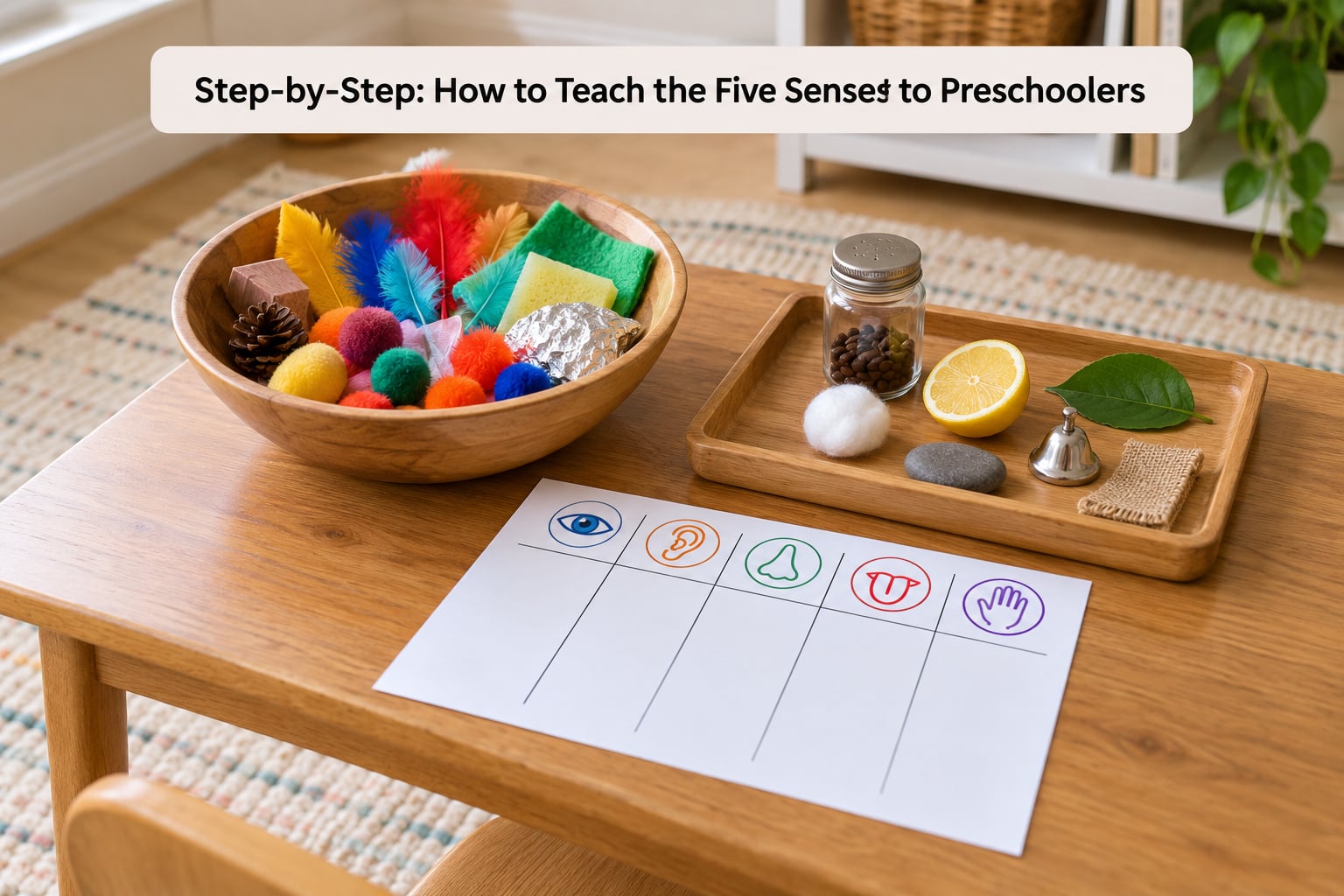
Step-by-Step: How to Teach the Five Senses to Preschoolers
Watch before you teach. Spend the first few days noticing what your child already chases: sounds they stop to listen to, textures they seek out, foods they sniff before eating. Start there, because play that follows attention is easier than play that has to fight it.
Then ask open questions instead of quiz questions. Say what you see happening, then hand the floor over: I see you chose the red one, what do you notice about it? What did that sound like? What would you like to try next? Naming and extending is how vocabulary grows; testing recall is not.
Introduce one sense at a time. Two or three days on touch, then a short sound block, is far more useful than cramming all five into one afternoon, which usually ends with the child leaving the table mid-way through smell.
Finally, connect it to the real day. A sorting game in the afternoon should turn up again at dinner, in the bath, and on the walk to the park. That repetition is what turns a fun hour into a skill.
Start With Sight
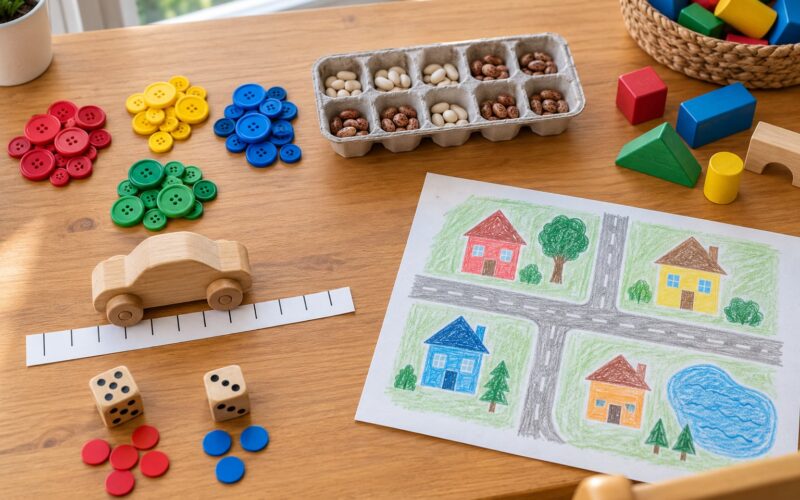
Sort before you teach. Put a muffin tin or a few bowls on the table with buttons, bottle caps, large counters and dry pasta in three or four colours. Your child sorts, you narrate: those two are the same blue, that one is much lighter, see how this one has a line right through it.
Then try a flashlight. In a dark room, shine it at the wall and let your child make a shadow with their hand, then change the distance and talk about how big the shadow grew. A magnifier on a leaf, a shell or a smooth pebble is the cheapest science lesson in the house and keeps attention for a surprisingly long time.
A nature colour hunt on a walk finishes it: collect one safe thing in each colour you can find, and sort the pile at a table when you get home. Words worth modelling are bright, pale, speckled, striped, glossy, dull.
Explore Sound
Start with a listening minute. Close your eyes, sit still, and count the sounds in the room. Then count them again on the porch, where traffic and birds take over. Preschoolers are usually astonished at how many sounds they had filtered out entirely.
Build instruments from what is already in the recycling bin. Fill a toilet paper roll with dried beans, tape one end, and it is a shaker. A pot lid and a wooden spoon make a drum. Fill several glasses with different amounts of water and tap the rims with a spoon for a water xylophone.
Two plastic cups joined by a taut string make a string telephone that teaches vibration as much as sound. Words worth modelling are high, low, loud, soft, muffled, clattering.
Try Smell and Taste
Make scent jars. Dab different smells onto separate cotton balls, drop each one into a lidded jar with a hole in the lid, and let your child shake and sniff. Cinnamon, lemon peel, garlic, coffee, soil and a sprig of mint give a wide range from sweet to sharp.
Keep smell play short. Strong scents are tiring and even a pleasant one is overwhelming if it goes on too long, so three jars at a sitting is plenty.
Taste works the same way with an added rule: get permission before every single taste, and treat a no as a complete answer. A blindfold test using a lemon wedge, a pretzel and a raisin is the classic, and a swap for raisin or cucumber keeps it safe for children who chew carefully.
A safety note for taste and smell activities. Anything a child might put in their mouth is a choking hazard until they are old enough to chew and swallow safely, so keep pieces larger than a grape and sit within arm’s reach the whole time. Check every ingredient against known allergies in the family before serving, and never use a food the child has reacted to before. If you cook as part of the activity, cook to safe internal temperatures: 165°F / 74°C for poultry, 160°F / 71°C for ground meat, and 145°F / 63°C for whole cuts and fish.
Use Touch
Fill a tub with dry rice, drop in a dozen large objects, and ask your child to find them with their eyes shut or looking away. Squirting, digging and sifting is fine too. This is the single most popular version of sensory play in most homes with a preschooler, and it burns energy as well as teaching.
Glue five or six textured squares to cardboard to make a texture board: sandpaper, felt, foil, velvet, a cotton swab, a zipper. Talk about the difference between rough and ridged, smooth and scratchy. Sorting fabric scraps into soft, smooth and stretchy piles is the low-mess version of the same idea.
Play dough and a flour-and-water dough give resistance and shape work that feed fine motor skills. For a child who dislikes textures, hand over tools first, a wooden spoon, tongs, a scoop, and let the material sit untouched on the tray. It often joins the play a few days later.
Put the Senses Together
Multisensory learning means using more than one sense in the same activity, which is how real life works. Walking into a kitchen after baking hits smell, sound, sight and touch at once, and that overlap is exactly what helps memory.
Build five stations on a table, one per sense, and let your child rotate through them for ten minutes. Or take a senses walk where you collect one thing for each sense and talk about all five on the way home. Baking, gardening, a trip to the building site and sorting the washing are the same idea at full scale.
Singing about it helps the vocabulary land. This short rhyme covers all five in eight lines:
Five little senses here in me,
I can see the yellow bee.
I can hear the morning bell.
I can smell the cookies on the shelf.
I can touch a stone that’s rough.
I can taste the sweetest stuff.
Make It Part of the Day
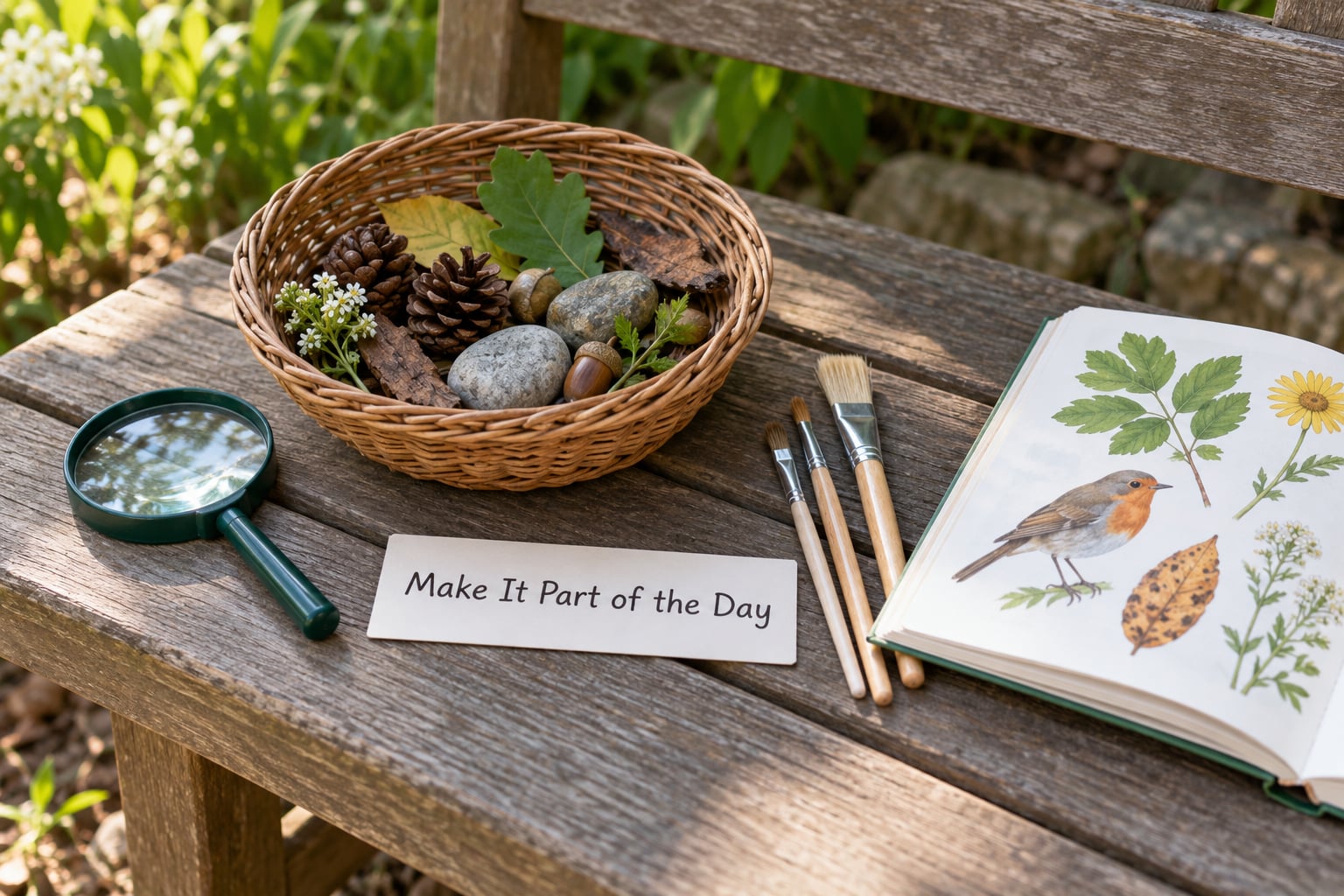
Meals are the easiest sensory lesson you will ever run, because they happen every day and nobody has to set up. Name the smells coming from the oven, describe the crunch of an apple, and let a child stir cold ingredients for a salad you are already making.
Bath time covers touch and sight: water temperature, foam texture, the sound of splashing, the shine of a mirror. Dressing is a matching and naming game. The car ride or the walk to the mailbox is a sound hunt and a counting game at the same time.
Reading has sensory pages in it, so point them out: the woolly bear in one story, the crackling fire in the next. Cooking is the activity home educators lean on most, and for good reason, since it hits all five senses, scales to any age, and the results get eaten.
The trick is narration without interruption. Talk about what you are both noticing, keep it light, and stop the moment the play loses its glow.
Common Mistakes
Racing through all five senses in one day. The fix is one sense per block of two or three days, repeated through the week. Cramming produces noise, not learning.
Correcting constantly. Saying no, that’s not right or not that one interrupts the very attention you are trying to build. Offer a richer description instead: instead of wrong, say that one is rougher and this one is softer.
Using unsafe materials. Small parts, broken glass, whole coins, water beads and strong perfumes cause real injuries. Everything in a sensory tub should pass the toilet-paper-roll test: if it fits through the tube, it is a choking risk.
Over-complicating the setup. If the activity takes longer to prepare than the child takes to finish it, simplify. Sorting pasta, tapping a pot and walking around the block are better than a station with forty pieces, and cleanup anxiety is a genuine reason families give up.
Staying on worksheets. A page of drawn eyes and ears teaches labels. It does not teach perception, which is the actual skill. If you want printable material, print a five senses chart or a body map, but put it on the table beside real objects rather than in place of them.
Ignoring sensory preferences. A child who refuses a texture is not being difficult. Offer choices, keep the material visible, and let participation stay optional. For a child who seeks sensory input intensely, add heavy work such as carrying water or pushing a cart, and keep quiet corners available in a classroom.
Two habits do more work than any activity list: narrate specifics while they play, because naming exact details of a toy or a texture is what turns play into learning, and keep sessions short. Five focused minutes daily beats a Saturday spent setting up a station nobody used.
Frequently Asked Questions
How long should a five senses activity last for a preschooler?
Most sensory activities work best at five to ten minutes, and attention is a better measure than the clock. Watch for wandering eyes, dropped materials or repeated questions, then stop while the fun is still there. One short activity most days beats one long session a week, and children aged two to three may manage only three or four minutes before needing to move on.
What are good five senses activities for a 2-year-old?
Keep it single-sense and single-step: shake a jar of dried beans, sniff one cinnamon cotton ball, sort three large buttons by colour, or stomp on bubble wrap to make popping sounds. Two-year-olds learn through repetition and movement rather than explanation, so repeat the same activity for several days and keep every piece of material large enough that it cannot be swallowed.
What are the five senses in Montessori?
Montessori approaches the five senses through real, self-correcting materials in a prepared environment, such as the pink tower for visual order, sound cylinders for hearing and fabric samples for touch. The method isolates one sense at a time so the child concentrates, then names it with a precise word. The practical version for home is the same principle: one sense, real objects, exact vocabulary.
Can you give me a rhyme about the five senses?
Try this one, which covers all five in order: Five little senses here in me, I can see the yellow bee. I can hear the morning bell. I can smell the cookies on the shelf. I can touch a stone that’s rough. I can taste the sweetest stuff. Sing it once a day for a week and children usually fill in the next line themselves.
How do I know if my child has a sensory processing problem?
Occasional avoidance is normal at preschool age. A concern is when distress is consistent across settings and shows up across several systems, such as extreme reaction to ordinary noise, gagging on safe textures, or not seeming to notice pain, heat or a full bladder. Talk to your pediatrician about developmental screening and ask about a referral to an occupational therapist for a full evaluation.
What materials do I need for five senses activities?
Only pantry and household items: buttons, bottle caps and pasta for sorting, sandpaper, foil, felt and cotton for texture, a plastic bottle with rice or beans for shakers, a pot lid for a drum, glasses of water for a xylophone, cotton balls and spices for scent jars, and familiar foods for tasting. A tray with a rim and a shallow tub contain the mess, and dry materials keep cleanup to a dustpan.
Start with the sorting tub tonight. Put out three kinds of material, sit down beside your child, and name what you both notice out loud. Five minutes of that, most days, teaches the five senses better than any packet you could buy.