Kindergarteners learn early math fastest when their hands are doing the counting. Hands on math activities for kindergarten turn numbers into objects they can pick up, move, group and take apart again, which is why they hold attention far better than a worksheet at this age.
That is the whole idea behind this list. Every activity below runs in about ten minutes, uses things most homes already have in a kitchen drawer or a craft box, and builds one specific skill: counting to ten with one-to-one correspondence, sorting by two rules, extending an AB pattern, comparing two lengths, combining two groups. I have tagged each one with the skill it targets and a stretch version for children who move through the basics quickly.
None of these need a screen, a printable pack, or a store trip. If you only have fifteen minutes and a bag of buttons, activity 1 alone is a solid math session.
Table of Contents
- Hands On Math Activities for Kindergarten at a Glance
- 1. Count and Sort Everyday Objects
- 2. Build Patterns with Blocks
- 3. Measure with a DIY Ruler
- 4. Play a Number Hunt
- 5. Make a Shape-and-Size Grid
- 6. Count and Create with Play Dough
- 7. Add Step by Step with Snack Mats
- 8. Build Fraction Towers
- 9. Roll, Draw, and Compare
- 10. Map the Neighborhood with Math
- Frequently Asked Questions
- What are some hands-on activities for learning math?
- What are some fun math projects for kindergarteners?
- What are some good hands-on activities for kindergarteners?
- What are fun ways to teach kindergarten math?
- How long should a math activity be for a kindergartener?
- A Simple Place to Begin
Hands On Math Activities for Kindergarten at a Glance
Use this table to match an activity to the skill your child needs or the moment you have for it. The setup column tells you how much clearing out happens beforehand.
| Activity | Main skill | Materials and setup | Best for |
|---|---|---|---|
| 1. Count and Sort Everyday Objects | Counting to 20, one-to-one correspondence, sorting by a rule | Buttons, blocks, socks, spoons; 2 minutes setup | Any child, any day, no prep |
| 2. Build Patterns with Blocks | Pattern recognition, visual memory | Any blocks or cups; 1 minute setup | Children ready for AB and ABB patterns |
| 3. Measure with a DIY Ruler | Non-standard measurement, comparing length | Paper strips, tape, string; 10 minutes setup | Once number counting feels easy |
| 4. Play a Number Hunt | Numeral recognition, number order | Index cards, tape, a hiding spot; 5 minutes setup | Movement plus focus in the same activity |
| 5. Make a Shape-and-Size Grid | Shape recognition, positional language, sorting | Paper, crayons, stickers, cut shapes; 5 minutes setup | Children still mixing up shapes |
| 6. Count and Create with Play Dough | Counting, grouping, fine motor control | Store-bought or homemade play dough; 5 minutes setup | Sensory learning, rainy afternoons |
| 7. Add Step by Step with Snack Mats | Combining two groups, addition stories | Paper plate, crackers or counters; 3 minutes setup | Just learning what addition means |
| 8. Build Fraction Towers | Parts of a whole, half and full, comparison | Paper squares, blocks, craft sticks; 5 minutes setup | Introducing fractions without symbols |
| 9. Roll, Draw, and Compare | Addition and subtraction within 10, comparing, simple probability | Two dice, counters, paper; 1 minute setup | Children secure with counting to 10 |
| 10. Map the Neighborhood with Math | Symbols, distance, direction, location words | Paper, pencil, sidewalk chalk; 10 minutes setup | Outdoor learning, big-body math |
1. Count and Sort Everyday Objects
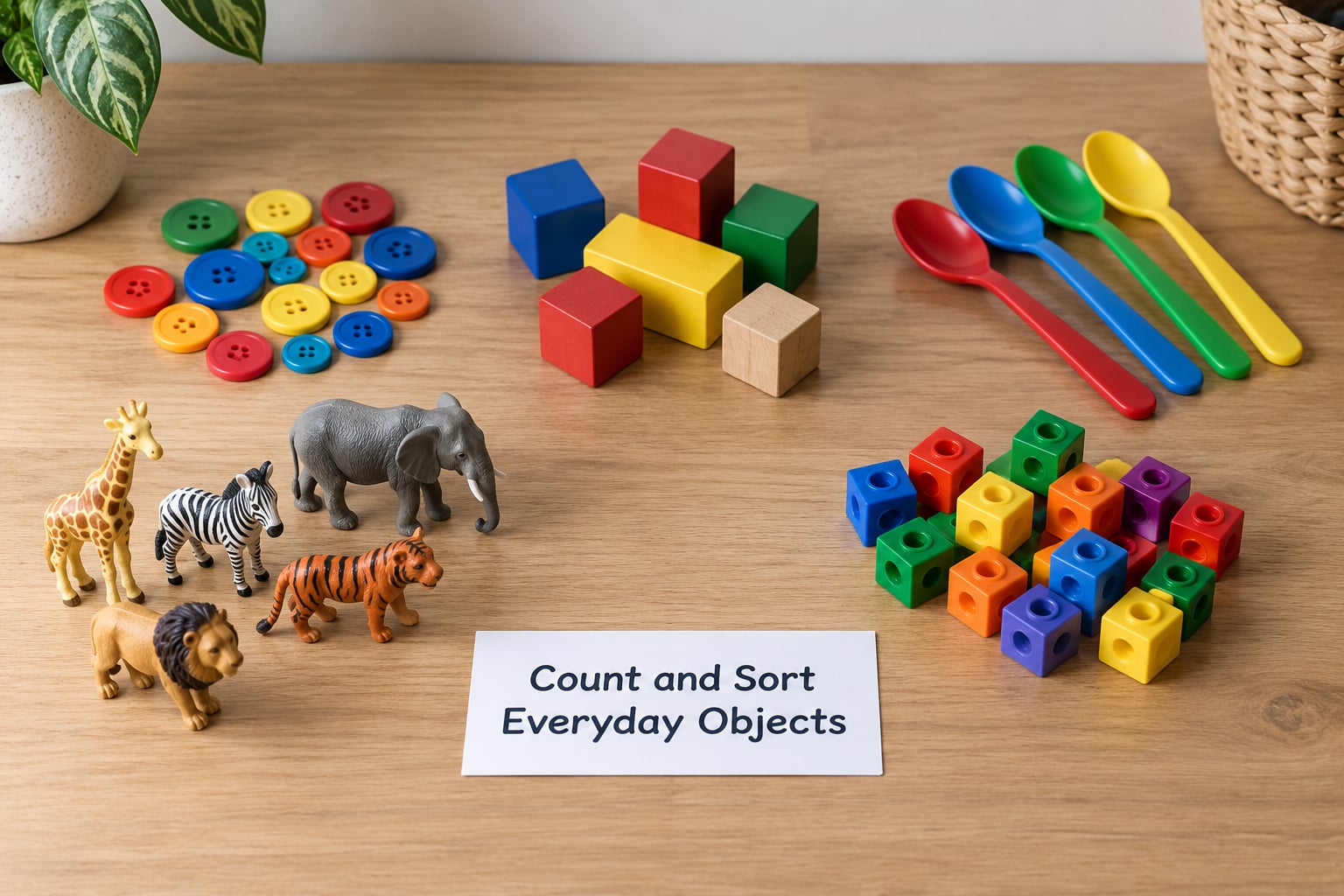
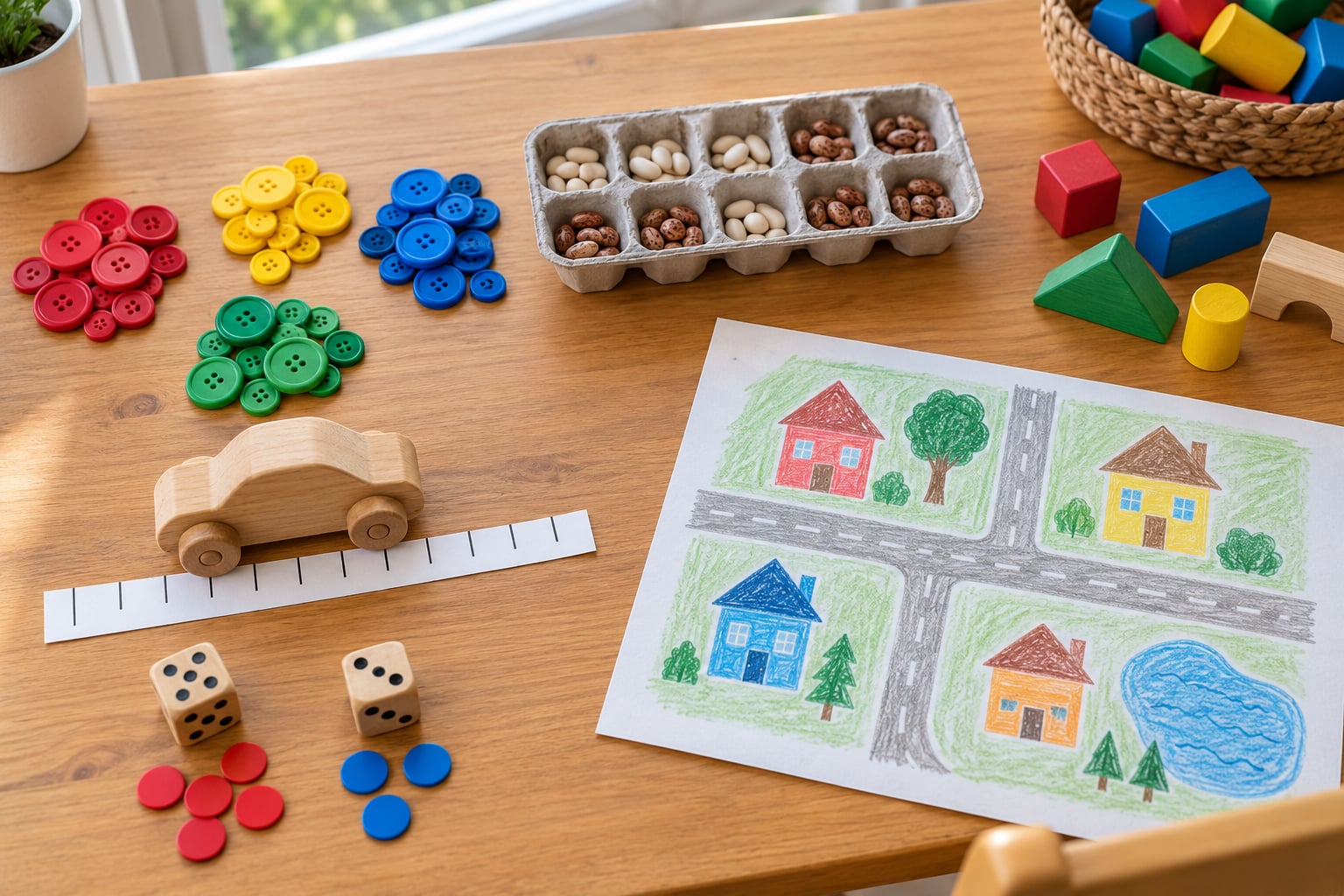
Sorting is the highest-value math activity most families skip, because it looks like tidying up. Pick a drawer, a basket of laundry or a bag of craft supplies, dump it on the table, and ask your child to make one pile for every kind of thing.
Count each pile out loud together, touching each object once as you say the number. That touch-and-say is one-to-one correspondence, the habit that makes every later math skill work.
Stretch it: sort the same objects a second time by a different rule. Buttons by color, then by size, then by whether they have two holes or four. Two rules in one session is genuine classification work, and it takes about four minutes longer.
For a group: pour the objects into five trays and let each child take a turn choosing the rule for everyone to follow.
2. Build Patterns with Blocks
Make a pattern and let your child finish it. Start with the easiest possible one: a row of blocks where blue, red, blue, red stops halfway and the turn passes over.
Once that is easy, add a second element so the pattern becomes blue, red, blue, red, blue, and then a shape too, which turns it into an ABB pattern. Patterns train the visual memory that later makes it possible to see a number as a group rather than a string of separate objects.
Stretch it: hand your child the wrong block on purpose and see whether they catch the break. Correcting a pattern takes more thinking than building one.
Anything repeatable works as a block. Cups on a counter, coins in a tray, paper shapes cut freehand, or clothes pegs on a piece of string all teach the same thing.
3. Measure with a DIY Ruler
Cut a strip of card stock and mark it with hand-drawn lines about an inch apart, labelling nothing. Your child now has a ruler with units only they can read, which is the point: measurement is about repeating units, not about inches.
Measure a shoe, a spoon, a book, the edge of the table. Write down how many units long each one is and put the objects in order from shortest to longest.
Stretch it: ask what happens when two objects measure the same, and let your child find a longer measuring strip made of two joined units. That is the reasoning behind a standard unit, taught without a lecture.
String and yarn work well too. Wrap it around a pencil, a toy car and a cereal box, then mark each length on a piece of paper to compare.
4. Play a Number Hunt
Write numerals 1 through 12 on index cards and hide them around one room. Cupboards, under a chair, inside a shoe, taped to a door frame where an adult would have to look up.
Your child’s job is to find a card, bring it to you, and say the number out loud. Then they put it in order on the floor.
Collecting the cards and laying them out is what makes this more than a scavenger hunt. Ordering the numerals builds recognition of the counting sequence as a fixed sequence rather than as a list to be guessed at.
Stretch it: hide 15 through 20 as well and ask which card is missing. That gap question is the first step toward understanding that numbers occupy spaces.
For a group: give each child two cards to hide while the others count to thirty, then race to find them all.
5. Make a Shape-and-Size Grid
Draw a four by four grid on paper. Draw a square in the first cell, a circle in the second, a triangle in the third and a rectangle in the fourth, then repeat the row. Leave the final row blank.
Ask your child which shapes belong in the empty row. Most five-year-olds will tell you what a shape is called before they can explain why it belongs, so this is where the naming happens.
Stretch it: change the sorting rule halfway through. Sort the second rows by size instead of by shape and say the rule out loud each time. Describing position with words such as beside, below and in the corner is pre-writing positional language that shows up later in reading too.
Sticker dots, cut paper shapes and linking cubes all work on the grid if drawing is not yet comfortable.
6. Count and Create with Play Dough
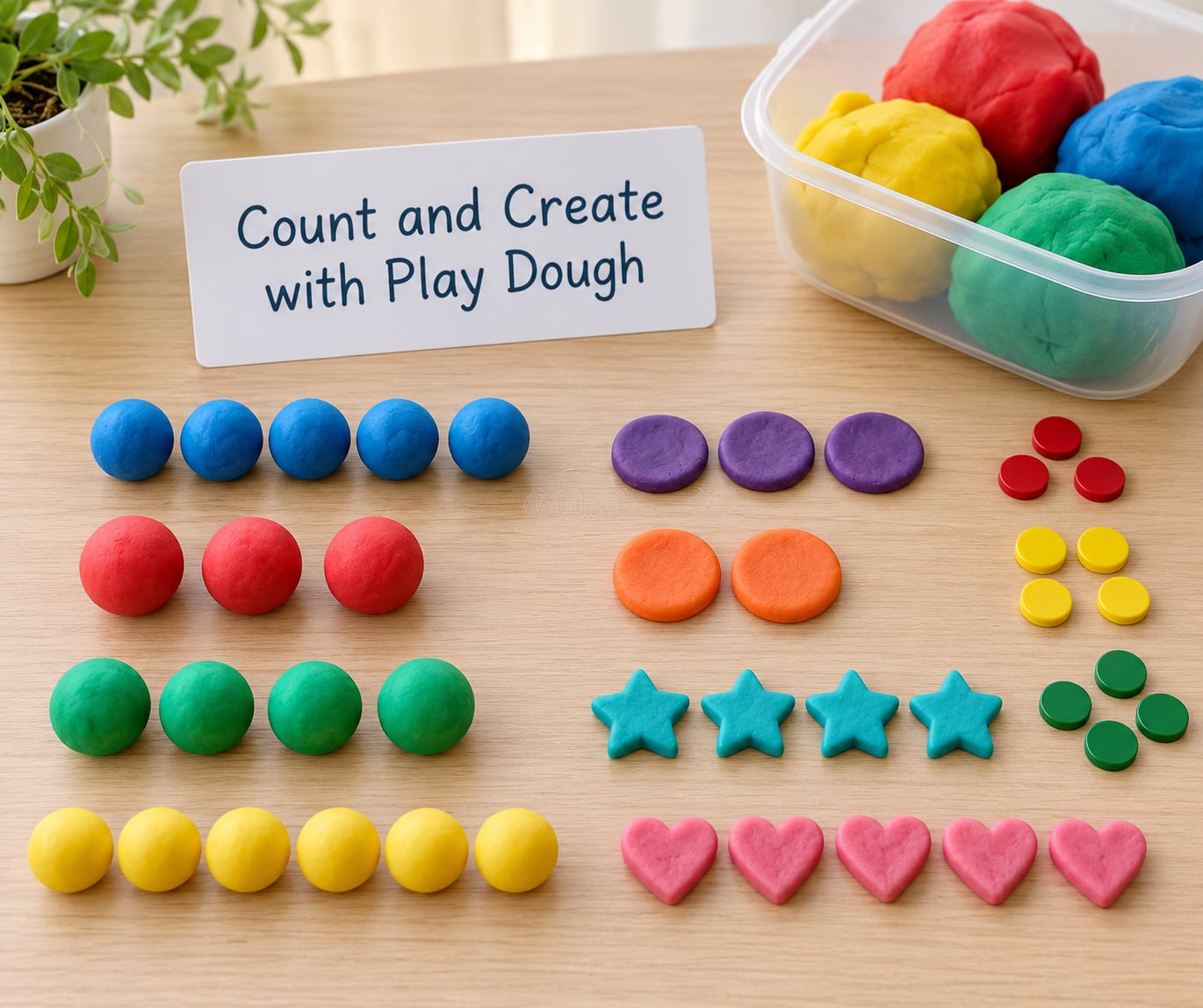
Roll a small ball of dough for each number as you count. Ten balls for ten, then press them flat into a ten frame shape so your child can see the whole set at a glance.
Next, build two separate rows and ask how many there are altogether. That is an addition problem with a physical answer, which is much easier to hold in the head than two numerals side by side.
Play dough is also the easiest material here for a child who needs input through the hands. Rolling, pressing and pinching builds fine motor control that later shows up in handwriting.
Stretch it: roll twenty balls and sort them into two groups of ten, then count the two tens together. That is place value taught with dough instead of blocks.
Household swap: dried beans or dry pasta in a cup with a closed lid give the same counting practice for a child who would rather not handle dough.
7. Add Step by Step with Snack Mats
Draw a long line on a paper plate or a sheet of paper with two sections marked. Put a small pile of crackers in the first section and ask your child how many.
Then add a second pile alongside it and count everything together. The two groups of the same size are the picture of 5 plus 5, and the child can see why the answer is not 5.
Keep the pieces small enough that nobody is tempted to eat them during counting. Sit at the table, check the label for allergens, and skip anything your child cannot safely handle.
Stretch it: take one cracker back off the second pile and ask how many now. Taking away from a set they can still see is a gentle way into subtraction.
No food needed: pom poms, bottle caps or linking cubes on a drawn mat work just as well and survive being dropped on the floor.
8. Build Fraction Towers
Cut ten identical paper squares or set out ten identical blocks in a row. Ask your child to build a tower of five, then a tower of ten, then a tower of three, using only that one kind of piece.
Now ask which tower is the whole and which is half of it. Nothing has been written as a symbol yet, and the child already understands that a half is a part with a fixed size, not just a smaller pile.
Paper squares work better than paper circles for this. A circle cut from paper rarely lands at the same size twice, and unequal pieces defeat the whole teaching point.
Stretch it: colour the tower of five one colour and ask for a second tower of five in another colour to sit beside it. That is half and half, and it is the mental picture behind almost every fraction a child meets later.
For a group: make towers of different heights and hand out descriptions like two more than this one, then let the children rebuild them.
9. Roll, Draw, and Compare
Roll two dice. Count the dots on each one and say the two numbers, then put that many counters on the table for each die. Count the counters together to find the total.
After a few rounds, draw a line between the dice and mark the taller stack with one counter and the shorter stack with two. Most children catch on quickly and start predicting.
This is where comparison quietly turns into subtraction. Taking the smaller number away from the larger one and saying what is left is exactly the operation on the dice.
Stretch it: keep rolling and tally how many times the total comes out below ten. A handful of tallies is a real introduction to collecting data, which is a kindergarten standard in its own right.
No dice: draw two number cards from a shuffled deck instead, or flip two coins and count the pennies.
10. Map the Neighborhood with Math
Walk one block and pick three landmarks your child already knows, such as the corner shop, a tree stump or a red door. Draw three symbols for them at home and use the symbols on the map, not the names.
Count the number of steps between two landmarks together, walking slowly so the counting matches the movement. Then ask which landmark is closer to the house.
Stretch it: draw a compass rose in one corner and ask which way the shop is from the house. Directions, distance and symbols on one page is spatial reasoning plus measurement plus data.
Chalk works well outdoors. Draw a hopscotch numbered one to ten and have your child count out loud on each square before hopping, which combines gross motor movement with the counting sequence.
Frequently Asked Questions
What are some hands-on activities for learning math?
Any activity where a child moves real objects while counting, sorting, measuring or combining them counts. Pour a drawer of buttons onto a table and sort them, build a repeating row of blocks, wrap string around three toys and compare lengths, or roll two dice and add the dots. The shared ingredient is that the child acts on the math instead of watching it. These all work at home with no purchase required.
What are some fun math projects for kindergarteners?
Projects last longer than a single sitting and end in something to show. Bake bread together and count spoonfuls, build a paper city where every building is a different height, run a measurement walk around the block and record lengths, or plan a snack shop and work out how many plates each customer needs. Activity 10, mapping the neighborhood, is a good starting project.
What are some good hands-on activities for kindergarteners?
The ten listed here are grouped by the skill each one builds, and the table above lets you pick by the skill your child needs rather than by popularity. For counting and classification use the sorting activity, for pattern recognition build rows with blocks, for measurement make paper rulers, for combining two groups use a snack mat or play dough. Each entry names its materials and a stretch version for a child who moves fast.
What are fun ways to teach kindergarten math?
Put the math inside something the child already wants to do. Counting steps on the stairs, matching socks by size, splitting a snack between two plates, counting cars in a parking lot. Keep the session to about ten minutes and stop while interest is still high rather than pushing to a worksheet. Mixing in ordinary household jobs means the practice costs you nothing and no time.
How long should a math activity be for a kindergartener?
About ten minutes, and finish early if you can. Attention at this age is short, and a session that ends on a high note is easier to repeat tomorrow than one that drags past the point of interest. If a child stays engaged for twenty minutes, let it run and simply increase the difficulty. Repetition over length is what builds number sense at this stage.
A Simple Place to Begin
Start with the sorting activity today. It needs two minutes of setup, it works with whatever is in the nearest drawer, and it tells you quickly whether your child counts each object once or recites numbers while moving objects around.
Then repeat that same activity three or four more times before adding anything new. Repetition, not variety, is what carries counting into number sense at this age, and these hands on math activities for kindergarten get better the more familiar they become.