The fastest way to teach a child to read at home is a short, repeatable routine built on three things: letter sounds first, blending those sounds into words second, and a daily read-aloud third. Ten to fifteen focused minutes most days is genuinely enough, and you can do it with books you already own plus materials from a kitchen drawer.
There is no single right program, and almost everything marketed as essential is optional. What matters is that the sounds your child hears match the letters on the page, that practice happens in short bursts, and that reading stays pleasant.
Here is the whole method in three groups:
- Teach letter sounds first. Say the short sound each letter makes, not its name, and keep it clean without an extra “uh.”
- Practice blending sounds together. Stretch out the sounds in a word, then say the word: s-a-t, sat.
- Build a daily reading routine. Read aloud together for about fifteen minutes, talk about the story, then finish with a few minutes of your child reading a text they can nearly read on their own.
Before the specifics, two words get tossed around so much that parents often half-know them. Phonics is the set of relationships between letters and the sounds they represent, the underlying code of written English. Phonemic awareness is the ability to hear and manipulate the sounds inside spoken words, like noticing that “sat” and “sad” share a sound, and it comes before reading letters at all.
Both matter. Reading science organizations such as NAEYC and the Child Mind Institute describe early reading as a set of connected skills rather than a single trick, and the sections below follow that shape. This guide is updated for 2026 and stays vendor-neutral: nothing here requires a paid program.
Table of Contents
- What You Need to Teach a Child to Read at Home
- How to Teach a Child to Read at Home Step by Step
- What Each Age Range Usually Looks Like
- Start With Read-Aloud Time
- Teach Print Awareness and Letter-Sound Knowledge
- Practice Sound Blending With Simple Words
- Teach High-Frequency and Sight-Word Words
- Move Into Short, Decodable Reading Practice
- Make Reading a Daily Routine
- Common Mistakes to Avoid When Teaching Your Child to Read
- When to Seek Extra Support for a Child Who Is Struggling to Read
- Frequently Asked Questions
- At what age should you start teaching a child to read?
- How long should a child read each day at home?
- Should I teach phonics or whole word methods?
- What if my child refuses to read with me?
- What are the five core skills a child needs to read?
- Does my child need a paid reading program to learn at home?
- Start Small Tomorrow
What You Need to Teach a Child to Read at Home
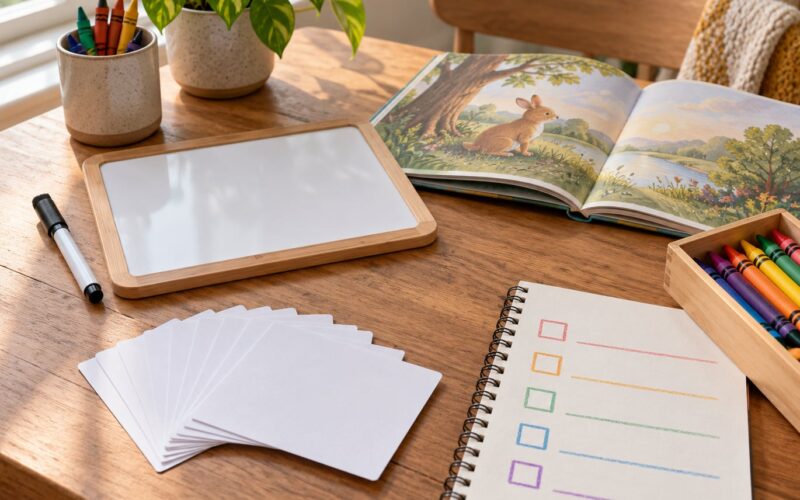
The list is short on purpose. If you have a comfortable place to sit, books, and something to write on, you can start this week.
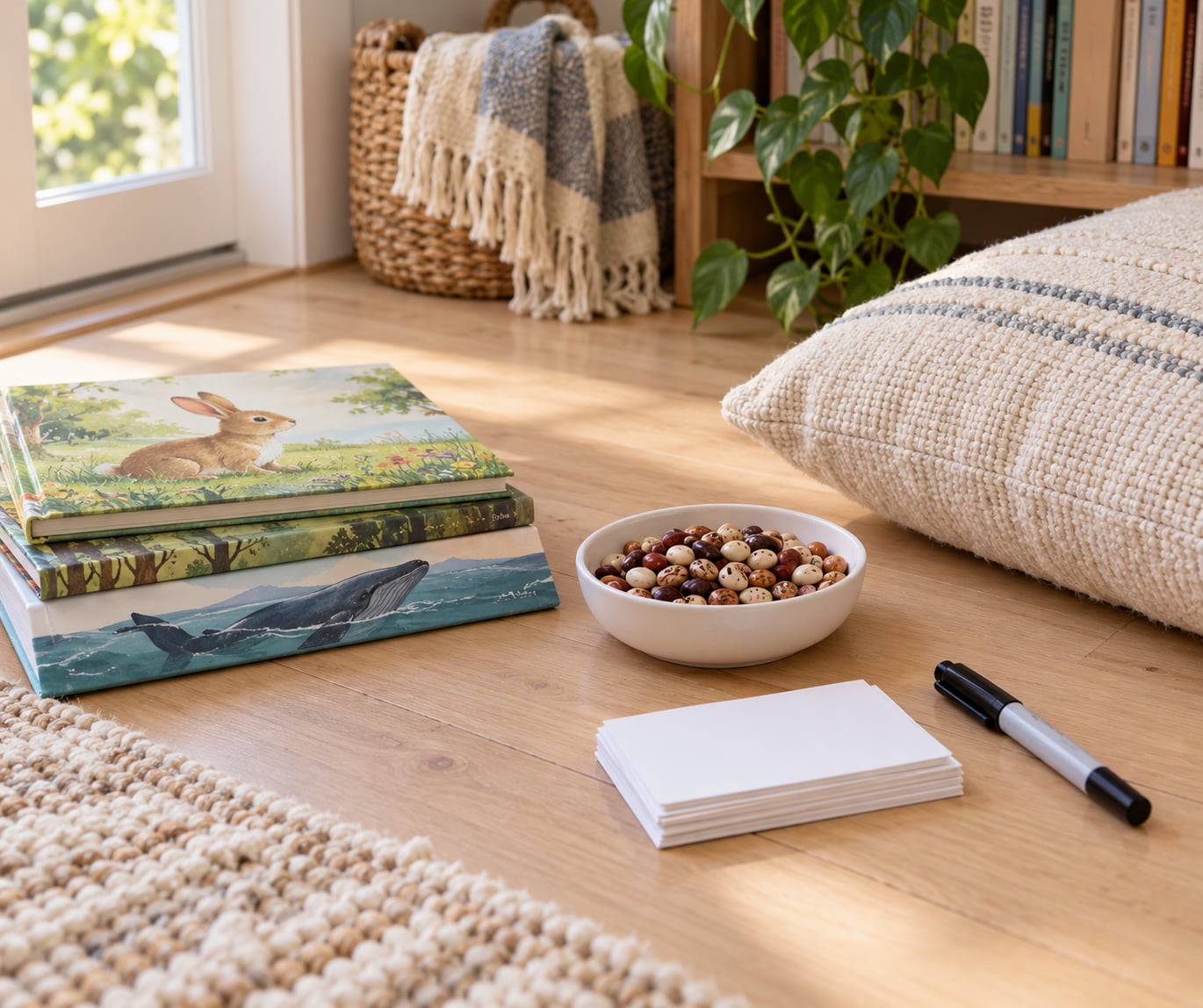
- Books at two levels. One set of books you can read comfortably to your child, well above their decoding level, and one set they can almost read themselves. Rhyming stories, cumulative tales, and simple rhymes work well for the first set.
- A consistent spot. A chair, a beanbag, the corner of the couch. Same place every time turns reading from an event into a routine.
- Letter materials. Index cards and a thick marker, magnetic letters if you have them, or cut shapes from paper. Lowercase first, because most early readers meet lowercase letters before capitals.
- A sound-tapping tool. A finger works. Dry beans or rice in a shallow dish gives you something to tap for each sound, which makes blending much more concrete for a young child.
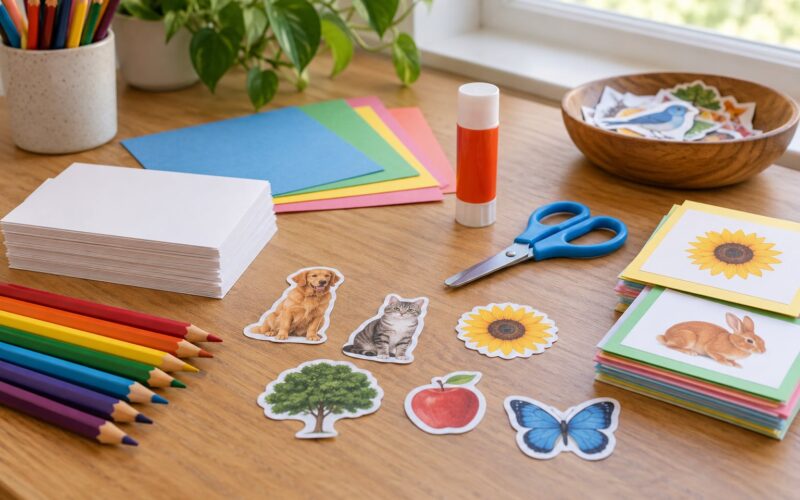
- Word and sentence strips. Paper folded into strips, or blank index cards cut in half, for sight words and for copying short sentences.
- Optional audio. A recording of yourself reading a familiar story lets your child hear how fluent reading sounds. Ten seconds of your own voice beats an hour of someone else’s.
You do not need letter flashcards with clip-art animals beside each letter, and you do not need worksheets. Those materials often work against a beginning reader, which is a problem worth covering below.
How to Teach a Child to Read at Home Step by Step
How to teach a child to read at home is really a sequence, and the order matters more than the pace. Children who learn letter names first often spend months able to recite the alphabet and unable to read a single word. Start with sounds, move to blending, then bring in books and routine.
What Each Age Range Usually Looks Like
Children move through this on their own schedule, and the table below is a map rather than a deadline. Readiness matters more than age, so a four-year-old who is not ready is not behind.
| Age | Main Goal | Typical Session |
|---|---|---|
| 2 to 3 | Love of books, print awareness, rhyme and sound games | 5 to 10 minutes, read-aloud only |
| 4 to 5 | Letter sounds, oral blending, some sight words | 10 to 15 minutes |
| 6 to 7 | Decoding CVC words, reading short texts aloud, comprehension | 15 to 20 minutes |
| 8 and up | Fluency, expression, comprehension, writing simple responses | 20 minutes, plus independent reading |
Start With Read-Aloud Time
Read to your child every day from books that are too hard for them to read alone. This is the step most parents skip because it does not feel like teaching, and it is arguably the one that matters most for vocabulary and background knowledge.
Parents on r/Montessori frequently describe reading above the child’s level deliberately, choosing richer language rather than easy text, because the words in easy books are exactly the words a struggling reader already knows. When you read aloud, you are building the vocabulary that comprehension will later depend on.
Make the session interactive without turning it into a quiz. Pause to ask what the character might be feeling, or what you would do in that spot. Predict what happens next and let the guess be wrong sometimes; the corrections from a wrong prediction are often the most useful part.
How to tell it worked: your child begins narrating parts of familiar books from memory, asks to read them again, or comments on the pictures in ways that go beyond naming what is there.
Teach Print Awareness and Letter-Sound Knowledge
Print awareness means knowing that marks on a page carry meaning, that English runs left to right, and that a space separates words. Children arrive with this in pieces, so name it explicitly rather than assuming it.
Point at the first letter in a word as you read it. Slide your finger under the whole word so the child sees it travel as one unit. When you come to a full stop, pause before the next word so the punctuation is visible as a break rather than something mysterious.
Now teach sounds. The distinction that trips up most parents is name versus sound. The letter B is named bee; its sound is a quick /b/ with no vowel attached. Say it cleanly and short, and resist adding “uh” to consonants, which turns /b/ into /buh/ and confuses a child who is being asked to match pure sounds.
Cover a few letters at a time rather than all twenty-six at once. Two or three new sounds per sitting, reviewed against the ones already known, keeps practice inside the edge of what your child can almost do.
How to tell it worked: given a letter, your child produces its sound instead of naming it, and they can track your finger from the left edge of a line to the right.
Practice Sound Blending With Simple Words
Blending is the skill that turns letters into reading, and it can be taught orally before a child ever touches a book. Say the sounds slowly and separately, then push them together into the word.
Start with two sounds: m-a, ma. Add the third: s-a-t, sat. Tap a finger for each sound, or tap a bean for each sound, so the child feels the separate parts before feeling them fused. Once the word comes together, say it again smoothly so the child hears the finished version.
Move through consonant-vowel-consonant words, the standard first pattern: cat, dog, sun, bed, top. Stick to three-letter words with short vowel sounds for months. Long vowels and consonant blends, like ship or stop, come later and should not be rushed.
Make it active. Build words with letter cards on a table and ask your child to find the “s” sound, or write a word on paper and have them point to each sound as they say it. The activity can be the same ten minutes of the daily session, with no extra time needed.
How to tell it worked: your child blends an unfamiliar three-letter word you say aloud, not just the ones they have practiced twenty times.
Teach High-Frequency and Sight-Word Words
About half of the words in a typical children’s book are high-frequency words that appear again and again: the, you, I, was, have, said, come, some, there, they. Decoding every one of them wastes energy, so readers eventually learn them on sight.
Teach them in meaningful sentences rather than on lonely flashcards. If you drill the alone, it is just a shape. If you write “The dog ran” and your child reads it as one chunk, the word has a job.
Keep the list short per session. Three to five new sight words at a time, written on cards and stored in a shoebox with a rubber band, is plenty. Review the old ones before adding new ones, and shuffle the order so your child reads them rather than reciting them in sequence.
Where you place them matters too. Put them on a door frame, a bathroom mirror, or the kitchen window where cooking happens, so the word appears in a real context rather than only during practice.
How to tell it worked: your child reads a sight word correctly out of the middle of a sentence they have not practiced before.
Move Into Short, Decodable Reading Practice
Decodable readers are short texts built so that nearly every word can be sounded out using the patterns your child has already learned, with only a few sight words mixed in. They are not the same as leveled picture books, which are sorted by difficulty but include plenty of undecodable words.
Let your child read a text aloud and handle any stumble immediately. If they miss a word, cover it and ask what sound it starts with. Provide the sound yourself if they cannot find it, then have them read the word in context and move on. Correcting every error in a passage turns a two-minute read into a ten-minute lesson.
Keep early texts short. One paragraph or a page of large print is plenty. Read the same passage several times over a week; repetition is what builds reading fluency, the ability to read smoothly and with expression rather than sounding each word out from scratch.
Also keep one read-aloud book well beyond their level, every session. Practice and pleasure are doing different jobs, and a child who only ever reads texts they can decode can start to think they are a weak reader.
How to tell it worked: your child rereads a familiar passage with fewer stops, and corrects themselves when a word does not look or sound right.
Make Reading a Daily Routine
Consistency beats intensity, and parents consistently say the same thing about this: short sessions every day outperform one long weekend session. Fifteen minutes on five days will move a child further than two hours on Saturday.
A workable daily session looks like this:
- 5 minutes: review known letter sounds and sight words, using cards or the door frame.
- 3 minutes: blending practice with three-letter words, tapping a finger per sound.
- 10 minutes: read-aloud of a book above their level, with talk about the story.
- 5 minutes: your child reads a decodable text aloud, rereading yesterday’s book if they like.
Spread the practice into routines that already exist. Sing the alphabet in the car, hunt for words on a shop aisle, name letters on a cereal box, stretch out the sounds of the words on a bath-time book. Parents looking for screen-free ideas for their kids get the same mileage from a kitchen word hunt as from an app.
Tie it to the school program where you can. Ask the teacher which letter sounds are being taught and which sight words are on the current list, and practice exactly those. Mismatched sequences waste effort, and no competitor in this space bothers to mention it.
How to tell it worked: reading happens without a negotiation, and it starts while your child is still getting comfortable.
Common Mistakes to Avoid When Teaching Your Child to Read
Most frustration in home reading practice traces back to one of a handful of avoidable habits. Each of these has a straightforward fix.
Starting with letter names. Sing the alphabet all you like, but a child who can recite twenty-six names and no sounds cannot decode anything. Switch the first lesson to sounds and let the names come along for free later.
Adding an “uh” to consonants. Saying /buh/ instead of /b/ sounds harmless and is not. It gives the child a vowel to blend in that is not in the printed word.
Using phonics books with pictures next to every word. The argument on r/homeschool is that a picture invites a guess from context instead of an attempt at the letters. For decoding practice, choose a text with no picture cues on the practice page, and keep the illustrated books for read-aloud where the pictures help comprehension.
Correcting every mistake. Parents ask about this constantly, because a child who reverses sounds, says “teh” for “the,” or skips a word is a common frustration. Stop the sentence, cover the word, ask for the first sound, give it if needed, and continue. One fix per word is enough for a beginning reader.
Fixing a timeline. Comparing your four-year-old to a neighbor’s six-year-old, or to a video of a child reading chapter books, is the fastest route to feeling like a failure. Readiness varies widely, and a child who is not yet ready at four is not behind at four.
Relying on worksheets. A page of letters to trace builds handwriting, not reading. The same ten minutes with word cards, a finger tapping on the table, or a hunt for words in the kitchen builds reading.
Practicing past the point of fatigue. Under twenty minutes per session for ages three to five is a reasonable ceiling. A child who ends practice frustrated carries that frustration into tomorrow’s session, and parents see this most often with reluctant readers.
When to Seek Extra Support for a Child Who Is Struggling to Read
Most reading trouble is a normal mix of slow progress, insufficient practice, and an instruction sequence that does not match the child. Some is not, and it is reasonable to check.
Reading red flags worth raising with a professional include a child who is still reversing letter sounds or losing the order of sounds in a word well after a year of consistent instruction, who recognizes very few sight words past first grade, who cannot blend sounds even when shown a model, or who avoids reading situations entirely with no explanation. A sudden loss of skills, along with broader concerns about attention or schoolwork, deserves a conversation sooner.
Start with the people who already know your child. The classroom teacher can share which skills are missing relative to the rest of the class and whether the school offers intervention support. A pediatrician can rule out hearing issues, and a qualified reading specialist can complete a structured assessment of phonics and phonemic awareness.
Ask for a reading evaluation specifically rather than a general one. You are looking for someone trained in evidence-based reading instruction, and for an explanation of what they will test and what the results mean.
The other side of this is worth saying out loud. Plenty of children read late and catch up fine. If your child is engaged with books, progressing even slowly, and happy to keep trying, you have room to be patient. Get help for stalled progress or distress, not for a birthday.
Many parents who worry about dyslexia find that a structured, explicit approach at home changes the conversation with the specialist, simply because there is finally something specific to describe.
Frequently Asked Questions
At what age should you start teaching a child to read?
Formal reading instruction usually begins between ages four and six, but reading aloud should start much earlier, from birth. Before age four, the goal is print awareness, vocabulary, rhyme games, and a genuine love of books rather than letter drilling. From four, short sessions on letter sounds and blending are appropriate. Readiness beats age: a child who cannot sit for ten minutes or who shows little interest in print is not behind, and rushing usually creates resistance rather than skill.
How long should a child read each day at home?
Fifteen minutes a day, five days a week, is a solid target, and consistency matters far more than total minutes. Split it into about five minutes of letter sound and sight word review, three minutes of blending practice, ten minutes of read-aloud, and five minutes of your child reading a just-right text. Keep sessions under twenty minutes for ages three to five, since attention drops quickly and a short daily habit beats one long weekend session.
Should I teach phonics or whole word methods?
Most evidence-based programs use phonics, meaning teaching the relationships between letters and their sounds, and most children need explicit teaching in that area. Whole word methods, which treat words as shapes to memorize, do not scale well and leave children guessing at unfamiliar text. The practical compromise many families use is phonics for decoding practice plus rich read-aloud of vocabulary-heavy books above the child’s level, which is where comprehension and language grow.
What if my child refuses to read with me?
Stop pushing and go back to read-aloud only, keeping the book time warm and entirely your own reading. Many reluctant readers are exhausted by forced practice rather than opposed to books. Offer choices about when and where to read, let your child take turns reading one line, and stop while they are still enjoying it. A refused session followed by a good week of shared reading is better than a forced session followed by refusal.
What are the five core skills a child needs to read?
The five widely used core skills are phonemic awareness, the ability to hear and manipulate sounds in words; phonics, the letter-sound relationships in written language; vocabulary, the words a child knows and understands; reading comprehension, the ability to derive meaning from text; and fluency, reading smoothly and with expression rather than sounding out every word. Home practice should touch all five, even though decoding gets most of the attention.
Does my child need a paid reading program to learn at home?
No. The core method needs a short daily routine, books you can borrow from a library, index cards, and a marker, which means free. Paid programs can save you planning time and provide structured decodable texts and assessments, but the evidence-based skills they teach can be taught by a parent without them. If you buy anything, match it to the letter sounds and sight words your child already has, rather than starting a second program on a different sequence.
Start Small Tomorrow
Pick one book your child loves and one set of index cards. Write three lowercase letters on three cards, say their sounds, and stop there. Fifteen minutes tomorrow, five days a week, with the same chair and the same routine, will teach a child to read at home faster than any program you could buy this week.