Knowing how to teach fractions with food comes down to one idea: give a child something real to divide, count and share. Split a pizza, cut a sandwich, pour half a cup of milk, and the symbol 1/2 finally points at an object they have touched and eaten. Every activity below takes 10 to 20 minutes, needs nothing more exotic than a plate and a knife you control, and works from about age three upward.
Start with the pizza. It is the fastest way to get a child saying “one half” and “one quarter” out loud, and everything after that builds on it.
Table of Contents
- What You Need
- Fraction materials
- Foods that hold their shape when cut
- Tools
- Step-by-Step: How to Teach Fractions With Food
- 1. Divide a Pizza Into Equal Fraction Slices
- 2. Make Fraction Sandwiches or Wraps
- 3. Build Fraction Trays With Snacks
- 4. Share a Batch of Cookies or Pancake Pieces
- 5. Measure Fraction-Sized Ingredients
- Common Mistakes
- Frequently Asked Questions
- What age is appropriate for learning fractions with food?
- Which foods work best for teaching fractions?
- Can fractions be taught without worksheets?
- How can I explain equivalent fractions to a young child?
- Are these food fraction activities suitable for preschoolers?
- How do I know if my child understands the fraction?
- Conclusion
What You Need
You can run any of these activities with what is already in your kitchen. The list below is a mix of ingredients, serving tools and the fraction materials that make the modelling visible.
Fraction materials
- A paper plate or a sheet of paper and a pencil for drawing circles and bars
- A ruler for drawing straight division lines on a paper pizza
- A muffin tin, a divided plate, or a muffin liner tray for portion trays
- Dry erase marker and a small whiteboard, if your child likes to record what they build
- Fraction circles or fraction bars, once the food version has landed
Foods that hold their shape when cut
- Paper or real pizza, and sliced bread for sandwiches and wraps
- Crackers, pretzel rods, sliced fruit, baby carrots, popcorn, cheese cubes
- Small cookies, pancakes, crackers or fruit pieces for a shareable batch
- Ingredients you already cook with: milk, water, sugar, flour, oil
Tools
- A child-safe knife for adult-assisted cutting, plus a plastic knife for pretend cutting
- Measuring cups, measuring spoons, a mixing bowl and a whisk
- A cutting board, a plate per person and a damp cloth for the floor
For dietary restrictions, the swap is usually easy. Use a gluten-free cracker or a slice of a rice cake for the sandwich, seed butter or sunflower butter instead of nut butter, coconut cream or oat milk for the measuring cup, and olives, cucumber rounds or tofu cubes where another child gets berries. Anything that holds a straight edge works as a portion model.
Step-by-Step: How to Teach Fractions With Food
The five activities below are ordered on purpose. Start where portions are simply equal, then move to portions that must be shared, then to fractions that have to be measured. The one rule that keeps this from turning into a worksheet is simple: the child does the dividing and the naming, and you do the talking only after they have answered.
1. Divide a Pizza Into Equal Fraction Slices
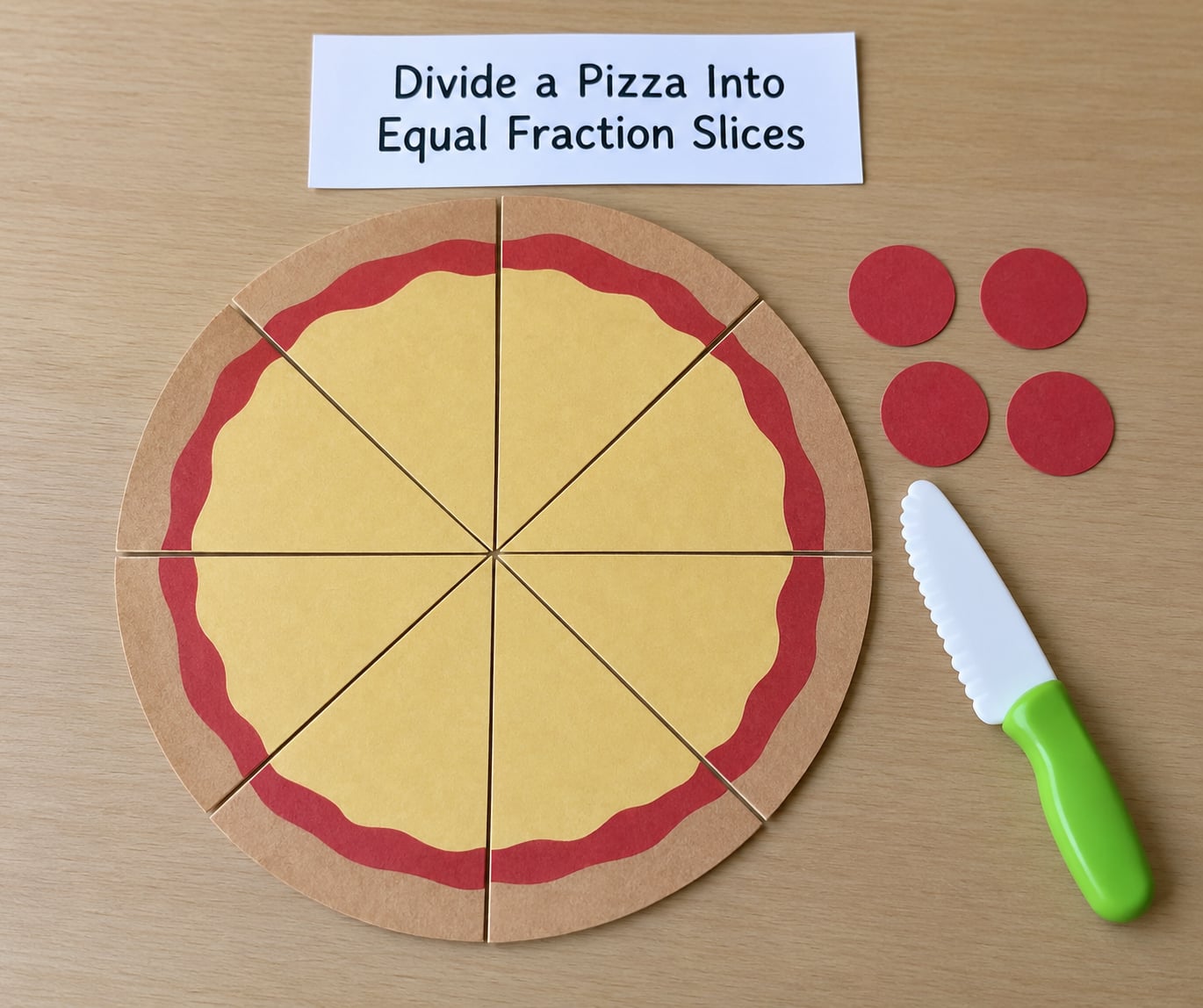
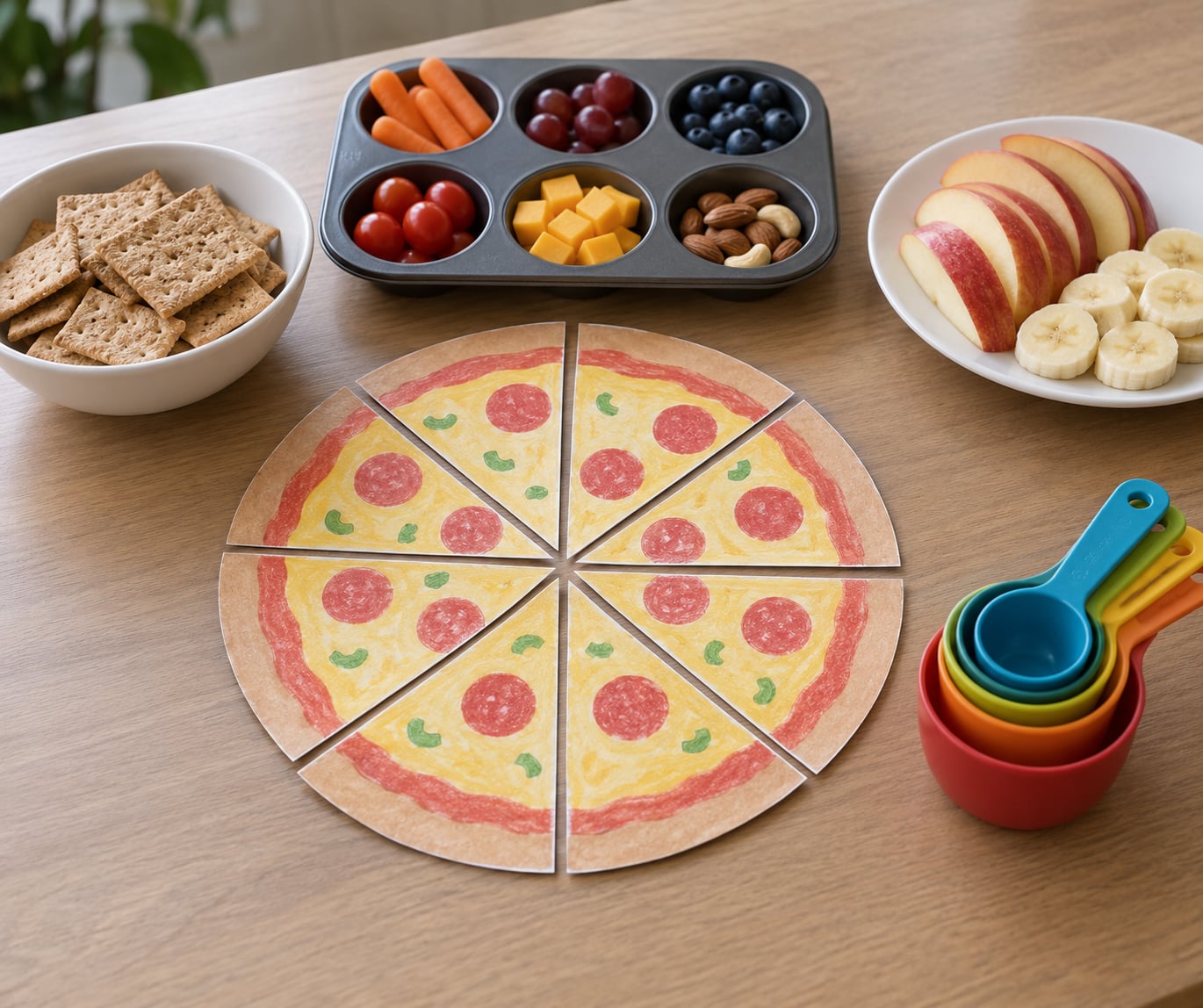
Draw a circle on paper and cut real pizza the same way, side by side, so the two versions line up. Start by folding the paper circle in half and asking how many pieces your child thinks are in it, then unfold and cut. Two pieces is one half. Cut each half once more and you have four quarters, and each quarter is still the same size as the others.
Now push it one step further and cut the pizza into eight. Your child will usually insist that eight is “more” than four, which is the moment worth slowing down for. The two slices they are holding together cover the same area as one of the larger slices, so two eighths equal one quarter. Write both on the paper and let them place the pieces on top.
Add the vocabulary here rather than earlier. The bottom number, the denominator, is the count of equal parts in the whole. The top number, the numerator, is how many of those parts are being taken. A slice that is one of the equal parts is a unit fraction.
You know it worked when your child points to a slice and tells you how many slices are in the whole without being asked, and can say why four eighths and one half cover the same pizza.
2. Make Fraction Sandwiches or Wraps
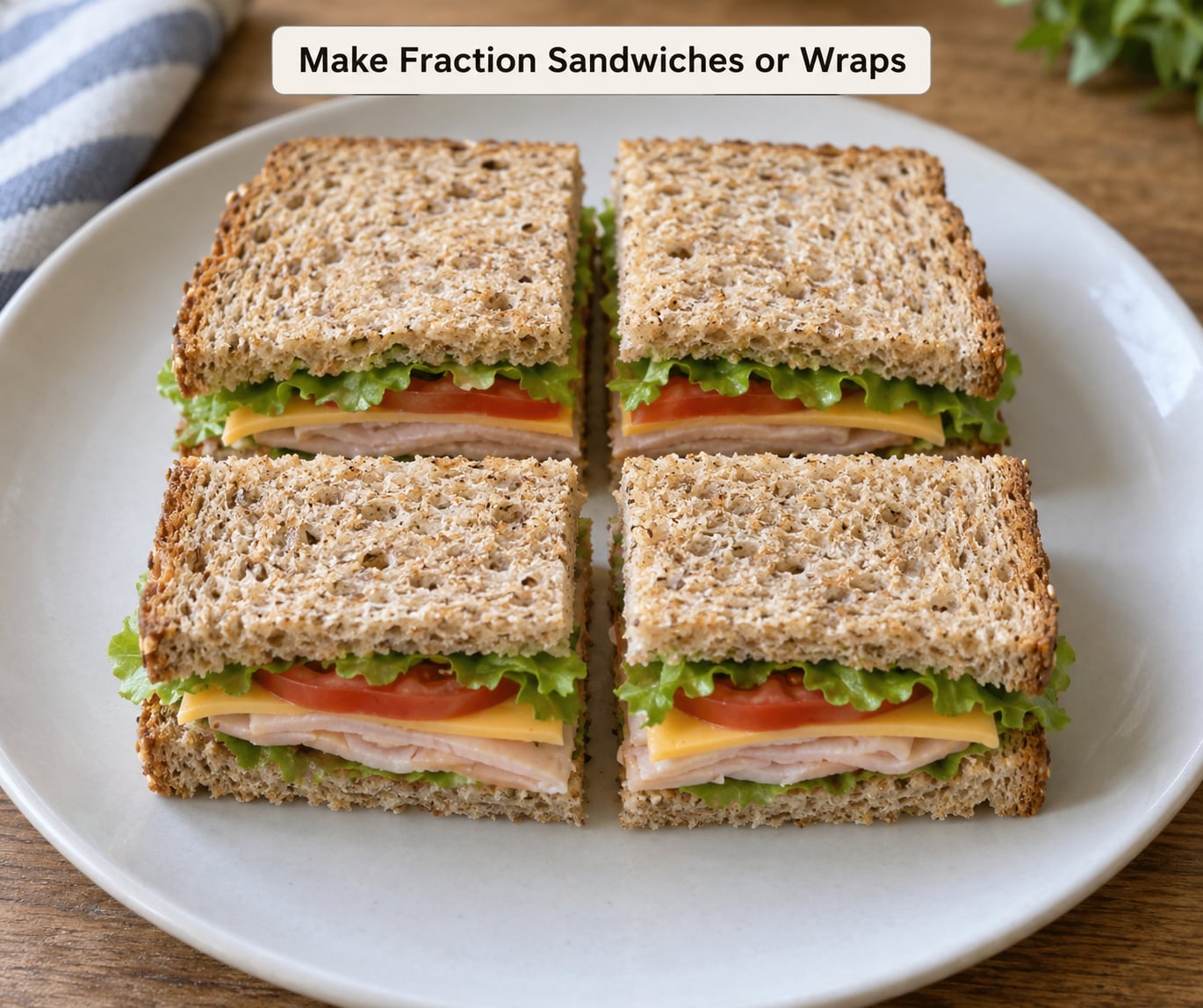
A sandwich is the best food for showing that a whole can be cut into different numbers of pieces and still divide the same amount. Let your child build it, then cut it yourself into two. Two halves. Next time cut it into four strips. Four quarters. Then into eight small triangles, which gives eighths of the same sandwich.
Set two of those triangles beside one half and ask how many pieces it takes to match it. The answer, two, is equivalent fractions in its plainest form: two eighths and one half cover the same bread. Wraps work even better for thirds because you can roll the filling out evenly and cut three long sections without the layers sliding out.
Ask what would happen if four people shared one sandwich instead of two. Each person gets one quarter, and there is nothing over. Then ask what happens with three people. Now the leftovers have to be split into thirds of what remains, which is exactly the step that most worksheets skip.
You know it worked when your child can look at a sandwich cut a different way and say how many people could each get a fair share.
3. Build Fraction Trays With Snacks
This is the most flexible activity, and the one that scales from preschool to upper elementary without changing at all. Give your child one muffin tin cup or one section of a divided plate and ask them to fill it completely with one snack. Count together. That is one portion. Now ask how many portions are in the whole tray.
Fill the tray with eight pretzels, then cover two of them and ask what is showing. Two eighths. Cover six and it is six eighths, or three quarters written another way. Children who are further along can write the fraction, match it to a drawn bar model, and order three fractions from smallest to largest by laying the pieces out side by side.
Keep the snack slow. Anything that rolls, breaks or disappears gets counted wrong, and the child concludes the math was wrong rather than the cracker. Small crackers, cereal pieces, blueberries, banana coins, carrot coins, cheese cubes and popcorn all stay where you put them.
You know it worked when your child builds a portion, names it, and then says what the rest of the tray is without prompting.
4. Share a Batch of Cookies or Pancake Pieces
Bake or buy a batch and do not pre-cut anything. Set the whole tray on the table and write a number: four people, three people, two people, one person. Ask your child how the batch should be divided fairly, then have them do the cutting and the distribution.
Sharing turns fractions into a social problem, which is why it works so well after the first two activities. With two people, each one gets one half. With four, one quarter each. Ask how much one person would get out of eight pieces, then have them give out eight pieces to two children and describe each share as a fraction of the original batch.
For older children, push the leftover problem. If four people eat and two pieces remain, what fraction of the batch is left? Then double the recipe question: if you need cookies for eight people instead of four, what has to double? Most of the arithmetic here is done in their head while their hands are busy, which is exactly where you want it.
You know it worked when your child explains why both ways of dividing were fair, using the word “equal” and meaning it.
5. Measure Fraction-Sized Ingredients
Once portions are comfortable, move to fractions you read in recipes. Fill one measuring cup with milk or water and ask what one cup is called. A cup is one whole. Half a cup is one half, three quarters of a cup is three quarters, and one third is the same cup marked at a third of the way up.
Make the marks visible by using a cup with a clear side, or by showing the level in a glass first. Doubling or halving a recipe is the classic kitchen math problem: if the cookie recipe calls for one third of a cup of oil and you are making double, the child works out that you need two thirds, and then the practical part, which is measuring two thirds of a cup without spilling it.
Use the language out loud while you pour. Half, half of that, a quarter, one third, two thirds, remainder. A measuring cup is also the one model that transfers straight to the fraction bar and the number line, so it is worth repeating after the tray and sandwich stages.
You know it worked when your child reads a recipe line and says how much more of the ingredient is needed, rather than pouring blindly to the top.
Common Mistakes
Portions that are not the same size. A sandwich cut into a fat triangle and a thin triangle looks like two halves but is not two halves. Cut the whole before separating the pieces, use a ruler for straight lines on paper, and if the food will not cut evenly, discard the leftover sliver out of sight so the model stays honest.
Treating a fraction as a count. If your child says “I got three” and stops, the fraction language never attached. Ask the follow-up every time: three of what, out of how many? The answer, three out of eight, is the fraction.
Vocabulary too early. Numerator, denominator and improper fraction mean nothing to a five-year-old and slow the whole activity down. Use halves, thirds and quarters first, and add the written language once the child can name the portion without looking at you.
Doing all the thinking. If you cut, count and narrate, your child is a spectator. Hand over the knife, the plate and the counting job, and keep your explanations for after they have answered.
Choosing food that fights you. Grapes roll off the tray, crackers crumble mid-count, and very small children find a full sandwich overwhelming to handle. Stick to slow, flat, countable snacks on a divided surface, and skip anything sticky near the numbers.
Over-complicating the activity. A pizza cut into eighths with toppings to sort is two lessons at once. Run it plain, and add the extra layer the next time, once the first one is easy.
Frequently Asked Questions
What age is appropriate for learning fractions with food?
Start around age three with halves, quarters and the words same and equal. Children ages five to six handle thirds, eighths and the idea that different numbers of pieces can share one whole. From about seven upward, use the sharing and measuring activities to work on equivalent fractions and recipe doubling. The same food activity can stretch five years if you change the question, not the snack.
Which foods work best for teaching fractions?
Pick food that holds its shape, divides into even lines and is slow to eat. Pizza, sandwiches, crackers, pretzels, sliced fruit, cheese cubes and popcorn all work. Paper versions count too, and they let a child cut the same circle several times without running out of pizza. Avoid food that rolls away, crumbles during counting or melts before the last piece is named.
Can fractions be taught without worksheets?
Yes, and for many children food is the only version that lands at first. Dividing, sharing and measuring are the mathematical acts themselves, not preparation for them. A notebook sketch of the tray your child just built is worth more than a printed page, because the picture came from something they handled. Add worksheets later as a record of what they already understand.
How can I explain equivalent fractions to a young child?
Skip the words and use two objects. Cut a sandwich into two pieces, then cut one sandwich into four and put two of the small pieces side by side on top of the big piece. Ask how many small pieces it takes to cover the big one. Once the child can see the match, the idea sticks, and equivalent fractions becomes something they can rebuild themselves with pizza or crackers.
Are these food fraction activities suitable for preschoolers?
The pizza, sandwich and tray activities are, if you keep the language to halves and quarters and let the child handle the food instead of watching you. Skip the measuring activity, which depends on reading numbers, and skip recipe doubling entirely. Many preschoolers already sort crackers and fruit into groups by eye, and this gives that sorting a name they can hear.
How do I know if my child understands the fraction?
Ask them to point at a portion and tell you how many equal parts make the whole, then say how many are taken. Next, change the number of parts and see if they can predict the new fraction before cutting. If they can explain why one half and two quarters are the same amount, the concept has landed. If they only recite the name, keep cutting and sharing.
Conclusion
Five activities cover most of what fractions ask of a young child: equal parts on a paper pizza, a sandwich cut several ways, snacks built into portions on a tray, a batch shared among different numbers of people, and a measuring cup for halves, thirds and quarters. Nothing here needs a worksheet or a special curriculum.
Begin with the pizza and let the equal parts be the whole lesson. Once your child names a portion and says how many made the whole, move to sharing, and finish with the measuring cup.