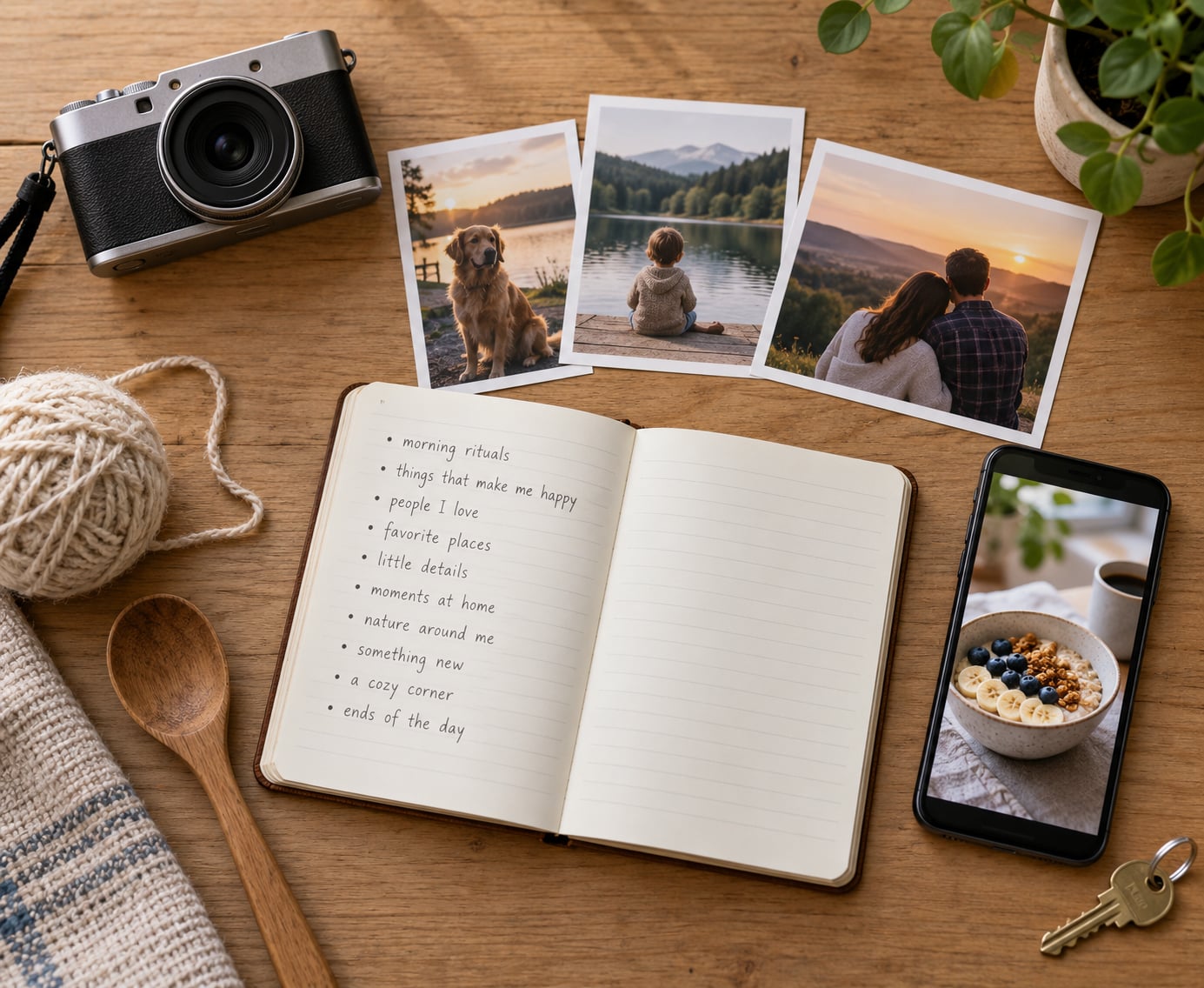
A family photo challenge is a short, structured set of prompts, one per day for a week, a month, or a year, that gives you a reason to photograph ordinary life instead of only staging formal portraits. These family photo challenge ideas for beginners all work with a phone camera and about ten minutes.
That is the whole trick. A challenge solves the hardest part of family photography, which is deciding what to photograph in the first place. Once the prompt is written down for you, the only job is to point the camera at something real and take the shot.
I have run these with kids ranging from three to fifteen, and the pattern is always the same. The families who keep going are the ones who picked one short challenge, let everyone take turns holding the phone, and never once mentioned the word posed. Updated for October 2026.
Table of Contents
- Family Photo Challenge Ideas for Beginners at a Glance
- 1. One Photo a Day for a Week
- How to keep it honest
- 2. The Same Moment Three Ways
- 3. Color of the Week
- 4. Family Photo Walk
- 5. Document the Daily Routine
- 6. Tell a Family Story in Five Photos
- 7. Texture and Pattern Hunt
- 8. Same Place, Different Seasons or Weather
- 9. At-Home Mini Portrait Setup
- 10. Create a Shared Family Photo Journal
- Frequently Asked Questions
- Do I need a DSLR to do a family photo challenge?
- How long should a family photo challenge be?
- What are some fun photo prompts for a family session?
- How do I get my kids to take part in photos?
- What do I do with family photos after the challenge ends?
- Conclusion
Family Photo Challenge Ideas for Beginners at a Glance
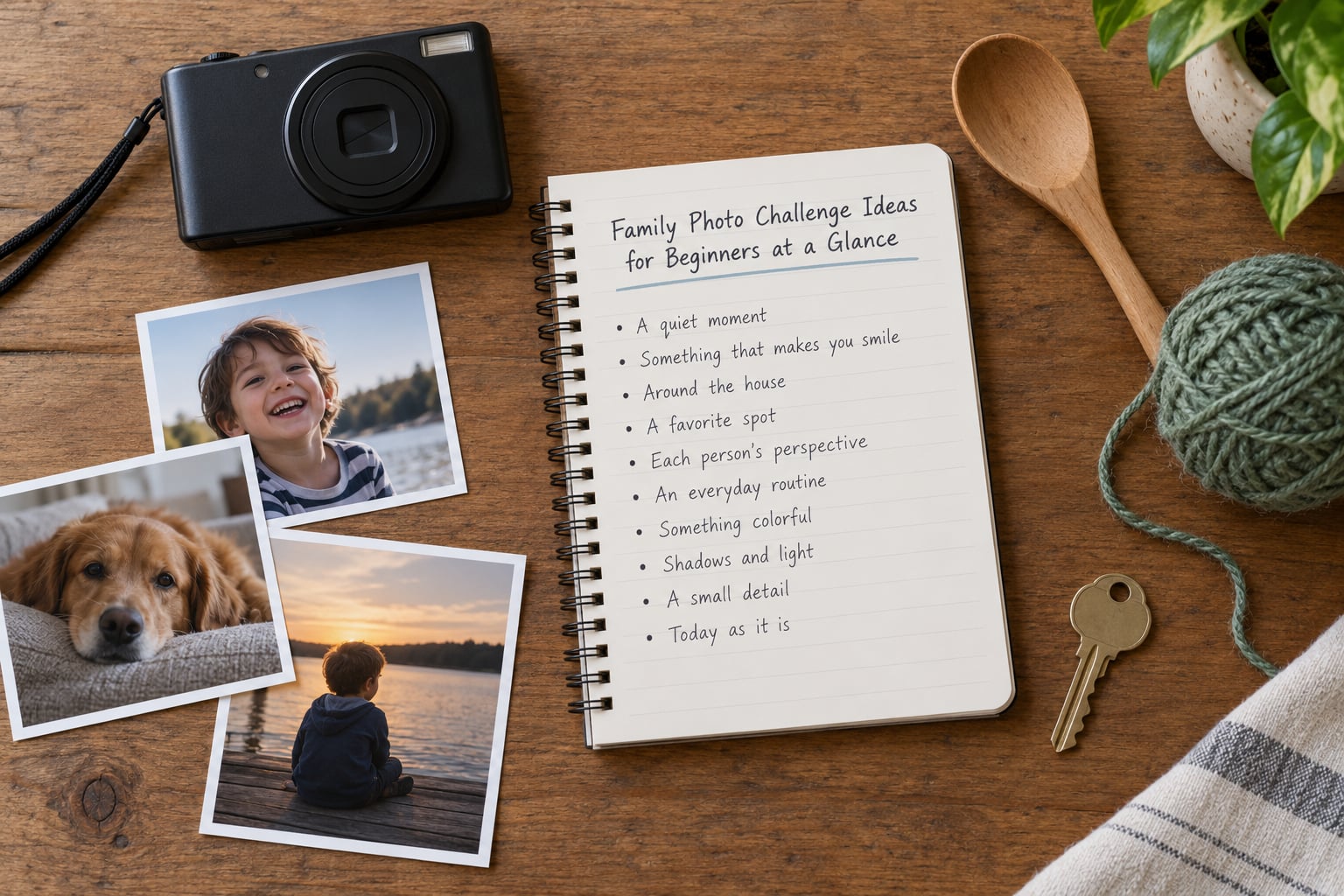
Every challenge below needs nothing beyond a phone, a few minutes, and whatever is already in the room. The table shows what each one asks of you before you commit.
| Challenge | Ideal length | What you need | Difficulty | Memory it captures |
|---|---|---|---|---|
| One photo a day | 7 days | Phone only | Very easy | How your kids looked this month |
| Same moment, three ways | 3 days | Phone only | Easy | One ordinary scene, seen properly |
| Color of the week | 7 days | One color | Very easy | A season through one shade |
| Family photo walk | 1 to 2 hours | Shoes and a list of prompts | Easy | Your neighborhood as your kids see it |
| Daily routine | 7 days | Nothing | Very easy | The parts of a day you never see |
| Story in five photos | 1 session | Five minutes of planning | Easy | A whole story, start to finish |
| Texture and pattern hunt | 1 to 2 hours | Nothing | Easy | How sharply a child looks |
| Same place, changing weather | 4 weeks | One familiar location | Medium | Seasons stacked on one view |
| At-home portrait setup | 1 session | A window and a chair | Easy | Real portraits without a studio |
| Shared photo journal | Ongoing | A notebook or shared album | Easy | Words attached to the pictures |
If you only have the energy for one, start with row one. Seven days is short enough that nobody can quit, and long enough that you end up with something to look at.
1. One Photo a Day for a Week

This is the starter challenge. One photo each day for seven days, no theme, no editing, no scoring.
Most people try to be interesting on day one and quit by day four. Pick boring subjects instead: the front hallway with everyone’s shoes piled up, the kitchen table at 7am, the back of the car with the sports bag. Ordinary pictures are the point. In ten years you will care far more about the shoe pile than about a good portrait.
How to keep it honest
Set one repeating time of day. Before dinner works well for most families because everyone is already in the same room. Shoot it, put the phone down, do not edit it that night. Seven raw photos are worth more than seven heavily filtered ones.
A good beginner rule: if you have to set anything up, it is not this challenge. That is challenge nine.
2. The Same Moment Three Ways
Pick one scene, like the kitchen table at breakfast, and photograph it three times from a different distance, a different angle, and a different height.
This teaches beginners more in ten minutes than any settings lesson. WIDE: stand back so you see the whole room and everyone in it. CLOSE: walk over and frame one person’s hands on the table. LOW: put the phone on the counter and shoot across the tabletop so the ceiling and window light come into frame.
Keep your phone in automatic mode the whole time. Forum advice from beginner photography communities lands on the same point over and over: lighting and how you handle the people matter more than equipment.
3. Color of the Week
Choose one color on Sunday and photograph it wherever it turns up for the next seven days. Red works well. So does green in the spring, blue during a stretch of rainy days, or whatever color your kid is completely fixated on that month.
That fixation is the useful part. A four-year-old who will not wear the yellow shirt will still hunt for every yellow thing in the house if yellow is the assignment.
Look in the places people forget: a chipped mug, the school bag, a book cover, the neighbor’s fence, a leaf on the pavement. On day seven, line up the seven photos in order and you have a small study of one shade that a child made for you.
4. Family Photo Walk
A photo walk turns an errand you were doing anyway into a scavenger hunt with a camera. Everyone gets a different job.
Before you leave, agree on five or six prompts. Textures, shadows, signs, pets, interesting doors, and anything yellow are reliable starters. Write them on a scrap of paper and hand each one to a different person, or give everyone two prompts and let them roam.
Toddlers do well with a single simple prompt repeated, like finding dogs. Teens do well with competitive totals. The walk works in any weather because the prompts are about what is out there, not about nice light.
5. Document the Daily Routine
Photograph one step of a routine each day instead of the whole routine at once. Monday is the morning scramble, Tuesday is shoes, Wednesday is the school run door, Thursday is homework, Friday is bath time, Saturday is pancakes, Sunday is the sofa.
Keep the camera low and out of the way. Photographing from behind, from below, at the level of the actual activity gets you far better pictures than standing over your children asking them to look up.
Framing a normal indoor shot near a window, with the people turned toward the light, fixes about eighty percent of the dim indoor photos beginners complain about. Cloudy daylight is even better, because it behaves like a giant softbox.
6. Tell a Family Story in Five Photos
Pick something small that already happened, then shoot it as a five-part sequence: the beginning, the middle, a reaction, one detail, and the ending.
A worked example. Beginning: the birthday cake still in the box on the counter. Middle: your kid blowing out the candles. Reaction: the face two seconds after, mid-laugh. Detail: a close shot of the paper plates and a squashed cracker on the floor. Ending: the abandoned frosting on the kitchen table at bedtime.
Five photos in this order read as a story with no caption at all. That is the whole concept of photo storytelling, and it works with any family moment, including a bad one. My rule is that the ending photo should show what is left over.
7. Texture and Pattern Hunt
Put the challenge on close-ups only. Fill the frame with something: a knitted blanket, a crumbly biscuit, a cracked pavement, a shiny tap, a wooden spoon worn smooth at the handle, a woven basket.
Ask for rough, smooth, wrinkled, shiny, and repeating. Then, once the frame is full, change one thing at a time. Same spot, brighter light. Same spot, shadow across it. Same spot, in black and white.
This one quietly teaches your kids to notice, and it works on a rainy afternoon with a sheet of paper and a lamp on the table. Six-year-olds remember this challenge longer than the family portrait ones, because the photos look weird and that is fun.
8. Same Place, Different Seasons or Weather
Pick one safe, familiar spot: the front step, the school gate, the bench in the park, the view out of the kitchen window. Stand in the same spot each time and take one photo. Come back weekly until you have eight or twelve.
Keep the framing roughly identical so the changes do the work. Leaves, snow, rain, fog, a flood of sun, the same tree bare and then full, kids who have grown visibly taller between frame one and frame eight.
This is the slowest challenge on the list and the one families end up keeping the longest, because the comparisons become obvious only months later. Eight photos of one doorstep beats a hundred scattered ones.
9. At-Home Mini Portrait Setup
For one person at a time, move a chair near a window. Plain wall behind them, window to the side, not behind, so half the face is lit and half is in soft shade.
Shoot between 10am and 2pm on an overcast day for the easiest version of this. If the sun is direct, hang a thin white sheet or a towel over the window to soften it. Then ask your subject to do something while you take pictures. Hold up a book, tie a shoe, drink a glass of water. Movement gives you expressions that a pose never will.
One chair, one window, and no equipment beyond a phone is a complete portrait setup. Photographing your child with a photo scavenger hunt at the park is another way to get real faces, if the living room version stalls.
10. Create a Shared Family Photo Journal
The photos are half the project. The second half is what you do with them, and this is the step most people skip.
Pick one person to be the keeper and give them one job per week: collect everyone’s photos into one shared album, write the date and a single sentence about what was happening, and print or display one image. A shared album on a phone works if everyone can add to it without hunting you down.
For the paper version, a cheap spiral notebook, a glue stick, and the weekly print is enough. Glue in one photo per page, add the date and the sentence. Once you have a stack of pages, the book assembles itself and it becomes a Christmas or birthday gift for grandparents without any further effort.
One rule keeps it alive: every family member contributes a photo on their turn, including the parent. A journal that only contains one person’s view of the family stops being a family record after about a month.
Frequently Asked Questions
Do I need a DSLR to do a family photo challenge?
No. Every challenge on this list works on a phone camera, and phone cameras handle the situations families actually shoot in, daylight and indoor rooms, perfectly well. Beginners who buy gear first often stall before they start. Use what is already in your pocket, learn where the light is coming from, and upgrade only if a specific limitation starts to bother you.
How long should a family photo challenge be?
Seven days is the right starting point because most families can finish one without rearranging their life. A month gives you real practice and enough photos to spot a theme. A year works only if you pick themes broad enough that you never need an idea on a Tuesday night. Skip freely. A missed day does not break the challenge, and restarting after a bad week is normal.
What are some fun photo prompts for a family session?
Try hands in action, a favorite object on the kitchen table, the view from the front door, someone mid-laugh, a shadow on the ground, and what the house looks like from inside at bedtime. Prompts work far better than instructions. Instead of telling your kids to stand there and smile, give them a job and photograph the job.
How do I get my kids to take part in photos?
Hand over the phone. Kids photograph themselves and their siblings happily because being the one behind the camera removes the pressure. Follow their lead, let them choose the prompts, and stop after ten minutes while they are still enjoying it. Photography that ends early gets repeated. Photography that becomes a long, fussy session gets hidden from.
What do I do with family photos after the challenge ends?
Do something small within a week, while the interest is still there: print one photo, fill one page of a shared album, or pick one frame per week for a calendar. A simple notebook with a photo, the date, and one sentence per page produces a keepsake that becomes a gift without any extra planning. Big projects never start, and small ones do.
Conclusion
Pick one challenge, set a start date, and use the phone already in your pocket. Seven days of one photo a day is the easiest place to begin, and the hardest part, choosing what to shoot, is already written down for you. Miss a day, take two the next, and put the finished set in one place where everyone can see it.