The public library is the largest learning resource most homeschool families never fully use. Knowing how to use the library for homeschooling means turning one free card into books, audiobooks, research databases, hands-on kits, and free programs that a family could never buy outright.
The trick is that the library rewards families who arrive with a specific question, not a vague request for “something fun.” Below is the workflow I wish someone had handed me before our first library day: get the cards sorted, set one learning goal, search the catalog the way a librarian would, ask for what the catalog cannot give you, and track what you bring home so nothing gets lost.
Table of Contents
- What You Need
- Step-by-Step: How to Use the Library for Homeschooling
- 1. Set the learning goal before you search
- 2. Learn the catalog and find sources you can trust
- 3. Ask the librarian specific questions
- 4. Borrow beyond books
- 5. Use research tools and databases for homeschool
- 6. Attend programs and use the study space
- 7. Record, evaluate, and return what you borrowed
- Common Mistakes That Waste Library Trips
- Frequently Asked Questions
- What is a homeschool library card?
- What if my child cannot get a card without their own ID?
- Is Libby or Hoopla better for homeschoolers?
- Can you request an interlibrary loan through Libby?
- Which library databases help most for homeschool research?
- How do I keep library use sustainable year after year?
- A Simple Library Routine for Homeschool Families
What You Need
Before the first visit, gather five things. None of them are expensive, and most libraries can sort you out in a single fifteen-minute stop at the desk.
- A library card for every family member. Most systems issue free cards to any resident with proof of address, and a parent’s ID usually covers a parent. Children often need their own card, sometimes with a birth certificate, school ID, or proof of address in a parent’s name.
- Proof of residency and identification. A driver’s license, state ID, utility bill, or lease usually works. If you move or are in a rural area with no in-system branch, ask about a non-resident or reciprocal card, which some states offer for a modest yearly fee.
- A written list of learning needs. Write down the current unit topic, the ages of your children, and any specific skills you are working on, such as reading long chapter books or writing a research paper.
- A notebook or device for notes. Kids who arrive with a place to write down author names and call numbers stop losing books at home.
- The name, email, and phone number of the children’s librarian. This one contact saves hours later. Librarians curate reading lists, pull books for unit studies, and know what is arriving next month.
If a child is too young for their own card, they can still check out items on a parent’s card, and some systems let you apply online as a family so children appear as authorized borrowers on one account. Ask at the desk before you assume the worst.
Step-by-Step: How to Use the Library for Homeschooling
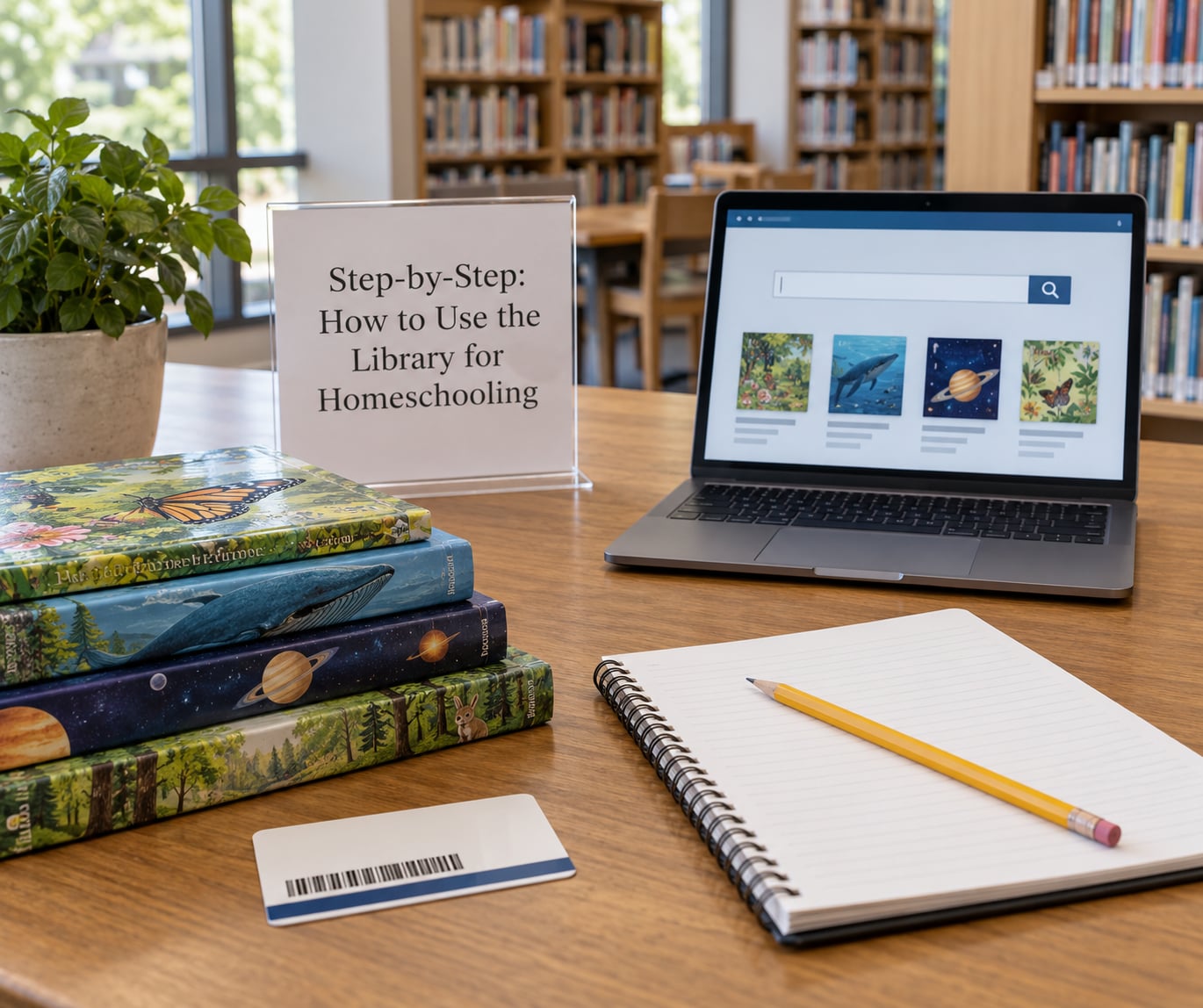
This process works the same for a two-week unit or a full semester. Run it before, during, and after each study topic, and your visits stop feeling random.
1. Set the learning goal before you search
Turn each lesson into a single library question. Instead of “find books about ecosystems,” write “compare three U.S. ecosystems and find one reliable source for each.” A question with a shape forces the catalog to give you something usable.
Write the goal at the top of the notebook page along with the date. When you come back from the trip, you can tell instantly whether anything you brought home actually answers the question.
2. Learn the catalog and find sources you can trust
Use subject headings and keywords first, then narrow by format and reading level. Most catalogs let you filter to nonfiction, large print, and a specific interest area, and the subject heading list under any good search will point you toward the terms librarians actually use.
For browsing, the Dewey Decimal System puts all nonfiction on the shelves in the 000s to 999s, with 500s holding science and 300s holding social sciences. Standing in front of a shelf and reading call numbers works better than guessing keywords, especially with a younger child.
Read the description, the reading level, and the reviews before you put anything on hold. A book that looks perfect in a search result can be written for a completely different age.
3. Ask the librarian specific questions
Children’s librarians are the most underused resource in this whole system. They are usually happy to pull titles, and the question just needs to be concrete.
- “I’m doing a two-week unit on pollinators with a nine-year-old. What do you have that isn’t a picture book?”
- “Do you have any copies of this title, and if not, can I request one through interlibrary loan?”
- “Which of your databases can I use from home with my card?”
- “Are there any kits, passes, or equipment loans we could borrow for science this month?”
- “Is there a display or new-arrivals list for homeschool families?”
Email works well for anything complicated, and it gives the librarian time to gather material. Families who email on Monday and request a bundle for a Friday unit report usually have it back in hand with plenty of time to spare.
4. Borrow beyond books
Most homeschool families use maybe ten percent of what the library offers. Audiobooks and e-books cover read-alouds and independent listening while a child works on something else. DVDs, documentaries, and educational series cover history, geography, and science far better than a worksheet does.
Ask about the rest of the collection too. Many systems lend binoculars, telescopes, microscopes, nature kits, board games, musical instruments, crafting supplies, sewing machines, and maker equipment through a library of things program. Some branches hand out museum passes, zoo passes, or free admission coupons, and a few have reservable study rooms with reliable Wi-Fi and printers.
Check the borrowing rules before you commit. Loan periods for kits and equipment are often shorter than for books, and some items cannot be renewed at all while others renew only once.
5. Use research tools and databases for homeschool
This is the step that separates a library visit from a real research lesson. Many libraries subscribe to reference works, newspaper archives, genealogy collections, and general encyclopedias that are free to cardholders but invisible in the public search box.
The library’s website usually has a Research, Databases, or Online Resources tab. Sign in with your card number and PIN, then look for an encyclopedia for background reading and a periodical or newspaper database for primary sources.
Ask which ones the library considers age-appropriate. Some databases are locked to adults or restricted by content filters, and other branches have dedicated children’s research portals that give students a narrower, cleaner set of results.
Teaching a child to search a database rather than a general web search is one of the most transferable research skills you can hand them, and it costs nothing beyond a library card.
6. Attend programs and use the study space
Programs are free and usually require nothing more than a card. Look for story times for younger children, hands-on science and maker sessions, homeschool-specific events at some branches, author talks, and exhibits. Teen advisory groups and volunteer days are useful if your older children want something social.
Confirm the details before you go: age limits, whether registration is required, whether adults must stay with younger children, and the start and end times. Schedules are usually posted a month or two ahead on the branch website and on social media.
For independent work, ask about reservable study rooms or quiet study areas. Some libraries have soundproofed rooms with a whiteboard and a screen for presentations.
7. Record, evaluate, and return what you borrowed
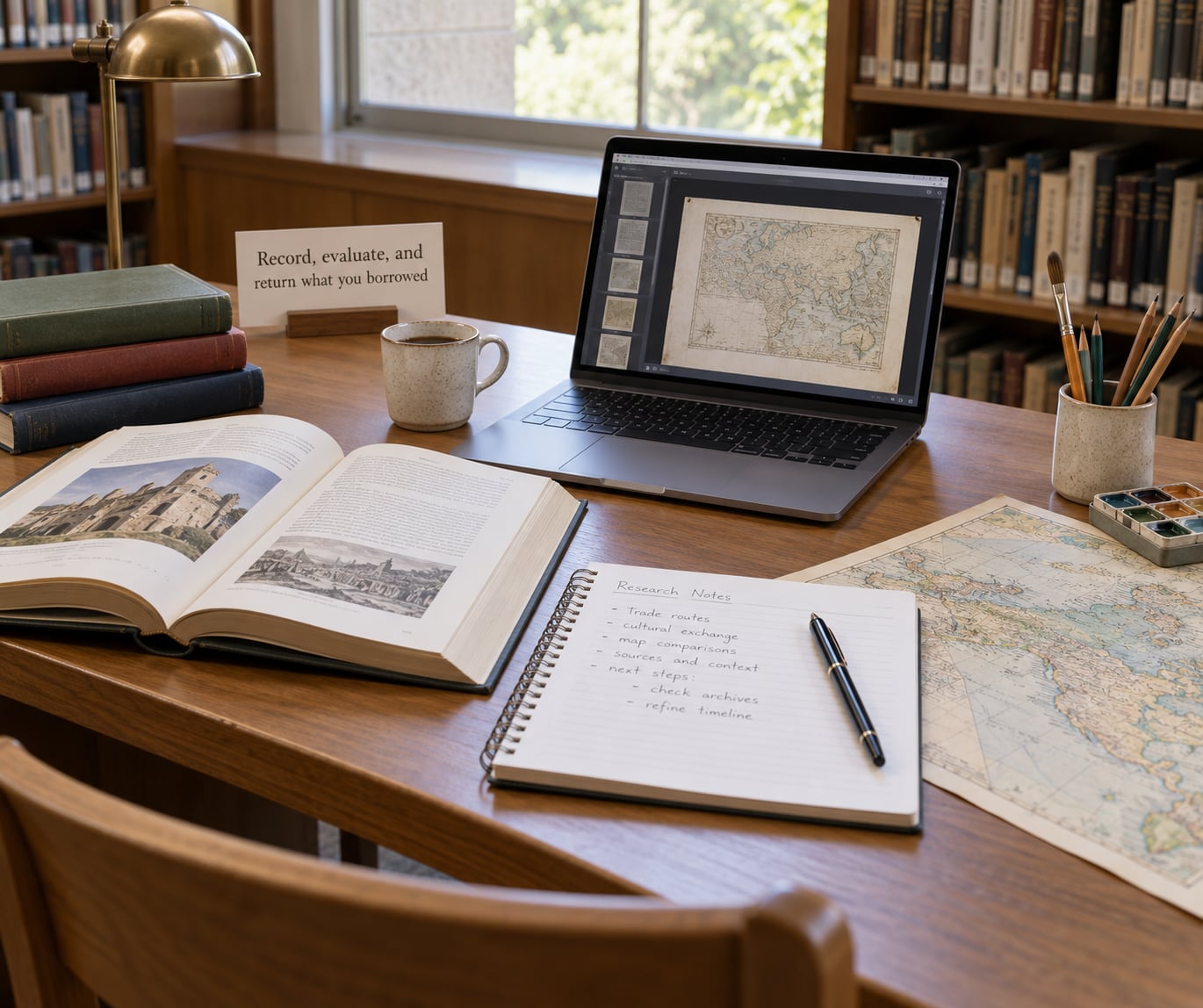
Write the title, author, and due date in the notebook the moment you get home, or snap a photo of the receipt. A simple shelf basket for everything due soon works better than a system spread across four rooms.
At the end of a unit, spend ten minutes asking one question about each item: did this support the goal I wrote down? Books that failed still taught you something about your child’s level or interests, and that knowledge makes the next search faster.
Returns go back through the book drop, the service desk, or a staffed locker. Then set the next hold before you leave, which keeps the cycle moving without another trip to the building.
Common Mistakes That Waste Library Trips
Waiting until the lesson is already half done. Holds can take a few weeks for popular titles, so place them at the start of a unit. Fix it by placing next month’s holds the day you return this month’s books.
Relying on one search term. Every topic has synonyms, and the term a librarian uses is often not the term you would guess. Fix it by searching a related term and by following the subject headings the catalog suggests.
Forgetting that reading level varies wildly. A recommended title may be too advanced or too babyish for your child. Fix it by filtering for a reading level or age range and by checking the description before placing the hold.
Ignoring lending limits. Cards have item counts, hold limits, and renewal rules, and a family that hits them stops borrowing for a week. Fix it by counting current checkouts in your notebook and returning finished items early.
Choosing sources without opening them. The first page tells you the vocabulary level and whether the book is really about your question. Fix it by browsing the nonfiction shelves once so your child knows where topics live.
Forgetting digital access requirements. Many databases, apps, and downloadable items work only if the PIN is set on the account first. Fix it by setting your PIN at the desk on your first visit.
Skipping programs entirely. A missed science workshop costs nothing to fix. Fix it by putting the branch program calendar in your homeschool planner and booking the ones that match your current unit.
A few habits help most families: keep one basket for everything due, set a recurring phone reminder two days before due dates, and use a shared list, whether a co-op spreadsheet or a simple shared note, so two parents are not placing duplicate holds.
Frequently Asked Questions
What is a homeschool library card?
A homeschool library card is simply a regular public library card that lets a parent sign up as a homeschool family. Some systems offer educator or teacher cards with longer loan periods, higher item limits, or fee waivers, and a few recognize homeschool status directly when you apply. Ask the desk whether your branch issues one, because policies differ widely between systems.
What if my child cannot get a card without their own ID?
Most libraries let a parent check out items on their own card for younger children, and many allow a family account where children are listed as authorized borrowers. For a child’s own card, a school ID, birth certificate, or a document showing your shared address often qualifies as proof of residence. If you are new to the area, ask about a non-resident card before assuming you need one.
Is Libby or Hoopla better for homeschoolers?
It depends on what your library subscribes to. Libby by OverDrive covers e-books, audiobooks, and magazines, and it usually supports several library systems on one account. Hoopla adds streaming video, music, comics, and a kids mode for younger children. Ask your librarian which platform your card includes and what the monthly borrowing allowance is.
Can you request an interlibrary loan through Libby?
Usually not. Interlibrary loan runs through the library catalog or a separate online form, not through a reading app like Libby. Log in to your library’s catalog, open the title, choose Request or Borrow, and select Interlibrary Loan when the item is not held locally. Expect a longer wait and possible pickup location at the branch that owns the copy.
Which library databases help most for homeschool research?
For most families, an encyclopedia for background, a periodical or newspaper archive for primary sources, and a genealogy database for family history projects cover the bulk of homeschool research needs. High schoolers writing papers benefit most from the newspaper and magazine archives, since those provide dated, citable sources. Ask the librarian which databases allow home access and which have age filters set.
How do I keep library use sustainable year after year?
Keep a running list, place holds early, and return on time. A simple notebook with title, due date, and a photo of the receipt is enough for most families. Review what actually got used each quarter and stop reordering what sat unread. Sustainable use also means respecting limits so other families, including co-op members sharing a pickup, can borrow easily too.
A Simple Library Routine for Homeschool Families
Start with one learning goal written in a single sentence. Search or ask a librarian for it, borrow one solid source and one resource that argues a different angle, and put a follow-up activity on the calendar before you leave the house: a report, a comparison chart, a discussion, or a hands-on project.
Do that once and you will understand how to use the library for homeschooling better than any single app or website. Everything else, holds, databases, kits, and programs, attaches to that simple loop.