Adding music to your homeschool day means weaving listening, singing, rhythm games, and music history into the routine you already have, using as little as ten to twenty minutes a day. You do not need to play an instrument, own a keyboard, or have any musical training yourself. A phone with a speaker and a short playlist will carry most families a long way.
Music is also the subject that quietly disappears first when the schedule gets crowded. Reading and math get the leftover energy, and music gets whatever is left over, which is usually nothing. The fix is not more music. It is giving music a small, fixed slot tied to something you already do every day.
Here is the approach that tends to stick: pick one role for music in your day, choose music that fits that role, and repeat it long enough to become boring. Boring is the goal here. A routine that survives January is worth more than an ambitious one that dies in October.
Table of Contents
- What You Need
- Step-by-Step: How to Add Music to Your Homeschool Day
- Step 1: Choose How to Add Music to Your Homeschool Day
- Step 2: Pick Music That Matches the Learning Goal
- Step 3: Use Music to Reinforce Lesson Content
- Step 4: Add a Short Movement Break
- Step 5: Build a Repeatable Family Music Routine
- Simple Music Ideas for Different Ages and Subjects
- How to Make Music Work on a Low Budget
- Common Mistakes and Easy Fixes
- Tips for Keeping the Routine Fun and Flexible
- Frequently Asked Questions
- What type of music is best for a homeschool day?
- Does adding music to homeschool work without music lessons?
- How much music should I include in a homeschool routine?
- Can I use music for math, spelling, or history?
- How loud should music be while children are learning?
- What can I do if my child does not enjoy music?
- Start With One Song and Build From There
What You Need
Nothing is required. That is the part most guides get wrong, because they arrive with a shopping list. The true minimum is a way to play audio, ten minutes of an existing routine to attach it to, and one song.
Helpful extras, if you have them:
- Audio: a phone, tablet, laptop, or speaker. Free streaming accounts and your public library’s music collection cover most of what I suggest below.
- Printed lyrics or picture cards: a few sheets makes singing dramatically easier for young children who are still decoding words. Free printable lyric sheets for public-domain songs are widely available from library and classroom sites.
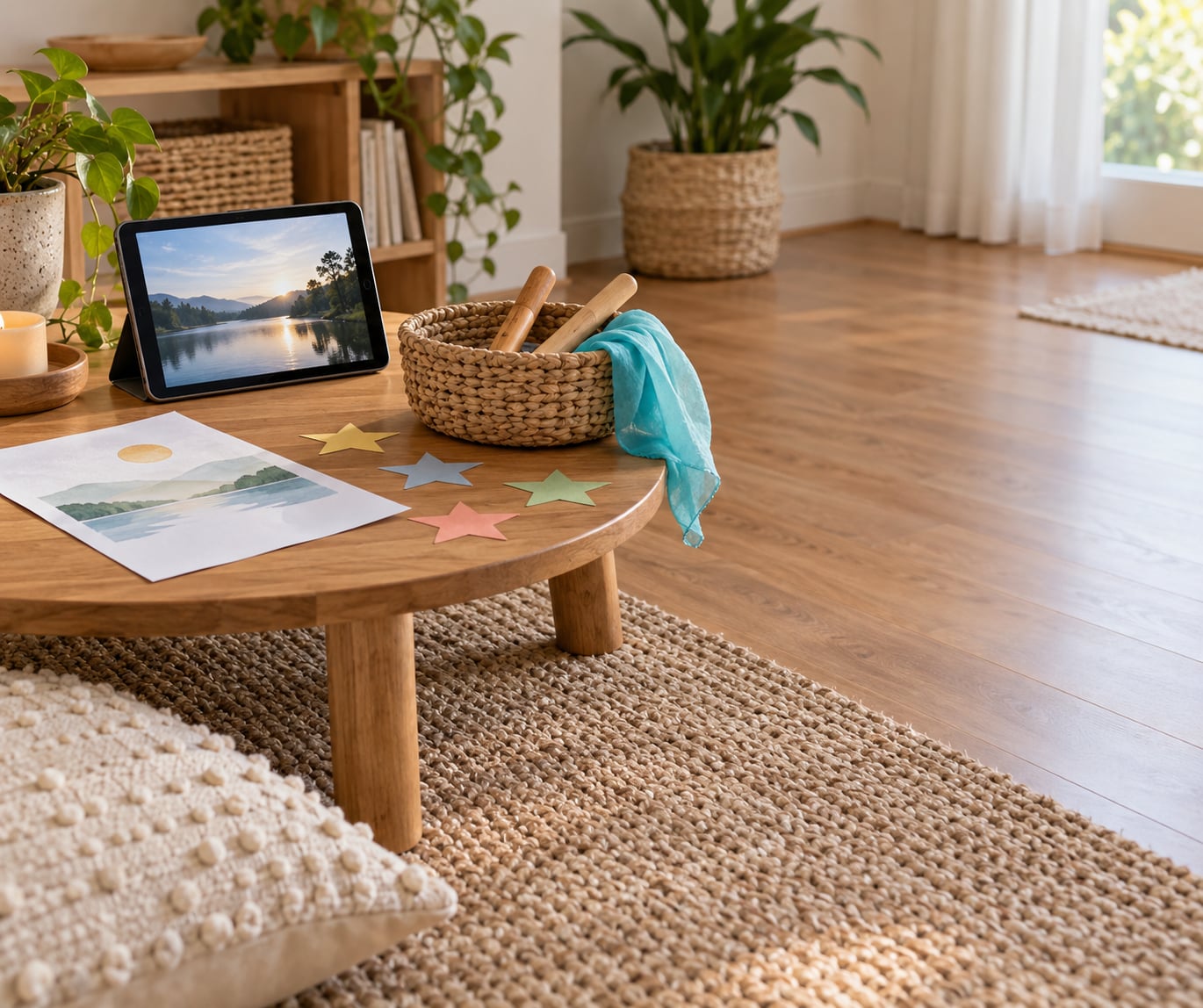
- Basic rhythm instruments: optional, and often improvised. Two wooden spoons, a plastic tub, a comb, or a handful of dried beans in a sealed jar work as well as a purchased drum.
- Open floor space: three by six feet is enough for a movement break. Push back a chair.
- A short playlist: ten to fifteen tracks you have already checked. Building a new playlist every morning is how this becomes homework.
Skip anything that would need a separate lesson to use. If a resource requires you to read a teacher’s guide before you can start, it is the wrong resource for a ten-minute daily slot.
Step-by-Step: How to Add Music to Your Homeschool Day
Five steps, and the whole routine can run on about twenty minutes a day. Adjust the order freely; most families land on their own version within a couple of weeks.
Step 1: Choose How to Add Music to Your Homeschool Day
Choose one musical role for the day rather than trying to do everything at once. Six roles come up again and again in homeschool routines, and each one is easy to keep going.
- Energizing opener: one upbeat track at the start of the morning while notebooks and cups are still being found.
- Memory aid: a song that carries facts, sight words, or state names into a lesson.
- Movement break: a three-minute reset between two harder blocks.
- Transition signal: the same short jingle every time you clean up or shift activities, so children hear the change before you announce it.
- Art accompaniment: instrumental music while drawing, painting, or building.
- Family sharing: Friday afternoon, everyone picks something to play or sing for the group.
One role at a time. Families who try all six in the first week usually quit by the third.
Step 2: Pick Music That Matches the Learning Goal
Match the music to the job, not to your taste. A toddler and a fourteen-year-old need different things from the same fifteen minutes.
For attention and energy resets, instrumental tracks with a steady beat work better than anything with lyrics, because there is nothing to follow and nothing to argue about. For memory work, a melody with repeated phrases is easier than a complicated one. For cultural and history study, folk songs, hymns, spirituals, sea shanties, and jazz standards carry real history in the words, and that context belongs in the homeschool day rather than only in a music block.
Match tempo to attention span. A two-year-old will last about ninety seconds of anything. A first-grader can sit through three minutes of a story song. A teenager will tolerate a full piece if it is interesting, but not if you call it a lesson.
Give unfamiliar music a label before it plays. Say the composer’s name, the country, and roughly when it was written. A sentence of context costs nothing and changes how a child hears it.
Step 3: Use Music to Reinforce Lesson Content
Music works well as support for other subjects, which is also how it survives a busy week. Nobody drops music time to make room for music time.
Spelling and phonics: write a short verse using the week’s target words and sing it on a familiar tune. Six lines is enough. Older children can invent the second verse themselves, which is where the real learning happens.
Math: skip-counting songs work for multiplication tables, and clapping a beat into groups of four or eight makes remainders physical. Counting drumbeats in fractions is quietly one of the better ways to teach that halves and quarters are not the same size.
History: folk songs and hymns from the period a unit study covers. Children remember the tune of a Civil War marching song long after they forget the dates, and the words often carry the attitudes of the people who sang them.
Geography and culture: one song per region you study. Most families keep a running list, and by the end of a year it doubles as a listening history.
Art and handwriting: instrumental music at low volume during drawing or handwriting practice tends to loosen up reluctant writers.
Step 4: Add a Short Movement Break
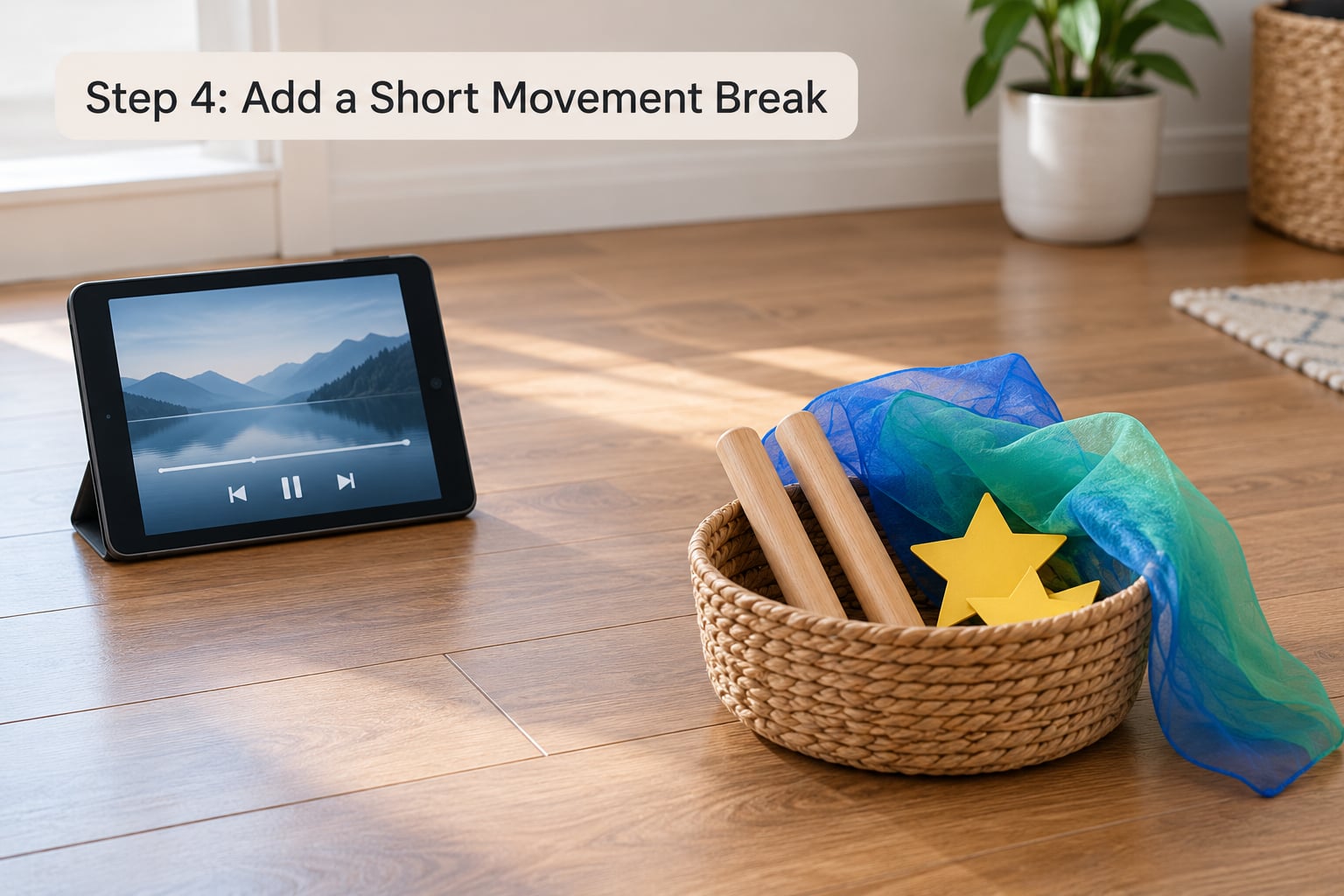
Three minutes of movement is one of the cheapest attention fixes available, and it needs nothing but space and a beat.
Marching to a steady beat works for almost everyone. Slow stretching works after reading-heavy work. Free dance works with toddlers, who will invent their own and consider it correct. Acting movements, where children mime the words to a song, pull in kids who would rather not perform. Beat matching, where one child claps a rhythm and another copies it, quietly teaches pattern recognition better than most theory worksheets.
A few practical notes. Keep the volume low enough that you can speak over it without raising your voice. Clear the floor first, every time, because the commonest injury here is a chair. Offer a stationary option for any child who prefers one or is sensitive to being watched, and let that child skip without discussion. Sensory-aware families should check the tempo first; some children find a fast beat activating rather than settling.
Stop while it is still working. A movement break that runs five minutes too long becomes the thing children resist.
Step 5: Build a Repeatable Family Music Routine
A repeatable weekly rhythm is what turns a good idea into a habit. Here is a sample seven-day schedule built around a ten-to-twenty-minute daily slot. Nothing in it requires an instrument.
| Day | Activity | Minutes | Needs Equipment? |
|---|---|---|---|
| Monday | Energizing opener plus one new song introduced | 10 | No |
| Tuesday | Clapping and beat-matching game during morning basket | 10 | No, hands only |
| Wednesday | Song tied to the week’s history or geography subject | 15 | No, printed lyrics help |
| Thursday | Movement break between two hard blocks | 3 | Floor space |
| Friday | Child picks a song; whole family sings or listens together | 15 | No |
| Saturday | Composer or musician of the month, one short biography | 10 | No |
| Sunday | Ambient music during chores, baking, or quiet reading | As fits | No |
Two habits make this survive. First, let children choose part of it; parents on homeschooling forums consistently report that kids retain far more of what they picked themselves than of what was assigned as listening homework. Second, review the week and rotate one song out, so nothing becomes irritating. If a particular song starts grating on you, it has done its job.
Simple Music Ideas for Different Ages and Subjects
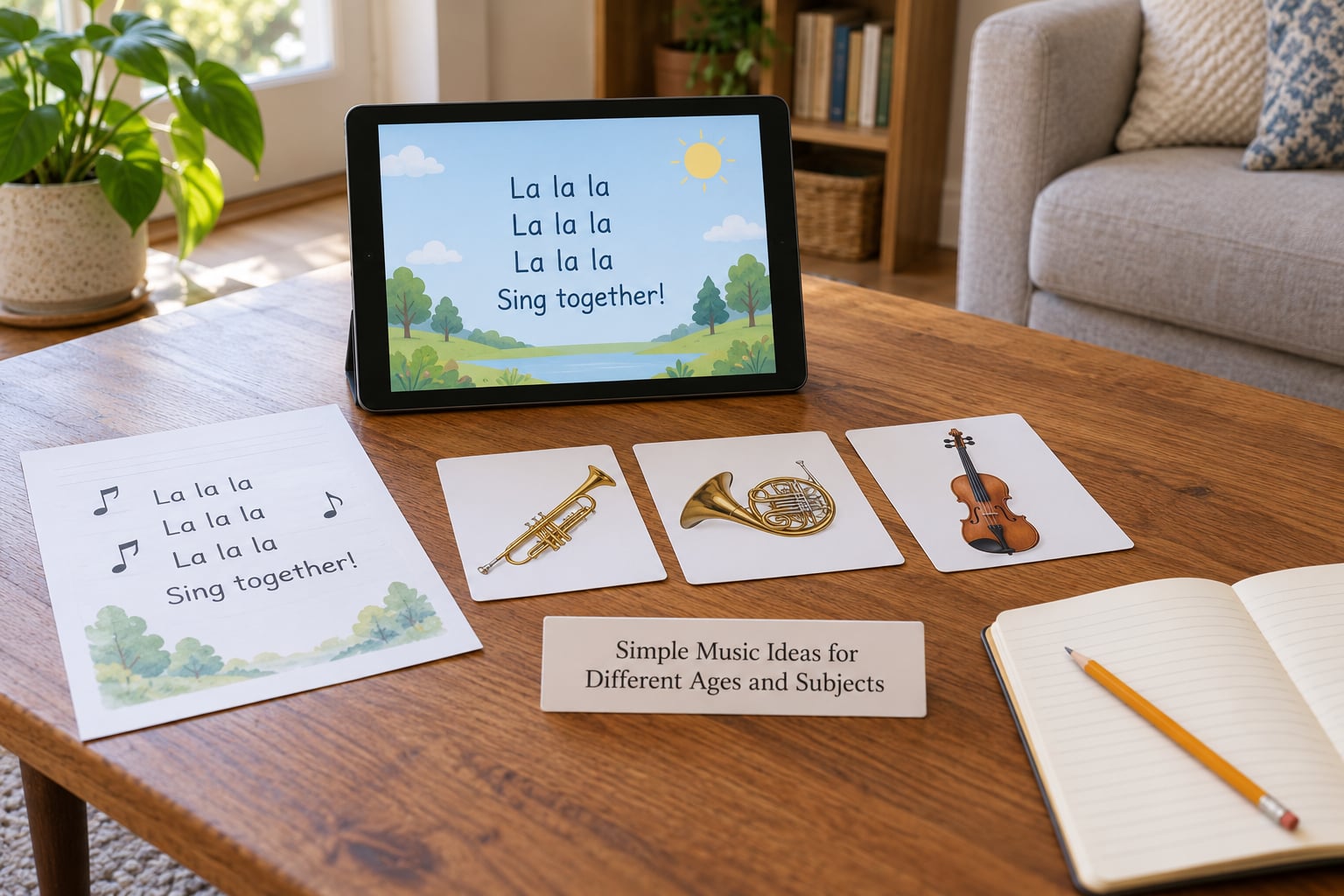
The same fifteen minutes can look completely different across a family. Age the activity, not the time slot.
Toddlers and preschoolers (under 6): action songs with gestures, clapping patterns, nursery rhymes, and lots of repetition. Movement and singing come first, and staying on task comes second. Lyrics do not need to be read if the child knows the tune.
Elementary (roughly 6 to 11): this is the sweet spot for music appreciation. Add composer studies, one folk song per unit, and simple beat games. Children this age can hold a short melody in memory and will sing songs connected to history topics for years.
Middle school (roughly 11 to 14): give them a job. Keeping a listening log, choosing the week’s song, or researching a performer adds ownership. Karaoke and sing-along formats work better here than any workbook.
High school (14 and up): music can count toward a fine arts credit, depending on your state’s requirements, so keep documentation from the start: dates, pieces listened to, and hours. Teenagers usually disengage from anything framed as forced practice, so aim for listening and discussion rather than performance.
Adapting one song across ages is easier than it sounds. Pick a folk song with a clear narrative. The four-year-old acts it out, the eight-year-old draws the story in three panels, the eleven-year-old rewrites a verse from another character’s point of view, and the sixteen-year-old researches when it was written and what was happening in that country. One song, four lessons, one morning.
For families with mixed ages, keep the shared part short and give older children a separate task. A single history-linked listening lesson can serve ages 8 to 17 when the younger children get the story and movement and the older children get the research.
How to Make Music Work on a Low Budget
Most of music in a homeschool day is free. The spending is usually optional, and it usually shows up in instruments and lessons rather than in the daily listening.
Free and no-cost sources: Ambleside Online and SQUILT offer music appreciation material without a paid tier, and both are frequently recommended in homeschooling communities. Public-domain songs from folk song collections and hymnals can be printed for free. Your public library lends recordings, often including full orchestral works and children’s music programs, and many libraries run free family concert series.
DIY instruments: a comb and a paper cup, two spoons and a shoebox, dried beans in a sealed jar, a plastic tub and wooden blocks. These take ten minutes to make and cost almost nothing. Some families keep them in one basket by the door and pull the basket out only on music days, which keeps the rest of the house calm.
Where money actually helps: private or online lessons when a child is genuinely motivated, and low-cost starter instruments rather than full-size ones. The honest warning from experienced families: children abandon expensive instruments often. A cheap keyboard or a well-made ukulele that gets played every day beats an expensive piano that gathers dust.
Free outings: school performances, community concerts, holiday sing-alongs at the library, and outdoor car concerts are all legitimate music education. Families who attend local performances tend to remember them vividly years later.
Common Mistakes and Easy Fixes
Music as background noise. If it plays constantly, children stop hearing it. Give it defined slots instead.
Songs that are too stimulating for the task. Fast, loud music competes with reading and writing. Save it for movement breaks and cleanup.
Sessions that run too long. Fifteen minutes is plenty for most ages. Attention falls off well before that for young children, and boredom ends the habit faster than any other factor.
Forced performance. Requiring an audience turns music into a test. Children who dislike performing usually still enjoy listening and singing with no one watching, so let them skip the recital and keep the music.
Ignoring volume and sensory needs. Keep the volume low enough to talk over, and offer a headphones or no-movement option on every movement break.
Unfamiliar music with no context. A ninety-second introduction of who wrote it and why is what turns a random track into a lesson.
Tips for Keeping the Routine Fun and Flexible
Rotate activities so nothing becomes the same ten minutes every single day. Let children pick at least one slot per week. Keep lyrics age-appropriate; a teenager handed preschool songs will opt out. Vary the movement, since marching gets boring in a week. And stop an activity that has stopped working instead of pushing through it, because a dropped music habit is harder to restart than a boring one.
Frequently Asked Questions
What type of music is best for a homeschool day?
Match the music to the job. Use instrumental tracks with a steady beat for energy resets, opening, and cleaning up. Use songs with repeated, simple melodies when you are teaching facts, sight words, or math tables. Use folk songs, hymns, and jazz standards when a unit study covers history or culture, because the words carry context. Keep tempo age-appropriate: short and bouncy for toddlers, longer pieces for older children.
Does adding music to homeschool work without music lessons?
Yes. The daily slot in most homes is listening, singing, and rhythm work rather than instrumental instruction, and none of that needs a teacher. For learning music theory specifically, a beginner parent can work through a free curriculum such as Ambleside Online or SQUILT at their own pace. If a child wants real instruction, start later and keep the daily listening habit running in the meantime.
How much music should I include in a homeschool routine?
Ten to fifteen minutes a day, most days, is a realistic and sustainable amount for most ages. That gives a family roughly an hour of music a week, which is plenty to build familiarity and enjoyment. Older children can stretch toward twenty minutes when they are studying composers or keeping a listening log. Consistency matters far more than duration for younger children.
Can I use music for math, spelling, or history?
Yes, and this is often where music earns its place in a schedule. Write a short verse using the week’s spelling words and sing it on a familiar tune. Use clapping or drumbeats to show fractions and to drill multiplication tables. Play folk songs and hymns from the period your history unit covers. The audio supports the lesson, so it does not need extra time on the schedule.
How loud should music be while children are learning?
Low enough that you can speak over it at a normal talking volume without raising your voice. Loud music competes with reading, spelling, and handwriting because the brain processes speech and sound at the same time. For movement breaks, turning it up is fine. Children with sensory sensitivities may need it quieter still, or headphones with the volume capped low.
What can I do if my child does not enjoy music?
Let them keep listening without performing. Many children who dislike singing will still enjoy a short movement break, a story song, or a composer biography. Offer choices between two tracks rather than insisting on one. Avoid recitals for now, since a forced performance is a common reason children decide music is not for them. Try again with different material after a few weeks.
Start With One Song and Build From There
Pick one song everyone already knows. Tie it to whatever lesson is happening that day, add a minute of marching or clapping to it, and repeat that for a week before adding anything else.
Most families add the next thing about a month in, not a day in. That is the whole trick to how to add music to your homeschool day: one song, one attached slot, repeated until it stops taking any effort at all. Once that is boring, add the second song.