A homeschool schedule that works gives your family a predictable start, a short list of daily must-dos, and a few short work blocks that can move without collapsing the whole day. How to make a homeschool schedule that works comes down to four hours of focused work for an elementary-aged child, fewer for a preschooler, and enough open space that one rough morning never costs you the week.
Most families don’t fail at homeschooling because they lack discipline. They fail because they copy a classroom timetable — periods, bells, six subjects a day — and then wonder why 2:00 p.m. arrives with three worksheets finished and everyone at each other’s throats.
I’ve built and rebuilt our own weekly plan more times than I’d like to admit, and the version that finally stuck came from treating the schedule as a set of movable blocks instead of a clock. Here is how to build one that fits your kids, your commitments and your actual energy.
Table of Contents
- What You Need Before You Plan
- Step-by-Step: How to Make a Homeschool Schedule That Works
- Step 1: Choose the Right Weekly Rhythm
- Step 2: Add Flexible Blocks Instead of Rigid Hourly Times
- Step 3: Test the Schedule for Two Weeks
- Common Mistakes That Break a Homeschool Schedule
- Frequently Asked Questions
- How many hours a day should I spend homeschooling my child?
- What is the best way to organize homeschool work?
- How do I create a homeschool loop schedule?
- What is a good four-hour homeschool schedule for elementary?
- Do homeschool children need a strict schedule?
- How do I handle homeschool days when I work outside the home?
- Start With One Change This Week
What You Need Before You Plan
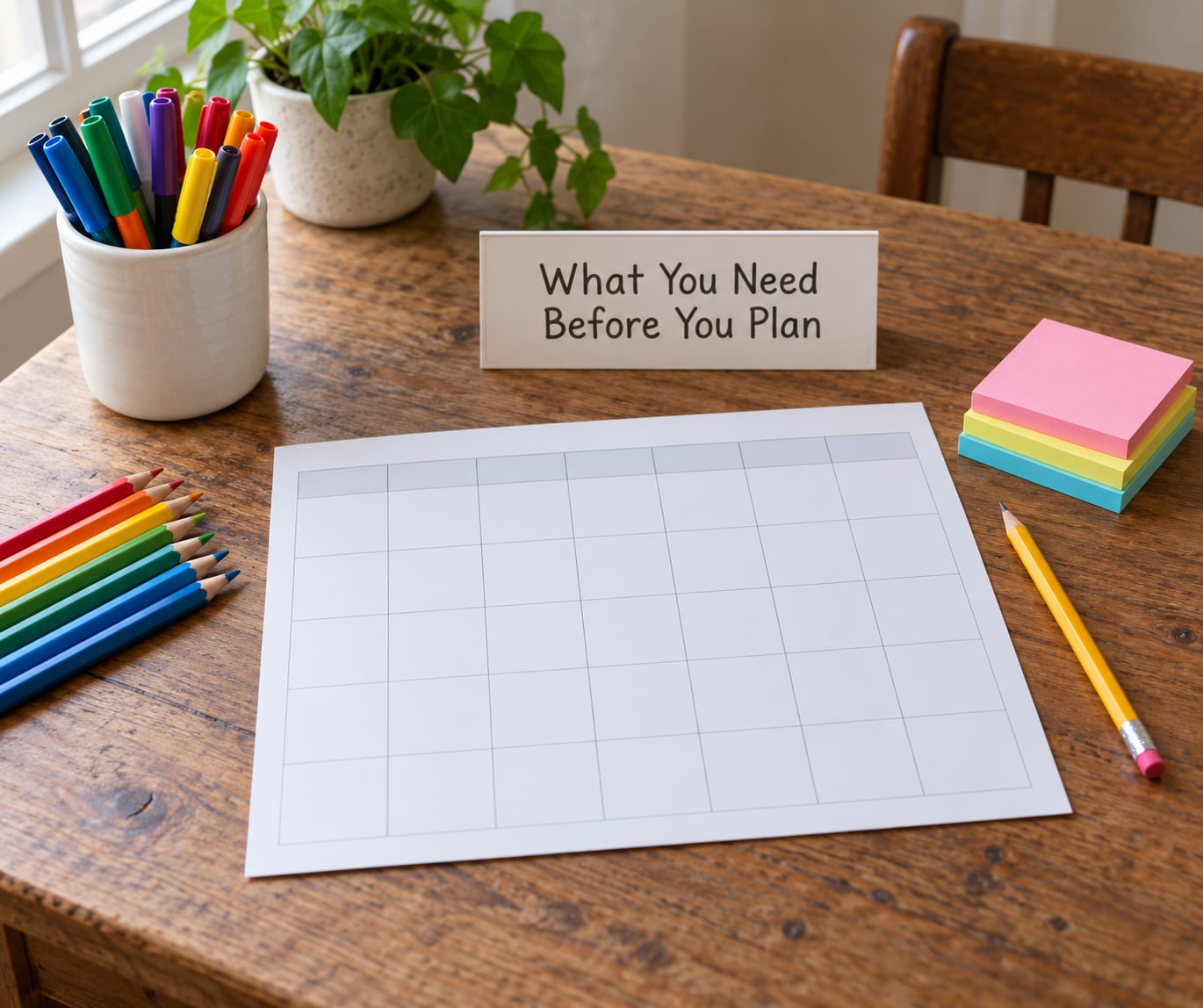
Gather the raw material before you draw a single block. Ten quiet minutes of honest information beats two hours of rearranging colored squares.
- Your curriculum priorities. Pick the two or three subjects that matter most this year. Everything else is negotiable, and knowing your non-negotiables keeps the plan from sprawling.
- Fixed commitments. Co-op days, therapy, appointments, sports, church, a work-from-home calendar, sibling pickups. Write the real hours down, including travel.
- Meals, chores and movement. Lunch happens, laundry happens, and children who sit for three hours straight stop retaining what you just taught them.
- Each child’s energy pattern. Note who sharpens after breakfast and who wakes up around 3 p.m., plus attention spans that are honest rather than hopeful.
- A weekly planning method. A paper planner, a whiteboard, or a phone calendar. The tool matters far less than doing the planning in one sitting, once a week.
Add one fact most parents skip: how long your child actually stays focused. A kindergartener sitting still with one book is doing about 20 to 30 minutes. Planning two hours for that age guarantees the day ends in tears.
Step-by-Step: How to Make a Homeschool Schedule That Works
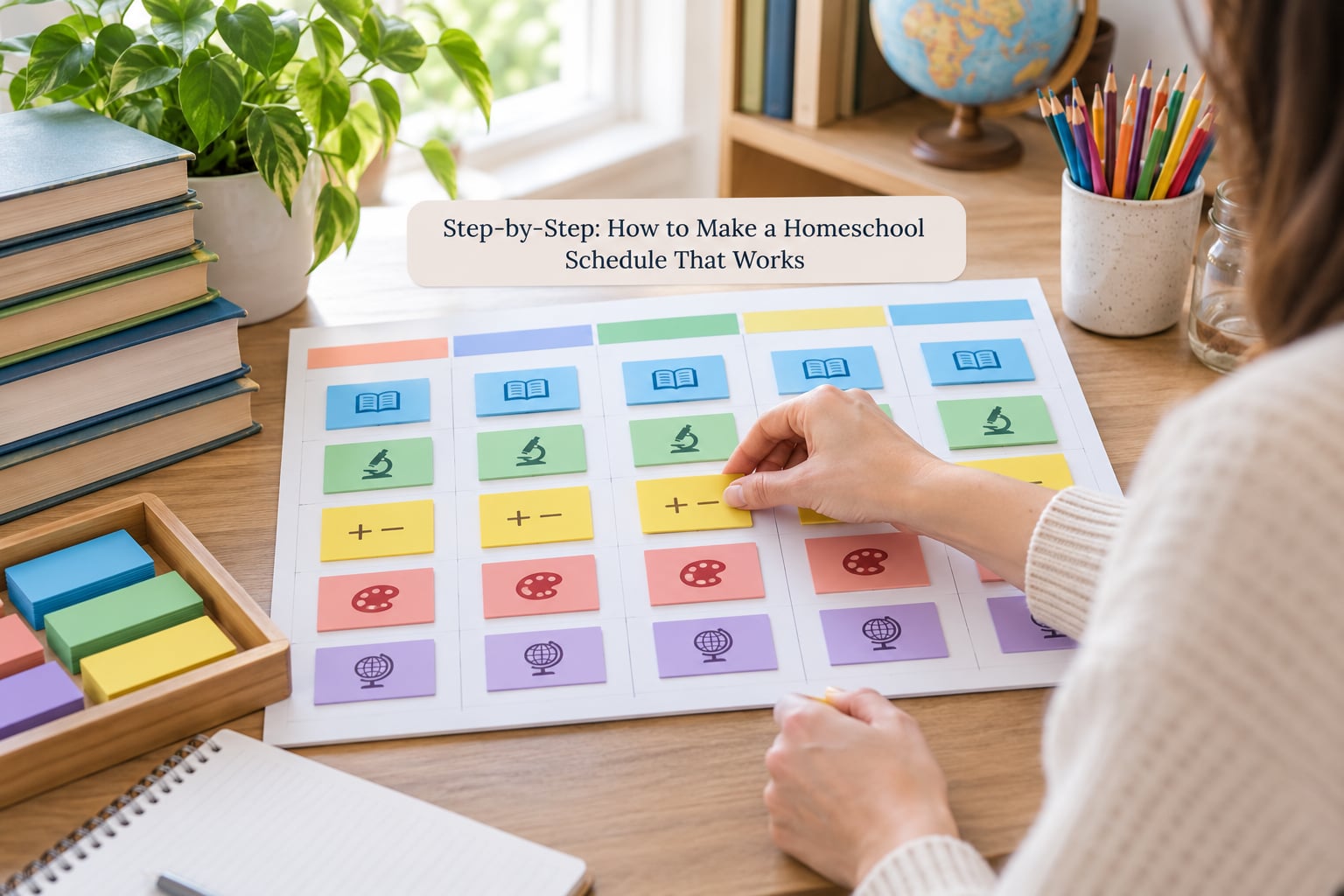
Step 1: Choose the Right Weekly Rhythm
A working schedule is built around focused academic work, independent tasks, creative projects, outdoor time, chores, meals and rest — not a filled calendar. Use these ranges as a starting point and adjust for your kids:
| Age band | Focused work per day | Typical shape of the day |
|---|---|---|
| Preschool (ages 3 to 5) | 60 to 90 minutes | Short bursts, heavy on read-alouds, crafts and movement |
| Early elementary (ages 6 to 8) | 2 to 3 hours | Math and language arts in the morning, independent work after |
| Upper elementary (ages 9 to 11) | 3 to 4 hours | Two core blocks, one independent block, one project block |
| Middle and high school | 4 to 6 hours | Fewer, longer blocks with the student tracking their own time |
Those numbers count focused work, not time spent at the table. Reading aloud to a preschooler, painting, building with blocks and cooking dinner together all count as school time. Most school days that run smoothly are four to six hours long once you count living.
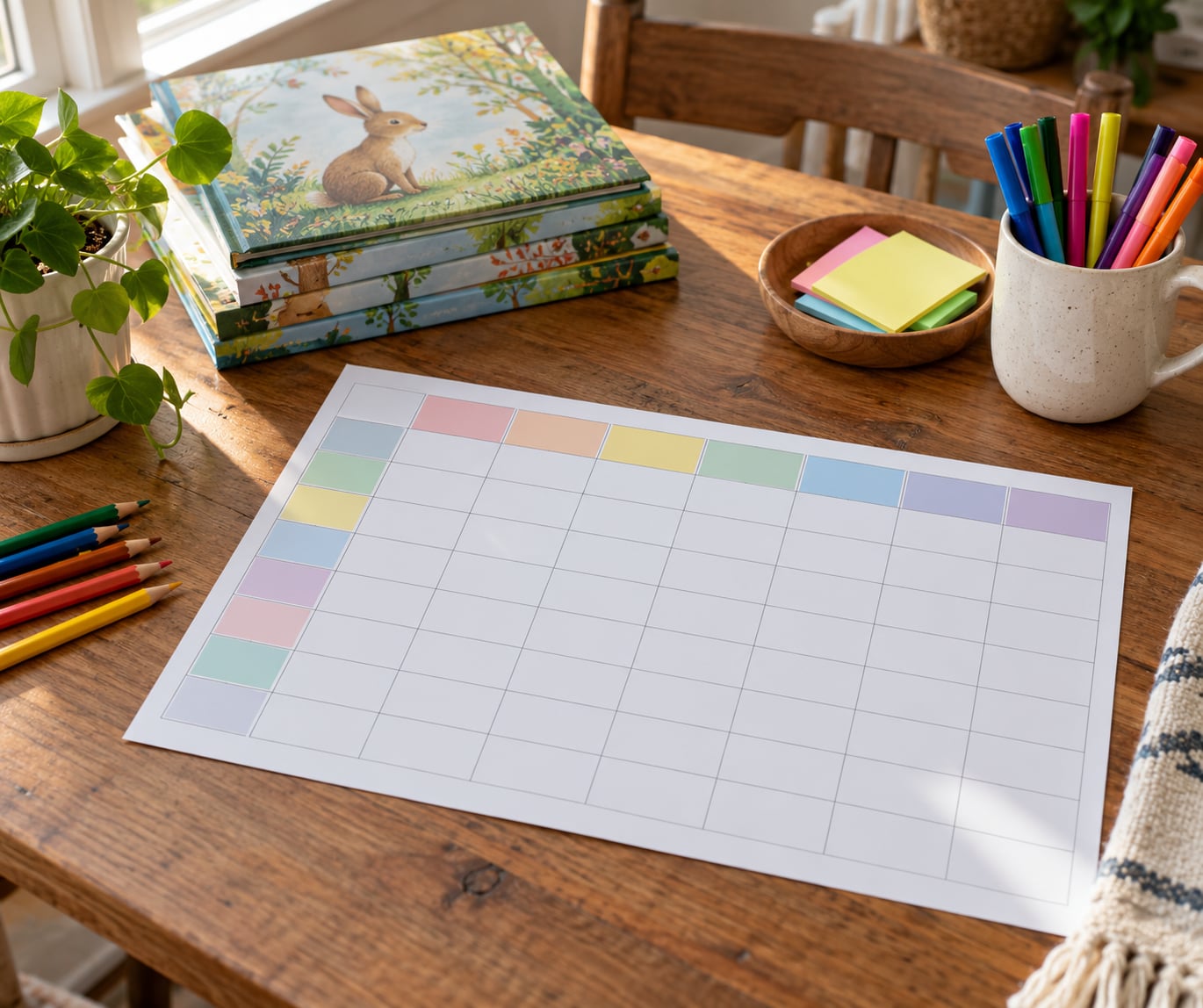
Here is a week you can copy and edit. Note the empty cells — those are your buffer, and they are doing real work.
| Time | Monday to Thursday | Friday |
|---|---|---|
| 8:00 | Launch routine and breakfast | Launch routine, light review |
| 8:30 | Math and phonics | Catch-up block |
| 9:30 | Independent work from a checklist | Choice reading and games |
| 10:30 | Outside time, walk or nature scavenger hunt | Free |
| 12:00 | Lunch and chores | Lunch and kitchen cleanup project |
| 1:00 | History, science or art block | Family showcase of the week’s work |
| 2:15 | Reading, quiet time | Free |
| 4:00 | Buffer for co-op, appointments or overflow | None needed |
Step 2: Add Flexible Blocks Instead of Rigid Hourly Times
Rigid hourly times break the first time someone is sick. Flexible blocks survive it, because a block says what happens next, not when it must happen. Two models handle this well, and they’re not interchangeable:
| Model | How it works | Best for | Watch out for |
|---|---|---|---|
| Block day | One or two subjects per day, finished properly | Older kids who need depth | Fewer subjects per day can feel lopsided |
| Chunk schedule | Day divided into morning, school, lunch, afternoon and evening chunks with routines | Families with appointments and a flexible start | Needs a clear stop signal each chunk |
| Loop schedule | One subject per day rotating through the week — Monday math, Tuesday science, Wednesday history | Preschoolers, multiple ages, kids with short attention spans | Older students need weekly review time |
| Six-week cycle | Six weeks on, one week off to finish early and reset | Parents who want a built-in catch-up week | Off weeks tend to slide back into full weeks |
For a loop, keep the rotation visible on the wall. A parent in a homeschooling forum suggested letting children pick the order of their assignment sheet, with a time limit beside each item and a timer running — independence plus time-boxing in one move.
Every child gets a visual checklist of their own. Laminated cards with boxes work, as does a whiteboard the kids tick off themselves. The moment a child manages their own list, you stop being a full-time dispatcher and become a reference instead.
Step 3: Test the Schedule for Two Weeks
Run the plan for two full weeks without changing it, then review it on a Sunday. Your job during the trial is to write down five things, not to judge:
- Completion. Which subjects actually got finished most days?
- Frustration. Where did voices rise, and on whose behalf?
- Energy. Which block happened while children were sharp, and which fought them?
- Cooperation. Did the checklist reduce arguing about what to do next?
- Unfinished work. What rolled over, and how big was the pile by Friday?
Keep what survived the two weeks. Change one thing at a time, usually the timing of a block rather than the work itself. Most families discover their math lands far better after lunch, which is exactly the question parents keep asking about mornings versus afternoons.
Common Mistakes That Break a Homeschool Schedule
Packing the day like a classroom. Correction: leave 20 percent of the day blank. Unscheduled time absorbs appointments, dentist visits and the Tuesday your child decides to have a bad day.
Planning for ideal behavior. Correction: plan for a normal Tuesday. If the plan only works when everyone is cooperative and well-rested, it is a fantasy, not a schedule.
Dropping unstructured time. Correction: schedule nothing for one afternoon block. Free play, building, drawing and boredom teach things a worksheet can’t.
Forgetting meals and movement. Correction: put lunch and an outdoor block on the calendar like real appointments. Kids who sit for three straight hours stop listening around hour two.
Using one schedule for every child. Correction: share the rhythm, not the content. A preschooler, a fourth grader and a ninth grader can all work in the same morning block while doing entirely different things — read-aloud and cutting practice while an older kid tackles fractions.
Skipping the buffer entirely. Correction: reserve one block at the end of the day for overflow. Catch-up time you planned for beats catch-up time you scramble for at 7 p.m.
Ignoring the parent. Correction: put your own work, exercise and quiet time on the calendar too. Burnout starts where the schedule stops accounting for the adult running it.
A four-hour elementary day looks like this when you need it to: morning meeting and read-aloud, two hours of core academics, one hour of independent work, and a final hour for enrichment — art, science, a kitchen project or a walk. If the core work is running long, cut enrichment first, not the independent block.
Frequently Asked Questions
How many hours a day should I spend homeschooling my child?
Plan on 2 to 3 hours of focused work for ages 6 to 8, 3 to 4 hours for ages 9 to 11, and closer to 4 to 6 hours for middle and high school. Preschoolers need only 60 to 90 minutes of structured work. If your child finishes early and stays engaged, add time. If they dread the start each morning, cut a block rather than pushing through.
What is the best way to organize homeschool work?
Use a visual checklist the child controls, one anchor start time, time-boxed subject blocks, and a set amount of buffer time each day. Review the week once, on Sunday, and adjust one thing at a time. The checklist matters most, because it moves decisions off you and onto the person doing the work.
How do I create a homeschool loop schedule?
List every subject you want to cover, decide how many days each one needs per week, then assign one subject per day in a repeating weekly rotation. Monday might be math, Tuesday science, Wednesday history, with reading daily because it benefits from frequency. Post the rotation where everyone can see it and let children tick items off themselves.
What is a good four-hour homeschool schedule for elementary?
Try a morning meeting and read-aloud, about ninety minutes of math and language arts, one hour of independent work from a checklist, and a final hour for enrichment such as art, science or a kitchen project. If the core blocks run over, cut the enrichment hour first. Keep a buffer block at the end for overflow.
Do homeschool children need a strict schedule?
No. What works one week often fails the next, because home education is not a fixed roster where every child has to fall in line. A consistent start time, a short daily checklist and predictable block order give kids enough structure, while movable blocks absorb appointments and slow mornings without costing you the day.
How do I handle homeschool days when I work outside the home?
Anchor school to a fixed early block before your workday, use a written checklist your child can follow without you, and keep afternoons short and light. If mornings are impossible, flip the day and put reading and math after your work block instead. Consistency of start time matters more than which side of the day it sits on.
Start With One Change This Week
If you only do one thing after reading this, pick an anchor start time and a three-item checklist for your oldest child. Put it on the fridge, run it for two weeks, and then adjust one block at a time. That is how to make a homeschool schedule that works for your family — not by finding the perfect template, but by building a simple one and letting it prove itself.