Starting homeschooling means taking over your child’s education at home: meet your state’s legal requirements, pick one core resource per subject, and build a daily routine you can actually keep. For most first-time parents the first four to six weeks are about paperwork and habits, not academics. This guide covers how to start homeschooling for the first time, step by step, without buying a year’s worth of materials before the first Monday morning.
Here is the whole roadmap in seven steps. Each one has a clear “done” test, so you always know whether you are finished with it.
- Learn your state and local rules, including filing deadlines and record-keeping duties.
- Write down what a good year looks like for your family, in one paragraph.
- Check where your child actually is in reading, writing, and math.
- Choose one core curriculum per subject, and only that.
- Build a simple weekly routine with room for real life.
- Run the plan as a two-week trial before committing to the full year.
- Review attendance, skills, workload, and mood after 30 days.
One note before you start: homeschool law lives at the state level and changes often, so treat anything you read as a starting point and confirm the current version with your state education agency or your district. Nothing here is legal advice for your specific situation.
Table of Contents
- What You Need
- How to Start Homeschooling for the First Time: Step-by-Step
- 1. Check Your State and Local Homeschooling Rules
- 2. Define Your Family’s Goals and Approach
- 3. Know Where Your Child Stands Before You Start Homeschooling
- 4. Choose a Curriculum Without Overspending
- 5. Build a Simple Weekly Routine
- 6. Run a Two-Week Trial
- 7. Review Progress After the First 30 Days
- Common Mistakes
- 1. Buying the Whole Curriculum Stack Up Front
- 2. Copying a Public School Schedule Exactly
- 3. Pushing Socializing to the End of the Week
- 4. Ignoring State Record Requirements
- 5. Mistaking Busywork for Learning
- 6. Deciding It Failed After a Bad Week
- Frequently Asked Questions
- Do I need a degree to homeschool my child?
- How much does it cost to start homeschooling?
- How do homeschooled children socialize?
- What if I do not know which state homeschool rules apply?
- How will I know if homeschooling is working?
- Can I start homeschooling in the middle of the school year?
- Your First Step: Start With One Simple Week
What You Need
You need far less than the curriculum catalogs suggest. Before you buy anything, write down the answers to these seven questions in a single page. Most beginners skip this and regret it by week three.
- Your child’s age and current level. Age, last grade attended, and what they can already do. A seven-year-old who reads chapter books and a seven-year-old who is still decoding need completely different first books.
- Your available hours. Count the realistic weekday hours you can protect, not the hours you wish you had. A preschooler typically needs one to three focused hours; a middle schooler needs less direct teaching but more materials management.
- Your goals. Academic skills, enrichment, independence, and family rhythm. Write one sentence per goal so you can measure against it later.
- Your support system. A co-parent, grandparent, sitter, or nearby friend who can cover an hour. Even one hour of backup prevents a bad morning from becoming a bad week.
- Your budget. Decide the number you are comfortable with before browsing. Curriculum, supplies, art materials, and field trips all draw from it.
- Your style. Structured, loosely structured, unit-study, or relaxed. This is the decision that determines everything else you buy.
- Your legal checklist. Your state education agency’s homeschool page, your district’s contact information, and a folder where every form, notice, and attendance record goes.
Requirements vary a lot by state. Some states ask for a simple notice of intent, some require an annual homeschool affidavit or a statement of assurance filed with the district, and some require standardized testing plus a portfolio review. A handful of states treat homeschooling as operating a private school, which adds paperwork. Start at your state education agency’s official site rather than a blog, and save the page as a PDF so you have a dated copy of the rules you are following.
How to Start Homeschooling for the First Time: Step-by-Step
Seven steps, in the order that prevents the most rework. Do not skip ahead to curriculum shopping, because the legal and planning steps shape what you should buy.
1. Check Your State and Local Homeschooling Rules
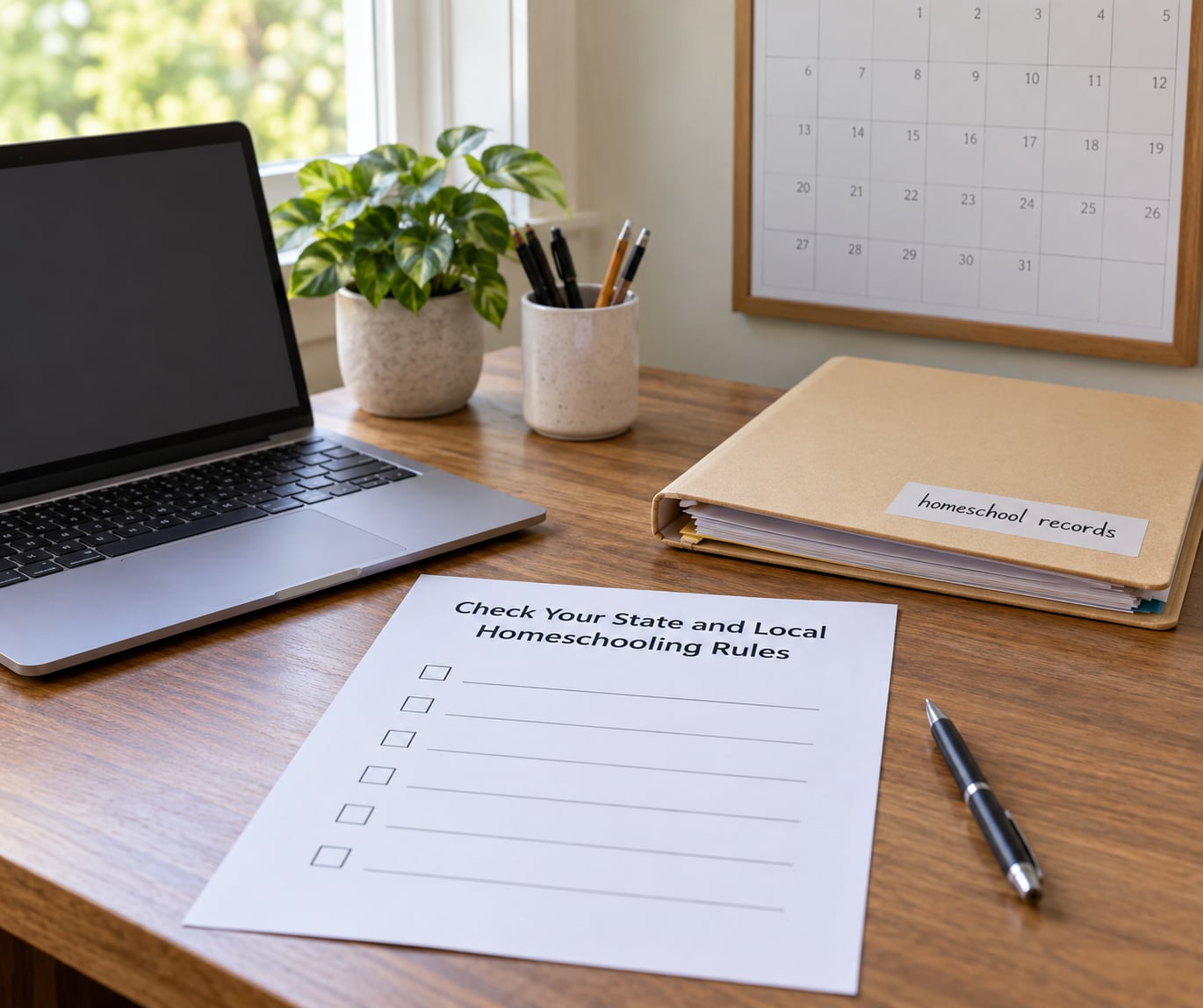
Find your state education agency and look for the homeschool or home education page. Read for five specific things: whether you must file a notice, registration, or affidavit; how many days of instruction are required; whether testing is mandatory and which tests count; whether you must keep attendance records; and whether a portfolio or progress report must be reviewed by someone outside your home.
Then check local rules on top of those. Some districts ask for a copy of your notice, and a few require a meeting with a school counselor or an annual review. If you live on a military base, coordination requirements sometimes differ, so confirm with your base education office as well.
Texas, which comes up often in searches, requires parents to file an annual statement of assurance with the district superintendent, along with a required number of days of instruction and specified subjects. Details change, so verify the current version on the Texas Education Agency site. For your own state, the same pattern applies: a filing, a set of days, a list of subjects, and some form of records.
Starting mid-year is legal in every state. The difference is that you usually file your notice and start counting attendance days from the withdrawal date rather than the first day of the school year. Decide the exact withdrawal day, keep it in writing, and file before that date if your state requires advance notice.
You are done with this step when you have a one-page checklist in your folder with the filing deadline, the required form, the required number of days, and the record-keeping rules written on it.
2. Define Your Family’s Goals and Approach
New homeschoolers often choose a method before they choose a goal, then buy materials for a family they are not. Reverse that. Write four short goals: one academic, one enrichment, one independence skill, and one family-life goal. “Reads independently for 20 minutes” and “can handle a disagreement without walking out” are usable goals. “Do more school” is not.
Then pick an approach you can live with. Structured programs lay out daily lessons and expect you to follow them. Eclectic families mix resources subject by subject. Unit-study families build everything around a topic or question. Unschooling leans on interest and self-direction with few required subjects. Charlotte Mason, classical, Montessori-inspired, and Waldorf-inspired approaches each come with their own rhythm, and most of them cost less time to set up than their reputation suggests.
Match the approach to your hours, not to your ideals. A full structured program alongside a full-time job is a lot of daily load. A relaxed approach with a stay-at-home parent and a library card works fine. Your approach should describe the kind of household you already have.
You are done when you can say in one sentence what a good six months from now looks like, and which approach gets you there.
3. Know Where Your Child Stands Before You Start Homeschooling
A baseline keeps you from either drilling material your child already owns or sitting on a gap for three months. Spend one low-key week on it.
In reading, read a familiar passage aloud and notice whether your child joins in, tracks print, and can read a familiar book independently. Write down the level of books they can handle with no help. In writing, ask them to write a paragraph about something they did this week, and look at spelling, sentence structure, and whether ideas get organized. In math, work through a few problems at the level you plan to teach and see where it wobbles.
Also pull the last two or three report cards and any work samples you can find, and if your child came from a classroom, email the teacher for a candid one-paragraph description. Teachers describe attention level, working style, and where a student sits socially, and that information is gold for planning.
Remember that grade placement is looser than it looks. It is normal for a kindergartener to need first-grade math while still reading at a kindergartener level. Spreading subjects across different levels is common, not a sign that something is wrong.
One rough afternoon is data, not a diagnosis. A tired, sick, or newly moved child will underperform, and treating a single bad day as a placement decision is the most common beginner mistake here. If you have specific concerns about development, hearing, speech, or attention, raise them with your child’s pediatrician or a qualified learning professional rather than trying to solve them with a workbook.
You are done when you have a short note per subject: what works, what is shaky, and what you will start with on day one.
4. Choose a Curriculum Without Overspending
The rule that saves the most money: one core resource per subject, chosen after the trial, not before. Everything else is a supplement you add later when you can name the gap.
Start with what already exists. Your public library almost certainly has a lending library of curriculum, and librarians who help with homeschool collections can point you at free resources and used copies. State education agencies and home education organizations publish free scope and sequence guides, which are simply a list of what a child should learn and in what order. Many subject areas, especially science and history, have free museum programs, digital archives, and open textbooks that stand on their own.
When you do evaluate a paid program, download the samples first, read the parent’s guide, and check the first two weeks of lessons. Look for whether the pace fits your child, whether the format matches your approach, and whether the answers are included. A program that looks perfect in a reviewer’s list and wrong in your hands is still wrong in your hands.
Do not forget the real costs outside the curriculum itself: paper and ink, a decent printer or copy store access, art supplies, science kits, field trip admission, and activity fees. Write those down in your budget line before the school year starts, because they arrive in October.
For families with several children, plan each subject once and adapt the level. Two kids in grades 2 and 5 can share a history topic with two different reading lists. Family-style learning, where children in a group study the same theme at different depths, cuts planning time significantly compared with running separate full programs.
You are done when you can name the core resource for every subject and see the opening lessons laid out, and you have not bought anything you have not seen in use.
5. Build a Simple Weekly Routine
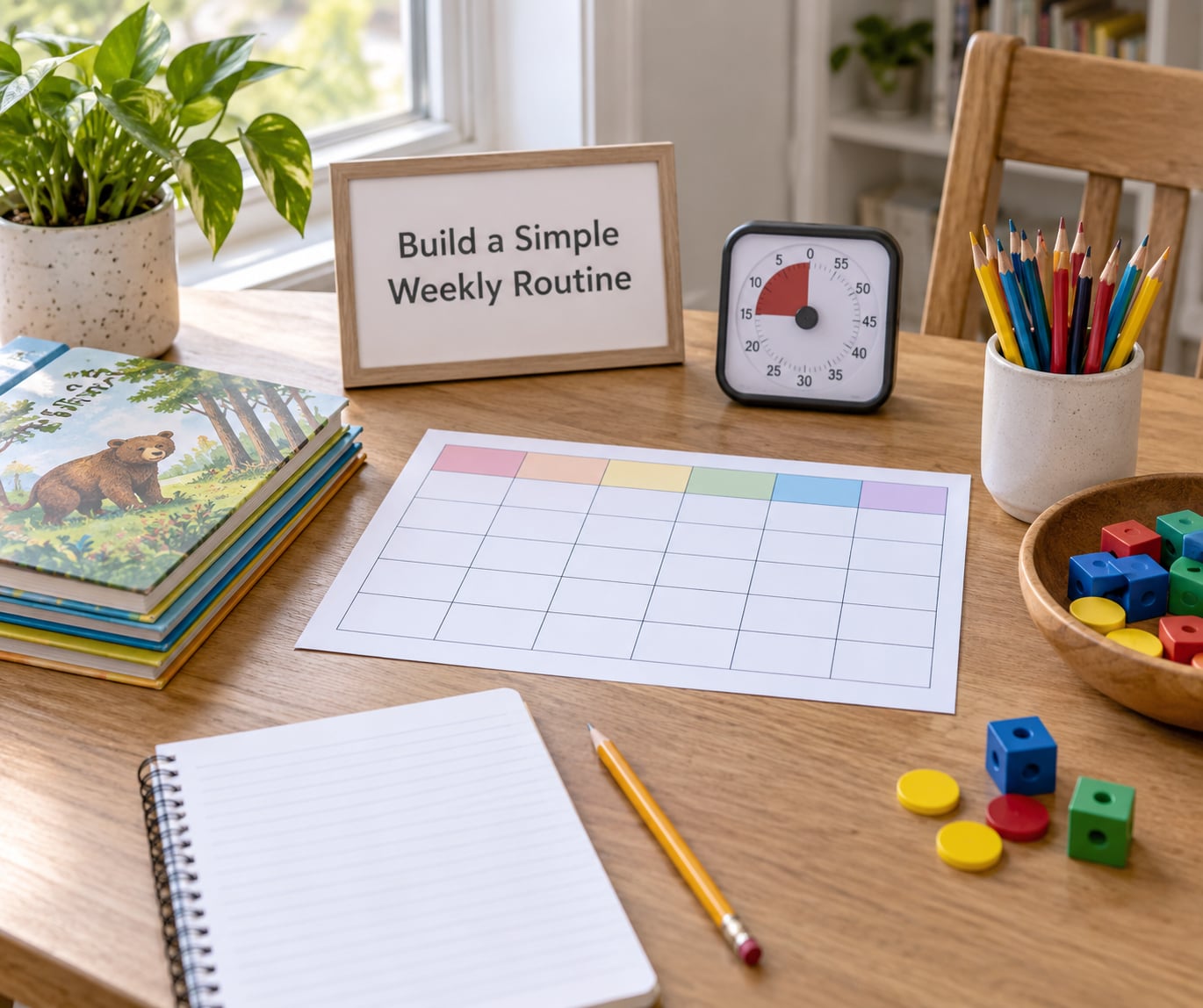
Write a routine, not a prison schedule. A routine says reading happens every morning and math happens three days a week; a schedule says math runs from 9:15 to 9:45 and everything collapses when breakfast runs late. Families who burned out and came back tend to have one thing in common: they loosened the clock.
A workable first draft for elementary ages looks something like this. Morning: reading aloud or independent reading, plus a short writing or language activity. Mid-morning: math, the most concrete block, while everyone is fresh. Afternoon: science, history, or a unit-study session, followed by outdoor time. Late afternoon: chores, reading for fun, and free play. Keep one block for independent work so the youngest child can play nearby while an older child works.
Adjust by age. Preschoolers do well with 60 to 90 minutes of structured activity, broken up, followed by lots of movement and pretend play. Elementary students manage three to four hours of focused work with breaks. Middle schoolers need fewer but longer blocks and more independent reading. High schoolers can run largely on a weekly checklist of courses, with a couple of in-person hours and plenty of outside commitments.
If you work outside the home, protect one block and defend it. Plenty of working parents school in the early morning before the day starts, or in a late afternoon block, with a lighter independent-work day in the middle. Batching also works: two focused mornings and two focused afternoons leaves the rest of the week for work, appointments, and family time. The point is a routine that survives a normal bad morning.
For more than one child, nest your work. Give the youngest a tabletop task at the same table while you teach the older one, and rotate who leads. The children who are not the focus of the lesson still need something in their hands.
You are done when the routine fits on one page, includes outdoor and unstructured time, and you can describe it in a sentence to a skeptical friend.
6. Run a Two-Week Trial
Treat the first two weeks as a test drive of the routine, not the curriculum. You are measuring your own system, so keep a short log and change things while changing is still cheap.
Track four things. How long the lessons actually took, compared to your estimate. Which materials were missing, which turned out not to be needed, and which turned out to be essential. When your child engaged well, and when they drifted or argued. And how you felt at the end of the day, because a routine that drains you will not survive a hard week in November.
Then revise. Lessons that run 15 minutes too long get trimmed. Subjects that fight you every morning move to a different slot. Materials you are using constantly go on a permanent list; materials you have not touched in a week get moved to a shelf instead of a shopping cart.
If your child came from a classroom, expect an adjustment period. Some children are tired and under-stimulated, some are argumentative, and some suddenly have too much unstructured time. That deschooling stretch is normal, usually lasts a few weeks, and passes faster when the routine has structure and friends to see. If distress continues for more than several weeks, talk with your child’s pediatrician about whether a learning evaluation would be useful.
You are done when the routine has survived two real weeks and you have made at least three deliberate changes based on what you logged.
7. Review Progress After the First 30 Days
Write a one-page review at the end of the first month. Most parents skip this and only evaluate during a hard week, which is the worst possible moment to judge a new approach.
Check your attendance record against your state’s required number of days. Look at skill growth in reading and math using the notes you took in step 3, not a feeling. Ask whether the workload is honest, meaning your child finishes most days without tears and you finish most days before dark. Look at emotional adjustment, sleep, and willingness to start. Then count social contact: playdates, a co-op, a library group, a team, a church or community group, or regular time with other children.
And check your own family balance. Homeschooling adds a job to a household that already has jobs. If dinner is at nine every night and you resent it, the plan is wrong, not you.
Documentation matters more than people expect. Keep a simple file: the notice you filed, a log of days and subjects, a list of materials, and a folder of work samples or photos labeled by date. When you eventually need a transcript, a portfolio for a co-op, or proof of instruction, it is already there. A monthly habit of five minutes beats a panicked search the following year.
Find support early, too. A co-op gives you classes and other parents in one place. Support groups, both local and online, are where the practical answers live. A homeschool convention or a simple coffee with a veteran family teaches you things no article can.
You are done when the review is written, your records are in order, and you have made a decision: keep the plan, change one part, or change the approach.
Common Mistakes
1. Buying the Whole Curriculum Stack Up Front
The most common financial mistake is buying a complete program for every subject before teaching a single lesson. Fix: buy nothing beyond the first two weeks of a core program in each subject, use free resources aggressively, and add materials only after you can name the specific gap. A used copy, a library set, and a printed scope and sequence carry a surprising amount of a first year.
2. Copying a Public School Schedule Exactly
Copying a school bell schedule at home recreates the least appealing part of school, including the parts your child hated. Fix: build around your household’s strongest hours, keep a reading habit and a math habit rather than a full timetable, and let at least half the day be yours. A routine with breathing room is the difference between a first year and a first year of quitting.
3. Pushing Socializing to the End of the Week
Parents who plan social life as an afterthought usually end up with an isolated child. Fix: put it on the weekly routine the same week you start, not the following term. Regular, repeated contact with the same few children matters more than constant variety. A weekly co-op class, a recurring playdate, a sport, and a library group will do more than a month of occasional outings.
4. Ignoring State Record Requirements
Attendance logs and progress records are the least enjoyable part of homeschooling and the most likely to cause a problem at the wrong time. Fix: set up the file on day one and fill in the log daily, while it is fresh. Five minutes a day is the entire habit.
5. Mistaking Busywork for Learning
Filling worksheets is not the same as learning to read, and a child who can finish fifty pages of repetitive arithmetic has not gained a transferable skill. Fix: judge activities by whether the child can do the skill without the book. If the answer is no, the activity is practice, not progress, and it should be brief.
6. Deciding It Failed After a Bad Week
Almost every new homeschool family hits a rough stretch in the middle weeks, when novelty wears off and the parent runs out of patience. Fix: commit to a 30-day review before you judge anything, and keep a list of what is working alongside what is not. Parents who quit in week three usually come back later and wish they had stayed one month longer.
A few smaller habits help too. Wear the teacher role lightly, especially in the first term, when your child is reading your mood more than the lesson. Say yes to outside help more often than feels necessary. And write down what you enjoy about it, because the first year is harder than the second, and families who remember why they started are the ones still going.
Frequently Asked Questions
Do I need a degree to homeschool my child?
No. No U.S. state requires a teaching degree, or any formal credential, for a parent to homeschool their own children. What states do require is some combination of notice, registration, or an annual affidavit, a minimum number of instructional days, specified subjects, and kept records. Parents often borrow confidence they do not feel they have earned, but if you can organize things for children and sit down with them, you have the qualification.
How much does it cost to start homeschooling?
Less than most families expect, and less than a single year of a private program. Core curriculum sets exist at every level, including entirely free paths built from your public library, state-published scope and sequences, museum programs, and open textbooks. The costs you cannot avoid are paper, ink, art and science supplies, activity fees, and field trips, so set a supply budget in advance. Buy one core resource per subject first and add materials only when you can name the gap.
How do homeschooled children socialize?
Through regular, repeated contact with the same children, not through occasional large gatherings. The most reliable options are a co-op that meets weekly, a recurring playdate, a community sports league, a 4-H group, a library story hour, and church or neighborhood groups. Aim for at least a few hours a week with peers plus unstructured play with friends your child chooses. Watch for signs of isolation, such as never being included, and adjust the mix if you see them.
What if I do not know which state homeschool rules apply?
Start from your child’s legal residence, which is usually where the family lives, and go directly to your state education agency’s website. Look for the home education or homeschool section, then confirm anything you find with your local school district, since districts sometimes have their own forms and deadlines. If your child travels between states, lives on a military base, or splits time between households, tell the district, because the applicable rules can change. Rules also shift from year to year, so recheck before each school year.
How will I know if homeschooling is working?
Look for steady, boring signs rather than dramatic ones: your child reads more easily than in the fall, finishes work without a fight most days, asks questions on their own, and has regular contact with friends. Track attendance from day one and keep a folder of work samples so growth is visible rather than remembered. Judge the approach at 30 days and again at one term, not on a hard Tuesday. If you have specific developmental concerns, involve your child’s pediatrician.
Can I start homeschooling in the middle of the school year?
Yes, and many families do it, usually because of a move, a school problem, or a change in a child’s needs. Decide the exact withdrawal date, keep it in writing, and file your notice or affidavit according to your state’s timeline, which may require filing before the withdrawal date. Attendance days are typically counted from the withdrawal date rather than the first day of the school year. Give your child a few weeks to adjust to the change in pace and structure before judging the new routine.
Your First Step: Start With One Simple Week
Here is how to start homeschooling for the first time without drowning in choices: spend this week on paper only. Find your state education agency’s homeschool page, write down the filing deadline and the record rules, and pick a withdrawal date if you are leaving a school. Then spend one afternoon writing your four goals and one sentence about your approach.
Do not buy anything yet. Find out what your child can already do, draft a one-page routine, and pull one core resource per subject from the library or a free option. Run it for five days. When it works, buy the curriculum for the year. When it does not, you have lost a week and gained a clear answer.