To plan a homeschool unit study, pick one narrow topic, write a short list of learning goals, gather books and materials that serve those goals, spread the work across a set number of days, and close with a project plus a quick check on what actually stuck. Most units run one to three weeks, and the whole plan can fit on one page.
I run unit studies alongside a regular routine rather than instead of one, and the difference between a good unit and a miserable one is almost always planning time. Twenty focused minutes with a notebook up front saves the two hours I would otherwise lose mid-week, hunting for books and wondering what to do Tuesday afternoon.
Start with a focused theme rather than a full subject. A unit study is a cross-curricular way of teaching, where one theme carries language arts, science, math, history, and art instead of each subject standing alone. You still need a spine for the daily basics, but the theme work sits beside it.
Table of Contents
- What You Need
- Step-by-Step
- 1. Choose a Focused Unit Topic
- 2. Define What Learners Should Know or Do
- 3. Map the Learning Activities
- 4. Build a Flexible Weekly Schedule
- 5. Gather Simple Resources and Materials
- 6. Add a Hands-On or Creative Project
- 7. Review Learning and Finish the Unit
- Common Mistakes
- Frequently Asked Questions
- How long should a homeschool unit study last?
- Do I need a formal homeschool curriculum for a unit study?
- How do I make a unit study work for multiple children?
- What should I do if my child loses interest halfway through?
- How can I tell whether my child learned anything from the unit?
- Can homeschool unit studies be counted toward required school days?
What You Need
You need very little, and most families already own most of it. Gathering these four things before you start planning saves the mid-unit scramble.
- A notebook or planner page. One page per unit. Paper in a binder works fine, and so does a shared spreadsheet or a board-style tool on a tablet, if you would rather not print anything.
- Twenty minutes of research on your topic. A library catalog search plus one encyclopedia or museum site is plenty. You are looking for vocabulary, a timeline, and three or four interesting angles, not a thesis.
- Your curriculum or reference list. Write down what your kids are already covering in math and reading so the unit lands beside it instead of on top of it.
- Activity supplies. Whatever your project needs: paper, paint, recycled containers, seeds, a magnifier. Check the supply list before the shopping trip, not during the project.
- A tracking habit. A folder, a binder section, or a single digital folder where finished work, photos, and narrations collect. This becomes your record of what was covered.
Step-by-Step
Seven steps is the process I use, and it takes about an hour the first time. After the first unit, the same skeleton takes twenty minutes because your planner page already exists.
1. Choose a Focused Unit Topic
Start with interest and narrow it. “Space” is too wide for a two-week unit, but “how astronauts eat in orbit” or “why the Moon looks like that” fits. A good test: can you name five sub-topics and still finish them before interest fades?
Write one guiding question to anchor the unit. Mine was “why does bread rise?” for a kitchen science unit, which gave me history (sourdough in ancient Egypt), chemistry (yeast and gas), math (measuring and doubling recipes), and reading all in one sentence.
Check that the topic suits the ages in your house. A four-year-old cannot narrate an essay, but the same theme becomes counting, sorting, and sensory play. Step one is done when you can say the topic in a single sentence and name three or four sub-topics under it.
2. Define What Learners Should Know or Do
Write three to five goals. Three knowledge (“name four parts of a plant”), two skills (“use a ruler to measure to the nearest quarter inch”), and one application (“build a container that holds water”) is a solid set.
Weak goal: “Learn about bees.” Specific goal: “explain in three sentences how a bee finds food and makes honey.” The second one tells you what to read, what to ask, and what to look for during the final review.
Keep the list visible on the planner page. Every activity you choose later has to point back at one of these goals, and if it does not, it is decoration. You know the step is complete when a stranger could read the goals and build a reasonable week from them.
3. Map the Learning Activities
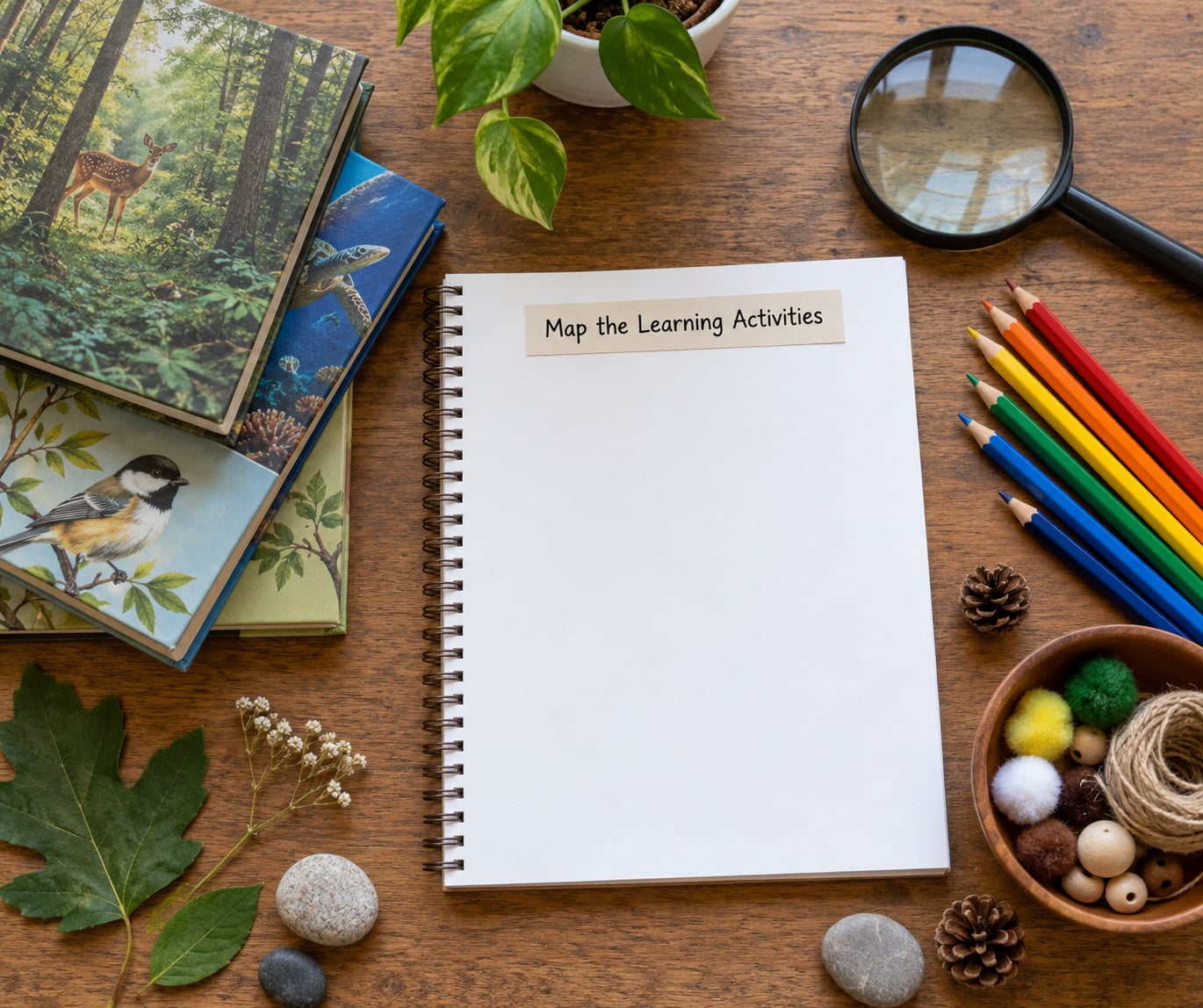
Now, and only now, do you pick activities. Work outward from the goals instead of browsing Pinterest for twenty minutes and hoping something fits.
- Reading: one reference book for you, one read-aloud for the kids, one easy reader or audiobook for independent reading.
- Discussion: three to five questions tied to the guiding question, saved for the car ride or the kitchen table.
- Investigation: one experiment or observation task, such as testing which surface holds water best or tracking which birds visit the feeder.
- Creative work: drawing, model building, cooking, or music, connected to the theme rather than done beside it.
- Real-world experience: a library program, a park visit, a phone call with a relative who knows the subject, or a walk through a neighborhood with a notebook.
Aim for about eight to ten activities across a two-week unit. That number keeps a busy homeschool day honest, because families on planning forums keep repeating the same lesson: shorter blocks beat ambitious themed days that fall apart by Wednesday.
4. Build a Flexible Weekly Schedule
Spread the activities rather than stacking them. Two or three short sessions a day, twenty to forty minutes each, usually beats one long afternoon that nobody survives.
| Unit length | Best for | Prep time | Books needed |
|---|---|---|---|
| 3 to 5 days | Preschool, a holiday week, a light Friday | About 30 minutes | 3 to 4 |
| 2 weeks | Most elementary unit studies | About 1 hour | 5 to 7 |
| 4 to 6 weeks | Older readers, history deep dives | 2 to 3 hours across a weekend | 8 to 12 |
| 8 to 12 weeks | Full-semester theme with several sub-units | A full planning session | 15 or more |
Leave gaps on purpose. A trip, a dentist appointment, or a bad week will eat into the unit, and a schedule with slack absorbs it without anyone deciding the whole thing was a failure. Also leave at least one day a week with nothing unit-related on it, because interest survives better with air around it.
Write the schedule where everyone can see it, and treat it as a plan rather than a contract. You know this step is done when you can point to any day and say what happens, without needing to reread everything.
5. Gather Simple Resources and Materials
Now collect what the plan already asked for, which keeps you from browsing aimlessly. Start at the library, since most states let you borrow from any participating system, and your card gets you read-alouds, reference books, and sometimes kits and equipment.
Free beats paid nearly every time. Public library databases, museum education pages, government and university extension sites, and library loan programs cover a surprising share of what a paid unit study pack sells. A common approach among experienced planners is to start with an outline of the sub-topics you want to cover, then pull resources for each one as you go, which keeps spending down and shortens the planning spiral.
You do not need to buy a curriculum to run a unit. Several families run a worktext for math and reading while using unit studies for history, science, and art, which prevents the theme work from doubling an already full week.
The step is finished the moment the books are in the bag and the supplies are in the drawer. Waiting to gather resources “as needed” is how a Wednesday afternoon disappears.
6. Add a Hands-On or Creative Project
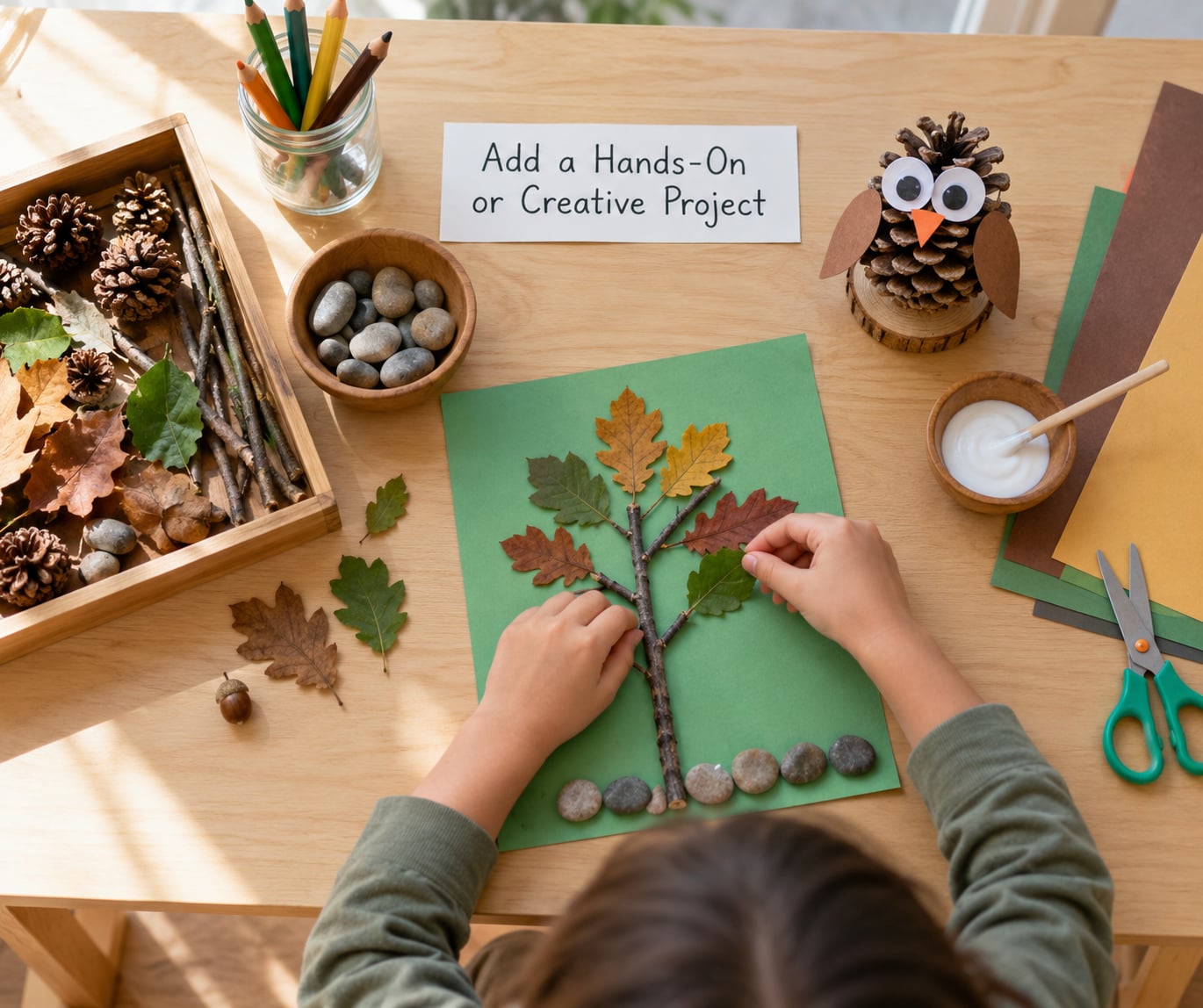
The project is the part kids remember, and it is also the clearest evidence of what they understood. Plan one project that uses the skills in your goals, and let it be a little messy.
For a kitchen science unit, we baked bread and kept a photo journal of the dough at each stage. For a weather unit, a simple rain gauge on the porch gave us a month of real data and one very proud six-year-old. Simple, cheap, and it uses what the unit taught.
Scale it to age: preschoolers draw and tell, elementary kids build and measure, older students research a sub-question and explain their findings to someone else. If the project takes more than a few days, cut the scope before you start.
7. Review Learning and Finish the Unit
Do not end a unit with a test. Four low-friction checks work better, and most take under fifteen minutes.
- Conversation: ask the guiding question again and see how the answer changed since week one.
- Demonstration: have your child walk you through the project, explaining each step in their own words.
- Writing or narration: narration is simply retelling what you read aloud, written or told back from memory, and it doubles as a reading comprehension check.
- A simple rubric: three lines, such as can explain the main idea, can do the skill, and can connect it to something real.
Then spend five minutes on the last piece: what to change next time. Too much reading? Not enough hands-on time? A sibling who finished in two days and wants more? Write it on the page while it is fresh.
Finally, save the plan, the goals, a few photos, and the finished work in one folder. Requirements for homeschool records vary by state and change, so check what yours asks for, but most states want some record of subjects and days, and this folder already contains it.
Common Mistakes
1. Choosing too many topics. Five topics spread across a term means five unfinished beginnings. Fix: one topic per unit, with a firm end date, and a short list of alternates for next time.
2. Planning more work than a school day holds. Ten activities in one week sounds productive and lands as a wall on Thursday. Fix: aim for eight to ten across the whole unit, then let go of what does not fit. Parents who plan less tend to finish more.
3. Using worksheets as the whole unit. Paperwork alone drains the curiosity that made the topic worth choosing. Fix: for every worksheet, add one thing hands-on, one thing read aloud, and one thing done outdoors.
4. Ignoring what the kids already love. A unit on a subject you find interesting but they do not will limp along. Fix: let interest lead, and put your own preferred topic in the queue two units later.
5. Skipping the review. Without a check, you finish the unit not knowing whether anything landed. Fix: add the four checks to your schedule at planning time, while they still feel easy.
6. Buying a kit for a topic you could build yourself. Pre-made packs are convenient, and they are also easy to buy twice for the same theme. Fix: borrow first, check the library, and only then look at what costs money.
A few habits that make planning faster next month: keep a running list of topics as they come up, reuse familiar suppliers, and save your finished planner pages as templates. After four or five units you will have a shelf of half-built outlines that adapt to almost any theme.
Frequently Asked Questions
How long should a homeschool unit study last?
One to three weeks covers most elementary topics well. A three to five day unit works for preschoolers or a holiday week, while four to six weeks suits older readers who can handle a longer book list. Match the length to your attention span rather than a calendar rule, and end the unit on a set date so it does not quietly stretch for a month.
Do I need a formal homeschool curriculum for a unit study?
No. A unit study can stand on its own with books from the library, free websites, and your own activities. Many families keep a worktext spine for math and reading and run unit studies alongside it for history, science, and art. Check what your state requires for records, since rules differ, then decide how much structure you actually want.
How do I make a unit study work for multiple children?
Choose one guiding question for the whole family and vary the depth, not the topic. A preschooler counts and sorts, an elementary child reads and builds, an older student researches a sub-question and writes it up. Give every child their own three-goal list on the same theme, and plan one shared session a day so the family still spends time together on it.
What should I do if my child loses interest halfway through?
Stop adding material first. Ask what part they liked and cut everything unrelated, even if you spent an hour on it. Then switch format rather than topic: visit a library program, do the project early, or hand the research part to you and let them teach the result. A short finished unit teaches more than a long abandoned one.
How can I tell whether my child learned anything from the unit?
Ask instead of quizzing. Have your child retell the guiding question, walk you through their project step by step, narrate one of the read-alouds from memory, or draw a diagram of the main idea. Any one of these shows you what stuck within about fifteen minutes, and they double as portfolio records you can file.
Can homeschool unit studies be counted toward required school days?
In most states, yes, because days are usually counted by subject and hours rather than by textbook. Record the topic, the dates covered, the subjects touched, and the work your child produced. Requirements vary by state and change over time, so check your current state homeschool law or association guidelines and keep the folder where you can find it in August.
Start with one topic this week and give it twenty minutes of planning, not a whole evening. Write the topic, one guiding question, three goals, and a rough week, then run it short rather than perfect. The units that stick are the ones that actually get finished.