
To handle homeschool burnout, you lower the demands before you try to fix the routine. Name what is draining you, cut the nonessential work, pick one small learning priority, and rebuild a rhythm you can actually hold. It takes a few weeks of honest load-shedding, not one dramatic weekend.
If you are homeschooling a toddler and a middle-schooler while working from home, this is aimed squarely at you. So is this: the part where you have not taken a real day off in months and every free hour has quietly become lesson prep.
Burnout in homeschool families usually runs a loop. An overloaded day leaves no real break, which breaks your sleep, which turns into irritability and snapping at your kids, which brings guilt, which wrecks the sleep again. You can break that loop at any link, and the easiest one to break is the schedule.
Table of Contents
- What You Need Before Starting Your Reset
- Step-by-Step: How to Handle Homeschool Burnout and Reset
- 1. Pause and Name What Is Causing the Burnout
- 2. Reduce the Load Before Rebuilding the Routine
- 3. Set One Small Learning Priority
- 4. Build a Flexible Routine That Leaves Room for Family Life
- 5. Reconnect With Your Child Without Turning Learning Into a Lesson
- 6. Ask for Support and Reduce Isolation
- 7. Decide Whether to Adjust, Pause, or Continue Homeschooling
- Common Mistakes When Recovering From Burnout
- Frequently Asked Questions
- How do I know if I am experiencing homeschool burnout?
- How long does it take to recover from homeschool burnout?
- Should I stop homeschooling if I feel burned out?
- How can I explain my homeschool burnout to my child?
- What is the simplest way to restart homeschooling after burnout?
- Where can homeschool parents find support during burnout?
- Conclusion
What You Need Before Starting Your Reset
You need very little to start: something to write on, one honest conversation with your family, and a list of everything you are currently doing. The reset begins with removing demands, not with optimizing them.
Gather three things before you change anything. First, a notebook. Burnout is hard to see while you are inside it, and writing it down is most of the work. Second, your calendar, loaded honestly. Not the one where school is 9 to 3. The real one, with the co-op drive, the piano lesson, the work calls and the grocery run stacked on top.
Third, input from the people in it. Ask your kids what part of the day they most want to keep, and what part they would happily lose. Ask your partner, or your co-parent, what they have noticed you carrying. Kids are often more accurate about the boring parts of a homeschool day than adults are.
Then write down your current commitments. Every subject, every outing, every group, every expectation other people have of you. You are not doing this to cut everything. You are doing it so you can see what is actually on the plate.
Step-by-Step: How to Handle Homeschool Burnout and Reset
1. Pause and Name What Is Causing the Burnout
Name the pressure first, because different pressures need different fixes. Overwhelmed by the curriculum needs a lighter load. Lonely needs people. Too little personal time needs a boundary.
Sort what you are carrying into a few buckets: the curriculum itself, isolation, schedule pressure, conflict with your kids or partner, broken sleep, and time with no adult conversation in it. Most parents find their real problem is not the one they assumed.
Set up a ten-minute check-in once a week, same day, and use the same three prompts. What felt draining this week? What is no longer working? What support am I missing? Write the answers without editing them.
A journal prompt I like: write one paragraph from your child’s point of view about your school day. It surfaces friction you have stopped noticing.
2. Reduce the Load Before Rebuilding the Routine
Cut before you build. A reset built on top of an unchanged load just rebuilds the same wall, with new paint.
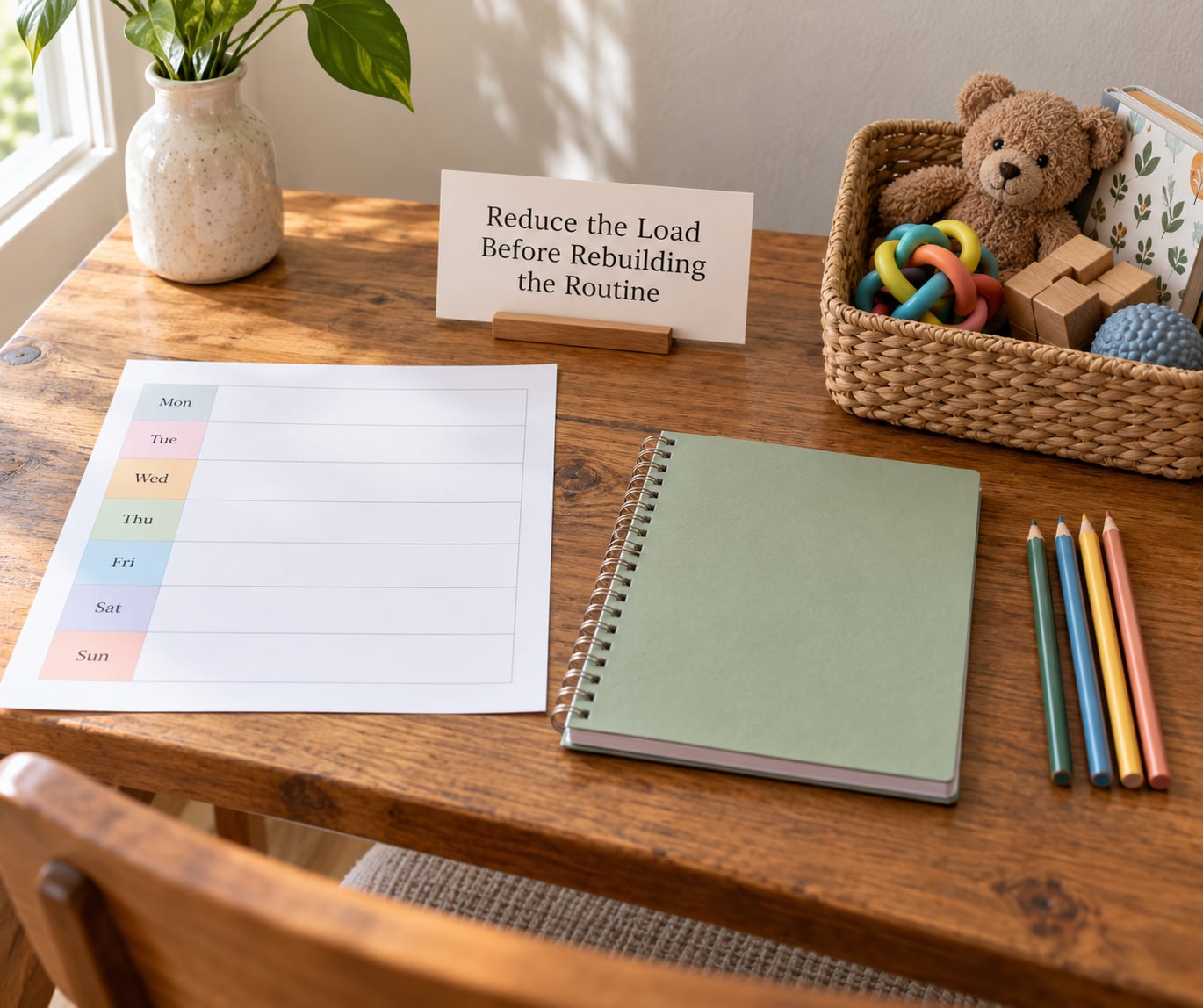
Move everything flexible onto one short weekly list and delete what does not need to happen. Non-essential activities go first, because they cost the most energy and produce the least. One co-op class. The weekly craft project swapped for a ten-minute open-ended activity. The family read-aloud, kept, because it costs you almost nothing.
Shorten the school day. Two focused blocks with a long break beats five scattered ones, and most families doing this report the shorter day holding up better than the long one did.
Say out loud that this is temporary. Burnout parents often refuse to reduce anything because it feels like admitting the year is over. It is not. You are making the run survivable so it can continue.
3. Set One Small Learning Priority
One priority a day. Pick the thing that matters most and let the rest slide for a season. A low-effort completion marker beats a checklist, because finishing one real thing is what tells your brain the day worked.
Good candidates: fifteen minutes of reading aloud, one page of math practice, a short creative activity the child chooses. That is a complete school day. It genuinely is, at this stage.
Pick the marker before the week starts. Something like the workbook page is done, or we read until the tea is ready. If you wait until the day is half over to decide whether it counted, you have just handed yourself another thing to fail at.
4. Build a Flexible Routine That Leaves Room for Family Life
A routine is a support tool, not a standard to fail against. The point is a shape for the day that leaves room for a bad Tuesday, not a rigid sequence that punishes one.

A rhythm that tends to hold: a short morning block, movement outside, reading at midday, lunch, one afternoon block, then independent play and downtime. Two blocks is plenty when you are depleted.
On a low-energy day, run the smallest version. Reading and outside time, and let the rest of the plan go without a discussion about it. Protecting that without renegotiating it in the moment is most of the skill.
Leave one day a week with no planned school at all if you can. Weekend-loaded weeks look fine on paper and fall apart in practice.
5. Reconnect With Your Child Without Turning Learning Into a Lesson
Connection comes before completion. On the days you snapped, the missed lesson is the smaller problem, and the relationship is the one that carries forward.
Follow their lead for an hour. Let them pick the activity, including the ones you would not have chosen. Legos, cooking, sorting, a fort, a bug hunt, drawing something awful on purpose. Fifteen minutes of genuine interest beats an hour of compliance, and it repairs more than it costs.
Repair after a bad morning with plain words: I was short with you this morning and that was not about you. Model the apology. Kids are watching how an adult handles a bad day more closely than how you handle a good one.
If your child has lost interest in something they used to love, that is worth taking seriously. It usually means the thing became a demand rather than a pleasure, and it needs a few weeks off before it comes back.
6. Ask for Support and Reduce Isolation
Isolation is one of the heaviest loads in this job, because there is no colleague, no substitute and no lunch break. Support is a coping strategy, not an admission that you cannot manage.
The realistic options: a partner taking one fixed block, a co-op where somebody else teaches part of the week, a library program, a local group, an online community, a tutor for one stubborn subject, a counselor, or a friend who will listen rather than solve.
Ask for one specific thing instead of general help. I could really use Tuesday afternoons covered while I take the kids out. Can you take bedtime three nights a week? Not help with school. Help with dinner.
Specific requests get met. Vague requests get well-meant advice about your schedule.
7. Decide Whether to Adjust, Pause, or Continue Homeschooling
There is no single right answer here, and you do not have to decide today. Try the lighter options first, in order, and give each one long enough to show whether it helped.
Start with adjust: a lighter curriculum, fewer days, more outside activities, more delegation. Then consider a pause, a few weeks off with no school at all, which many families find more restorative than any schedule change. Then a change in structure, such as a co-op twice a week, a tutor, or a hybrid virtual program.
Some families land on a transition away from homeschooling entirely, and that is a legitimate outcome too. Frame it around your child’s needs, your family’s circumstances, and whether a suitable alternative is actually available in your area.
A general information note: burnout is exhaustion and dread, and it eases with rest and load reduction. It is worth talking to your doctor or a counselor if low mood, hopelessness, or loss of interest in anything persists, because that is a different thing and a professional can help in ways a schedule cannot.
Common Mistakes When Recovering From Burnout
Almost every stuck recovery comes down to one of five mistakes.
Trying to fix everything at once. A new curriculum, a new planner, a new routine, all in the same week. The fix is one change, held for three weeks, because you cannot tell which change did anything anyway.
Copying another family’s schedule. The families online with tidy tables and finished projects have edited the boring parts out. The fix is to build your own rhythm from your own worst realistic day, not their best one.
Treating every bad day as failure. Some days will be bad during recovery, especially the early ones. The fix is a completion marker instead of a checklist, so a partial day still registers as a day that happened.
Adding enrichment to fill the gap. Activities are the easiest thing to add and one of the most common burnout drivers. A full co-op schedule on top of an already failing routine makes it worse. Drop something instead.
Refusing help until it is urgent. Waiting until you cannot cope turns ordinary support into a rescue. Ask now, for something small, while you can still receive it well.
Pick the smallest next step tonight, not the whole recovery. Write down what is draining you. That is enough for one day.
Frequently Asked Questions
How do I know if I am experiencing homeschool burnout?
Burnout shows up as dread before the school day, resentment toward tasks you used to enjoy, snapping at kids who did nothing wrong, and exhaustion that sleep does not fix. It is different from a bad week because rest alone does not restore your sense of the work. If you feel relief on days with no school and dread on days with school, that pattern is worth taking seriously.
How long does it take to recover from homeschool burnout?
Most families notice a shift within two to four weeks of genuinely cutting the load, and a fuller recovery takes closer to two or three months. The first week often feels worse before it feels better, because you are noticing demands you had stopped registering. Timing depends on how long you have been depleted and on whether sleep and support improve at the same time.
Should I stop homeschooling if I feel burned out?
Usually no, not as a first move. Try reducing days, lightening the curriculum, delegating one block, or taking a genuine break, and give each several weeks. Leaving can be the right answer when the arrangement keeps harming the family and a good alternative is available, but it is a later decision than most burned-out parents think.
How can I explain my homeschool burnout to my child?
Keep it simple and honest without making your child responsible for fixing it. Say that mom is really tired and school got too big, and that we are making it smaller. Kids worry most when they see a parent struggling and are given no explanation, so a calm few sentences buys a lot of security.
What is the simplest way to restart homeschooling after burnout?
Start with one priority a day, usually reading aloud, and one clear finish line so you know the day worked. Two short blocks are enough at first. Add back the second subject only once the first week feels ordinary rather than heroic, and keep one full day unplanned.
Where can homeschool parents find support during burnout?
Start close to home: your partner, a co-op where someone else teaches part of the week, a library program, or a local homeschool group. Then add one online community so you have adults to talk to on the bad days too. A counselor is worth it when the exhaustion has not lifted, rather than a last resort.
Conclusion
Pause, name the biggest pressure, cut the load, then choose one small learning priority you can finish on your worst day. That order matters, because rebuilding a routine on top of an unchanged workload just produces the same wall with fresh paint.
Rest is not falling behind. If you are wondering how to handle homeschool burnout, tonight’s job is small: write down what is draining you and cross off one nonessential. Asking for one specific piece of help this week is the second thing. If the low mood does not lift once the load drops, talk to your doctor or a counselor, because that is a different problem and it deserves a professional rather than another schedule revision.