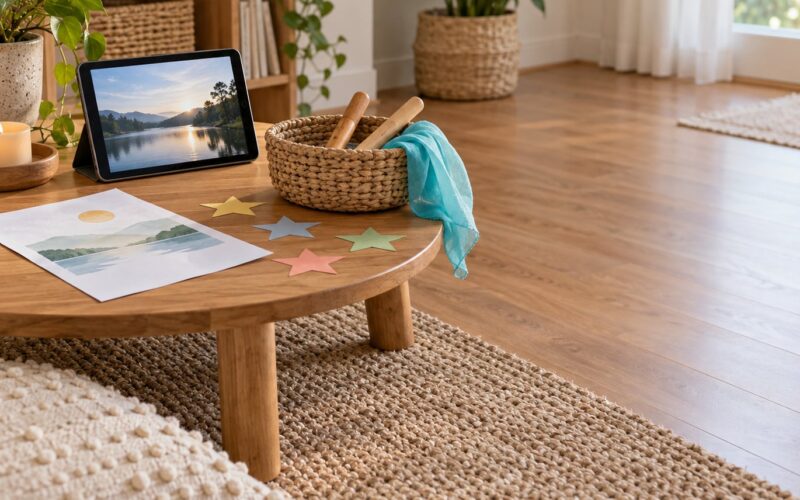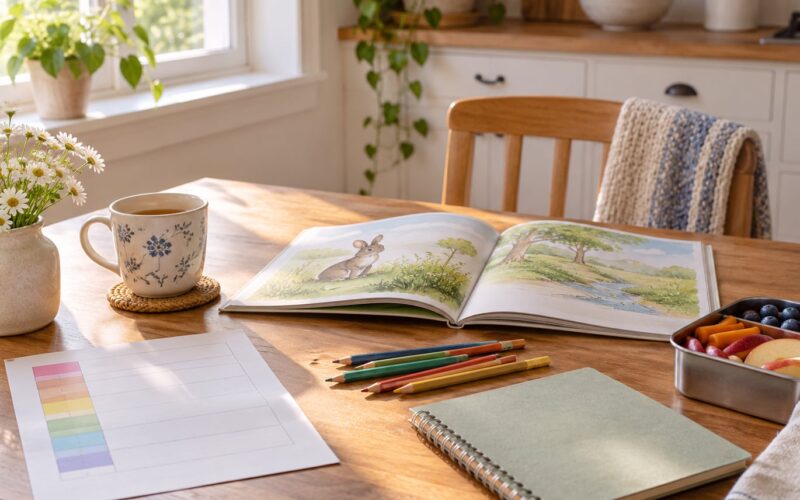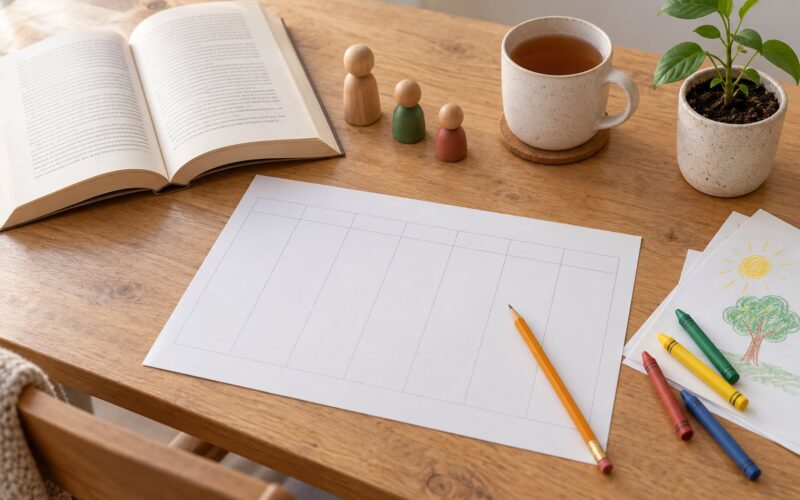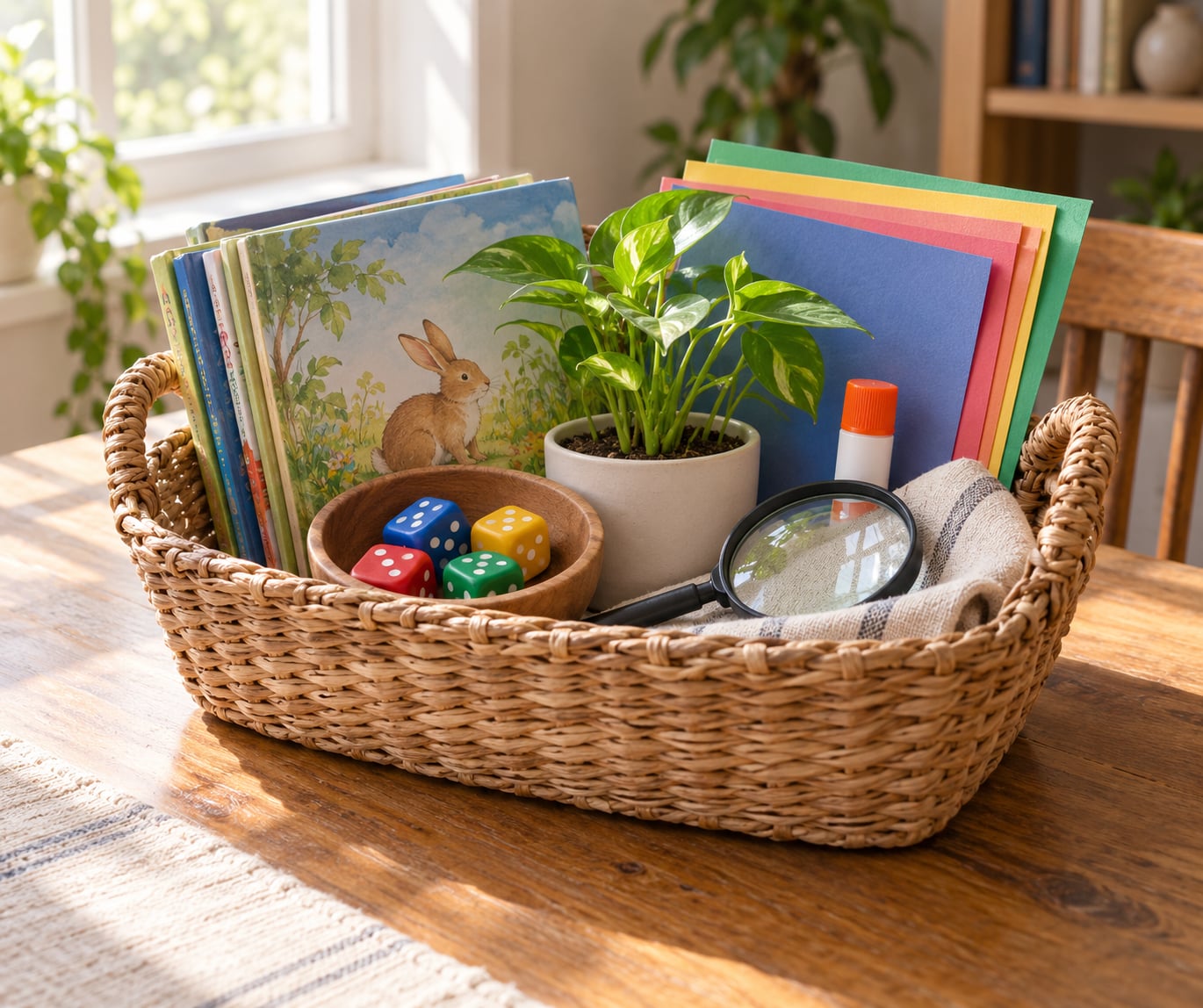
A homeschool morning basket is a shared set of books, games and hands-on materials that children use independently for the first 15 to 30 minutes of the school day. These morning basket ideas for homeschool families work because the basket is prepared the night before, so the morning opens with a read-aloud instead of an argument.
The custom comes from the classical Christian homeschool tradition, where families gather for read-alouds, recitation and memory work. Most families today keep the rhythm and drop the religious framing, and plenty of them do it with library books, a cardboard box and whatever is already in the kitchen drawer.
Here are 12 baskets that suit different ages and different mornings. Each one lists the supplies you need, roughly how long it takes to get ready, and a concrete way to use it.
Table of Contents
- Morning Basket Ideas for Homeschool at a Glance
- 1. Quiet Reading and Library Basket
- 2. Poetry and Language Basket
- 3. Fine-Motor Skills Basket
- 4. Math Discovery Basket
- 5. Art and Craft Basket
- 6. Nature Observation Basket
- 7. Geography and World Cultures Basket
- 8. Science Experiment Basket
- 9. Morning Movement Basket
- 10. Seasonal Learning Basket
- 11. Kids’ Kitchen Helper Basket
- 12. Independent Learning Basket
- Frequently Asked Questions
- What are some ideas for a homeschool morning basket?
- What are some ideas for morning work for homeschooling?
- What is a good morning schedule for homeschooling?
- How long should a morning basket last?
- How do I keep morning basket items fresh?
- How many hours a day should homeschooling be?
- Conclusion
Morning Basket Ideas for Homeschool at a Glance
| Basket idea | Main benefit | Basic supplies | Prep time |
|---|---|---|---|
| 1. Quiet reading and library | Calm start, strong reading habit | Rotating books, library card, notebook | 10 minutes |
| 2. Poetry and language | Vocabulary, rhyme and expression | Poetry cards, rhymes, word games, notebook | 5 minutes |
| 3. Fine-motor skills | Hand control and pencil readiness | Play dough, scissors, beads, yarn, tweezers | 5 minutes |
| 4. Math discovery | Number sense without worksheets | Dice, playing cards, coins, measuring cup | 5 minutes |
| 5. Art and craft | Independent creative thinking | Washable paint, paper, glue, prompt cards | 10 minutes |
| 6. Nature observation | Attention and careful looking | Notebook, magnifier, containers, field guide | 10 minutes |
| 7. Geography and world cultures | Place-based context | Maps, postcards, cuisine cards, atlas | 15 minutes |
| 8. Science experiments | Hypothesis thinking, safe mess | Water, color, magnets, foil, trays | 10 minutes |
| 9. Morning movement | Transition into seated work | Movement cards, scarf, ball, timer | 5 minutes |
| 10. Seasonal learning | Keeps content relevant all year | Seasonal books, observation prompts | 15 minutes |
| 11. Kitchen helper | Life skills and reading a recipe | Recipe cards, measuring cups, apron | 15 minutes |
| 12. Independent learning | Ownership and self-checking work | Puzzle cards, choice board, map, games | 10 minutes |
Pick two to start, not twelve. Families who report a morning basket actually sticking tend to run three to five items on a loop rather than filling every slot.
1. Quiet Reading and Library Basket
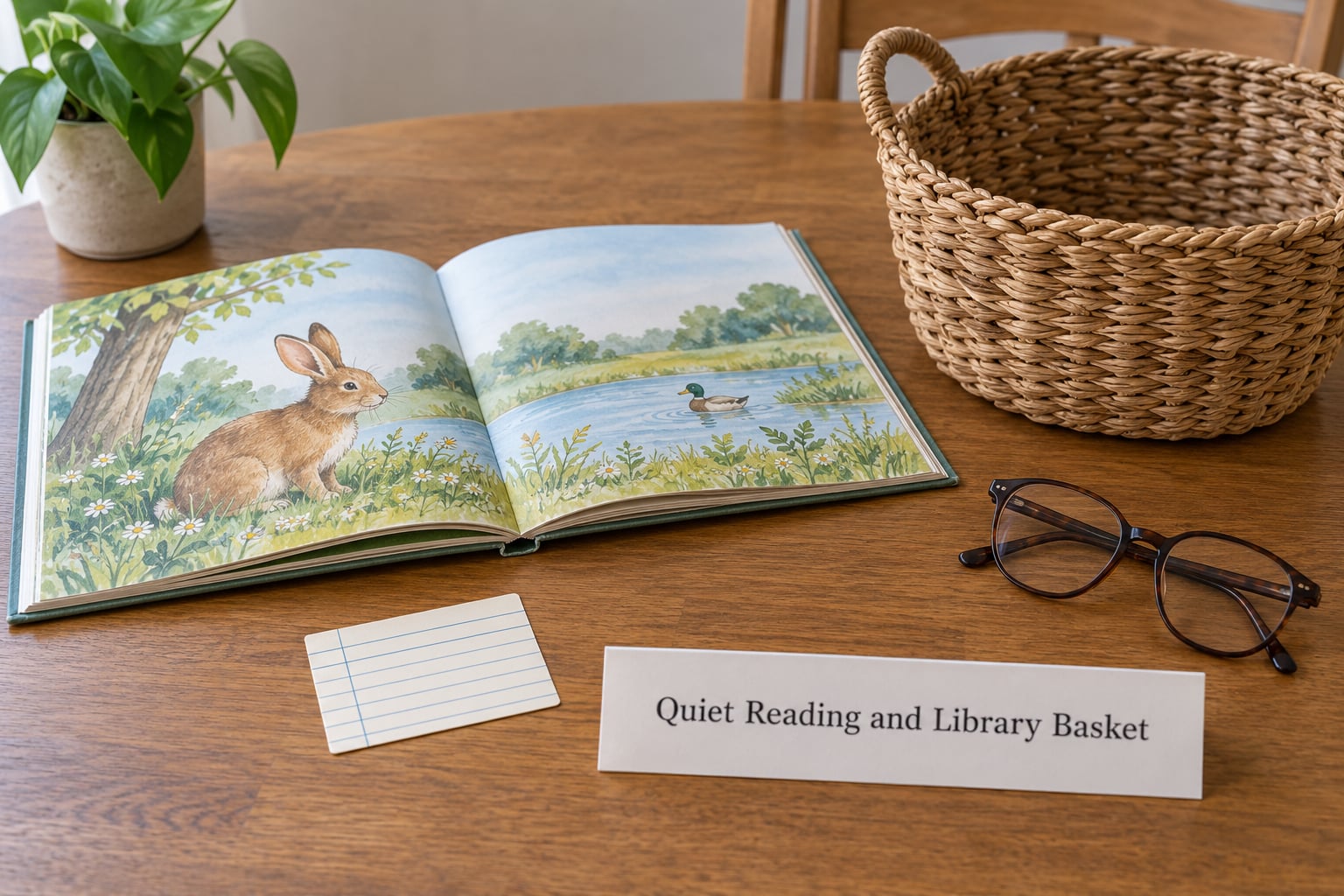
A reading basket works because almost nothing has to be prepared. You are simply putting books where a child can reach them without asking.
Fill a shallow box with four to six current-interest reads, a couple of library returns waiting to be shelved, a chapter book for older children and board books for the little ones. Add a notebook, a pencil and one small prompt card so the reading time is not purely passive.
Use it like this: everything on the prompt card gets done, then children choose whatever else they want to read. A four-year-old might circle pictures of dogs in the nonfiction book and copy the word into the notebook. A nine-year-old reads the chapter book and writes one sentence about what happened.
Library books are the cheapest way to keep this basket fresh. Borrow a different stack each month and only buy the ones your children ask for again.
2. Poetry and Language Basket
Poetry and rhymes give young children rhythm and vocabulary without feeling like school. Older children use the same cards to practise expression and to notice how sentences are built.
Put a small poetry collection in the basket, a deck of nursery rhyme cards, a word game such as a rhyming families set, and a notebook for copying lines. A magnetic letter set or a jar of letter tiles turns the whole thing into a word-building exercise.
A typical session is short. Read two or three poems out loud, let a child pick a line to copy into the notebook, then play one round of the word game. My favourite variation is to keep a “line of the day” card on the fridge and have whoever is doing the basket read it aloud to the rest of the family over breakfast.
For preschoolers, rhyme matters more than comprehension. They will chant a bad rhyme over a good poem every time.
3. Fine-Motor Skills Basket
Fine-motor work builds the hand control that later makes writing letters less painful. It also keeps hands busy while siblings do something quieter.
Pack the basket with play dough, blunt-tip scissors, a jar of large wooden beads, yarn and a blunt tapestry needle, tweezers, a threading card, crayons and thick paper for tracing. Add a card of three prompts, such as roll ten beads into a snake, tear paper into small squares, or thread beads in rainbow order.
Three prompts sit face up on the table and the child chooses. Anything left over at the end of the week goes into a “finished” jar they can look back through, which matters more than it sounds when a child is not sure they are good at anything yet.
This basket scales up. A teenager would find it insulting, but a seven-year-old who fights pencil work one day often manages it the next after twenty minutes of bead threading.
4. Math Discovery Basket
A math discovery basket teaches number sense through play, which is faster than flashcards for most children.
The supplies are ordinary: two dice, a deck of playing cards, a set of coins, a measuring cup and water bottle, a ruler, a small set of pattern blocks or linking cubes, and a timer. Stack them in a basket with a notebook and a grease pencil so children can record results.
Sample prompts: roll the dice and build the total with coins, deal five cards and find the largest two-digit number, or fill the water bottle and guess how many cups it takes before the line. The guessing first is the point, since the surprise at being wrong is what makes children pay attention.
Cards work well because a single set serves six years of math. Aces as ones, face cards as ten, and a deck is suddenly an addition table.
5. Art and Craft Basket
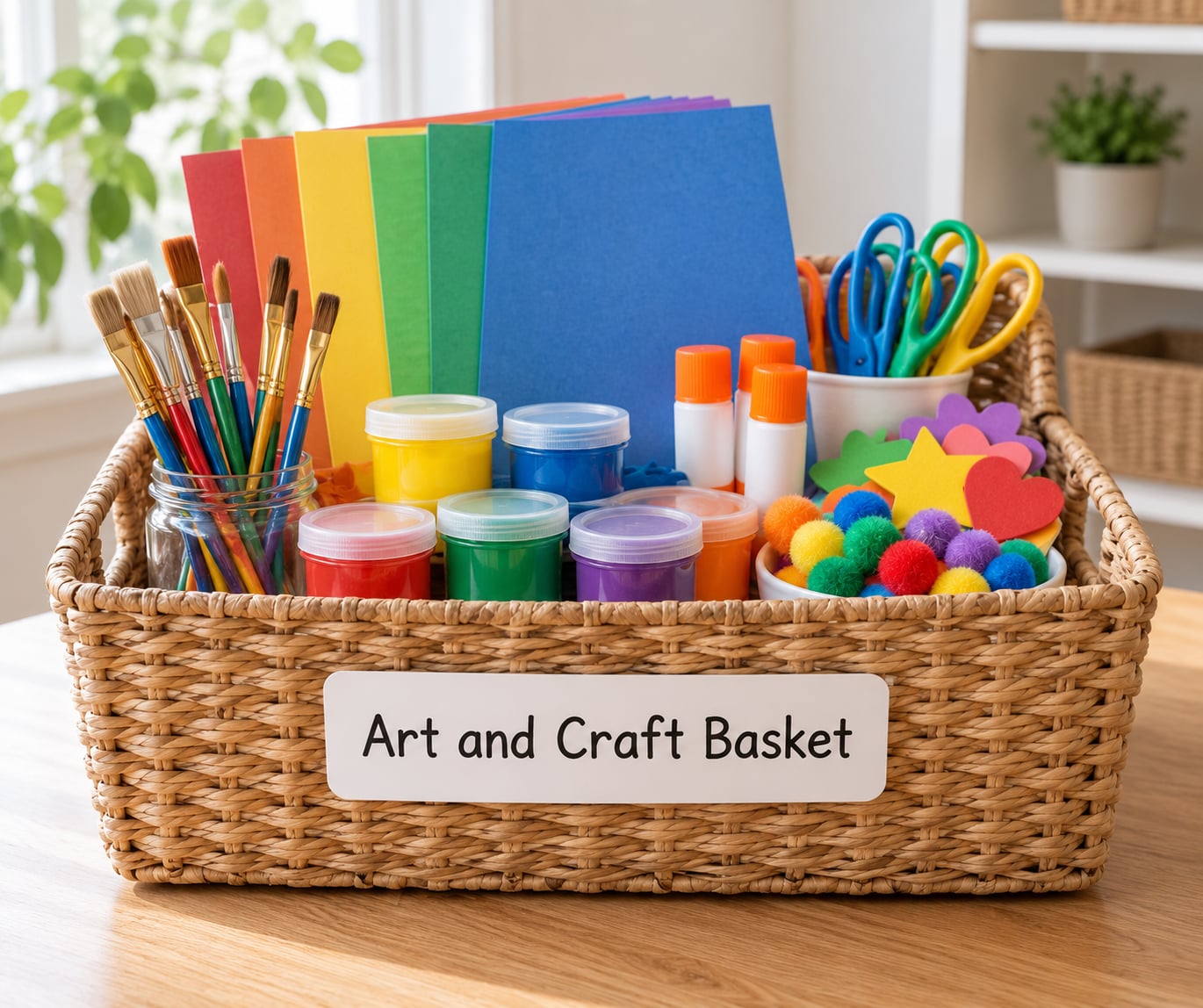
An art basket buys you about 20 minutes of quiet while one child creates and another does something else entirely.
Use washable paint, thick paper and card, glue sticks, safety scissors, a jar for rinse water, a smock or old shirt and a stack of cardboard or cereal boxes to build on. Add five or six prompt cards you rotate monthly: paint a letter, make a paper plate mask, build a model bridge from recycled pieces.
Keep finished work out of sight during the week. A drying line on the wall turns every basket morning into an excuse to walk past and admire something.
For craft tie-ins, our simple seasonal projects work well here since each one needs nothing more than paper, glue and paint, and they pair naturally with the seasonal basket later in this list.
6. Nature Observation Basket
A nature basket turns the ten minutes before breakfast into real observation practice rather than screen watching.
Include a small notebook or a nature journal, a pencil, a magnifier, clear specimen containers with lids, a simple regional field guide, a bird checklist and a small weather card with wind, cloud and temperature symbols.
The prompt each morning is one question: find something green, find something with an edge, find three different seeds, find something that changed since yesterday. Children draw or sketch what they see and note the date, which becomes a record your family will find interesting within a few months.
Keep the basket by the door instead of in the school room so the basket actually gets used. Weather kits and magnifiers are the only items worth buying beyond what you own.
7. Geography and World Cultures Basket
A geography basket gives children a sense of place, which is hard to get from a textbook chapter alone.
Fill it with a wall map or atlas, a stack of postcards, small flags, cuisine cards showing meals from different regions, a coloring map, and a few small objects such as a wooden die from a traditional game or a fabric square. A short nonfiction book about the current region goes in the slot shared with your reading basket.
Rotate one region per week. The basket sets out a map puzzle, one postcard and one food item to try at breakfast, then children find that country on the wall map and mark it with a sticker.
Food is what makes it stick. Tasting something at the table connects a name on a map to something real, and it costs no more than a grocery run.
8. Science Experiment Basket
Science basket prompts are cheap because the materials are mostly water, color and things already in the drawer.
Pack a tray, a cup of water, food coloring, a dropper, baking soda and vinegar, ice cubes, a small magnet, steel wool, foil, a balloon, a paper towel roll and some coins. A tray under everything saves the table more often than it should.
Each prompt states a guess first: will the ice sink, will the coin float in the balloon, which object will the magnet pick up. Children write the guess, run the test, then write what happened.
Some experiments need an adult nearby, particularly anything involving a stove, scissors or small parts a toddler could swallow. Test every setup before it goes in the basket if you have more than one age running around.
9. Morning Movement Basket
Some children cannot sit down at 8am, and asking them to is a losing battle. A movement basket buys you a seated child ten minutes later.
Include movement cards with drawn exercises, a silk scarf, a soft ball, a timer, chalk for a hopscotch grid on the floor, and a strip of masking tape for balance lines. Cards are easy to make from index paper with a stick figure doing something slightly silly.
Three prompts on the floor of the room work well: five jumps on each foot, balance along the tape line for 20 seconds, then catch the scarf ten times without letting it touch the ground.
For mixed ages, make this a relay. The four-year-old crosses the tape line while the ten-year-old walks it heel to toe, and everyone counts each other’s attempts out loud.
10. Seasonal Learning Basket
Rotating around the current season is the easiest way to keep a morning basket from going stale, because the subject matter changes on its own.
This 2026 autumn that means leaves, seed collecting, shorter daylight and weather observation, with books on harvest, animals preparing for winter and a leaf-pressing project. Swap them for bare branches, ice experiments, longer shadows and winter-bird counts in the cold months, then for seedlings, mud, nest building and egg collecting in spring.
The basket holds the same four slots all year and only the contents change: one seasonal book, one observation prompt, one hands-on project and one seasonal snack or sensory item. Leaf prints, a pinecone counting tray and a jar of smelled spice blends all fit the same small footprint.
National days work well as the same idea on a smaller scale. A quick craft or food item tied to a date the children already know about costs you very little planning time.
11. Kids’ Kitchen Helper Basket
A kitchen helper basket teaches measurement, sequencing and reading comprehension at the same time, and the results are eaten.
Set it up with a laminated recipe card in large type, measuring cups and spoons, a small bowl set, a whisk, a child-safe knife, an apron, a timer and a cloth for spills. An adult handles the knife, and it stays on the cutting board; the recipe card is laminated on purpose because flour finds every edge.
Breakfast jobs work best: setting the table, measuring milk, cracking an egg, stirring pancake batter, counting the plates. Put the recipe card in the reading basket the night before so the child has already seen the words they will be following.
Baking bread together once a week is a natural fit for the morning rhythm, since dough needs sitting time and the kneading keeps small hands busy.
12. Independent Learning Basket
An independent learning basket is for the children old enough to choose their own first task, and it is the one most families skip and then wish they had built.
Fill it with self-checking activities such as maze books, matching games, a dry-erase pen, jigsaw puzzles, a bin of wooden letters, a card game, a simple map to color, and a choice board with six activity squares. The rule on the card is simple: choose a square, do it, cross it off, choose again if time remains.
Self-checking matters because you cannot answer forty questions before breakfast. Mazes with answer keys, puzzles with a picture on the box and games that score themselves all let the work stand on its own.
For older children, the same basket holds bigger tools: a crossword book, a card game with real strategy, a newspaper crossword, and a short list of current-events questions to talk about over breakfast rather than answer alone.
Frequently Asked Questions
What are some ideas for a homeschool morning basket?
A morning basket usually holds four to six items: a read-aloud, one hands-on activity, one quiet independent task, a notebook for writing or drawing, and something seasonal. Popular versions include reading baskets, poetry baskets, fine-motor baskets, math discovery baskets, science experiment baskets, movement baskets, kitchen helper baskets and choice-board baskets. Rotate one item per week so the basket never feels finished.
What are some ideas for morning work for homeschooling?
Morning work that works without you standing over it includes reading and a reading response, a notebook or copywork page, one puzzle or board game, a craft with a written prompt, memory recitation from cards, and a short narration from a read-aloud. Keep it to two or three of these per morning and leave the rest optional. Pick the ones that match what the child is already learning this week rather than using a fixed set.
What is a good morning schedule for homeschooling?
A workable morning runs breakfast, then a 15 to 30 minute basket, then a short read-aloud together, then the focused school block. Sequence works best as quiet independent task first, connection second, and heavier work third, because children tire. End the basket session on a shared read-aloud so the day starts and ends with your attention rather than with you leaving the room.
How long should a morning basket last?
Fifteen to 30 minutes suits most families. Preschoolers do well with ten to fifteen minutes of basket time before the main school block. Upper elementary and teens manage 20 to 30 minutes if the content is genuinely interesting. Start shorter than feels right for two weeks, then extend it, since a basket that is cut off by a timer often gets restarted the next morning with more motivation.
How do I keep morning basket items fresh?
Rotate one item per week and one theme per month, which is far less planning than it sounds. Borrow books from the library rather than buying new ones, and return anything a child ignores twice to the shelf. Put the basket away when the session ends so the same objects stay slightly special. When interest genuinely fades, stop for a few weeks rather than adding more items to fight it.
How many hours a day should homeschooling be?
Expect roughly two to four hours of focused work for elementary ages, less for preschoolers and more for teens, plus read-aloud and basket time. State law for homeschool days varies by state, so check your own requirements rather than copying a general figure. The basket usually adds 20 to 40 minutes rather than replacing core subjects, and it works best when it stays short enough to protect the main teaching block.
Conclusion
Start with one or two themes that fit the children you actually have this week, fill the basket the night before, and let each child pick the first activity. Everything else, including the rotation schedule and the containers, can be sorted out once the routine is already running.