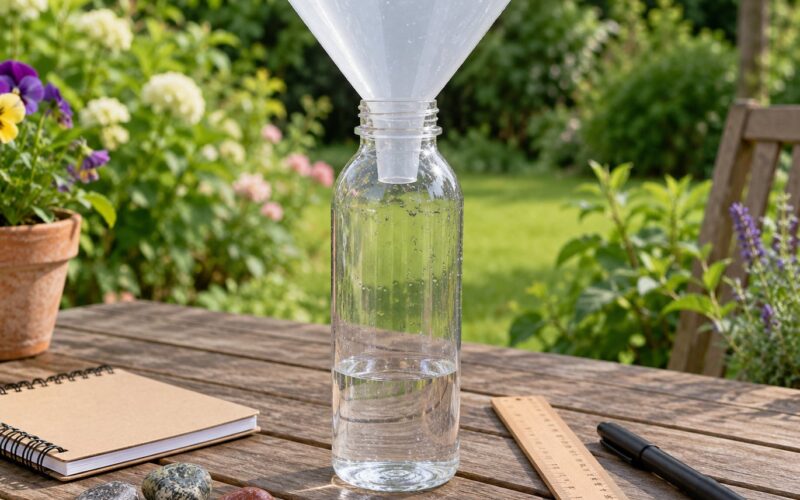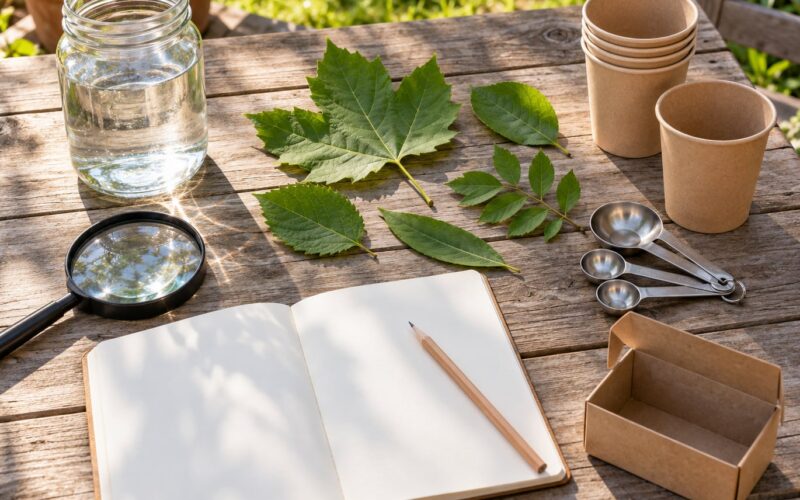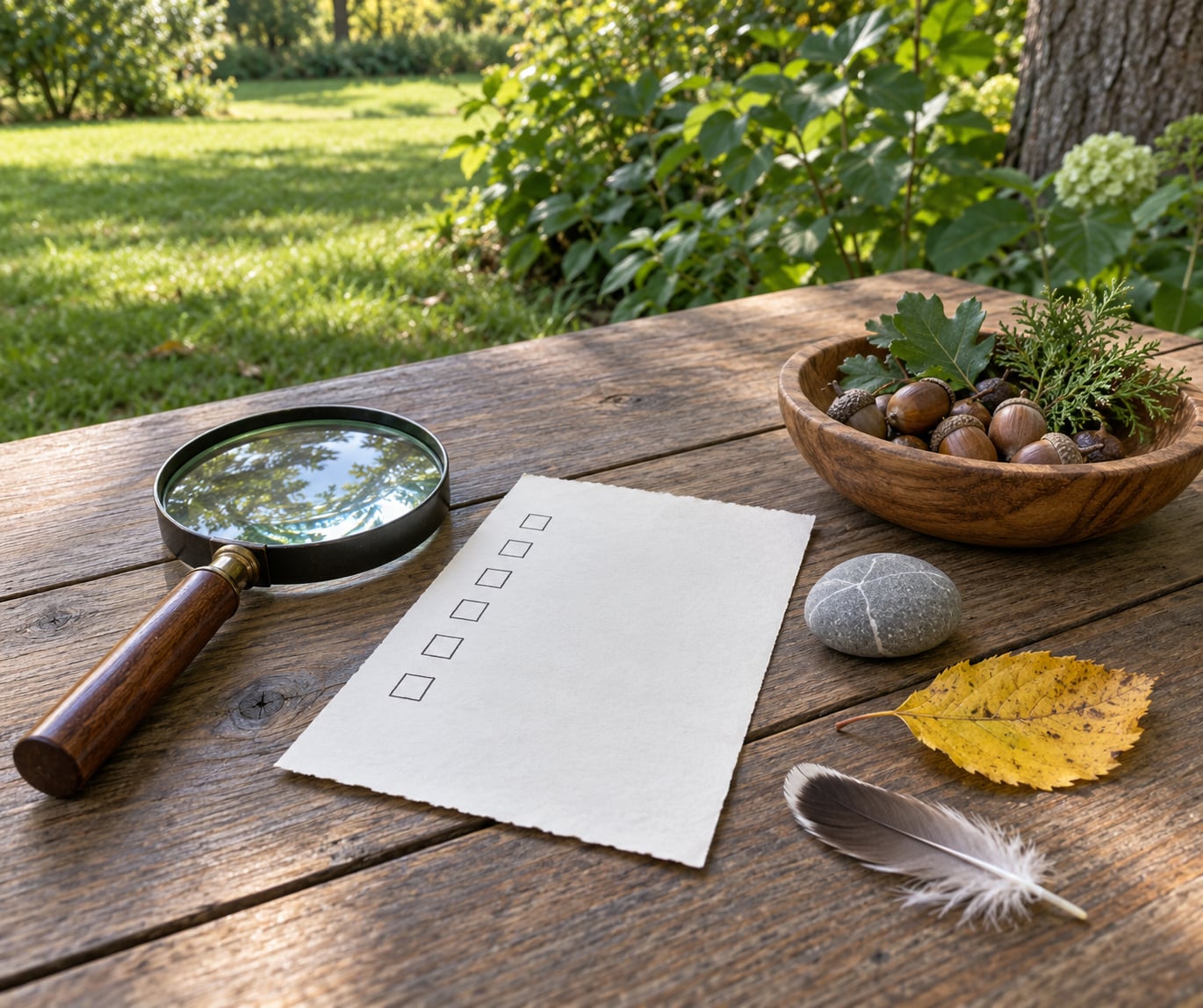
A nature scavenger hunt is an outdoor game where children get a short list, a picture checklist, or a set of clues to match while they explore a yard, park, street, or trail. It turns an ordinary walk into a focused mission, and it works well from about age 2 up through the teens without anything more advanced than paper and a bag. Below are 12 nature scavenger hunt ideas for kids, each labeled with the setting it suits, the age range, and roughly how long it takes to get going.
Everything here runs on supplies you already own. Several work with no printing and no list at all, which matters when you have three under-fives and a free afternoon. Sizes and durations are approximations, so treat them as a starting point rather than a rule.
Table of Contents
- Nature Scavenger Hunt Ideas for Kids at a Glance
- 1. Backyard Color Hunt
- 2. Texture Treasure Hunt
- 3. Miniature Nature Search
- 4. Five Senses Walk
- Five senses scavenger hunt prompts for each age
- 5. Nature Shape Hunt
- 6. Bird-Watching Discovery Hunt
- 7. Insect and Spider Hunt
- 8. Leaf Identification Challenge
- 9. Nature Photography Hunt
- How to run a photo scavenger hunt in four steps
- 10. Natural Alphabet Hunt
- 11. Weather and Sky Hunt
- 12. Neighborhood Nature Map Hunt
- More nature scavenger hunt ideas for kids that need no printing
- Frequently Asked Questions
- How long should a nature scavenger hunt last for a toddler?
- What ages work best for scavenger hunts?
- What supplies do I need for a nature scavenger hunt?
- How do I keep kids interested when they lose focus after ten minutes?
- What are good clues for an outdoor scavenger hunt?
- Are scavenger hunts safe for young children outdoors?
- Conclusion
Nature Scavenger Hunt Ideas for Kids at a Glance
This table sorts the 12 ideas below by setting, age, main skill, and setup time. Pick the row that matches the energy you have, not the one that looks most impressive.
| Hunt | Best setting | Ages | Main skill | Setup |
|---|---|---|---|---|
| Backyard color | Yard, patio | 2-6 | Color matching | 5 min |
| Texture treasure | Yard, sidewalk | 4-9 | Describing properties | 5 min |
| Miniature search | Anywhere outdoors | 5-10 | Close observation | 0 min |
| Five senses walk | Park, trail | 3-10 | Sensory awareness | 2 min |
| Nature shape hunt | Yard, beach | 4-10 | Geometry in nature | 5 min |
| Bird discovery | Park, yard | 4-12 | Patience and noticing | 2 min |
| Insect and spider | Grass, bark, flowers | 3-10 | Spot and count | 0 min |
| Leaf challenge | Trail, yard | 3-9 | Classification | 5 min |
| Photography | Anywhere outdoors | 7-16 | Framing and focus | 5 min |
| Natural alphabet | Sidewalk, yard | 4-8 | Letter recognition | 0 min |
| Weather and sky | Open space, porch | 3-10 | Prediction | 0 min |
| Neighborhood map | Short walk | 6-14 | Place and planning | 20 min |
1. Backyard Color Hunt
Children hunt for natural objects that match colors you name out loud, which turns a patch of grass into a color-matching game. Say “something yellow” and let them run until they find a dandelion, a gravel chip, or a piece of faded shingle.
Colors work well for the youngest hunters because the goal is concrete and the win is immediate. To stretch it, hand over a set of crayons and ask each child to find a crayon that matches something they found, which turns matching into comparison.
Older children can sort their finds into a row afterwards and look at shades instead of names: is that pebble sand-colored or gray-green? Two minutes of sorting teaches more about color than twenty minutes of collecting.
2. Texture Treasure Hunt
This hunt sends children after surfaces rather than objects: something rough, something smooth, something fuzzy, something shiny, something hard. Bricks, bark, gravel, clover, and a puddle edge all qualify.
Texture words are harder to pin down than color words, so give children a fixed list of six adjectives rather than letting them choose. Describe each find out loud in a full sentence, since that is where the vocabulary sticks.
One rule matters here. Children look and touch only what is already on the ground, and they never pick plants, insects, or litter. Say that before you start rather than after someone reaches for a mushroom.
3. Miniature Nature Search
The smallest things make the best hunt for children who have learned to say they are bored. Set the target small: anything smaller than a fingertip. Seed, grit, petal, bud, pebble, spider silk, bark flake.
Children routinely find things an adult walked past. On my last one, a five-year-old pointed out a moth and a snail shell that had been under the same shrub for weeks.
A phone camera held an inch from the ground solves most of this. Kids photograph what they find, then compare close-ups on the way home, and the close-up becomes the trophy rather than a jar of specimens.
4. Five Senses Walk
A sensory scavenger hunt asks children to find one thing for each sense: something to see, something to hear, something to smell, something safe to touch, and something to taste only if you approve it. Five prompts, about ten minutes, no equipment.
Five senses scavenger hunt prompts for each age
Toddlers and preschoolers handle two senses well, usually sight and sound. Ask them to find something round and something that makes a noise, then stop there. Adding a third prompt usually ends the game early.
Elementary children can run all five. The touch prompt needs a guardrail: bark, stone, sand, dry leaves, and playground equipment are fine, while mushrooms, berries, and anything with a fuzzy white surface are not.
Tweens tend to reject the format as babyish, so reframe it as a five-sense photo hunt. The photography version below asks for the same five categories but makes it feel like a camera challenge instead of a preschool game.
5. Nature Shape Hunt
Shapes hide everywhere outside, and children walk past them for years. Ask for a circle, a triangle, a straight line, a star, and a spiral. A wheel is a circle, a bare branch forks like a Y, a curl of a fern frond is a spiral.
Shadows widen the search. Late afternoon shadows of fence pickets and railings give long straight lines, and the silhouette of a weed against a bright wall shows off shapes the object itself hides.
Finish by drawing the shapes children found on a single sheet of paper. The drawing slows everyone down and usually produces the surprise of the afternoon: the child who found nine circles can hardly draw one.
6. Bird-Watching Discovery Hunt
Bird watching rewards stillness more than speed, so frame this one as a sit-down hunt. Bring a pair of binoculars if you have them, or use the phone camera zoom, and set a five-minute quiet timer.
Children can record bird colors, beak shapes, calls, movement, and what a bird did next. Call descriptions work better than species names at first: pointed beak, speckled chest, hopping, tail flicking.
Nest material is a great find, as is a feather or a pile of seeds under a tree. Keep the child beside you and let birds come to you. Do not approach a nest, and do not play recordings, since loud playback keeps parents and birds out of the area.
7. Insect and Spider Hunt
Grass, bark, flowers, and leaf litter all hold small arthropods, and looking is more interesting than catching. Ask children to spot and count: count the ants on one stem, count the different kinds of beetle you can find on a single log.
Counting removes two problems at once. Nothing gets picked up, so there is no live insect to rescue later and no cleanup, and children who were not going to touch a bug will happily count ten of them.
Watch from a crouch, look under leaves rather than into them, and let a wasp or hornet nest end the search at that spot. Wash hands when everyone comes in, and skip the hunt entirely during heavy mosquito season.
8. Leaf Identification Challenge
Matching leaves by shape works better with fallen leaves than live ones, and it avoids the plant-damaging that picky parents worry about. Send children for one smooth-edged leaf, one toothed leaf, one with a very visible center vein, and one that’s much larger than the rest.
Color is a poor identifier once leaves have started to turn, so treat it as a clue rather than a rule. Vein pattern, edge, and overall shape stay reliable all season.
Fold a simple identification sheet: leaf, edge, vein, color. Kids who sort a pile of ten leaves into two or three groups are doing real classification work, which is the part adults get to skip and children should not.
9. Nature Photography Hunt
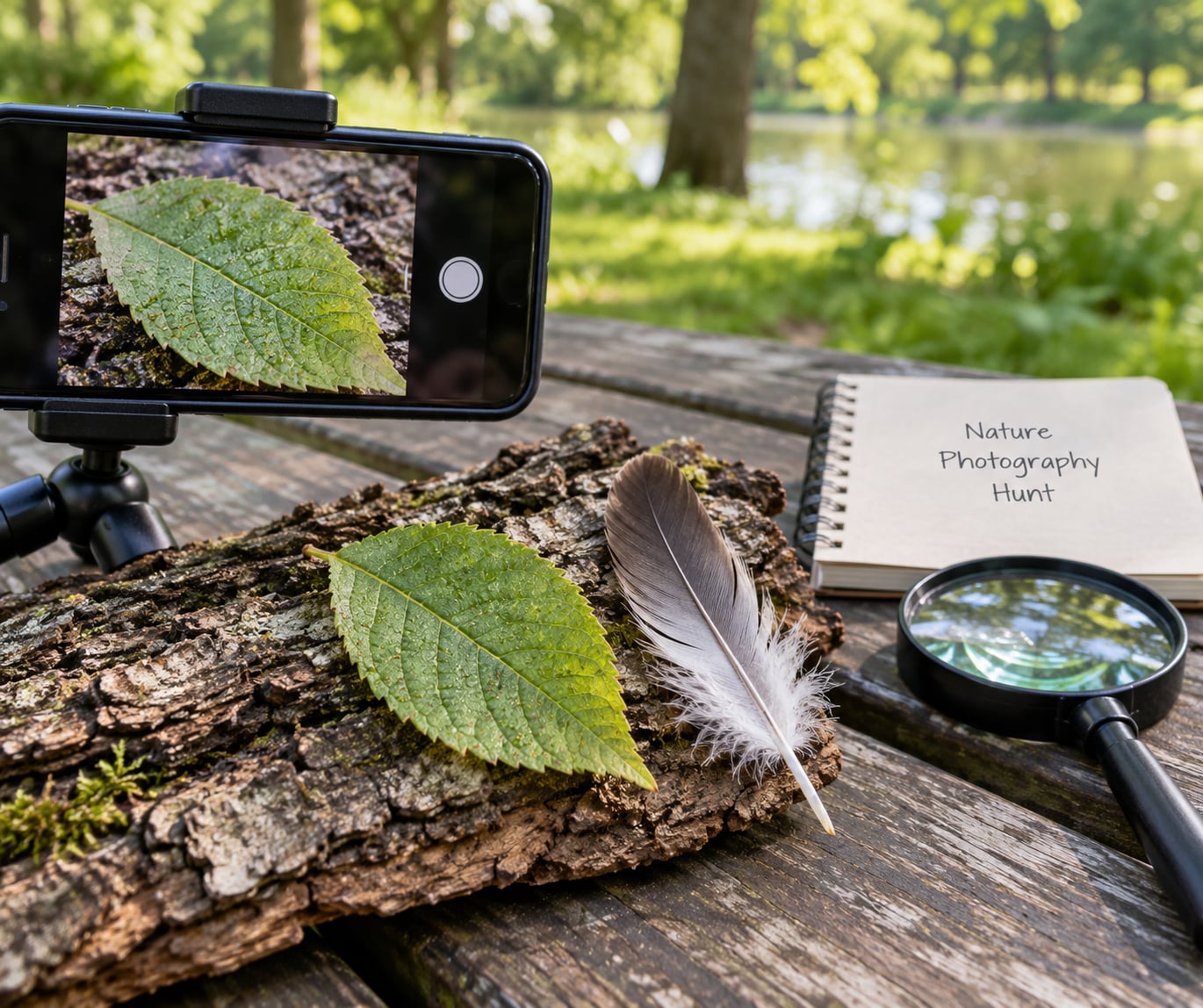
A photo scavenger hunt needs no collection and no cleanup, which makes it the lowest-effort version of the whole list. Children shoot what they find, and the camera keeps them from asking to bring it home.
How to run a photo scavenger hunt in four steps
First, pick six prompts rather than twelve. Long lists lose 6 to 8 year olds inside ten minutes, so six finished prompts beat twelve abandoned ones.
Second, give the prompts as a photo list on a phone, a piece of paper, or just spoken aloud. Bark pattern, a feather, a flower, a shadow, a cloud, and an interesting leaf make a solid six.
Third, say clearly that nothing gets picked up, moved, or posed. Children will want to arrange a leaf for the camera, and the hunt is better when the photo shows where the thing actually was.
Fourth, look at the photos together afterwards and ask each child what they had to get close to see. That conversation is where the learning lands, and it doubles as the moment the day stops feeling like a race.
Parents report this version holds attention longest with older children, partly because the camera gives them a job that does not depend on walking faster than anyone else.
10. Natural Alphabet Hunt
The alphabet hunt asks children to find outdoor objects that resemble letters or numbers. A Y in a bare branch, an L in a fence post and wire, a 7 in a twig, a W in a bird’s flight path.
Run it as a race to make a full word rather than a full alphabet. A name made from found letters takes three objects and finishes in about ten minutes, which fits the attention span of most four year olds.
On a sidewalk, chalk the target letter first and let children find something in the yard that matches it. That version works for pre-readers who cannot decode a written list, and it takes one minute to set up.
11. Weather and Sky Hunt
Sky hunts run in any weather, which makes them the reliable fallback when the ground is soaked or the wind is bad. Children can look for cloud shapes, moving branches in wind, long shadows, raindrops caught on a leaf, or a sun pattern through a fence.
Turn observation into a prediction. Ask what the clouds look like before the weather changes, write the guess down, and check it later in the afternoon.
Moon shapes work after dark with a clear horizon and a parent beside them. Lightning, hail, high heat, and any storm warning cancel the activity outright, and the plan becomes drawing the sky from a window instead.
12. Neighborhood Nature Map Hunt
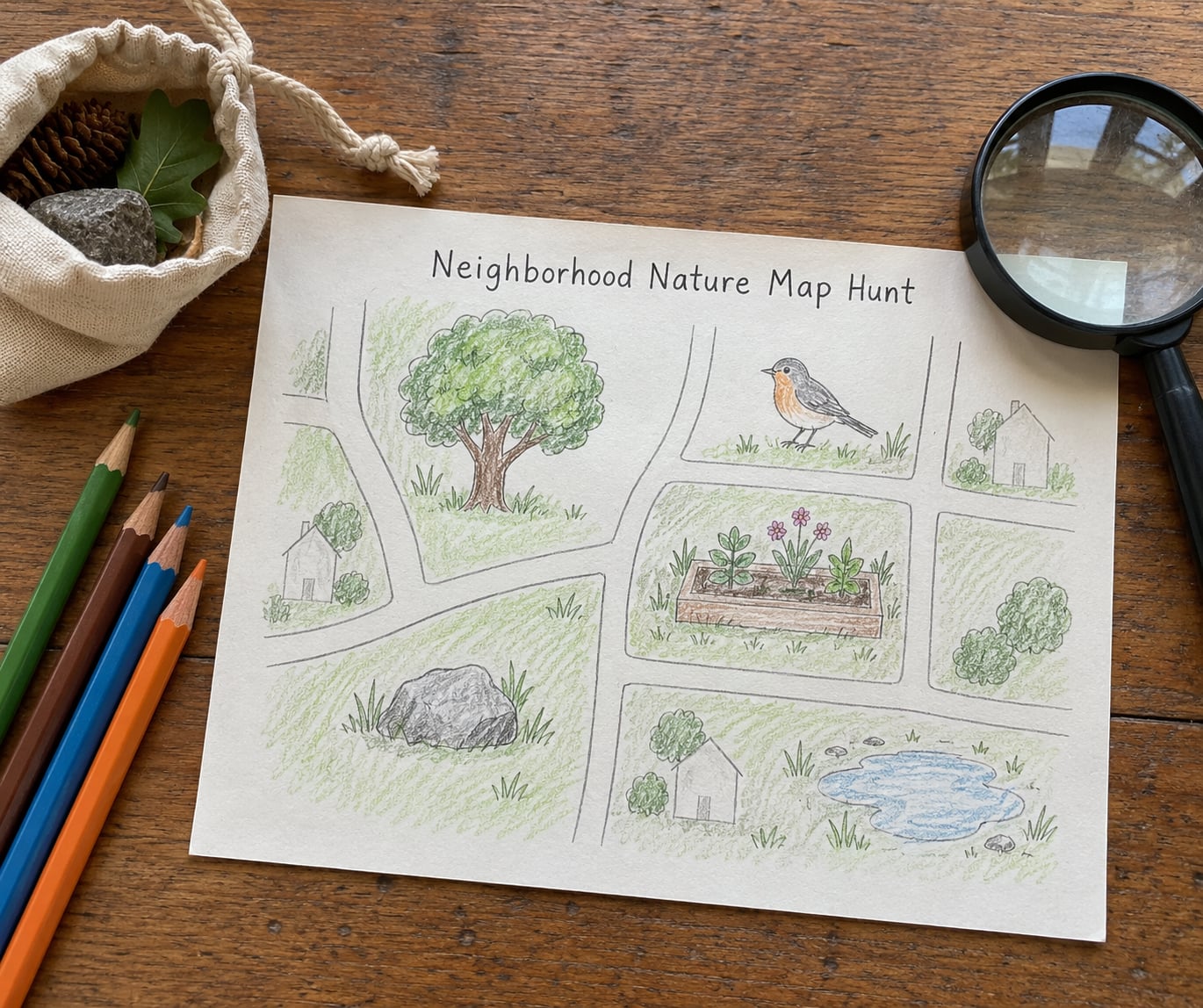
The map hunt turns a short walk into a project. Children walk a familiar route and mark what they find: trees, gardens, birds, insects, rocks, puddles, cracks in the pavement, moss, a bird’s nest in a gutter.
Start with a simple paper map. Write the street names around the edge, let children draw in symbols for each find, and finish with a legend. Nothing needs to be to scale, and in our experience the drawings get more accurate with each walk.
Once the first map exists, the next walk becomes an update. Add new finds in a different color, note what changed after a week of rain, and count the same trees again to see whether the leaves came back.
More nature scavenger hunt ideas for kids that need no printing
For no-print days, three ideas work without paper. Egg cartons with a color painted on each lid become a pocket checklist, with children dropping a small matching item in each cup. A stick wrapped with masking tape becomes a nature bracelet, and children tie on a leaf, a feather, a flower head, and a seed.
A word game also travels well on a hike. Name a target like “something with a hole in it” or “something softer than your sleeve,” and the first person who points it out calls the next clue. No list means no reading, which makes it usable with pre-readers and with a group of mixed ages.
Sorting the collected leaves, stones, and feathers afterwards into color, size, and texture groups makes a decent follow-up activity on its own.
Frequently Asked Questions
How long should a nature scavenger hunt last for a toddler?
Toddlers usually manage 10 to 15 minutes before attention drifts, so pick two or three prompts rather than a long list. Stop while they are still having fun rather than pushing to the end. A second short hunt later the same day works better than one long one.
What ages work best for scavenger hunts?
Almost every age can take part, but the format changes sharply. Ages 2 to 3 need two picture-based prompts. Ages 4 to 6 handle a six-item word list. Ages 7 to 10 stay interested with bingo, photography, or counting games. Teens usually prefer photography or designing the hunt themselves.
What supplies do I need for a nature scavenger hunt?
Most of these ideas need a sheet of paper and a pencil. A bag or small pouch helps if children collect fallen items, a phone camera replaces collecting entirely, and a magnifying glass makes the miniature and insect hunts much better. Clipboards help when the wind is up.
How do I keep kids interested when they lose focus after ten minutes?
Shrink the list first. Cut it to five prompts and let them finish, because completing five beats abandoning twelve. Add movement with a race mechanic, hand over the hunt design so they write the prompts, or switch to counting insects instead of collecting them.
What are good clues for an outdoor scavenger hunt?
Good clues describe a property rather than naming the object. Try something with a hole in it, something that grew on a tree, or something that has been walked on. Clues that describe texture, color, or sound work far better than clues that ask for a specific leaf.
Are scavenger hunts safe for young children outdoors?
They are, with simple rules set before you leave. Agree on a boundary the children do not cross, stay within sight, and never pick or taste wild plants or fungi. Stay away from water edges, skip unknown berries and mushrooms, and wash hands when everyone comes back in.
Conclusion
Start with the simplest version: one nearby hunt, a short list of five prompts, and a rule that children look rather than collect. The backyard color hunt and the five senses walk both start within five minutes and ask for nothing you do not own.
When the hunt ends, ask each child about the thing they almost missed. That question is usually where the surprise comes from, and it keeps the activity from feeling like another checklist to finish. Where there is nothing more to explore today, the neighborhood map hunt gives you a hunt to return to next week.