Mixing baking soda and vinegar makes carbon dioxide gas, and that gas is what fizzes, foams, inflates balloons and pushes objects around. The whole reaction costs pennies, needs ingredients most kitchens already have, and works from about age two up through tween years. These ten baking soda and vinegar experiments for kids are the ones that actually delivered on my family’s counter, in the order I would hand them to a parent on a rainy afternoon.
A note before we start: everything here uses food-grade white vinegar and standard baking soda, and an adult does the pouring of the vinegar. That single rule keeps the fizz where it belongs. I also run every one of these on a rimmed baking sheet, because a tray catches what a bowl does not.
Table of Contents
- Baking Soda and Vinegar Experiments for Kids at a Glance
- 1. Classic Balloon Inflation
- What you need
- 2. Rainbow Volcano Eruption
- 3. Baking Soda Garden
- 4. Dancing Dots Dance
- 5. Homemade Lava Lamp
- 6. Foaming Pillar of Density
- Why baking soda and vinegar experiments for kids foam harder with dish soap
- 7. Color-Changing Mixing Lab
- 8. Elephant Toothpaste Foam
- 9. Paper Cup Rocket Launch
- 10. Baking Soda and Vinegar Ice Excavation
- Frequently Asked Questions
- What age is best for baking soda and vinegar experiments?
- How much baking soda and vinegar should I use for one experiment?
- Can I do these experiments without food coloring?
- Why did my baking soda and vinegar mixture not foam much?
- Are baking soda and vinegar experiments safe for toddlers?
- How do I dispose of leftover baking soda and vinegar mixture?
- Conclusion
Baking Soda and Vinegar Experiments for Kids at a Glance
| Experiment | Reaction you see | Science concept | Best age | Mess | Prep |
|---|---|---|---|---|---|
| 1. Balloon inflation | Balloon swells on its own | Gas production, pressure | 4+ | Low | 5 min |
| 2. Rainbow volcano | Foam pours over the rim | Acid plus base, gas volume | 3+ | Medium | 10 min |
| 3. Baking soda garden | Bubbles rise through soil | Gas escaping a solid | 3+ | Medium | 10 min |
| 4. Dancing dots dance | Colored dots lift and flip | Buoyancy, surface tension | 4+ | Low | 10 min |
| 5. Homemade lava lamp | Two colors blob upward | Density, immiscible liquids | 5+ | Low | 10 min |
| 6. Foaming pillar | Foam climbs a tall column | Reaction speed, gas volume | 6+ | High | 10 min |
| 7. Color mixing lab | Colored layers swirl and fizz | Mixing, concentration | 5+ | Low | 15 min |
| 8. Elephant toothpaste | A tall foam column extrudes | Reaction rate, catalysis | 6+ | High | 10 min |
| 9. Paper cup rocket | Cup flips off the table | Gas pressure, force | 6+ | Low | 5 min |
| 10. Ice excavation | Frozen block melts and foams | Temperature, melting | 4+ | Medium | 20 min |
1. Classic Balloon Inflation
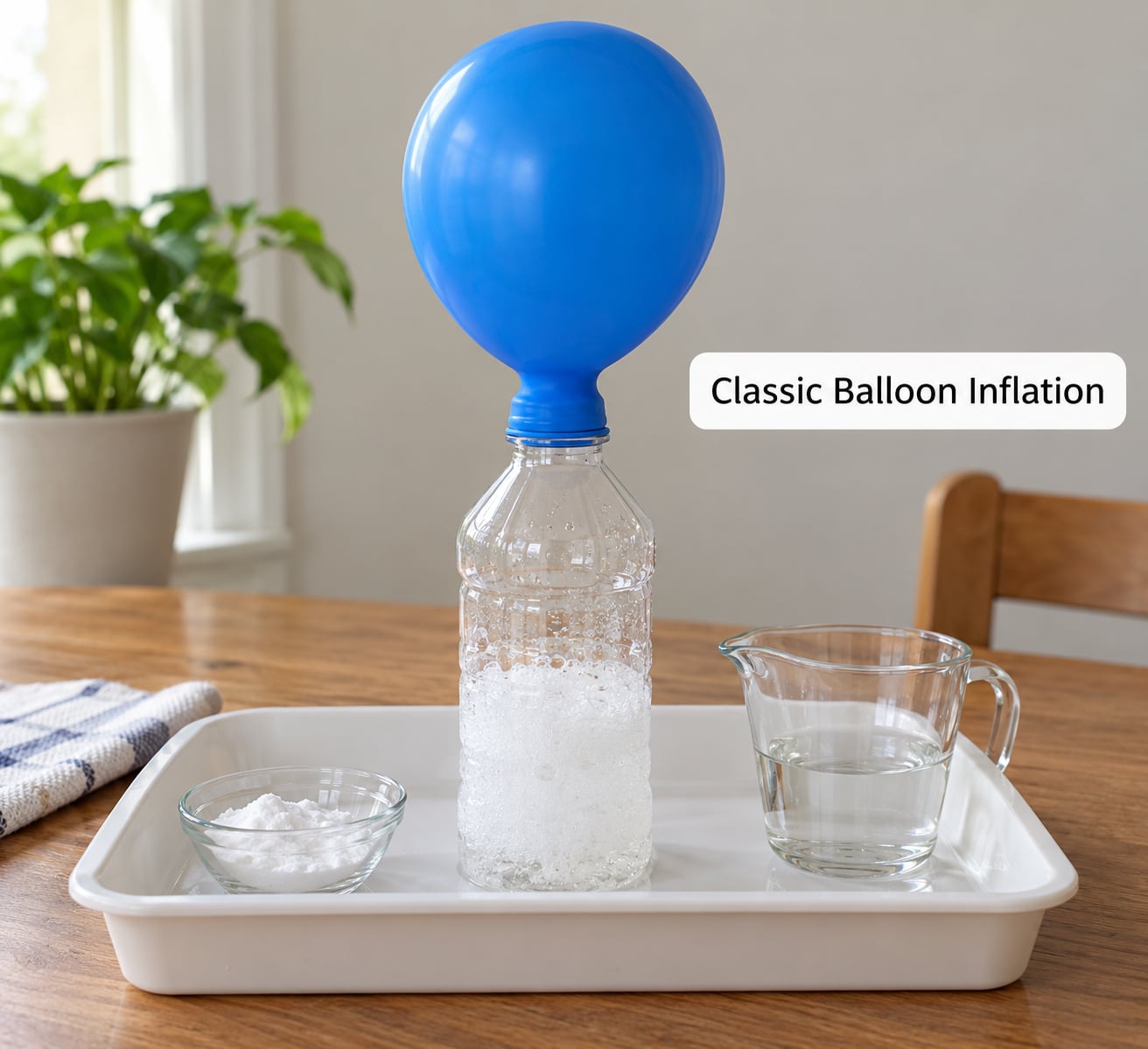
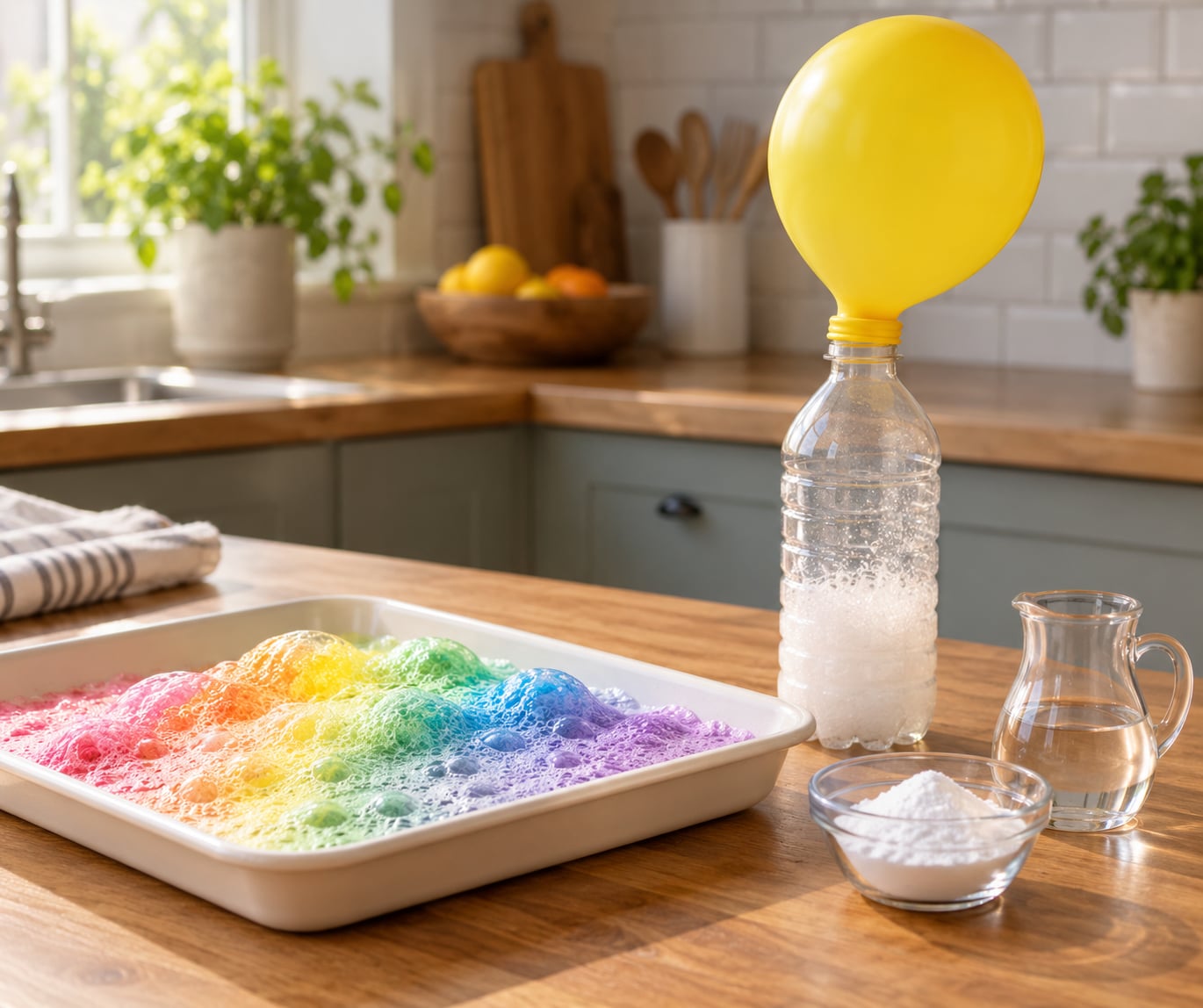
This is the one that makes kids stop what they are doing. Vinegar goes in the bottle first, then a funnel delivers baking soda into a deflated balloon stretched over the neck. When the balloon is lifted and set on top, the soda drops into the vinegar and the balloon starts filling itself in about 30 seconds.
Nothing pushes air into the balloon from outside. The gas being produced inside the bottle has nowhere to go but up, so it inflates the rubber, and the balloon feels cool because the carbon dioxide leaving the warm liquid carries heat with it. That is the same reason the fog around a dry ice block is colder than the air sitting next to it.
What you need
A 500 mL plastic bottle, a deflated balloon, a funnel or a cut paper cup, about 4 tablespoons of baking soda and 60 mL of white vinegar. Have the adult stand the bottle in a bowl or on a tray first, and let the child count the seconds out loud while the balloon fills.
2. Rainbow Volcano Eruption
A rainbow volcano is the standard volcano experiment with the colors turned into the point of the activity. Make the cone separately: mix 1 cup of flour with half a cup of salt, add water until it holds together, and shape it around a small cup set in the center of a tray. Fill that cup two-thirds full with vinegar, add a spoonful of dish soap, and tint the vinegar in bands using food coloring.
Pour about 2 tablespoons of baking soda in at the top and stand back. The foam rises, finds the low spots in the cone, and runs downhill through the color bands in a stripe pattern.
One thing worth saying plainly: food coloring changes how the foam looks, not what happens to it. The bubbles are the same gas either way. This is also the experiment to run outside or on a shower liner, because the overflow does travel.
3. Baking Soda Garden
For kids who have made a dozen volcanoes and would rather not make an eleventh one, spread a shallow layer of garden soil or sand in a tray and sprinkle baking soda across it in a thick even layer. Let your child pour colored vinegar over the surface with a watering can or a squeeze bottle.
The ground fizzes like wet sand at low tide and you get long, lazy streams of bubbles rather than foam. It is a good model for gas working its way up through a solid, the same way real gas pressure finds cracks in rock.
Water that seeps through afterward leaves a genuine salt-and-mineral smell in the soil, so use a tray you can tip outdoors, and skip it if you have pets that dig.
4. Dancing Dots Dance
Put a centimeter of water in a flat-bottomed dish, add a spoonful of baking soda and a few drops of food coloring, and stir so the color swirls into the water. Let it sit until the water is calm, then drip vinegar in from a dropper or pipette, one drop at a time.
Each drop of vinegar makes a small ring of bubbles, and any colored dot caught in that ring rises to the surface, turns over and falls back down. It looks like a dance. What is actually happening is that carbon dioxide bubbles stick to the colored water, and the bubbles are lighter than the liquid, so the whole blob floats.
Small drops matter. A big pour of vinegar fizzes the entire dish at once and the dots never get a lift.
5. Homemade Lava Lamp
Fill a tall bottle two-thirds full of water, add food coloring, and top it with about a quarter of its volume of vegetable oil. The oil sits on top because it is less dense than water and the two do not mix. Shake gently, then add a tablespoon of baking soda, wait for it to sink and dissolve, and pour in a spoonful of vinegar.
Bubbles carry color up through the oil layer and break at the top, which reads convincingly as lava. Younger kids will do this happily without ever seeing it as a density lesson, and that is fine. It is a sensory activity first.
Worth being straight about the Mentos comparison, since parents ask: a Mentos candy works because the rough surface holds nucleation sites where bubbles form fast. This version is a real acid-base reaction and the movement comes from bubbles, not from carbon dioxide dissolving out of a dissolved gas. They look similar and they are not the same experiment.
6. Foaming Pillar of Density
A tall narrow container turns a small batch of foam into something that looks like a geology exhibit. Set the bottle or narrow cylinder in the middle of a rimmed sheet pan, fill it two-thirds full with warm water and vinegar, add dish soap and color, then add baking soda from the top over a spoon held just above the surface so it lands in a small heap instead of a plume.
Foam builds from the bottom up and often creeps over the lip in a single slow dome. The variables are worth naming because kids can hold one steady and change the other: warmer water reacts faster, more dish soap means taller foam, more vinegar in the same water means more gas, and a narrower container pushes the foam higher.
Why baking soda and vinegar experiments for kids foam harder with dish soap
Dish soap does not create more gas and it does not make the reaction stronger. It traps the carbon dioxide that would otherwise escape as a thin fizz, and the gas-filled film holds its shape long enough to pile up. Pouring more soap in gives you taller foam, which is why almost every guide tells you to add it.
7. Color-Changing Mixing Lab
Set out four small cups, a pipette per child, and two or three food colorings. Kids add equal spoonfuls of baking soda to each cup, tint them differently, then drip vinegar in and watch the colors bleed outward and fade as the water dilutes them. The result is a five-minute art project that teaches that mixing is not the same as reacting.
For an older group, chop a little red cabbage and simmer it in water for ten minutes, then strain out the liquid. That juice is a genuine pH indicator: it sits purple in vinegar and shifts toward green and then yellow as the baking soda neutralizes the acid and the pH climbs.
The cabbage version is a real indicator test. The food coloring version is not, and it is worth saying so out loud, because children often assume color change means chemistry. It is just pigment moving through water.
8. Elephant Toothpaste Foam
The household version takes a squeeze bottle of warm water with dish soap and food coloring, a cup of vinegar, and a spoonful of baking soda. Mix the baking soda into the vinegar first, tip the cup over the bottle mouth quickly, and a thick column of foam extrudes into a bowl.
The theatrical version you have probably seen on video uses warm water, a squeeze bottle of dish soap, food coloring, and hydrogen peroxide, plus a catalyst called yeast that breaks the peroxide down into oxygen. The oxygen rush is what drives the huge column, and it is a different chemistry demonstration wearing the same name.
Hydrogen peroxide is not a baking soda and vinegar ingredient, it is a chemical that irritates skin and eyes, and it should not be part of a kid activity at home. The pantry version is smaller and completely fine. Say what you built, honestly.
9. Paper Cup Rocket Launch
Take a paper cup, drop a tablespoon of baking soda in the bottom, add about a third cup of white vinegar, fold a paper towel into a small packet and let it sit on the rim. When your child lifts the rocket, drops the towel packet in and steps back, the vinegar and soda react, gas fills the cup, and the cup flips off the table with a pap sound.
Every part of that flight comes from pressure. The reaction produces gas faster than it can escape, air pressure inside rises above the pressure pushing down on the cup lid, and the cup launches. This is the honest, safe version. A real bottle rocket that flies hundreds of feet involves a sealed chamber building pressure that is genuinely dangerous to stand near, which is why the paper cup version exists.
Keep this one outside or at the far end of a table, since a cup that launches unexpectedly is also a cup that can hit a lamp.
10. Baking Soda and Vinegar Ice Excavation
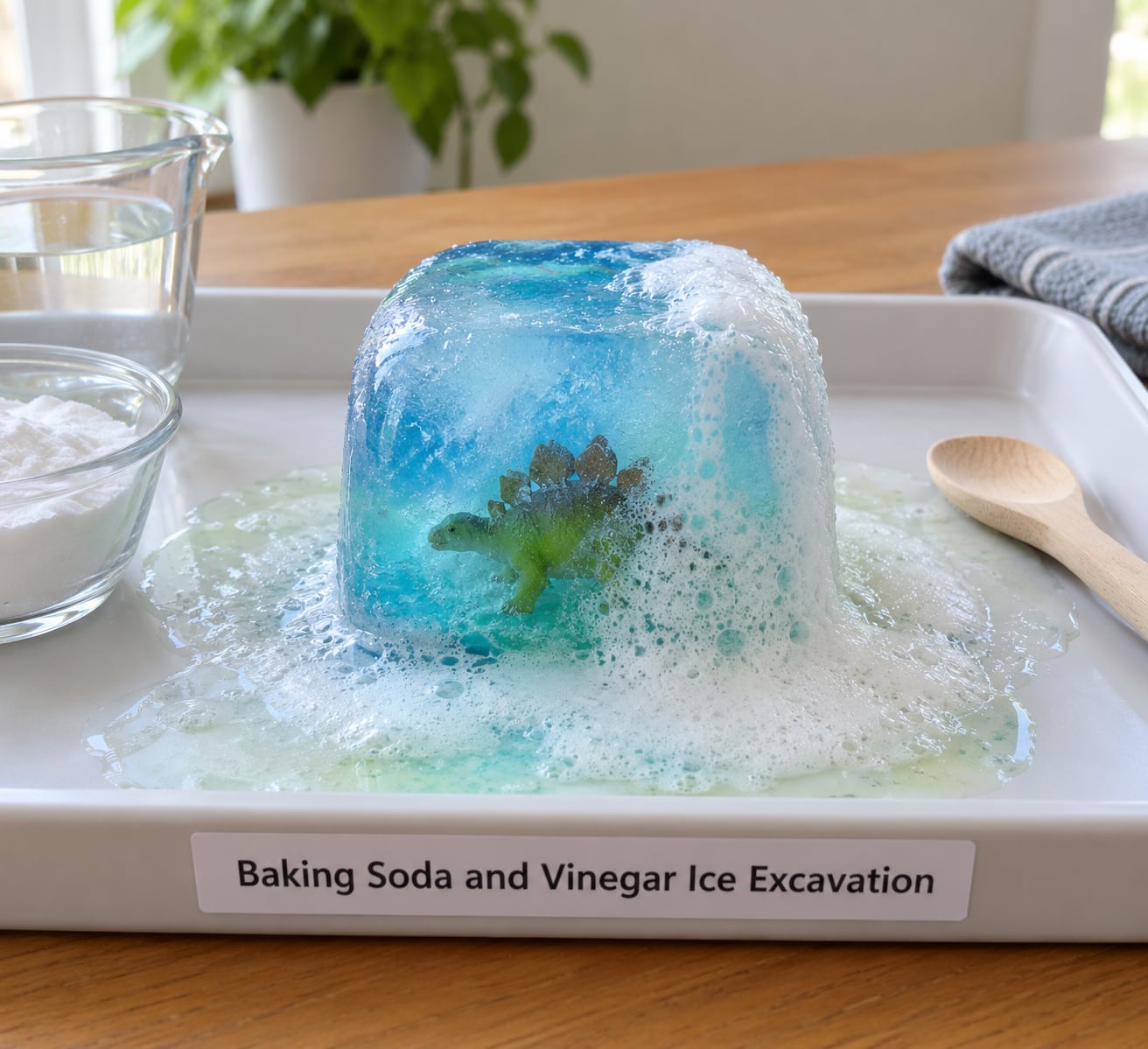
Freeze a small block of water with a small toy, a plastic figure or a slip of paper with a clue written on it buried in the middle. Set it in a tub and let your child drizzle warm vinegar mixed with baking soda over the surface as they dig.
Two things happen at once. The fizzing mixture is warm and chemically active, so it melts the ice faster than cold water would, and the reaction itself slows as the mixture cools, so the last third of the block takes noticeably longer than the first.
This is the one experiment on the list that connects to something beyond the fizz. It makes melting measurable, and the buried treasure gives kids a reason to be patient while it works.
Frequently Asked Questions
What age is best for baking soda and vinegar experiments?
Around two to three years, start with the baking soda garden or a tray of dots, where the child pours and watches without needing precision. From four up, the balloon experiment and the color mixing lab add the measuring and prediction steps that turn play into a real test. Most of these work through the tween years if you change one variable and ask them to predict the result first.
How much baking soda and vinegar should I use for one experiment?
For most of these, the working ratio is roughly 2 to 3 tablespoons of baking soda to half a cup of white vinegar. That is enough for a strong, visible reaction in a small container. The exception is the ice excavation, where you want a weaker mixture you can pour slowly, closer to one tablespoon per cup. Doubling either side without doubling the other mostly just gives you a taller mess.
Can I do these experiments without food coloring?
Yes, and the reaction is identical without it. You will lose the visual payoff on the volcano, the dots and the lava lamp, but the balloon, the garden, the pillar and the ice excavation all still work with clear liquids. Uncolored vinegar also means fewer stains on counters and hands, so it is worth a try with a younger child who tends to get more on their clothes than in the bowl.
Why did my baking soda and vinegar mixture not foam much?
The four usual causes are clumped baking soda sitting at the bottom where the vinegar never reaches it, too little dish soap to trap the gas, cold liquid slowing the reaction, and a container too wide to hold a visible foam column. Break up any lumps before they go in, add a squirt of dish soap, and use water that is close to room temperature. If it still fizzes weakly but the balloon fills, the reaction is working fine.
Are baking soda and vinegar experiments safe for toddlers?
The ingredients are food items and the reaction is not dangerous, but an adult should handle the vinegar pour and keep the setup out of reach during the reaction itself. Nothing goes near a child’s eyes, and any fresh scrape should be covered before the experiment starts. Avoid the paper cup rocket for under-fives, since the launch is sudden and unpredictable rather than gentle.
How do I dispose of leftover baking soda and vinegar mixture?
Pour it straight down the sink with plenty of cool water running. Once the fizzing finishes, what is left is close to a dilute salt solution with a trace of acetic acid, which is fine for household plumbing. Scrub the container by hand rather than letting the mixture sit in it. Do not pour it into a storm drain or onto soil where a pet might dig, and rinse sticky hands with plain water first.
Conclusion
Start with the balloon inflation, because the reveal is the one that tends to get repeated three or four times in a row without anyone getting bored. Then pick one favorite and rerun it with a single change: warmer water, half the vinegar, double the dish soap, a wider container.
Have your child say what they see out loud before you explain it. That sentence, written down on an index card and dated, is the whole difference between an afternoon of fizz and a start toward how scientists actually work. These baking soda and vinegar experiments for kids cost almost nothing, clean up with a rinse, and teach gas, pressure, density and heat without a single textbook in sight.