Teaching money skills to kids works best when the money is real and the choices are theirs. Give a child a small amount of actual cash, let them decide how to split it, and talk through what happened afterward. The whole system can run on coins, jars, and a notebook, and you can start this week.
Money is the one subject where practice beats explanation. A child who hands over a coin for a grocery item learns something a worksheet never teaches, and the mistake they make on Saturday teaches more than the lecture on Monday. I have watched the whole thing take about ten minutes a day, mostly because the lessons piggyback on errands you are already running.
Table of Contents
- What You Need
- Step-by-Step: How to Teach Money Skills to Kids
- 1. Identify Coins, Bills, and Their Values
- 2. Practice Paying and Making Change
- 3. Set a Savings Goal
- 4. Compare Wants, Needs, and Choices
- 5. Create a Simple Budget
- 6. Earn Money Through Real Responsibilities
- Common Mistakes
- Frequently Asked Questions
- What age should I start teaching my child about money?
- How much allowance should I give my kid?
- Should allowance be tied to chores?
- How do I teach my kid to save for something?
- Should I give my child a debit or credit card?
- How do I teach kids about advertising and online spending?
- Start With One Real Money Habit
What You Need
You need very little to get started, and most of it is already in your house. None of it has to be pretty.
- Real coins and small bills. A handful of mixed change is plenty for younger children. Play money works well for a pretend shop, but real money carries a weight that toy bills never do.
- A wallet, a small pouch, or three jars. Clear jars are ideal because a child can watch the level rise or fall. Label them Save, Spend, and Give with a marker and masking tape.
- A notebook or a single sheet of paper. A spending record only needs three columns: what it was, how much, and whether it was worth it. A spreadsheet works too once the habit is already in place, but paper is easier for a first system.
- Receipts. Keep the last few in an envelope. Real receipts make a budget feel real in a way that numbers on paper never do.
- A small cash budget for the week. A fixed amount your child decides how to use. Keep it modest enough that losing it stings a little and small enough that you can cover the mistake once.
- Optional: a few board games. Games with money built in, played with a rule that every purchase must be justified out loud, turn a rainy afternoon into practice.
On amounts, use one rule of thumb many families land on: roughly one dollar per week for each year of the child’s age. A five-year-old handling a single bill learns more than a twelve-year-old handling a fifty-dollar stack they did not earn.
The other preparation is emotional. Decide in advance that this is practice, not a test. If the first session ends in a meltdown over a purchase, you have taught them that money is a topic where adults get upset, which is not the lesson you wanted.
Step-by-Step: How to Teach Money Skills to Kids
The sequence below runs from identifying a coin to earning money from real work. Each step builds on the one before it, and the whole progression stretches easily from age three to eighteen. You do not have to rush through it. A five-year-old will spend a month on step one and be bored by step four.
| Age | Money skill to build | What it looks like in practice |
|---|---|---|
| 3 to 5 | Coins have values | Sorting coins by size, matching a coin to a price sticker, counting to ten with real change |
| 6 to 9 | Spending and saving are different | Making change, splitting money across three jars, choosing between two toys on a real shelf |
| 10 to 12 | Planning a goal | Saving toward a specific purchase, comparing unit prices, running a small weekly budget |
| 13 to 15 | Budgeting and income | Tracking earnings, comparing subscription offers, understanding interest and credit card interest |
| 16 to 18 | Independent money management | Opening a bank account, paying a bill, filing a simple budget, borrowing and repaying |
1. Identify Coins, Bills, and Their Values
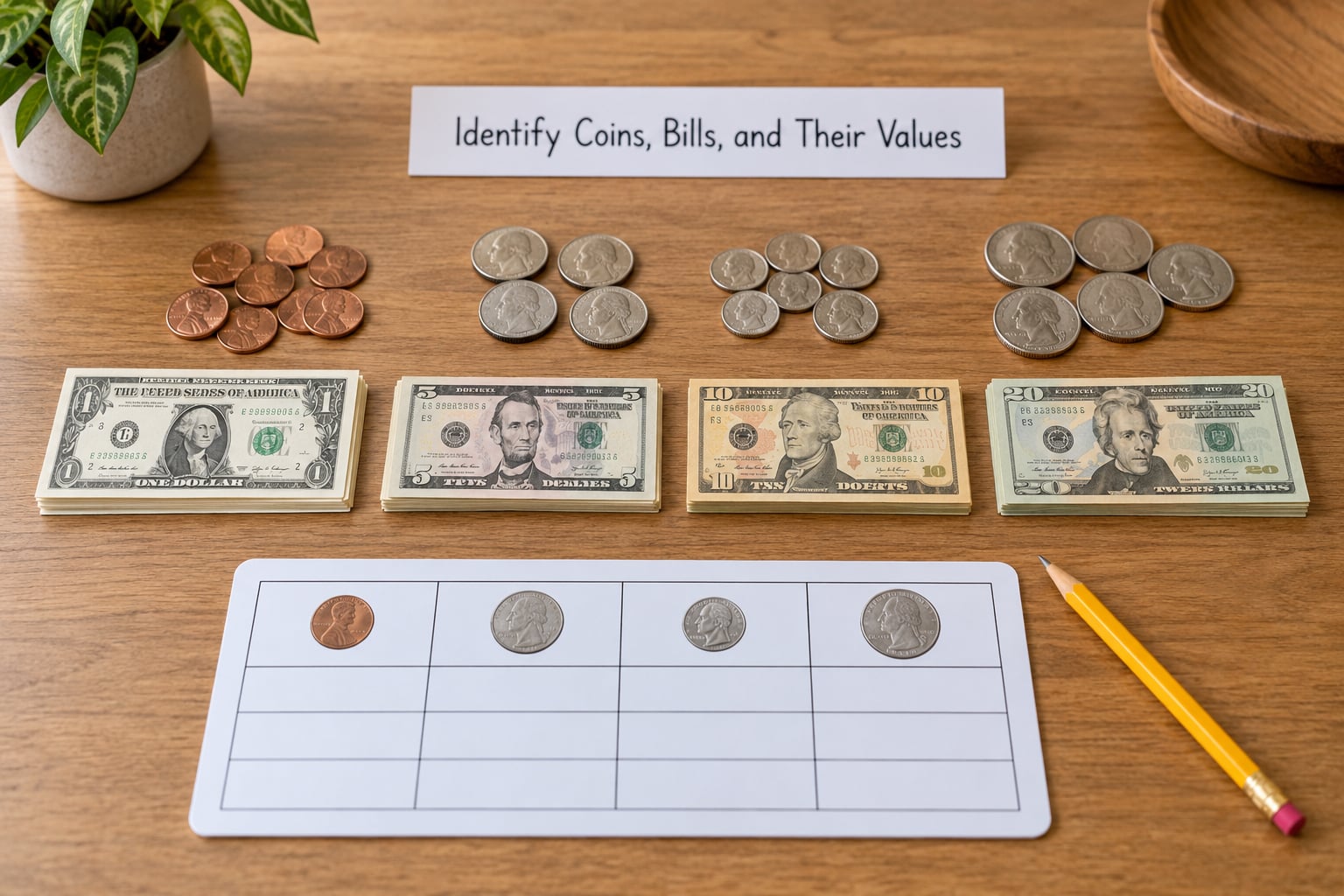
Start with recognition, not arithmetic. Put a mixed pile of coins on the table and sort them into groups while your child names them. Then match each coin to a written value on an index card, face up, like a self-checking quiz the child controls.
To check understanding without making it feel like a test, hand over a handful of coins and ask for a specific amount. If you ask for eleven cents, the child has to figure out which combination works, and every wrong guess is a visible fact rather than a wrong answer on a worksheet.
Keep the sessions short. Five or six minutes is plenty, and stopping while the child still wants more is what makes the next session easier to start.
2. Practice Paying and Making Change
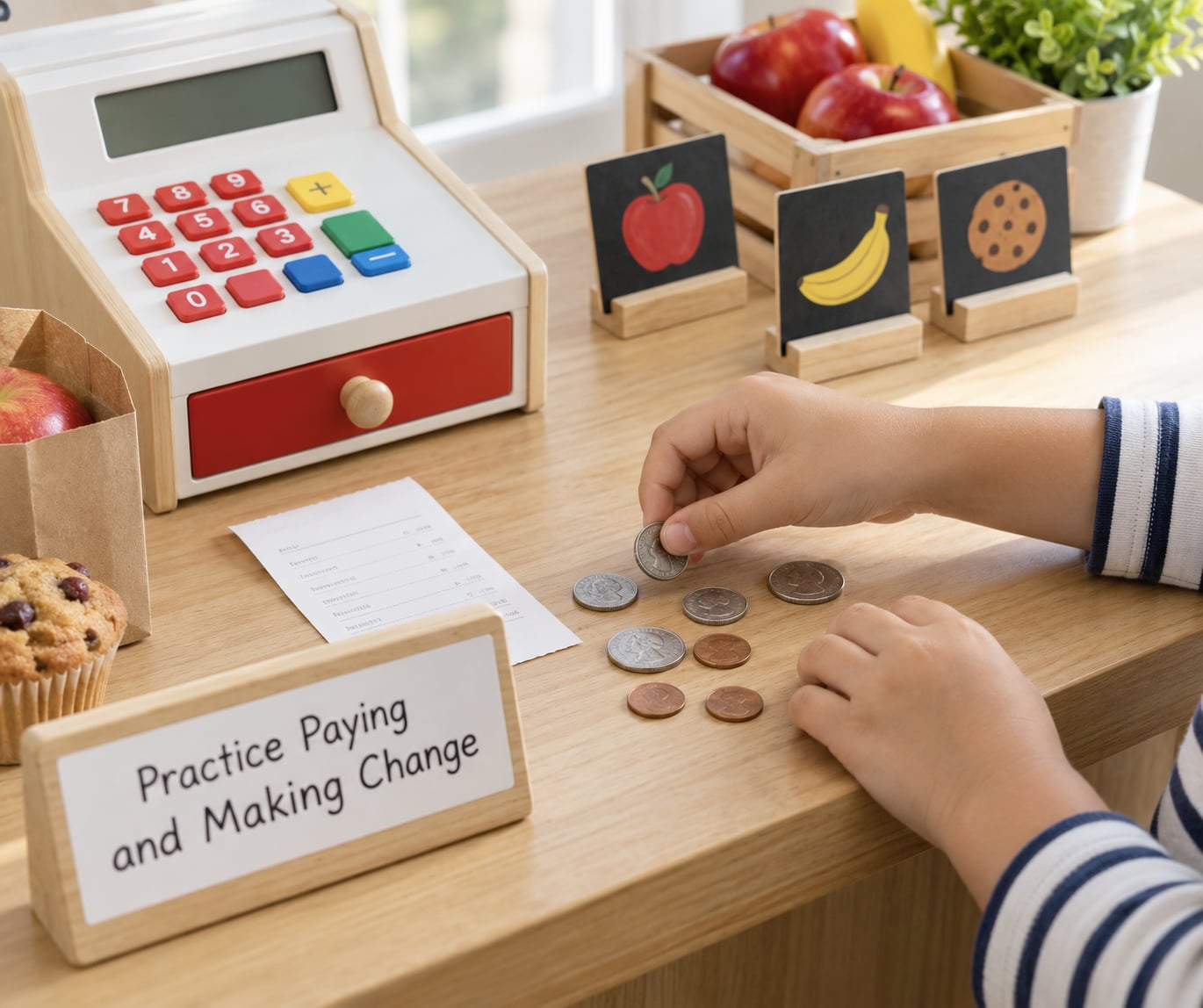
Once the values are familiar, add a transaction. A pretend shop with a shoebox till, some play or real coins, and handwritten price cards gives you a place to rehearse before the real checkout line does the same thing with an audience.
Model the whole exchange once, out loud and slowly. Name the price, count out the payment, then count the change back out loud from the biggest coin down. Younger children need the count-by-groups method, grouping nickels into tens so the number shrinks to something countable.
Then let the child run it. When they miscount change at your pretend shop, the error is free. At the grocery store it costs you a line of waiting people, which is why practicing at home first is worth the setup time.
Gradually move to real purchases. Give your child the item and the cash and let them complete the payment while you stand nearby. A single can of soup is a perfectly good first transaction.
3. Set a Savings Goal
A goal turns an abstract number into a picture of something they want, which is the whole trick. Pick something real and dated within a few months, like a book, a hobby supply, or a trip to the aquarium.
Have your child estimate the price, then check the real one. Let them be wrong. Overestimating by half is a useful lesson in research, and doing it at the planning stage costs nothing.
Choose a container they can see through and put a progress chart beside it. Divide the goal into weekly amounts that add up to the target, so progress is visible every week rather than at the end. Mark each deposit on the chart in a different color, and let a younger child use stickers instead of numbers.
When the goal is reached, do something with the money right away. Buy the item together, or if the goal was a trip, book the date. Money sitting in a jar with no destination stops being motivating after a few weeks.
4. Compare Wants, Needs, and Choices
Needs keep you alive and healthy. Wants are everything else, and the honest version of this lesson is that adults buy plenty of wants, so do not pretend otherwise. A child who catches you in a contradiction will stop believing the whole framework.
Instead of lecturing, use the shelf. Put two similar items in front of your child, one larger and one smaller, and ask which one they would pick and what the difference means for the money. Size, brand, and quantity all affect value differently, and a family of two needs smaller amounts than a family of five.
Run a low-cost comparison exercise: give them the price of one item and a budget below it, then let them find a substitute on the same shelf. The goal is not picking the cheapest option. The goal is noticing that a choice is a trade, and being able to say what they gave up to get what they wanted.
Needs versus wants is a recurring conversation, not a single lesson. It comes up again every time the answer is no.
5. Create a Simple Budget
Hand over a small amount for the week and set three categories: spending, saving, and giving. The three-jar system works because glass makes the split visible at a glance, so nobody has to guess where the money went.
For a child under ten, split it by hand at the start of the week. For an older child, let them do the split themselves and check the math. A middle-schooler can handle percentages; the widely used 50/30/20 rule gives half to needs, about thirty percent to wants, and twenty percent to saving and giving.
Have them write down what they bought, then look at what is left at the end of the week. The review is the lesson. Ask whether the purchases were the ones they wanted on Wednesday, and how they would divide the same money differently next time.
When the money runs out early, that is the most valuable moment in the whole system. Let them sit in it. Do not rescue the shortfall, and do not lecture. Ask what they would change, then let the week finish with a smaller amount and a plan.
6. Earn Money Through Real Responsibilities
Money attached to effort teaches that effort produces money. Chores that suit a four-year-old, like folding towels or putting toys in a bin, grow into watering plants, organizing a shelf, helping prepare a simple meal, or loading the dishwasher.
On the long-running argument about whether chores should be paid, most adults I know land in the same place: the basic ones should not be. A child who is paid for tidying their own room learns that contribution is optional work. The common compromise is to keep the ordinary family jobs unpaid, then pay for extras above and beyond: washing the car, organizing the pantry, doing dishes without being asked.
Set the rate before the work starts, write it down, and pay on the same day every week. Consistency matters more than the amount, because a payment that arrives late teaches a child that adults do not keep agreements.
A runnable business is worth doing once. A lemonade stand, a bake sale, or a school supply sale teaches pricing, cost, weather, profit, and loss in a way no chore chart can. The most valuable part is often losing money, which is exactly what a parent wants them to experience early and cheaply.
Common Mistakes
Most money teaching goes wrong in predictable ways, and the fixes are simple.
Making lessons too complicated. A five-year-old does not need to understand compound interest. If an activity needs a worksheet and a calculator, it is pitched years too high and the child will disengage before you finish explaining it.
Paying for every single task. When every behavior has a price, chores become a negotiation and character development becomes an afterthought. Keep the baseline unpaid and pay only for chosen extras.
Paying for good grades. School performance is not a service the child renders to the family. Paying for it creates an incentive to hit the number rather than understand the material.
Expecting instant independence. A ten-year-old will overspend the first time, and so will a fifteen-year-old. The goal is a kid who notices, not a kid who never errs.
Treating a purchase as punishment. Saying no while visibly enjoying saying no teaches that money is a weapon. A calm, dull, repeatable no works much better.
Skipping the debrief after a mistake. The evening after a bad spending day is when the lesson lands. Ask what happened, what they would do differently, and what the fix is now. Then stop talking about it.
Running one activity at the wrong age. A pretend shop bores a teenager and overwhelms a toddler. Follow the age table above rather than the age of the child you wish you had.
Three things help more than any single activity. Be consistent, so the habit actually forms. Model the behavior yourself, including admitting when you overspent. And encourage effort rather than outcome, because a well-executed decision that turns out wrong is worth more than a lucky one.
One more conversation worth having early: the difference between borrowing and buying. Children who grow up watching adults swipe cards often assume credit is free. Tell them directly that money borrowed must be repaid, with interest, and most of them get it immediately.
Frequently Asked Questions
What age should I start teaching my child about money?
Start as soon as your child can count, usually around age three, and keep the sessions to five minutes. At that age the goal is simply that coins have different values and that people trade things for money. Real practice comes later, around age six or seven, when they can handle a small amount and a simple choice. Waiting until the preteen years means starting from zero with less time to build the habit.
How much allowance should I give my kid?
There is no magic number, but many families start near one dollar per week for each year of age, then adjust for your cost of living and your family budget. The figure matters far less than three things: it is small enough that they will not spend it all at once, it is paid on the same day every week, and the parent can cover one genuine mistake. Raise it once a year, not weekly, so spending decisions actually have consequences.
Should allowance be tied to chores?
Most adults argue that ordinary chores should stay unpaid, because a child is part of the household and contributing is not optional work. A workable middle path is to keep routine jobs like tidying and dishes unpaid, then pay a set weekly rate for chosen extras such as washing the car or organizing the pantry. Write the rate down beforehand and pay on the same day, so the money teaches consistency rather than bargaining.
How do I teach my kid to save for something?
Pick a real goal with a date, then check the actual price together so your child can build an estimate. Divide it into weekly amounts that reach the target, use a clear jar so the level is visible, and mark each deposit on a paper chart. When the goal is met, spend the money or book the activity right away. An unclaimed jar loses its motivational pull within a few weeks.
Should I give my child a debit or credit card?
A debit card linked to a child account is a reasonable tool for a teenager who already understands spending and saving, because the money is genuinely theirs and overspending reverses automatically. A credit card should come much later and only with a clear agreement about paying the balance in full every month. Until then, cash is better, since a physical object leaving a hand is a stronger lesson than a declined tap.
How do I teach kids about advertising and online spending?
Point at ads out loud and name the trick: the price dropped from double what it was last week, the item is marked scarce, the ad shows an unusual-looking family. Let your child keep a running list of what ads want them to want, then compare that list with the family budget. For in-game purchases and app subscriptions, review the family account together and set a monthly ceiling they can see.
Start With One Real Money Habit
Pick a single repeatable practice and run it for a month. A weekly cash amount split three ways in labeled jars works, because it teaches saving, spending, and giving in the same five minutes. So does one savings goal with a paper chart taped to the fridge.
Begin it during the next ordinary purchase, not a planned lesson. Next time you are at the store, hand your child the item and the cash and let them pay for it. That single moment teaches more than a month of talking about budgets, and you can build the rest of the system on top of it from there.