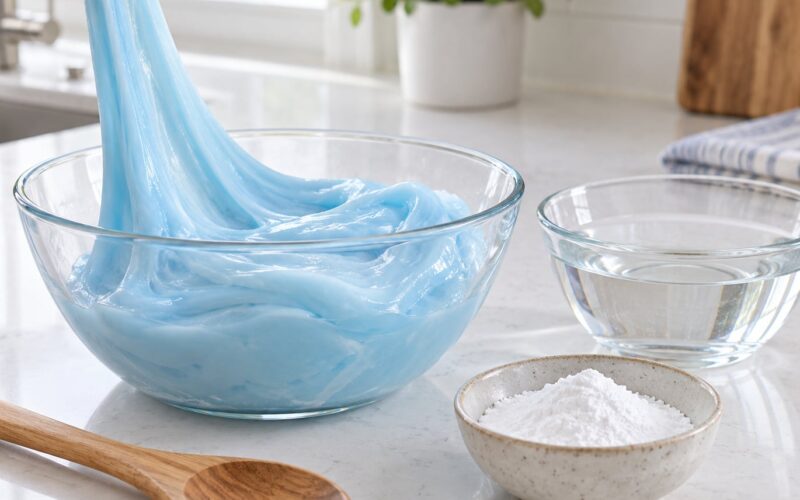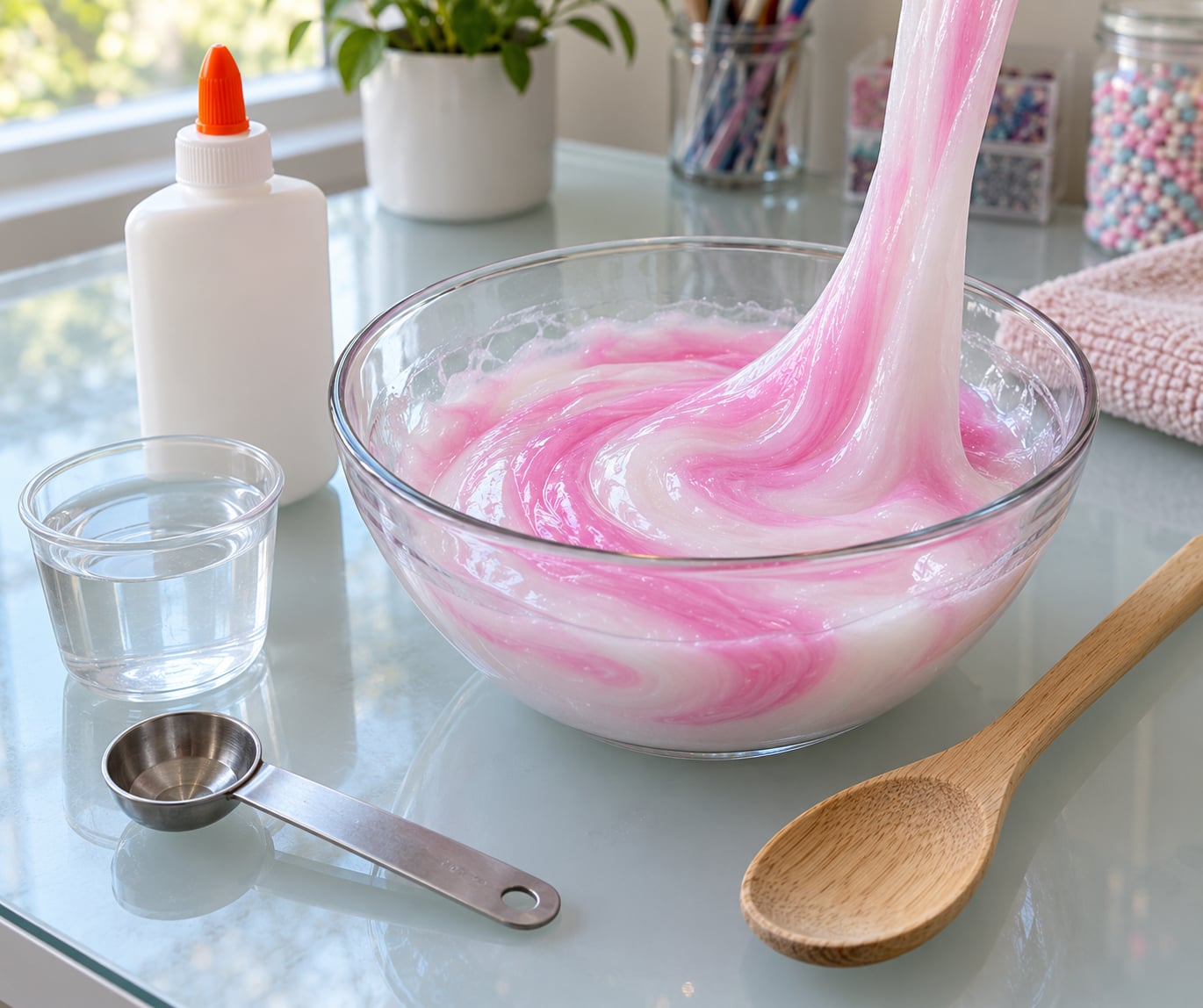
To make slime without borax, mix 1/2 cup of washable school glue with 1/2 teaspoon of baking soda, then stir in 1 to 2 tablespoons of saline contact lens solution a spoonful at a time until it turns stringy, and knead it until smooth. No heating, no special equipment, about ten minutes from bowl to play.
Worth knowing before you start: contact lens solution is borate-free as a powder but it does contain boric acid. If you want a slime with no boric compound anywhere in it, skip the contact solution and use the cornstarch and shower gel version further down. Both work. They feel different, and neither one is better.
Most families reach for borax because it is the activator in the classic slime formula, and it is a laundry booster rather than something meant for a toddler’s hands. Baking soda and saline do the same linking job with ingredients from the kitchen and the bathroom cabinet. Slime forums fill up with the same complaint every summer: people add activator by the handful because nobody told them to go slowly. Add it one spoonful at a time.
Table of Contents
- What You Need
- Step-by-Step
- How to Make Slime Without Borax: Combine the Ingredients
- How to Make Slime Without Borax: Knead and Adjust
- Common Mistakes
- Storage and slime care
- Ways to play once it works
- Frequently Asked Questions
- What ingredients can I use to make slime without borax?
- Can I make slime without contact-lens solution?
- How long does non-borax slime stay good at room temperature?
- Is homemade slime safe for toddlers to play with?
- How do I fix slime that is too watery or sticky?
- How should I clean slime off clothes, carpets, or tables?
- Conclusion
What You Need
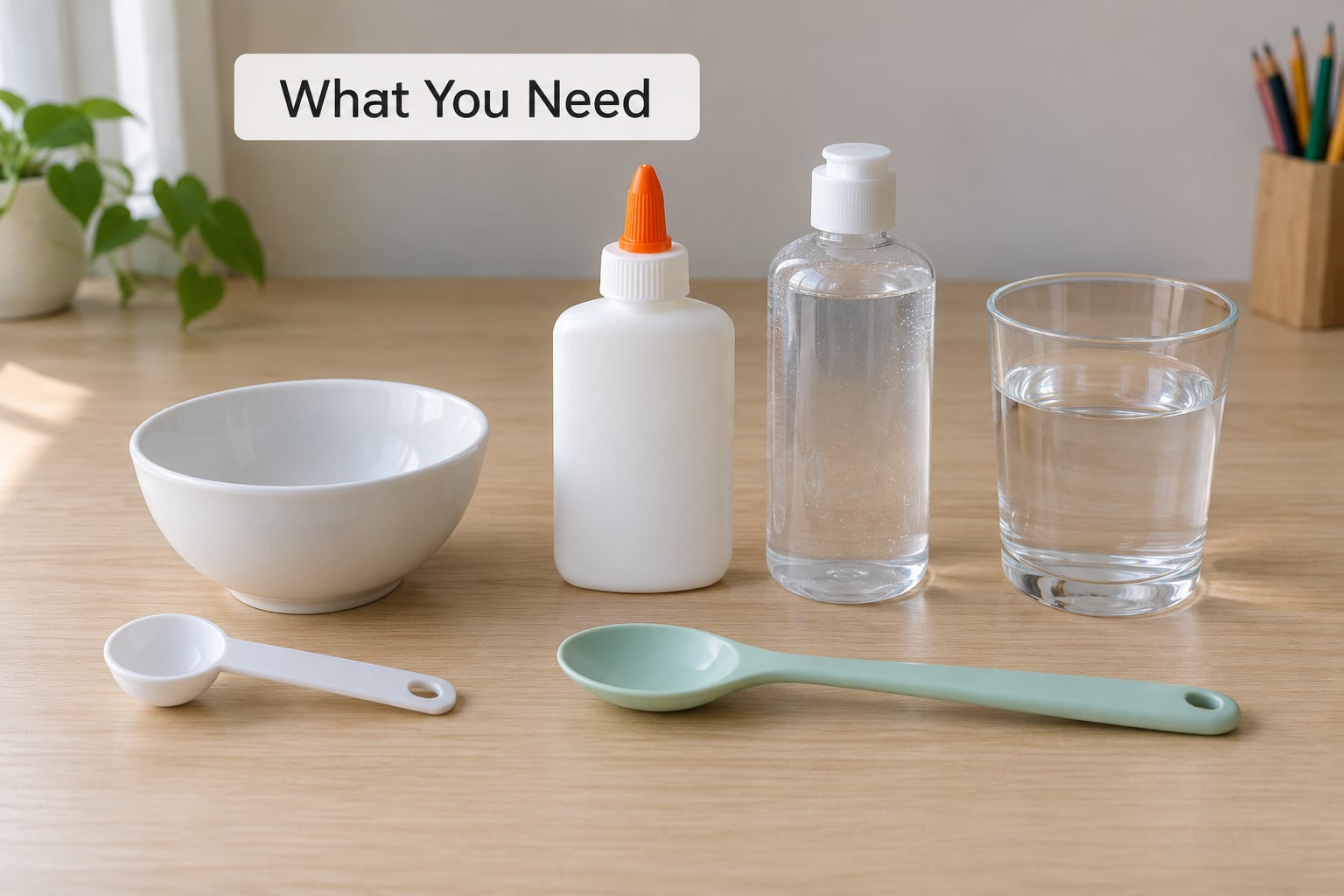
The basic recipe uses three ingredients and a spoon.
- 1/2 cup washable school glue (about 120 ml). This is the base. PVA school glue works best; craft glue that dries permanent will not stretch.
- 1/2 teaspoon baking soda (about 2.5 g). It reacts with the boric acid in the saline to form the borate links that thicken the glue.
- 1 to 2 tablespoons saline contact lens solution (15 to 30 ml). Any plain saline solution with no “rewetting drops” additives works. Check the bottle for sodium chloride and boric acid on the label.
A little warm water thins out a batch that turns rubbery, and a few drops of food coloring or glitter go in after the slime is finished so the color stays even.
Two tools matter more than people expect. A wide bowl leaves room to knead without spilling, and a wooden craft stick or butter knife mixes without picking up so much glue that you lose half of it on the utensil.
For the substitutions: dish soap works in place of saline, though the slime stretches less and stays softer. Cornstarch is a straight swap for baking soda at the same half teaspoon. If you want nothing boric in the bowl at all, use 1/2 cup cornstarch and 1/4 cup body wash or shampoo stirred together, no glue at all.
Step-by-Step
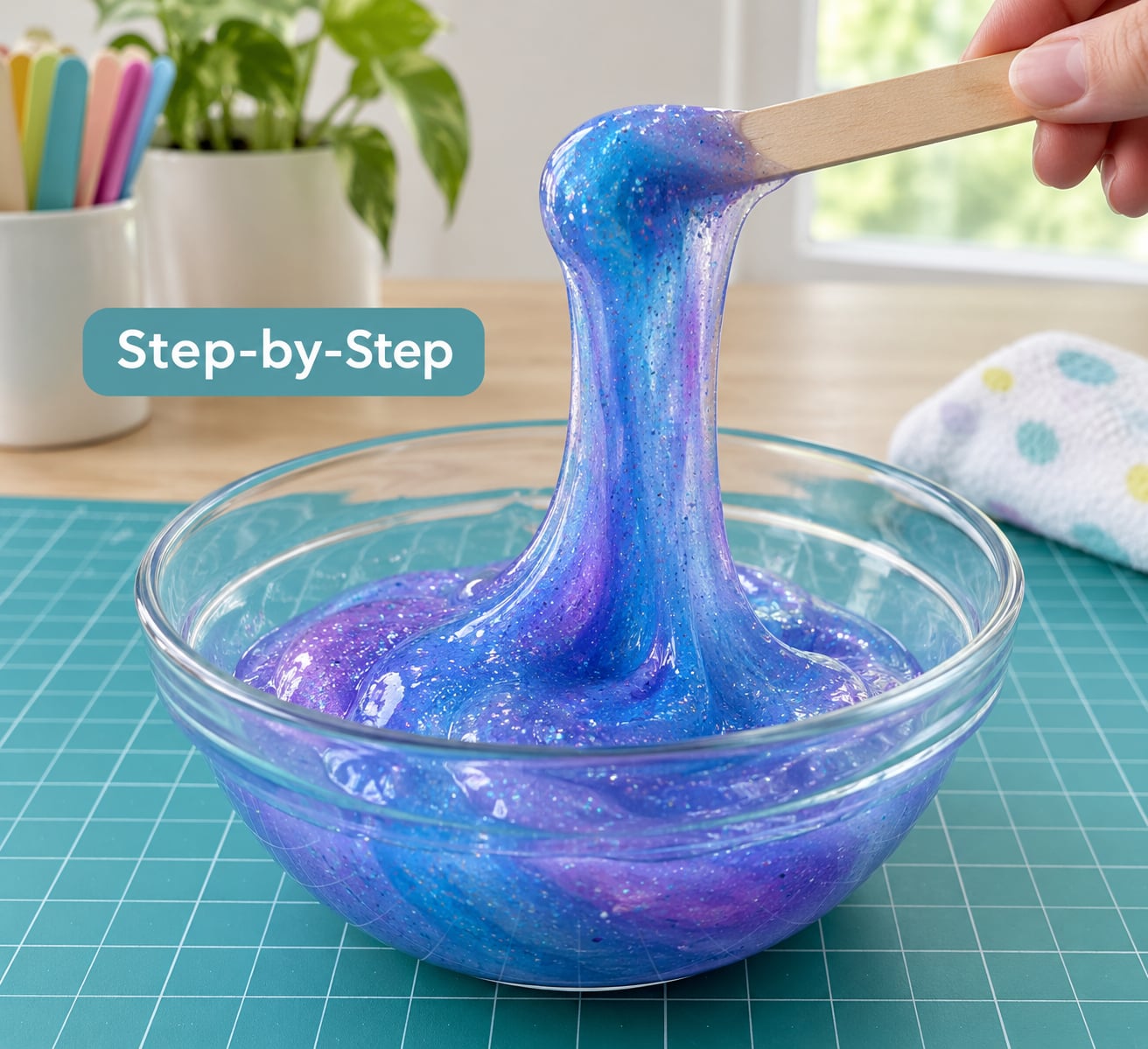
How to Make Slime Without Borax: Combine the Ingredients
Squeeze the glue into the bowl first, then sprinkle the baking soda over the top and stir until the white streaks disappear. The mixture goes from opaque to slightly translucent and a little thicker, like thin pancake batter. That is the cue that the soda has mixed in properly.
Pour the saline in a little at a time and stir after each spoonful. The slime pulls away from the side of the bowl, looks stringy when you lift the spoon, and stops flowing like a liquid. One tablespoon is usually enough; two is the ceiling for a half cup of glue.
Add food coloring or glitter now, a few drops at a time, and mix them through before you touch the bowl with your hands. Mixing color into finished slime leaves streaks that never fully blend.
How to Make Slime Without Borax: Knead and Adjust
Tip the bowl out onto a clean surface and knead with clean, dry hands for two to three minutes. Slime that feels sticky at this point usually just needs the kneading, because the first few passes are what finish the reaction. Stretch it slowly, fold it back, repeat.
Run the stretch test: pull a small piece up slowly and let it fall. Good slime forms long, thin strings that break cleanly. If it snaps instead of stretching, work it longer before you add anything else.
Fix a runny batch by working in a quarter teaspoon of cornstarch. Fix a sticky batch by adding glue a spoonful at a time. Fix a rubbery batch with a teaspoon of warm water or a squirt of plain dish soap. Never add more activator to a firm batch, because that is how batches go from stretchy to brick in about thirty seconds.
Knead in circles for bubble-free slime. If the bowl picked up air while you stirred, slap the blob against the counter ten times and the bubbles work out.
Common Mistakes
Slime never thickens. Almost always too much activator, added all at once. Start over if it is soup; you cannot un-thin slime. If you used the right ratio and it is still loose, knead for a full two minutes before touching the cornstarch.
Slime is sticky and grabs everything. Too little kneading, or a humid room. Add a tablespoon of glue and knead another minute. Put a washable mat or a silicone placemat underneath so the table stays clean.
Slime is firm and snaps. Extra saline or extra baking soda. A teaspoon of warm water softens it back. Warm water works better than cold because it loosens the polymer chains faster.
Slime is full of bubbles. You stirred fast or poured the saline from a height. Pour against the side of the bowl next time. Bubbles that are already there come out with a few firm counter slaps.
Slime gets on clothes, carpets or tables. Let it dry fully, then scrape it up and roll it between your fingers. For what’s left on fabric, rinse from the back of the fabric with cold water and work a little dish soap into the spot. Skip the dryer, because heat sets it.
Making slime at school. Contact lens solution is the part teachers often cannot approve. The cornstarch and shower gel version needs two ingredients, nothing is heated, and it cleans up with water and a bit of soap.
Storage and slime care
Airtight is the whole trick. Put the slime in a sealed plastic tub or a zip bag and press the air out. Kept that way at room temperature, a baking soda and saline batch stays playable for several days to a couple of weeks; the cornstarch and shower gel version dries out faster and lasts a few days.
When a batch goes stiff or dries out, add a teaspoon of water and knead. If it has separated into little curds, add a tablespoon of glue. Old slime often needs both, a little at a time.
Wash the bowl and utensils in warm water with dish soap while the slime is still in them. The slime sticks to itself far better than it sticks to a bowl left to harden.
Ways to play once it works
Hide small plastic figures in the slime and have kids dig them out, cut it with a plastic knife, or fill a sensory bin with it and bury loose objects. Slime stretches and flows differently when you push on it fast versus slow, which makes it a tidy five-minute demonstration of a non-Newtonian fluid: push a finger in and it resists, push hard and it flows.
Change the texture once you are happy with the base batch. Add more baking soda for a putty that holds a shape, or a squirt of shaving cream beaten in before the saline for a fluffy, marshmallow-style slime. Those changes come last, after you know the base recipe works in your kitchen.
Frequently Asked Questions
What ingredients can I use to make slime without borax?
The classic borax-free slime uses washable school glue, baking soda, and saline contact lens solution. Mix 1/2 cup glue with 1/2 teaspoon baking soda, then add 1 to 2 tablespoons saline a spoonful at a time. For a batch with no boric compound at all, combine 1/2 cup cornstarch with 1/4 cup body wash or shampoo. That version stretches less but cleans up easily.
Can I make slime without contact-lens solution?
Yes, and the easiest route is cornstarch and body wash. Stir 1/2 cup cornstarch into 1/4 cup shower gel or shampoo until it forms a stretchy dough, then knead it for two minutes. Plain dish soap works in place of the saline solution in the glue recipe too, though the slime comes out softer and pulls apart sooner.
How long does non-borax slime stay good at room temperature?
Stored in a sealed container, a glue and saline batch usually stays playable for several days up to a couple of weeks. Cornstarch and shower gel slime dries out faster, more like three to five days. If a batch goes stiff, add a teaspoon of water and knead it. If it curdles into pieces, work in a tablespoon of glue.
Is homemade slime safe for toddlers to play with?
Slime made with washable school glue and a small amount of baking soda is generally fine for supervised play, but it is not food and toddlers should not put it in their mouths. Keep it away from open wounds and eyes, and wash hands afterwards. If you want to skip any boric compound, contact lens solution does contain boric acid, so use the cornstarch and body wash version instead.
How do I fix slime that is too watery or sticky?
For watery slime, work in a quarter teaspoon of cornstarch at a time and knead for a full minute between additions. For sticky slime, add a tablespoon of glue and knead longer, since most early stickiness is just unfinished mixing. Never add extra activator to fix a firm batch; add a teaspoon of warm water instead, which is the only safe way to soften it.
How should I clean slime off clothes, carpets, or tables?
Let the slime dry completely, then scrape it off and roll the dried pieces between your fingers to pick up what is left. For residue on fabric or carpet, rinse from the back with cold water and work a little dish soap into the spot. Blot, do not rub, and skip the dryer, since heat sets slime permanently into fabric.
Conclusion
Start with the three-ingredient batch: 1/2 cup washable school glue, 1/2 teaspoon baking soda, and 1 tablespoon of saline solution added slowly. That is the whole recipe, no borax required, and once it kneads out smooth you have a base you can adjust any way you like.
Keep color, glitter, and texture changes for after the first batch works, and pick your bowl bigger than you think you need. Two ingredients is the honest answer if boric acid in contact solution bothers you: cornstarch and shower gel, mixed by hand, no glue at all.